The Spark UnfoldingBook Club

Text, meaning, and visual reflection

Scripture and Visual Atlas

Consult the primary passages, consider the visual concepts, and return to the book through the chapter links. Biblical summaries and practical applications remain distinct.

Nine primary passage families

Primary text: World English Bible, updated edition. The book principally paraphrases. The linked text uses “faith” in Galatians 5:22, a word commonly rendered “faithfulness.” Translation and public-domain information.

Romans 12:3–8

Differing gifts are situated within humility, grace, and membership in a shared body. The passage names prophecy, service, teaching, exhortation, giving, leadership, and mercy.

Reading practice: Read the whole paragraph before selecting an individual gift. Ask how the surrounding emphasis on humility changes the way a label is used.

Suggested thematic connections: chapter 5, chapter 8, chapter 9, chapter 11, chapter 12, chapter 13, chapter 14, chapter 15

1 Corinthians 12:4–31

Varied gifts and forms of service come from the same Spirit. Their purpose includes the benefit of others. The body image develops interdependence, care, and the value of members whose contribution may be less visible.

Reading practice: Distinguish the passage’s communal purpose from a workplace role chart. A practical analogy can illuminate service while leaving gift identification open.

Suggested thematic connections: chapter 6, chapter 8, chapter 10, chapter 17, chapter 18, chapter 19, chapter 20, chapter 24

1 Corinthians 13:1–7

Paul places love at the center of the discussion of gifts. His description includes patience, kindness, truth, and freedom from self-seeking or resentment.

Reading practice: Examine the manner of a contribution. A useful result and a loving process both deserve attention.

Suggested thematic connections: chapter 7, chapter 14, chapter 18, chapter 20

1 Corinthians 14:1–5, 29–33

The passage connects prophecy with strengthening, encouragement, and consolation, and calls for other people to weigh what is spoken.

Reading practice: Welcome spiritual discernment with accountable testing. Do not convert an ordinary suspicion into a claimed prophetic message.

Suggested thematic connections: chapter 8, chapter 18

Ephesians 4:11–16

The passage describes equipping the saints, growing toward maturity, speaking truth in love, and the contribution of each part.

Reading practice: Use accompaniment and equipping as reflective applications. A professional mentoring role alone does not establish a pastoral office.

Suggested thematic connections: chapter 11, chapter 16, chapter 20, chapter 24

Galatians 5:22–26

The fruit of the Spirit includes love, joy, peace, patience, kindness, goodness, faithfulness (rendered as faith in the linked translation), gentleness, and self-control. The passage also warns against conceit and provoking or envying one another.

Reading practice: Keep character and gifting conceptually distinct. Fruit concerns the quality of life and relationships across every form of service.

Suggested thematic connections: chapter 7, chapter 8, chapter 16, chapter 23

1 Peter 4:10–11

Received gifts are to be used in service to one another as stewardship of God’s varied grace. Service is associated with the strength God supplies.

Reading practice: Ask what has been entrusted, whom it serves, and how responsibility is shared without making exhaustion a measure of faithfulness.

Suggested thematic connections: chapter 5, chapter 13, chapter 15, chapter 21, chapter 22, chapter 24

Galatians 6:9–10

The text encourages perseverance in doing good and making use of opportunities to do good. Its harvest language does not supply a timetable for a particular professional project.

Reading practice: Distinguish steadfastness in doing good from a promise that a chosen method will succeed by a preferred date.

Suggested thematic connections: chapter 19, chapter 23

1 Thessalonians 5:19–22

The passage holds openness to prophecy together with testing, holding to what is good, and abstaining from evil.

Reading practice: Keep both welcome and examination present. A statement can be considered respectfully while its meaning and implications are still being weighed.

Suggested thematic connections: chapter 8, chapter 18

Thirty-one visual designs

Six part openings, twenty-four chapter visuals, and an original cover illustration accompany the reading. Exact diagrams include complete readable equivalents. These illustrations do not assign spiritual gifts or represent measured outcomes.

Part 1

Rose silk ribbons surround a luminous golden seed, with gold stems carrying ivory and rose blossoms and unopened buds.
Visual reflection
Read the complete visual description

Rose silk ribbons surround a luminous golden seed, with gold stems carrying ivory and rose blossoms and unopened buds.

Part 2

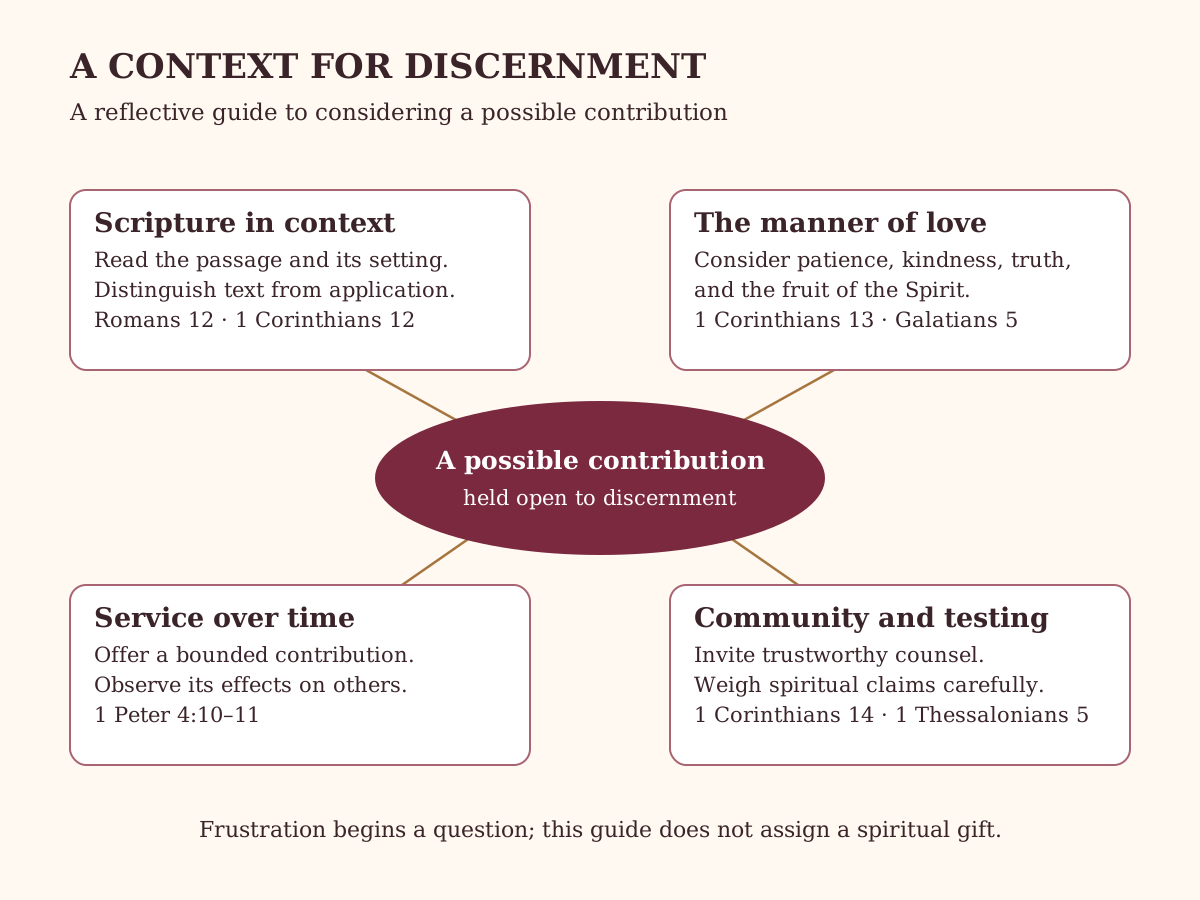
An interpretive diagram connects Scripture, love, service over time, and community with a possible contribution held open to discernment.
Visual reflection
Read the complete visual description

Four surrounding boxes connect to the central phrase, ‘A possible contribution held open to discernment.’ This is a reflective guide to considering a possible contribution. Scripture in context: Read the passage and its setting. Distinguish text from application. References: Romans 12 and 1 Corinthians 12. The manner of love: Consider patience, kindness, truth, and the fruit of the Spirit. References: 1 Corinthians 13 and Galatians 5. Service over time: Offer a bounded contribution. Observe its effects on others. Reference: 1 Peter 4:10–11. Community and testing: Invite trustworthy counsel. Weigh spiritual claims carefully. References: 1 Corinthians 14 and 1 Thessalonians 5. Frustration begins a question; this guide does not assign a spiritual gift.

Open this diagram at full size

Part 3

Three distinct ivory vessels hold a bud, an open flower, and branching leaves, connected visually by a loose rose ribbon.
Visual reflection
Read the complete visual description

Three distinct ivory vessels hold a bud, an open flower, and branching leaves, connected visually by a loose rose ribbon.

Part 4

A gold branch supports an open ivory petal holding a water droplet, with a rose bud and an open flower nearby.
Visual reflection
Read the complete visual description

A gold branch supports an open ivory petal holding a water droplet, with a rose bud and an open flower nearby.

Part 5

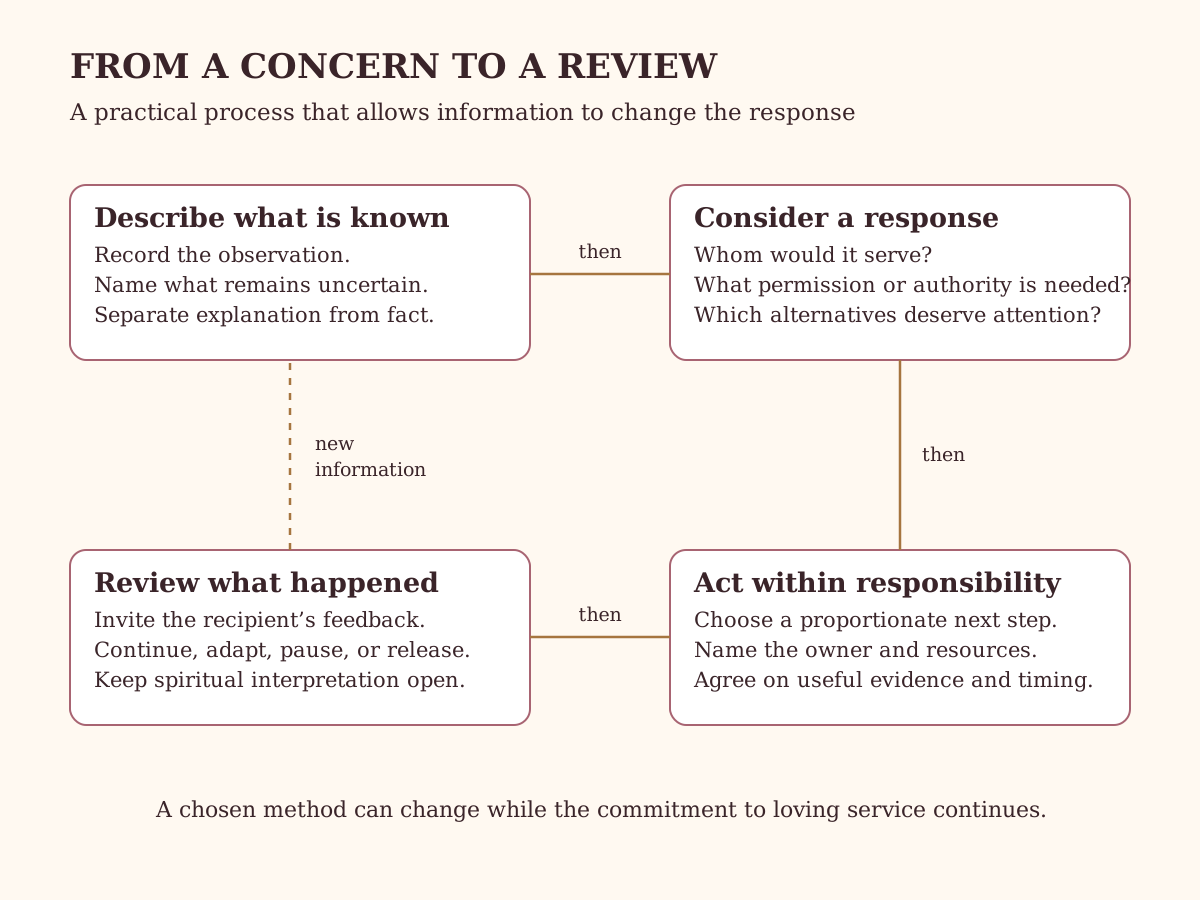
A practical review cycle connects observation, consideration, responsible action, and feedback, with a return for new information.
Visual reflection
Read the complete visual description

This practical process allows information to change the response. Read the four boxes clockwise from the upper left. Describe what is known: Record the observation. Name what remains uncertain. Separate explanation from fact. Consider a response: Whom would it serve? What permission or authority is needed? Which alternatives deserve attention? Act within responsibility: Choose a proportionate next step. Name the owner and resources. Agree on useful evidence and timing. Review what happened: Invite the recipient’s feedback. Continue, adapt, pause, or release. Keep spiritual interpretation open. The three solid links are labeled ‘then’; the dashed link labeled ‘new information’ returns from review to describing what is known. A chosen method can change while the commitment to loving service continues.

Open this diagram at full size

Part 6

Distinct golden branches, rose-edged flowers, and buds share a shallow ivory garden vessel while a ribbon extends into open space.
Visual reflection
Read the complete visual description

Distinct golden branches, rose-edged flowers, and buds share a shallow ivory garden vessel while a ribbon extends into open space.

Evidence that can support a decision

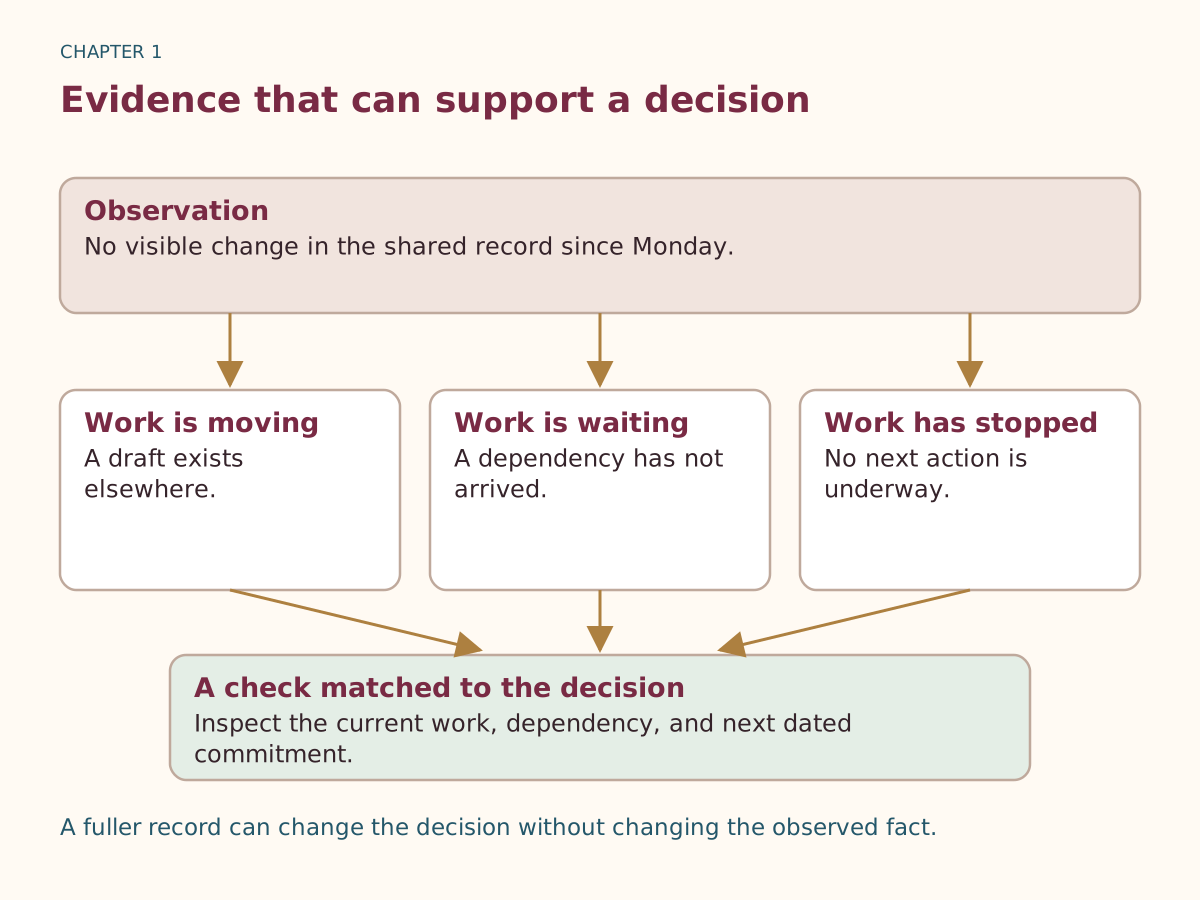
One observation can have several explanations. A useful check distinguishes them before a decision is made.
Progress becomes clearer when a question asks for evidence useful to a particular decision.
Read the complete visual description

One observation branches into three possible explanations, which all lead to a check matched to the decision. Observation: No visible change in the shared record since Monday. Work is moving: A draft exists elsewhere. Work is waiting: A dependency has not arrived. Work has stopped: No next action is underway. None of these explanations is established by silence alone. A check matched to the decision: Inspect the current work, dependency, and next dated commitment. A fuller record can change the decision without changing the observed fact.

Open this diagram at full size

Different means of protecting a shared good

Two stone channels of different widths run beside a flower garden with ivory and rose blossoms.
A shared concern can be served by different methods; the image invites comparison without choosing a winner.
Read the complete visual description

Two stone channels of different widths run beside a flower garden with ivory and rose blossoms. A shared concern can be served by different methods; the image invites comparison without choosing a winner.

Who carries the work of remembering

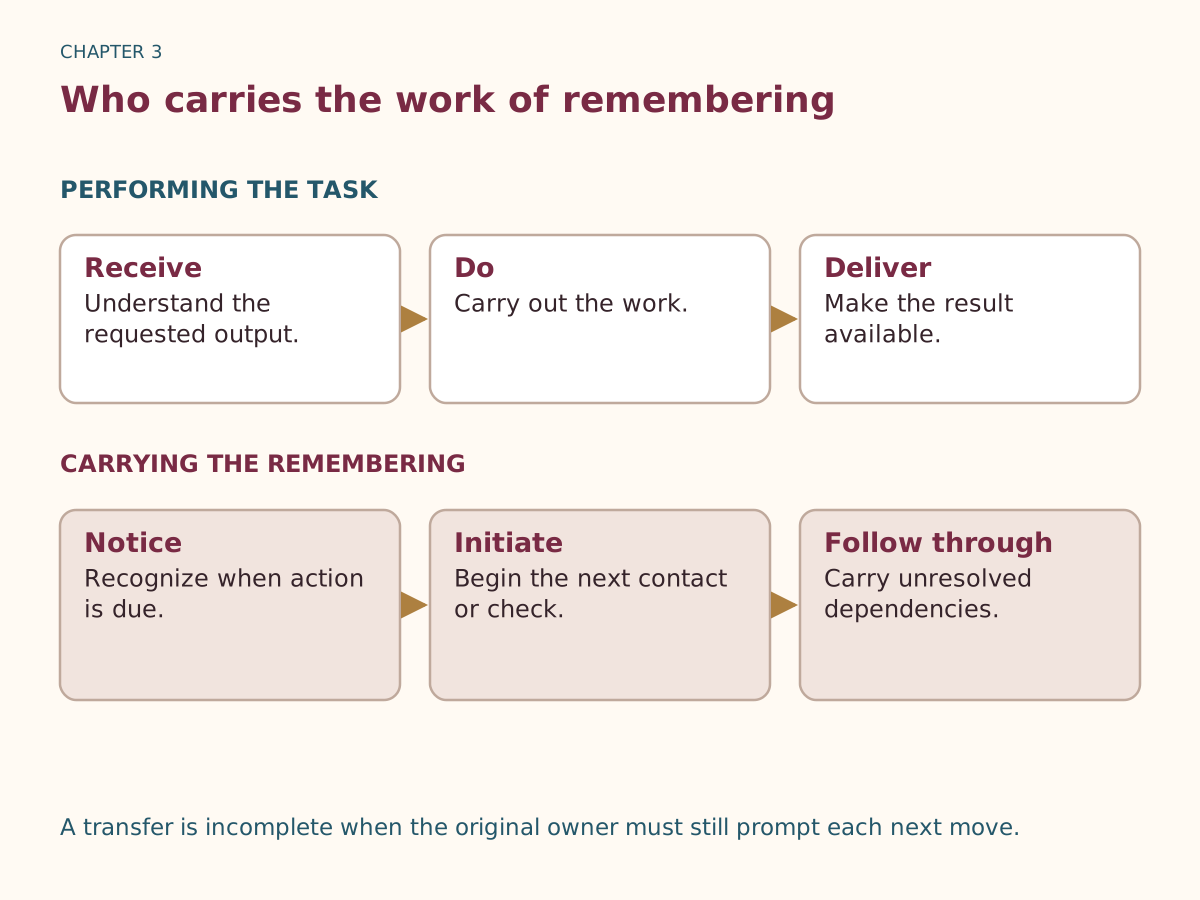
Doing an assigned task and initiating its follow-through are distinct responsibilities.
Delegation becomes lighter when the responsibility for initiating follow-through is explicit.
Read the complete visual description

Two parallel lanes run from left to right. Performing the task has three steps: Receive—understand the requested output; Do—carry out the work; Deliver—make the result available. Carrying the remembering has three different steps: Notice—recognize when action is due; Initiate—begin the next contact or check; Follow through—carry unresolved dependencies. Arrows connect the three steps within each lane. Assigning the upper lane does not automatically transfer the lower one. A transfer is incomplete when the original owner must still prompt each next move.

Open this diagram at full size

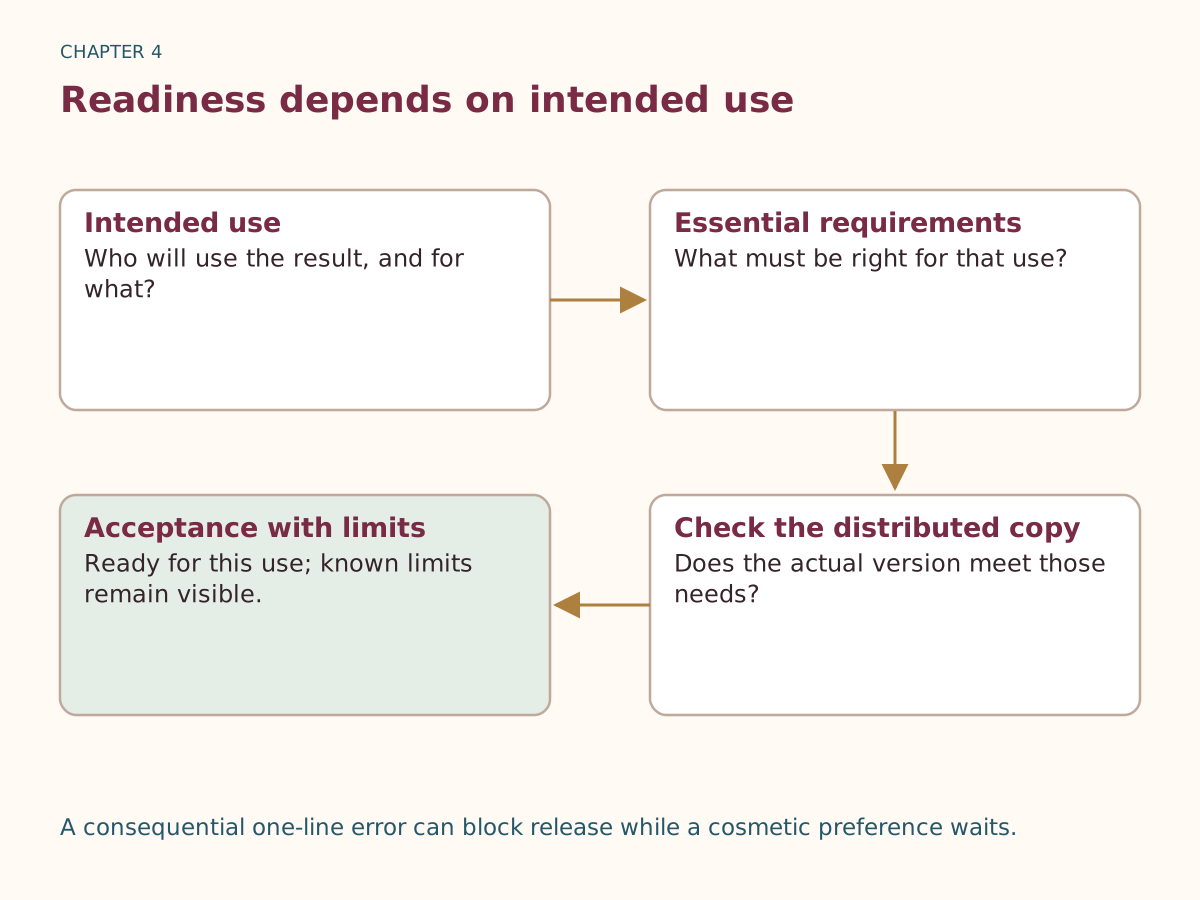
Readiness depends on intended use

Acceptance follows a chain from intended use through requirements and checks to an explicit decision.
A definition of completion names the use, the evidence, and any remaining limits.
Read the complete visual description

Three arrows connect four boxes clockwise, from upper left to upper right, then lower right to lower left. Intended use: Who will use the result, and for what? Essential requirements: What must be right for that use? Check the distributed copy: Does the actual version meet those needs? Acceptance with limits: Ready for this use; known limits remain visible. Acceptance is specific to intended use, not a claim of perfection. A consequential one-line error can block release while a cosmetic preference waits.

Open this diagram at full size

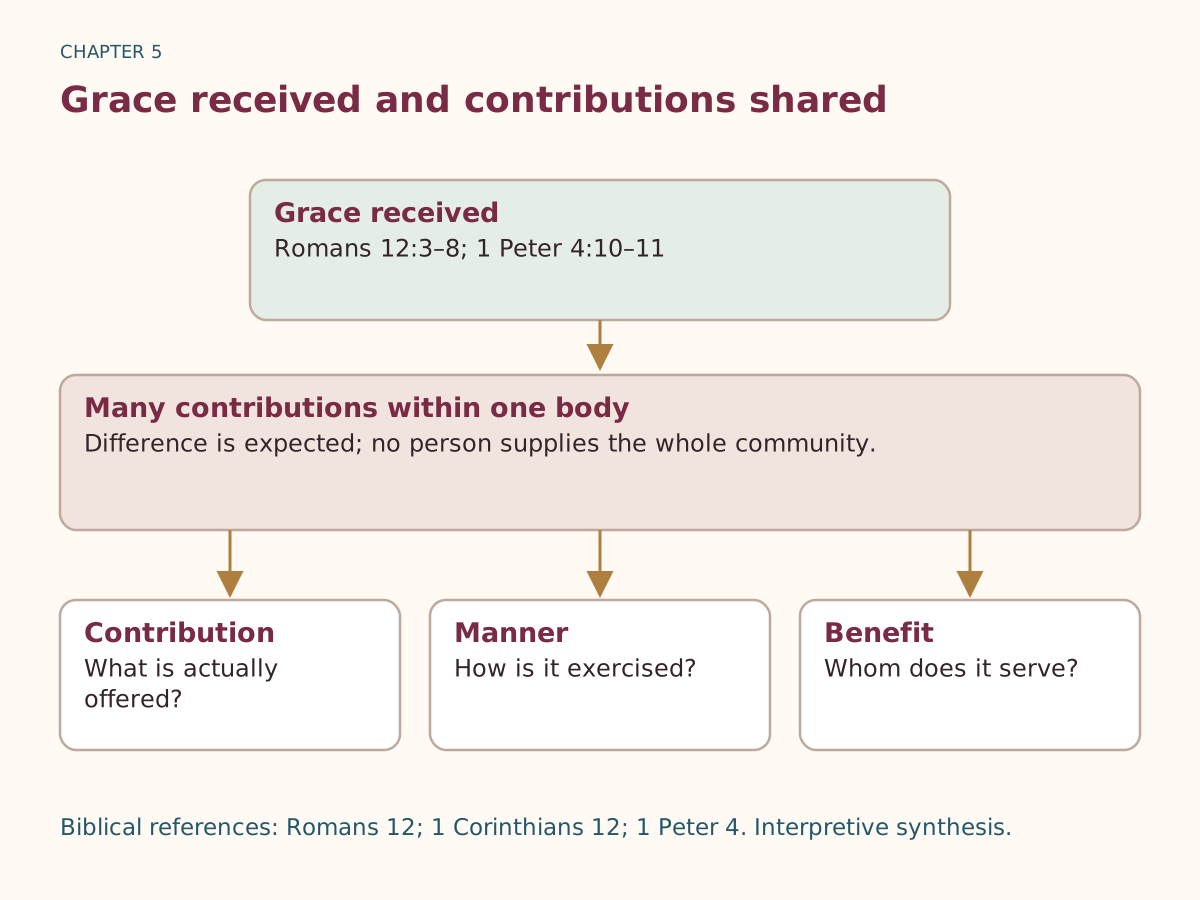
Grace received and contributions shared

The biblical accounts connect differing gifts with grace, service, and membership in one body.
Grace provides the setting for varied contributions without turning difference into rank.
Read the complete visual description

Grace received, with references to Romans 12:3–8 and 1 Peter 4:10–11, leads downward to many contributions within one body: Difference is expected; no person supplies the whole community. That shared body leads to three related questions. Contribution: What is actually offered? Manner: How is it exercised? Benefit: Whom does it serve? These questions are not personality scores or a gift assignment. The diagram is an interpretive synthesis of Romans 12, 1 Corinthians 12, and 1 Peter 4.

Open this diagram at full size

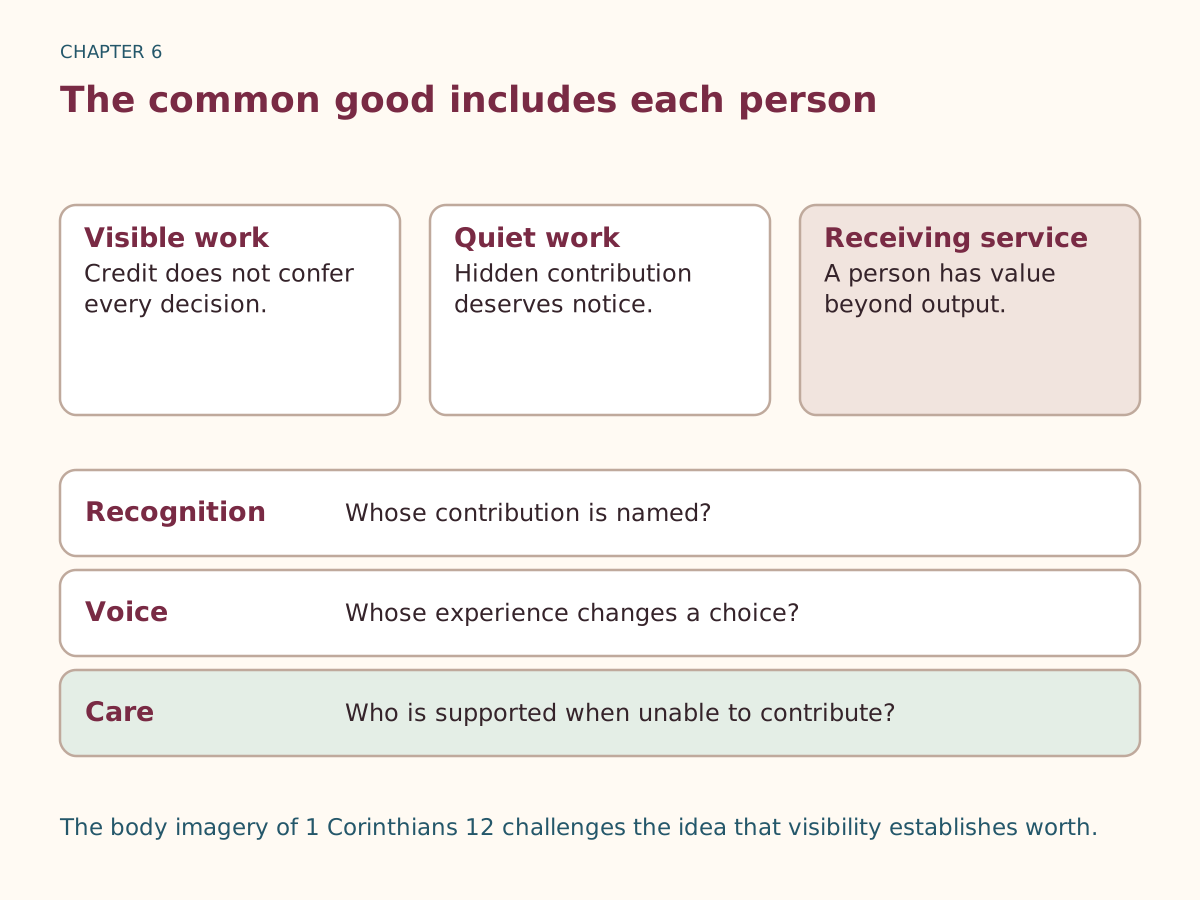
The common good includes each person

Recognition, a meaningful voice, and care extend to visible contributors, quiet contributors, and those receiving service.
The common good is tested through recognition, voice, and care across the whole community.
Read the complete visual description

Three upper columns identify people whose standing must be considered. Visible work: Credit does not confer every decision. Quiet work: Hidden contribution deserves notice. Receiving service: A person has value beyond output. Three lower rows address all of them. Recognition: Whose contribution is named? Voice: Whose experience changes a choice? Care: Who is supported when unable to contribute? The body imagery of 1 Corinthians 12 challenges the idea that visibility establishes worth.

Open this diagram at full size

A place made open again

A carefully repaired ivory and rose woven runner lies on a wooden meeting table beside an open place, a plain notebook, and a glass of water.
Repair attends to the manner of service and makes room for the contribution that was interrupted.
Read the complete visual description

A carefully repaired ivory and rose woven runner lies on a wooden meeting table beside an open place, a plain notebook, and a glass of water. Repair attends to the manner of service and makes room for the contribution that was interrupted.

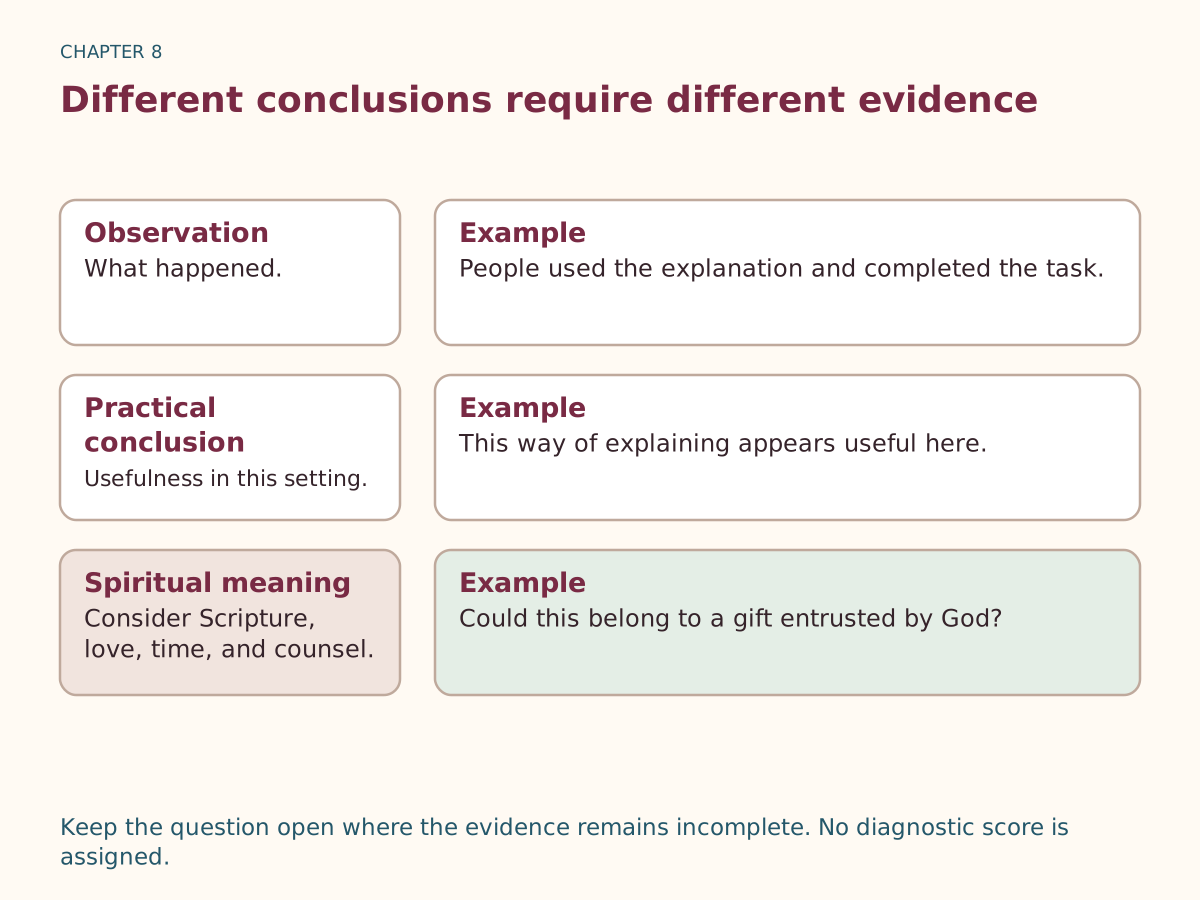
Different conclusions require different evidence

Observation, a practical conclusion, and spiritual interpretation are related but distinct levels of judgment.
Discernment becomes clearer when the strength of a conclusion matches the evidence available.
Read the complete visual description

Three separate rows pair a kind of statement with an example. Observation concerns what happened; its example is, ‘People used the explanation and completed the task.’ Practical conclusion concerns usefulness in this setting; its example is, ‘This way of explaining appears useful here.’ Spiritual meaning asks the reader to consider Scripture, love, time, and counsel; its example is, ‘Could this belong to a gift entrusted by God?’ Moving between rows adds interpretive claims; it is not an automatic promotion from skill to spiritual gift. Keep the question open where the evidence remains incomplete. No diagnostic score is assigned.

Open this diagram at full size

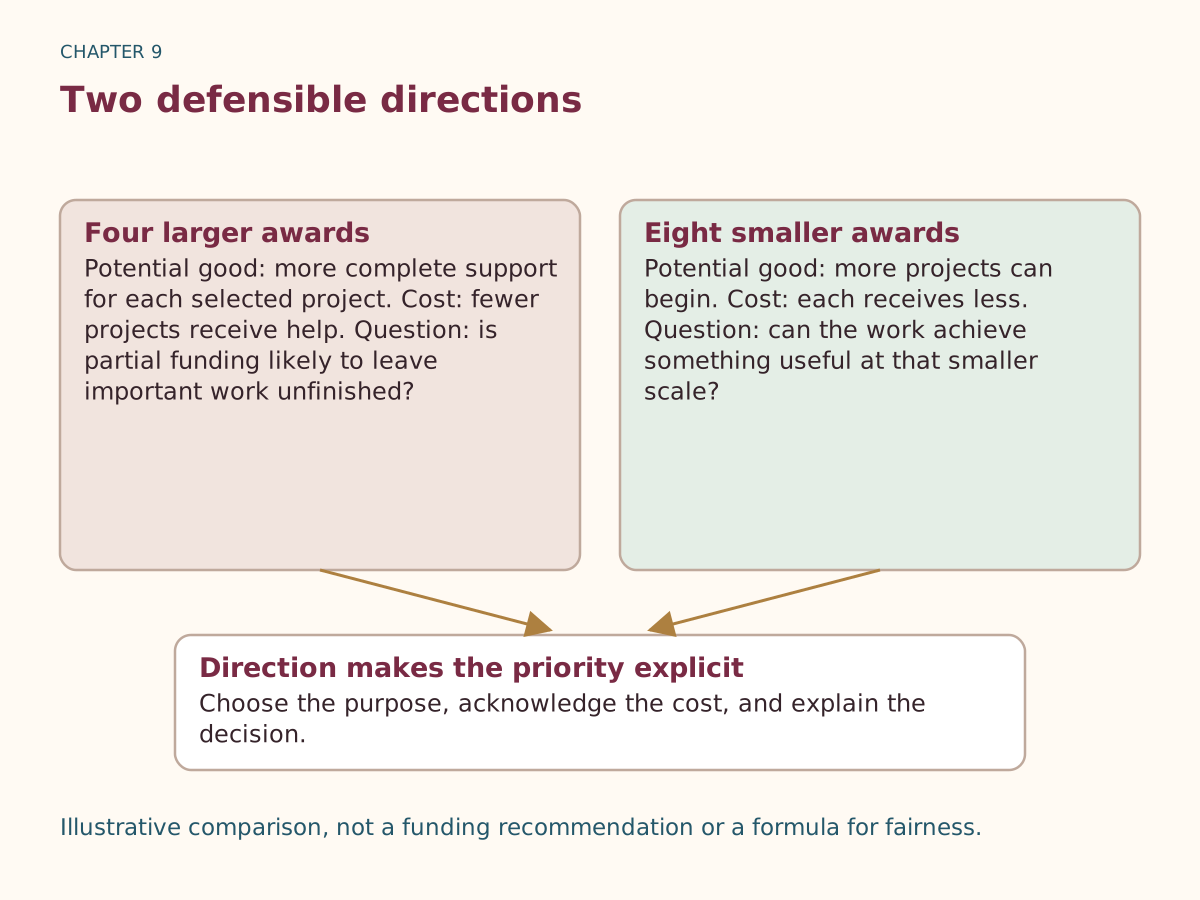
Two defensible directions

A fictional grant choice compares four larger awards with eight smaller awards. The arithmetic alone cannot decide the purpose.
Leadership names the good being pursued and the cost the choice carries.
Read the complete visual description

Two columns compare a fictional grant choice with equal standing. Four larger awards: The potential good is more complete support for each selected project; the cost is that fewer projects receive help. The question is whether partial funding is likely to leave important work unfinished. Eight smaller awards: The potential good is that more projects can begin; the cost is that each receives less. The question is whether the work can achieve something useful at that smaller scale. Both columns lead to ‘Direction makes the priority explicit’: Choose the purpose, acknowledge the cost, and explain the decision. The visual does not select a winning option. This is an illustrative comparison, not a funding recommendation or a formula for fairness.

Open this diagram at full size

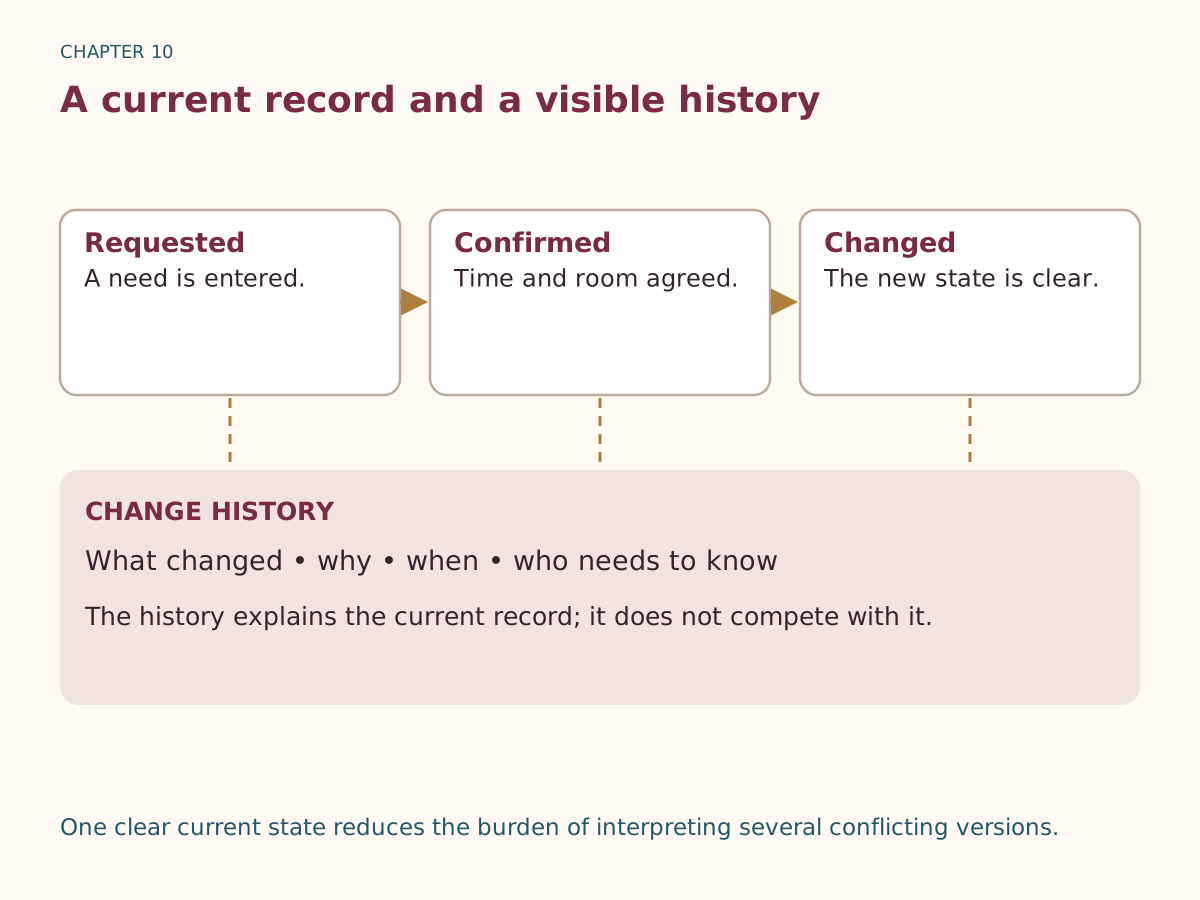
A current record and a visible history

A useful information system keeps the current booking state clear while preserving the reason for changes.
Administration keeps present information usable and the reasons for change recoverable.
Read the complete visual description

An upper lane carries the current booking status from Requested to Confirmed to Changed. Requested: A need is entered. Confirmed: Time and room agreed. Changed: The new state is clear. Dashed connectors relate each state to the separate Change history lane below: What changed, why, when, and who needs to know. The history explains the current record; it does not compete with it. One clear current state reduces the burden of interpreting several conflicting versions.

Open this diagram at full size

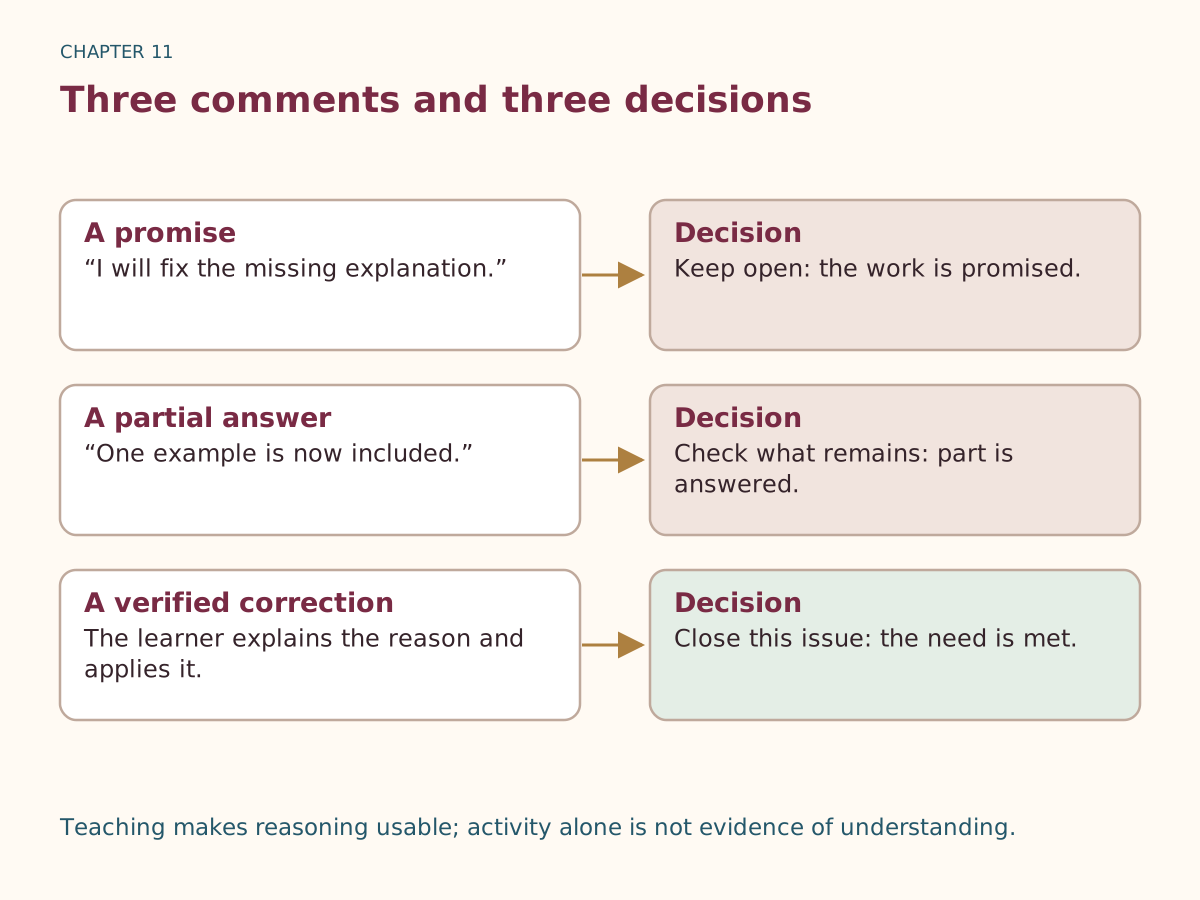
Three comments and three decisions

A promise to correct, a partial answer, and a verified correction justify different status decisions.
An explanation is useful when another person can work with its reasoning.
Read the complete visual description

Three rows connect different evidence to different decisions. A promise, ‘I will fix the missing explanation,’ leads to the decision, ‘Keep open: the work is promised.’ A partial answer, ‘One example is now included,’ leads to the decision, ‘Check what remains: part is answered.’ A verified correction, in which the learner explains the reason and applies it, leads to the decision, ‘Close this issue: the need is met.’ These decisions are not interchangeable. Teaching makes reasoning usable; activity alone is not evidence of understanding.

Open this diagram at full size

What remains sound

A small cabinet stands on a workbench beside a damaged door panel, a sound replacement panel, brass hinges, and a hand plane.
Truthful encouragement can acknowledge a real setback and the work that remains sound.
Read the complete visual description

A small cabinet stands on a workbench beside a damaged door panel, a sound replacement panel, brass hinges, and a hand plane. Truthful encouragement can acknowledge a real setback and the work that remains sound.

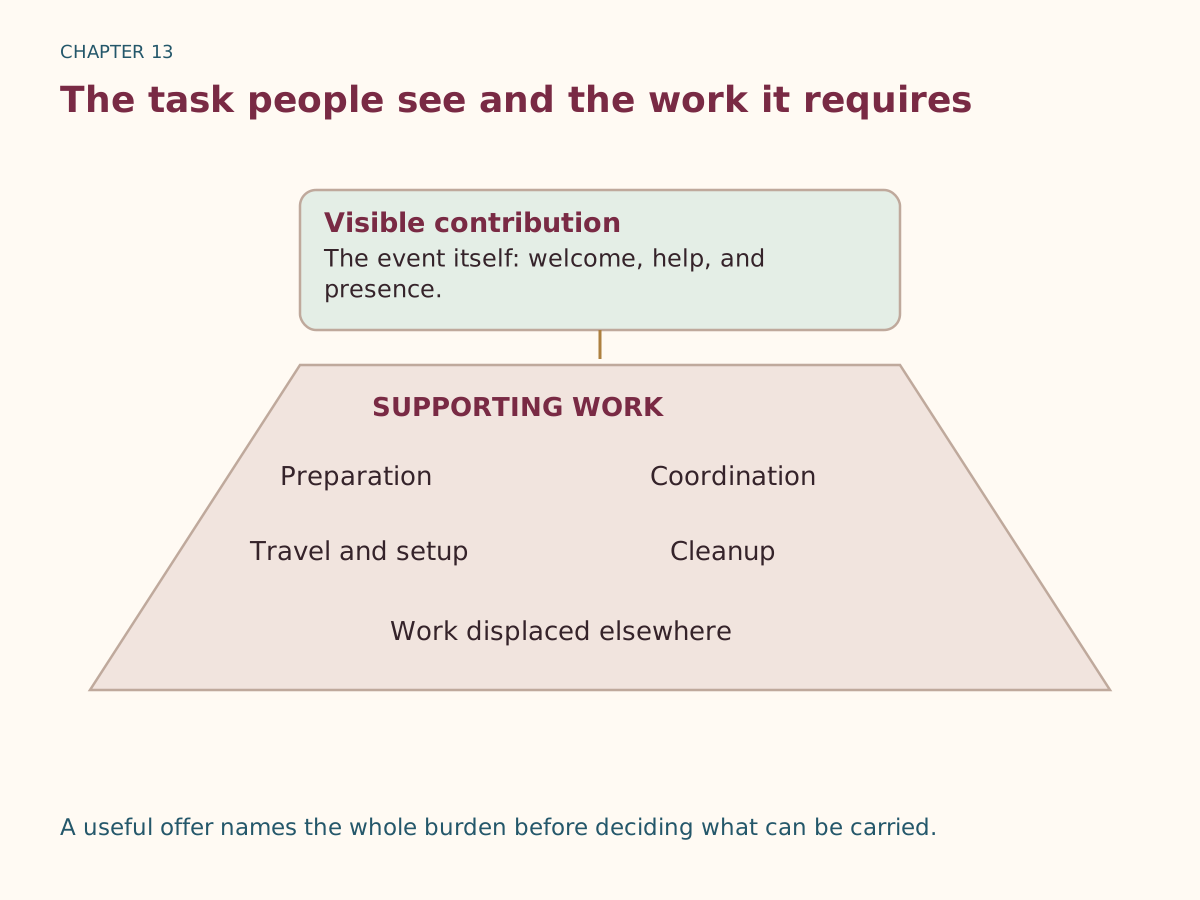
The task people see and the work it requires

A visible event task can depend on substantial preparation, coordination, and cleanup.
Practical help becomes more honest when its surrounding work is visible.
Read the complete visual description

An upper box names the visible contribution: The event itself—welcome, help, and presence. A connecting line links it to a widening shape labeled Supporting work. That shape contains Preparation, Coordination, Travel and setup, Cleanup, and Work displaced elsewhere. The shape’s size is metaphorical, not measured workload data. A useful offer names the whole burden before deciding what can be carried.

Open this diagram at full size

Room for another person’s choice

Two comfortable chairs offer different positions in a quiet room: one near a garden window, the other near a private alcove and an open doorway.
Care can offer dignified choices while attending to different needs.
Read the complete visual description

Two comfortable chairs offer different positions in a quiet room: one near a garden window, the other near a private alcove and an open doorway. Care can offer dignified choices while attending to different needs.

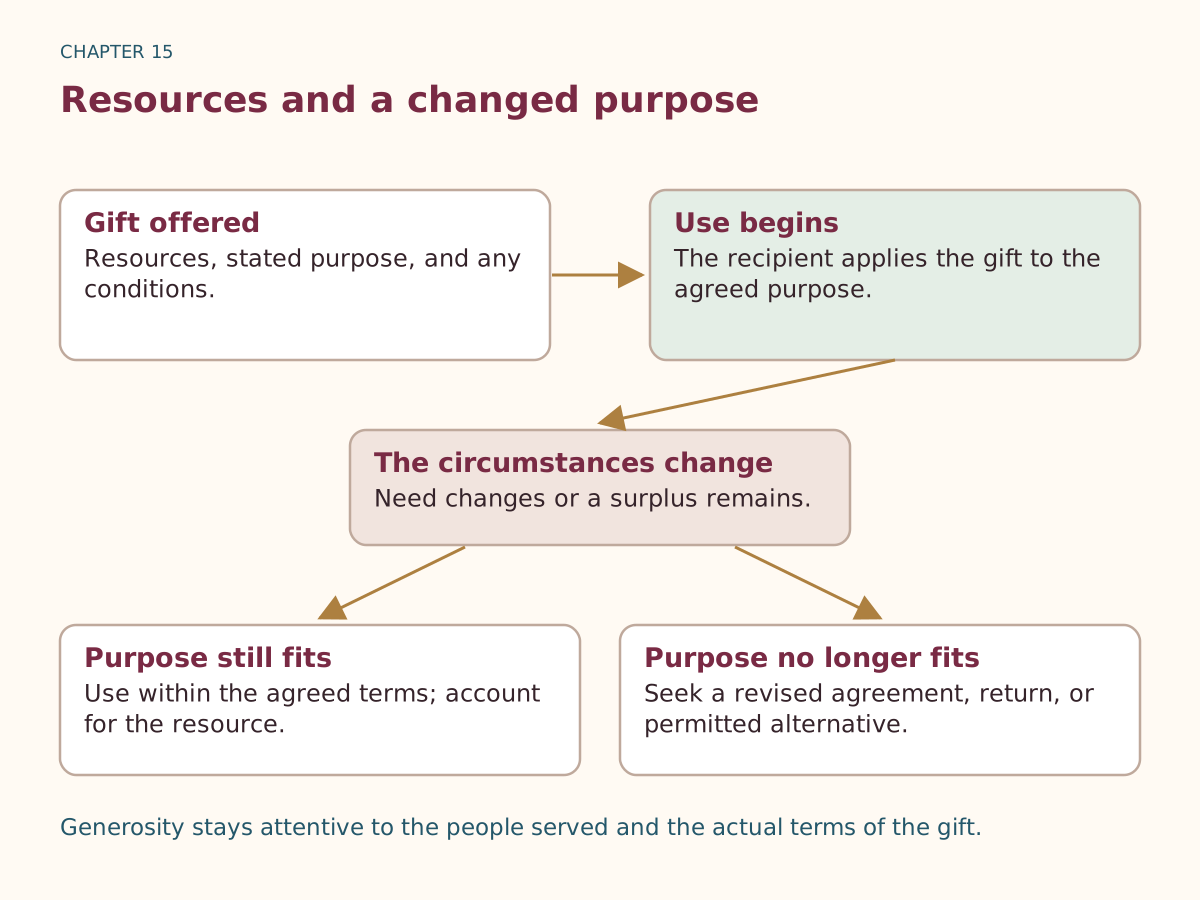
Resources and a changed purpose

Giving includes the destination of resources and the choices required when need, terms, or surplus change.
A clear destination protects generosity when circumstances change.
Read the complete visual description

Arrows move from Gift offered—resources, stated purpose, and any conditions—to Use begins: The recipient applies the gift to the agreed purpose. The next box, The circumstances change, describes a change in need or a remaining surplus. Two branches follow. Purpose still fits: Use within the agreed terms; account for the resource. Purpose no longer fits: Seek a revised agreement, return, or permitted alternative. A changed purpose requires a fresh agreement where the original terms require it. Generosity stays attentive to the people served and the actual terms of the gift.

Open this diagram at full size

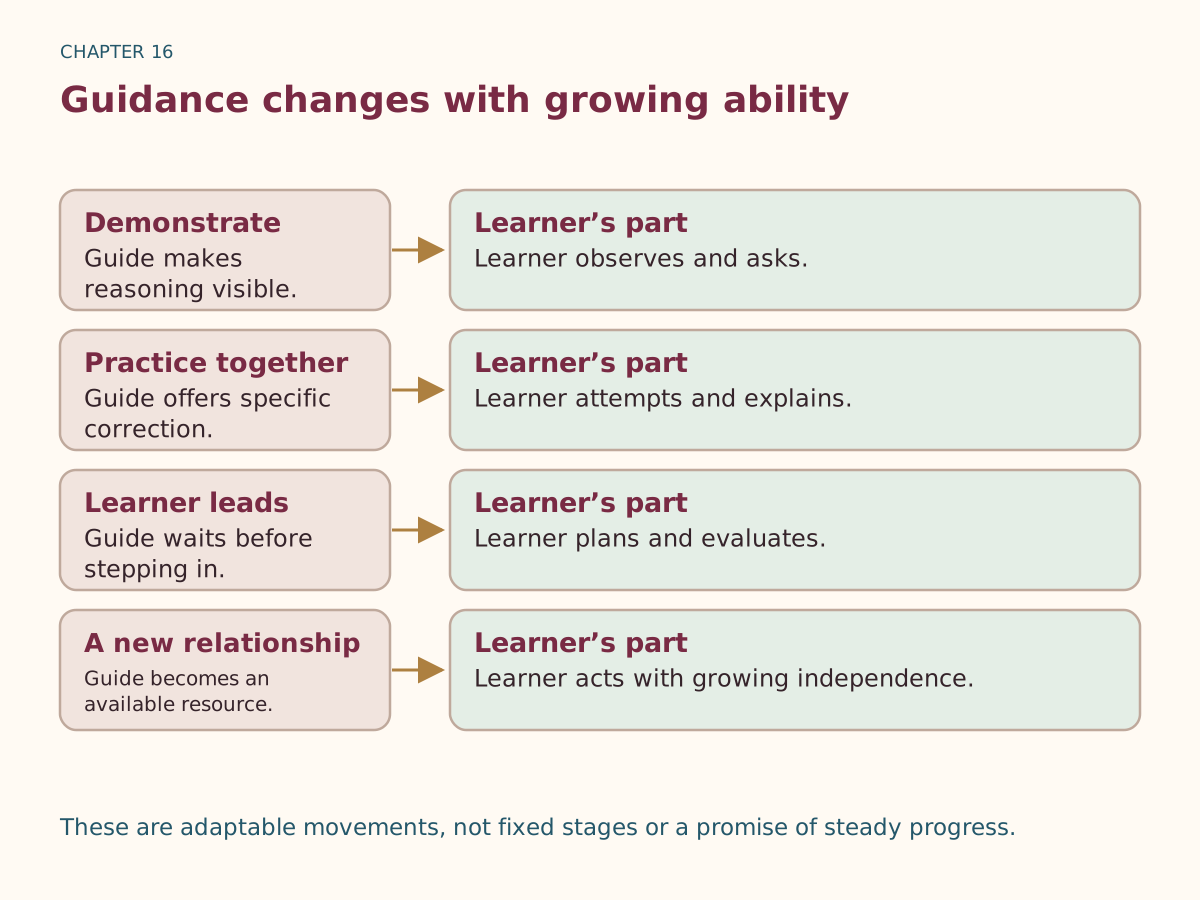
Guidance changes with growing ability

Mentoring can move from demonstration through shared practice to learner initiative and a lighter guiding role.
Good guidance makes room for a changing relationship as competence and judgment grow.
Read the complete visual description

Four rows pair the guide’s contribution with the learner’s part. Demonstrate: The guide makes reasoning visible; the learner observes and asks. Practice together: The guide offers specific correction; the learner attempts and explains. Learner leads: The guide waits before stepping in; the learner plans and evaluates. A new relationship: The guide becomes an available resource; the learner acts with growing independence. Each row has an arrow from the guide’s contribution to the learner’s part. Read downward through these possible movements, which may be revisited when a task changes. These are adaptable movements, not fixed stages or a promise of steady progress.

Open this diagram at full size

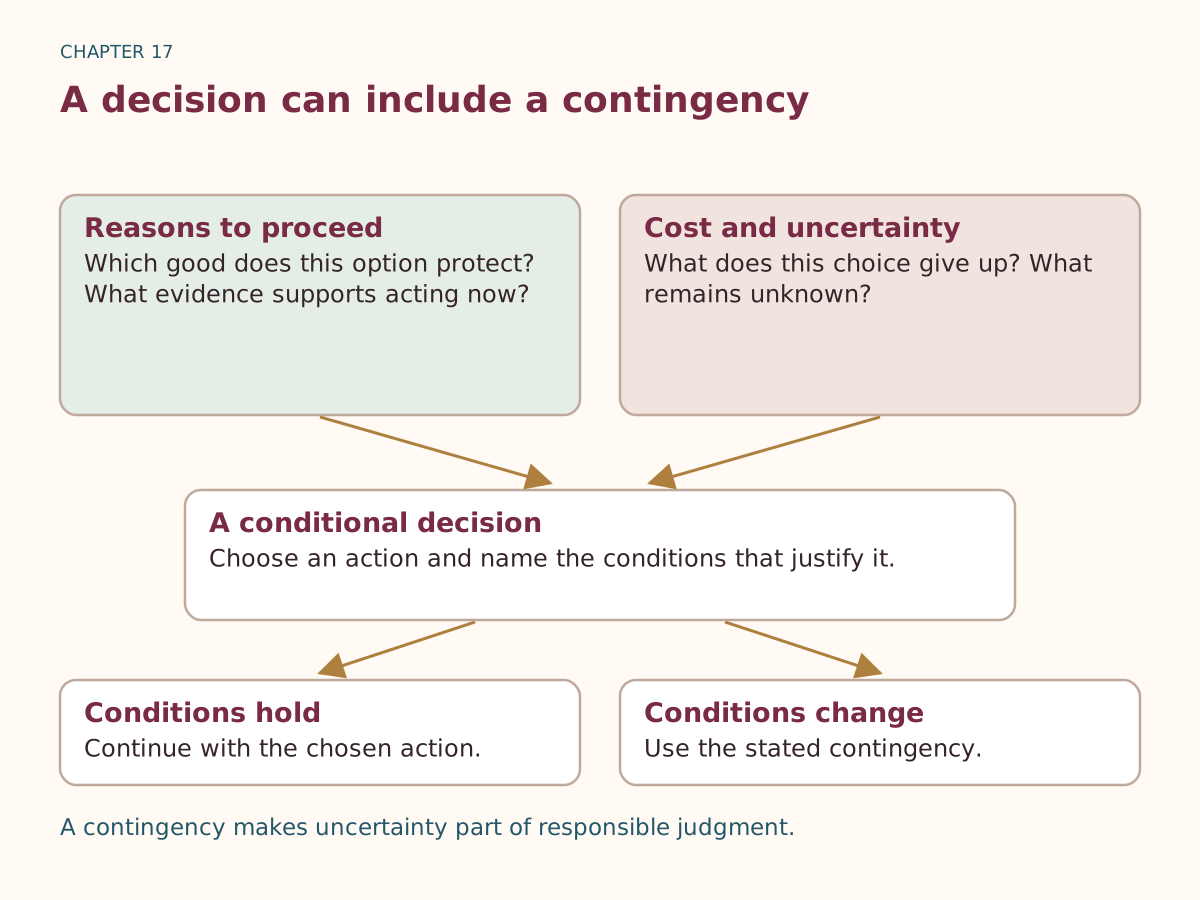
A decision can include a contingency

Wisdom weighs a chosen action alongside its cost, remaining uncertainty, and an alternative if conditions change.
A wise decision can be clear about both its purpose and its conditions.
Read the complete visual description

Two inputs feed a conditional decision. Reasons to proceed: Which good does this option protect? What evidence supports acting now? Cost and uncertainty: What does this choice give up? What remains unknown? A conditional decision: Choose an action and name the conditions that justify it. Two branches follow. Conditions hold: Continue with the chosen action. Conditions change: Use the stated contingency. A contingency makes uncertainty part of responsible judgment. This is an interpretive planning aid, not a guarantee.

Open this diagram at full size

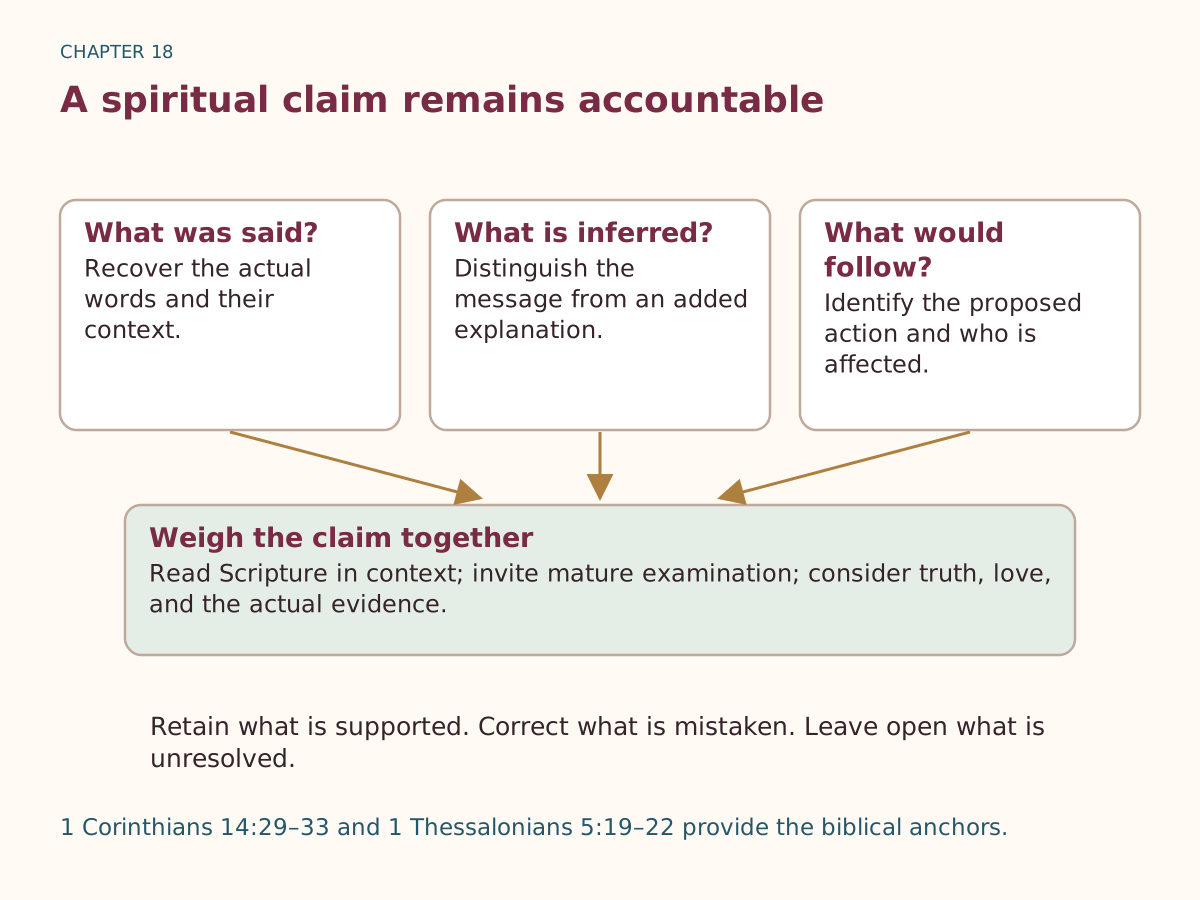
A spiritual claim remains accountable

The content of a specific spiritual claim, its interpretation, and its proposed consequence are examined distinctly.
Accountability attends to the claim itself and to the action proposed in its name.
Read the complete visual description

Three separate questions feed a shared weighing process. What was said? Recover the actual words and their context. What is inferred? Distinguish the message from an added explanation. What would follow? Identify the proposed action and who is affected. All three lead to Weigh the claim together: Read Scripture in context; invite mature examination; consider truth, love, and the actual evidence. The possible dispositions are to retain what is supported, correct what is mistaken, and leave open what is unresolved. Urgency does not bypass examination. First Corinthians 14:29–33 and First Thessalonians 5:19–22 provide the biblical anchors.

Open this diagram at full size

The people at the small table

Three blank notebooks and three chairs surround a modest table in dawn light; extra chairs remain folded against the wall.
The value of a small actual gathering can be considered honestly while its future remains open.
Read the complete visual description

Three blank notebooks and three chairs surround a modest table in dawn light; extra chairs remain folded against the wall. The value of a small actual gathering can be considered honestly while its future remains open.

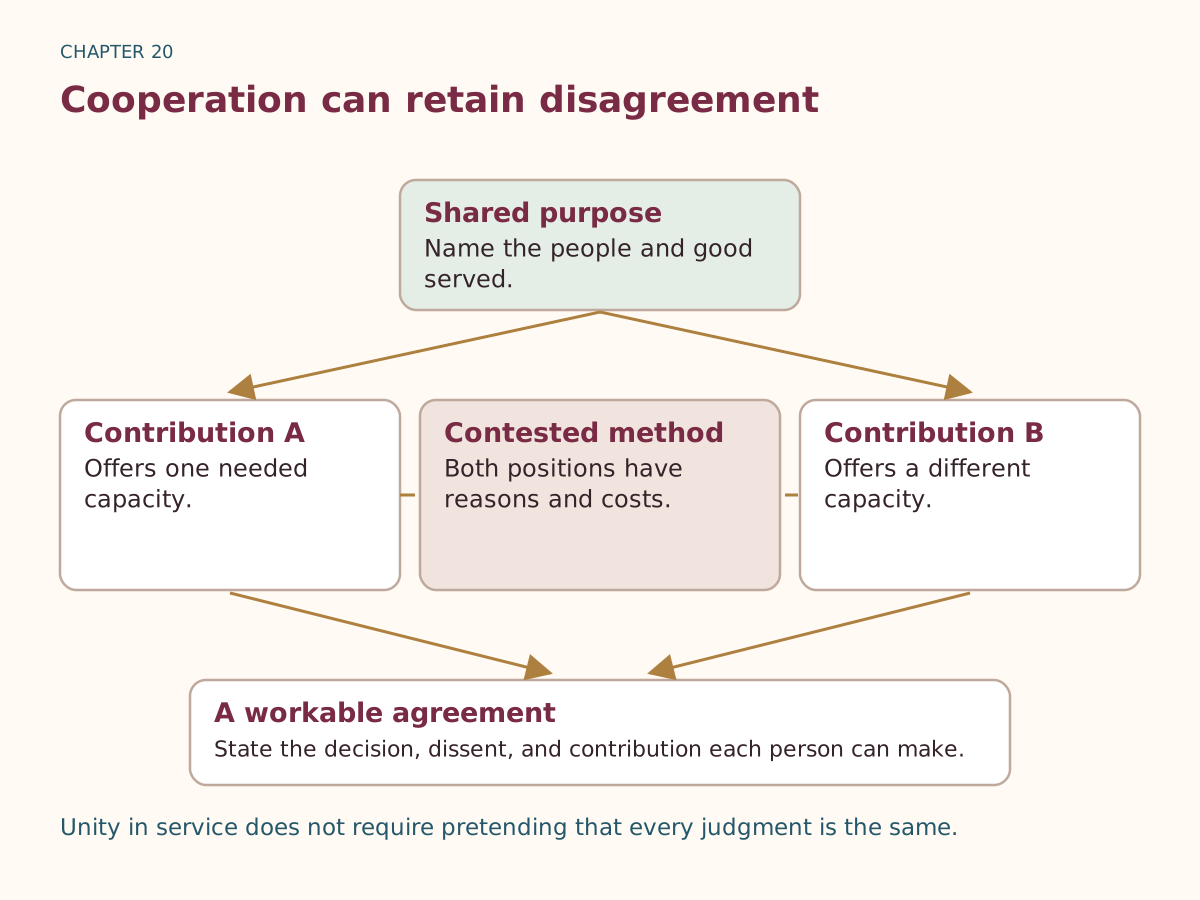
Cooperation can retain disagreement

Contributions can connect around a shared purpose while a real disagreement about method remains visible.
A shared purpose can support honest disagreement and a workable common decision.
Read the complete visual description

Shared purpose—name the people and good served—leads to two distinct contributions. Contribution A offers one needed capacity. Contribution B offers a different capacity. Both connect to the Contested method between them: Both positions have reasons and costs. Arrows from the two contributions converge on A workable agreement: State the decision, dissent, and contribution each person can make. The disagreement remains visible within the agreement. Unity in service does not require pretending that every judgment is the same.

Open this diagram at full size

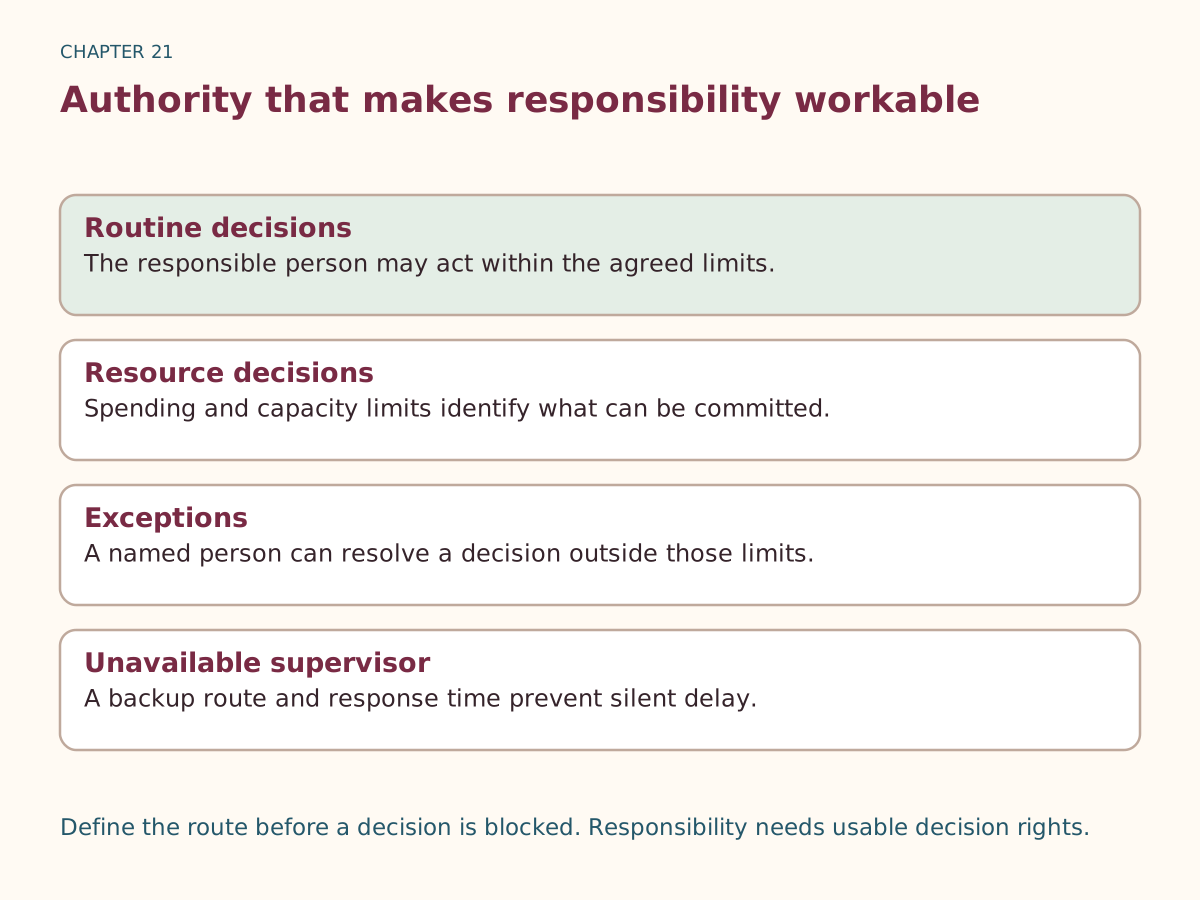
Authority that makes responsibility workable

A responsibility becomes actionable when decision categories, resources, backup, and escalation are explicit.
An assignment can be supported by concrete authority, resources, and a route for exceptions.
Read the complete visual description

Four rows describe complementary parts of an assignment. Routine decisions: The responsible person may act within the agreed limits. Resource decisions: Spending and capacity limits identify what can be committed. Exceptions: A named person can resolve a decision outside those limits. Unavailable supervisor: A backup route and response time prevent silent delay. The backup route supports exceptions when the normal approver cannot respond; it is not unlimited authority. Define the route before a decision is blocked. Responsibility needs usable decision rights.

Open this diagram at full size

The work continues in other hands

An open garden gate leads to tended beds. A plain open booklet rests on a welcome table, and the path continues beyond the frame.
A contribution can remain useful as its maker releases control and enters a new season.
Read the complete visual description

An open garden gate leads to tended beds. A plain open booklet rests on a welcome table, and the path continues beyond the frame. A contribution can remain useful as its maker releases control and enters a new season.

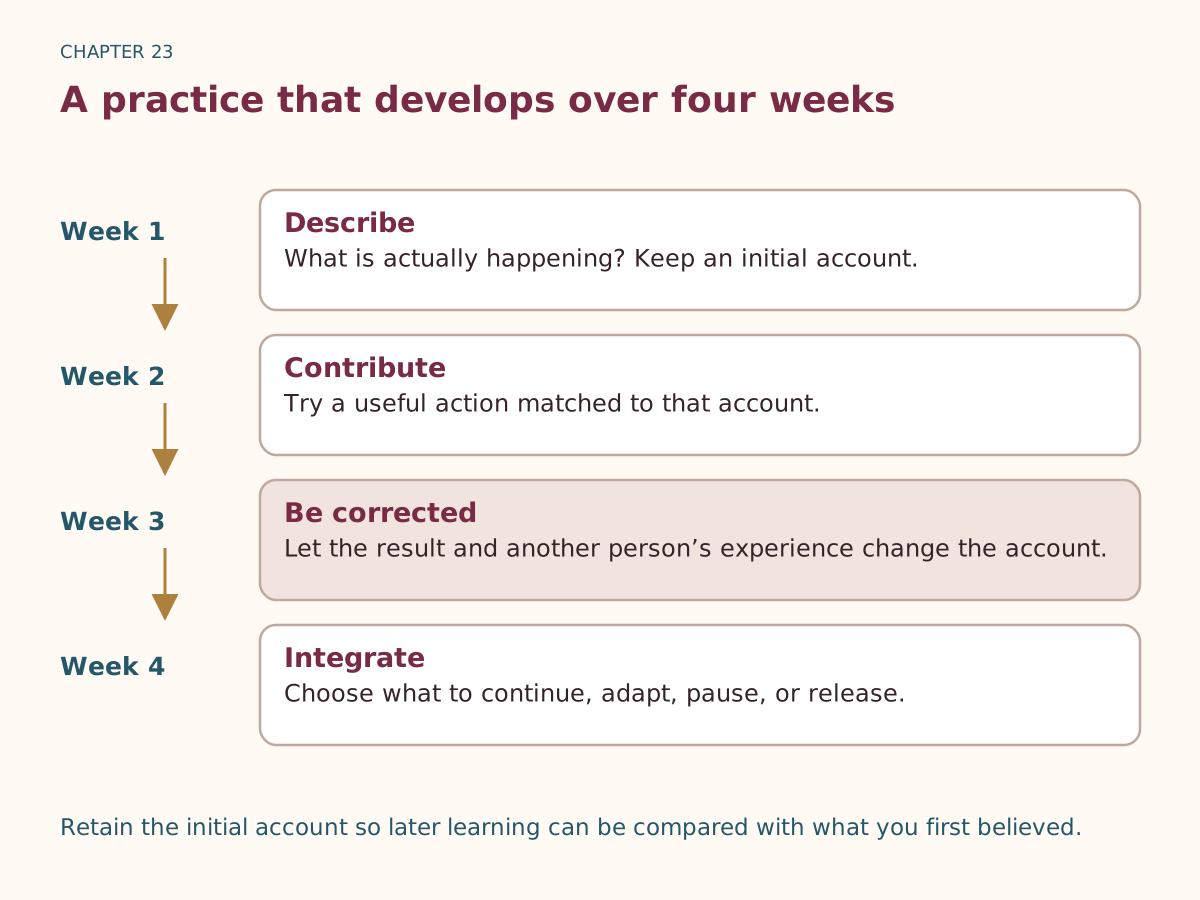
A practice that develops over four weeks

A four-week practice carries one concern through description, action, correction, and a changed understanding.
Integration becomes visible when a record shows how experience changed the response.
Read the complete visual description

Arrows connect four weeks in order. Week 1, Describe: What is actually happening? Keep an initial account. Week 2, Contribute: Try a useful action matched to that account. Week 3, Be corrected: Let the result and another person’s experience change the account. Week 4, Integrate: Choose what to continue, adapt, pause, or release. Retain the initial account so later learning can be compared with what you first believed. Later weeks do not rewrite the earlier evidence as though the insight was present from the start.

Open this diagram at full size

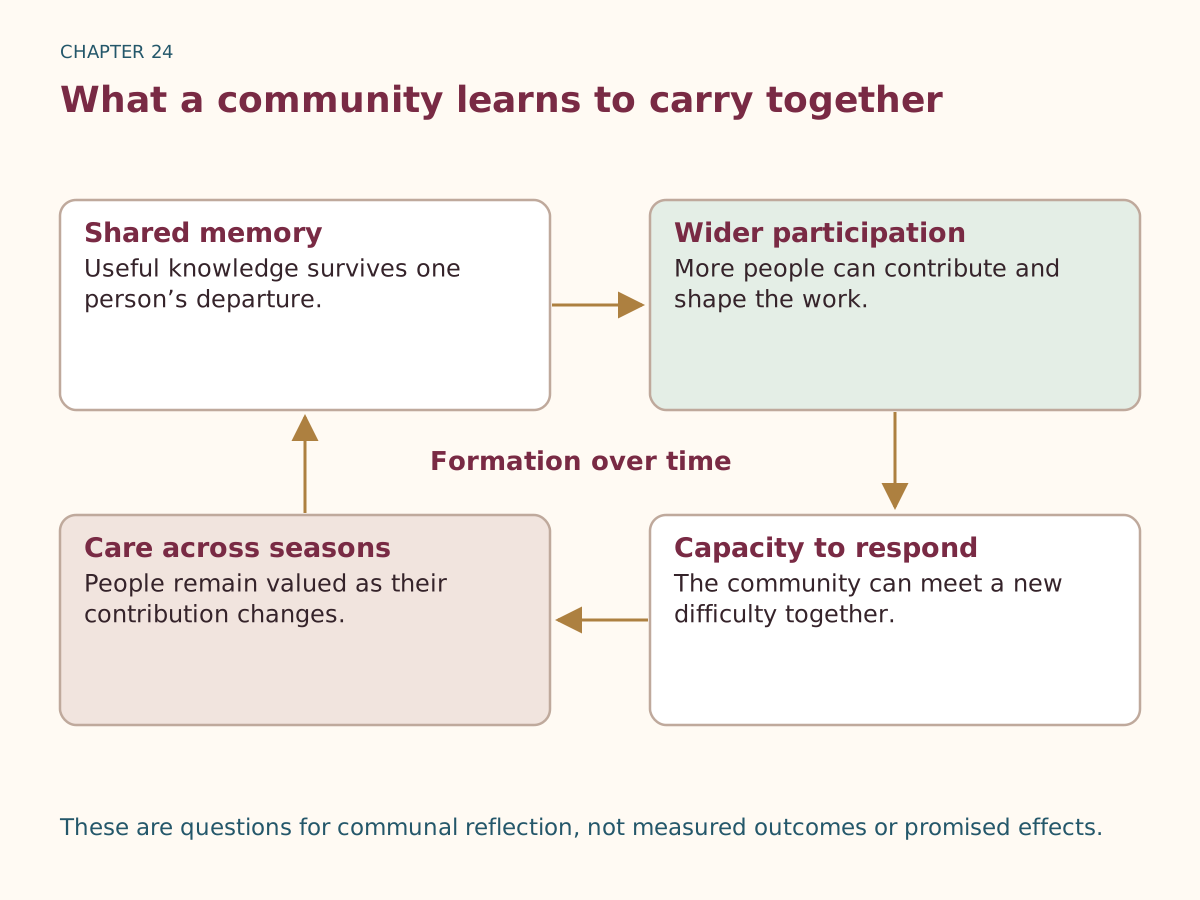
What a community learns to carry together

Repeated acts of service can leave a community with shared memory, wider participation, and greater capacity to respond.
The enduring fruit of service includes what a community becomes able to carry together.
Read the complete visual description

A clockwise cycle surrounds the phrase Formation over time. Shared memory: Useful knowledge survives one person’s departure. Wider participation: More people can contribute and shape the work. Capacity to respond: The community can meet a new difficulty together. Care across seasons: People remain valued as their contribution changes. Arrows connect these four boxes in that order and return from care across seasons to shared memory. The cycle represents the book’s cumulative interpretation of community formation, not an empirical causal model. These are questions for communal reflection, not measured outcomes or promised effects.

Open this diagram at full size

Cover illustration

Separate ivory bridge pieces with gold botanical details cross calm water; a rose ribbon leads from a closed seed toward an open ivory and rose flower.
Visual reflection
Read the complete visual description

Separate ivory bridge pieces with gold botanical details cross calm water; a rose ribbon leads from a closed seed toward an open ivory and rose flower.

Glossary

Concern
A specific matter that appears to require attention. In this book, a concern is described in relation to people, promises, resources, or a shared purpose before spiritual meaning is considered.
Frustration
The felt difficulty that can arise when desired movement is obstructed or unclear. The book treats frustration as an occasion for inquiry. It does not infer a diagnosis, motive, or spiritual gift from the feeling.
Observation
A description of what was seen, received, heard, or otherwise established. An observation can be corrected by additional evidence and should be distinguished from an explanation of why it happened.
Interpretation
A proposed meaning or explanation attached to an observation. Interpretations may be reasonable while remaining uncertain. Good discernment makes their tentative status visible.
Evidence of progress
An artifact, decision, completed action, or clarified obstacle that helps people understand the actual state of a task. The useful evidence depends on the work and the agreed checkpoint.
Completion condition
An observable feature of a deliverable or result that establishes whether it is ready for its intended use. It is agreed with an appropriate recipient or decision maker.
Delegation
An agreed transfer of responsibility for specified work, together with the necessary scope, authority, resources, and communication. The exact arrangement depends on the setting.
Accountability
An arrangement in which responsibilities, evidence, review, and correction are clear. In this book, accountability supports truthful service and does not confer permission to shame others.
Agency
A person’s meaningful ability to express preferences, make appropriate decisions, and accept or decline an offered form of assistance within the situation’s legitimate responsibilities.
Spiritual gift
In the Christian framework of this book, a grace-enabled contribution associated with the Spirit’s work for the benefit of others. The book’s primary biblical discussions are Romans 12 and 1 Corinthians 12. Romans 12:3–8 1 Corinthians 12:4–31
Common good
The shared benefit toward which gifts and service are directed in the reading of 1 Corinthians 12 used here. The workplace applications are reflective extensions of that communal purpose. 1 Corinthians 12:4–31
Fruit of the Spirit
The qualities of life named in Galatians 5:22–26. Fruit concerns character across forms of service and is kept conceptually distinct from a particular gift or professional skill. Galatians 5:22–26
Discernment
The careful consideration of meaning and response through relevant evidence, Scripture, prayer, service, and appropriate counsel. This broad practice should be distinguished from the particular gift of discerning spirits named in 1 Corinthians 12. 1 Corinthians 12:4–31 The ordinary use of careful judgment in a workplace should not be assumed to demonstrate that particular gift.
Prophecy
A biblical gift discussed here through passages that associate it with strengthening others and require accountable weighing. This book supplies no prophetic message to the reader and assigns no prophetic office. 1 Corinthians 14:1–5, 29–33 1 Thessalonians 5:19–22
Shepherding analogy
The use of accompaniment, care, and equipping language to reflect on a professional or volunteer relationship. The analogy does not establish pastoral office or spiritual authority over the recipient. Ephesians 4:11–16
Stewardship
Responsible care for what has been entrusted, including abilities, resources, opportunities, and responsibilities. First Peter 4 supplies the book’s explicit connection between received gifts and service to others. 1 Peter 4:10–11
Service experiment
A small, bounded contribution undertaken with appropriate permission, followed by observation and feedback. It produces evidence about an action and setting; it is not a validated gift assessment.
Review point
An agreed time or condition for examining what exists, what has helped, what remains difficult, and whether the plan needs to change.
Handoff
The practical transfer of a usable result and its next responsibilities. A clear handoff identifies location, access, ownership, open questions, and an appropriate route for support.
Release
The act of allowing transferred or completed responsibility to move to its next owner or stage. Release may follow a careful handoff and can coexist with an agreed, limited support period.