
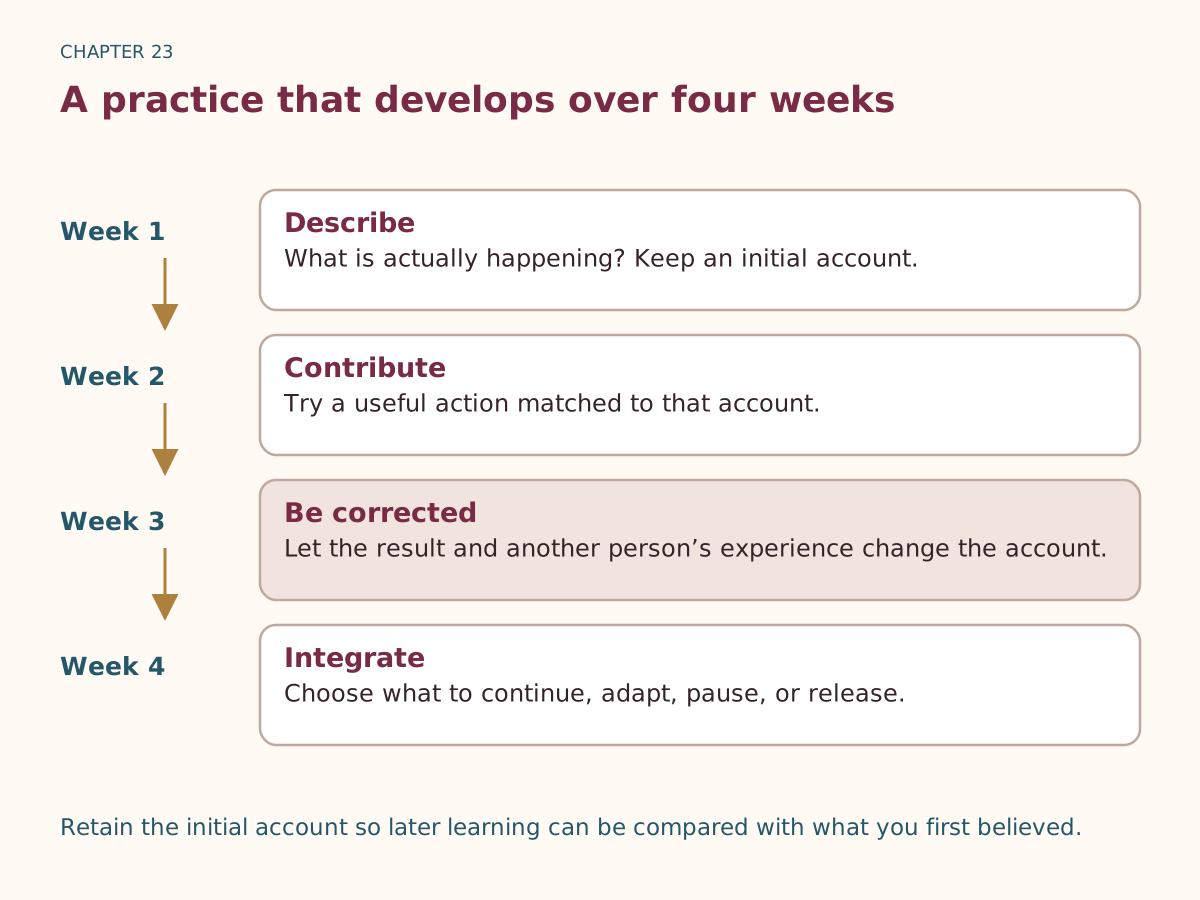
The preceding chapters become more useful when their questions remain with you long enough to meet a second situation. One act of help can reveal an ability. A later correction can reveal how you carry that ability when another person does not welcome its form. A month offers room for both. Its value lies in the continuity of attention: what you notice, what you try, what another person experiences, and what you actually change afterward.
The following four weeks are fictional. Elena works as an operations associate at an arts cooperative. She answers room requests and helps instructors find the information they need. Repeated questions have begun to irritate her. She wonders whether clearer explanation could become a more deliberate part of her service. She decides to keep a brief record while continuing her ordinary work and to discuss the experience with a trusted Christian mentor outside the workplace.
Elena uses four pages in a notebook, one for each week. She records events without confidential details or judgments about colleagues' motives. The notebook belongs to her reflection; it is not a rating system for other people. Her working question is concrete: can she help someone proceed more confidently, and can she learn to offer that help with greater patience? The broader discernment of gifts will grow from the service and the Christian conversation described in chapter 8.
Week one: the explanation changes
On Monday, an instructor asks where to request extra room time. Elena begins to answer sharply. She has explained this before. The instructor shows her the message she has been using, and Elena recognizes an address that changed several weeks earlier. The message came from a template Elena herself had prepared. She had corrected the main instructions but overlooked the copy still being sent to new instructors.
The discovery changes the direction of her attention. The question she found irritating has exposed a gap in her own update. She corrects the template and informs the colleague using it. Her first notebook entry is short: an old instruction was still leaving my desk; the repeated question helped me find it. She includes the initial impatience because it belongs to the event. The record is already more useful than a description of other people failing to read.
On Wednesday, another instructor asks the same question while holding the current instructions. Elena now expects another version problem, but there is none. The obstacle is the term room variation, which the cooperative uses for several kinds of requests. The instructor understood it as a change of location, not a request for more time. Elena explains the term and recognizes a different cause beneath a similar question.
She has now corrected two assumptions in three days. On Monday, she assumed people were overlooking information. On Wednesday, she assumed every recurrence would have the same explanation as Monday's. The emerging practice requires more than replacing an ungenerous story with a generous one. It requires staying close enough to the particular situation to discover what is actually making the task difficult.
At the end of the week, her mentor asks what Elena enjoyed. She enjoyed finding the outdated template and improving the wording. She found the second explanation tiresome because it interrupted another task. The mentor asks whether Elena could see the interruption from the instructor's position. He needed to arrange a room before a deadline. His question was part of his work, not an intrusion invented to test her patience.
Romans situates differing gifts within sober self-understanding and membership in a shared body. Romans 12:3–8 Elena applies that teaching by including her contribution and her dependence in the same account. She knew where to find the answer. The instructors supplied information she needed about the instructions she had produced. Her service becomes more accurate when she recognizes that she is also receiving help.
Before the next week begins, she changes one habit. When a familiar question arrives, she asks what information the person has already seen. This is a small action she can actually carry into Monday. She does not assign herself the large task of becoming patient in every conversation at once. The first page closes with a practice specific enough to be tried and observed.
Week two: someone uses the first attempt
Elena and her supervisor agree that she will prepare one page explaining the three most common room requests. The booking approver checks the process described. Elena enjoys the task and produces a page with a clear sequence, concise headings, and examples. She is proud of how much information it contains without appearing crowded. She expects the first trial to confirm that the page is ready.
A new volunteer tries it with a sample request. He selects the correct form and finds where to send it. Then he asks whether submitting the form reserves the room. Elena realizes that the page never explains the difference between making a request and receiving confirmation. She had assumed that distinction because it was obvious in her own daily work. The volunteer has reached the precise point at which the guide could create a mistaken expectation.
She adds the missing explanation after checking its wording with the booking approver. The second attempt works better. The volunteer can describe when he should wait and what message confirms the booking. Elena records the change between the two attempts. Her evidence is the task the volunteer could explain after the revision, not merely the compliment he offered about the page's appearance.
The next day, an experienced instructor finds the guide useful but asks Elena to handle his request for him. She has time and could complete it quickly. Instead, she asks which part he wants help with. He is uncertain whether his proposed activity fits one of the listed categories. They examine that question together, and he completes the request himself. The service takes longer than doing it for him, but it leaves him able to make the next similar request.
A different instructor still prefers to ask Elena directly. She feels disappointed that the guide has not replaced every conversation. Her supervisor reminds her that the purpose was to give people a usable reference. Some questions may still need a person, and some users may choose a conversation even when a page is available. Elena can examine whether the guide helps without requiring everyone to engage with it in the form she prefers.
By Friday, she has spent more time on the page than planned because she began adding rare cases. She places those additions in a separate working note and returns to the agreed three requests. This choice is easier to explain after the trial: the most useful correction addressed a common misunderstanding, while the extra cases had expanded the page without answering an observed difficulty. Her enthusiasm can be directed by use instead of by every possibility she can imagine.
The second notebook page contains both satisfaction and a warning about her working habit. She likes creating explanations, and she can lose track of the time they require. She chooses to record the actual hours alongside the useful revision. The experience may be worthwhile at its present scale while still needing a different arrangement if her supervisor later asks for a whole collection of guides.
Week three: the correction is about her
On Tuesday, a colleague asks Elena to check the dates in a draft message about studio access. Elena notices a long opening and several repeated details. She rewrites the message, believing that the colleague will be relieved. The response is direct: the dates are now correct, but the revision removed information instructors had specifically requested and changed a tone the colleague had chosen deliberately.
Elena's first explanation concerns clarity. She can defend shorter sentences and show where the removed material appears elsewhere. Her colleague replies that she asked for a date check. The reply leaves little room for Elena's preferred account of herself as the helpful person improving a difficult draft. The central failure is an intervention that exceeded the request. Some of the editorial suggestions might have merit, but that is a different conversation.
She apologizes, restores a copy containing only the date corrections, and asks whether anything further is needed. The colleague says that is enough. Elena feels a strong wish to explain again that she meant well. She lets the answer stand. Accepting the limit is part of the repair. An apology followed by another attempt to win acceptance of the unwanted rewrite would continue the same difficulty in a more polite form.
Her notebook entry includes the action, the response, and the change she made. She also notes the pleasure she expected from being told that the message was much better. This admission is uncomfortable and useful. Her desire to serve had become entangled with a desire to have her competence recognized. Seeing the mixture gives her something more specific to examine than either condemning her whole intention or declaring that good intentions should have settled the matter.
First Corinthians places love at the center of its treatment of gifts. 1 Corinthians 13:1–7 Elena and her mentor apply that teaching to the request she actually received. Skill with words should become attentive to another person's purpose. The colleague was responsible for the message and knew why certain details belonged there. Elena's ability could have supported that responsibility if she had first asked what kind of help was wanted.
On Thursday, someone else asks her to examine a message. Elena asks whether the person wants factual checking, comments on structure, or attention to tone. The colleague chooses structure. Elena supplies suggestions in a separate copy and explains one question she could not resolve. The colleague accepts some changes and leaves others. Elena experiences the difference between making a contribution and taking possession of the result.
The third page ends with an observable repair: the next offer changed. This matters more than a general promise to become considerate. A practice of discernment needs room for the occasions that disturb a preferred identity, then needs enough continuity to see whether those occasions alter behavior. Elena's month has become richer because one colleague was willing to give her an answer she did not want.
Week four: choose what can continue
By the fourth week, Elena has a useful but mixed record. An outdated template has been corrected. The guide has helped a new volunteer understand confirmation. One section still prompts a question. A requested structural review has been useful to a colleague. An unrequested rewrite required an apology. She has enjoyed some of the work and underestimated the time it could consume. The record gives her material for judgment without requiring a simple declaration of success or failure.
The remaining question concerns what to do while a request is unanswered. The guide tells instructors to wait for confirmation but gives no route for an approaching deadline. Elena checks the existing arrangement with the booking approver and adds the appropriate contact and the point at which to ask about a pending request. She asks the next user to describe that step in their own words. The revision completes a specific piece of the month's learning instead of leaving the same observation in her notebook for another four weeks.
Her supervisor wants the guide kept current but cannot yet say whether it has reduced the total number of questions. They do not have a reliable earlier count, and several other things changed during the month. Elena can accept that limit because she has direct examples of the guide's use. She agrees to maintain the page within her role and to bring a larger expansion back as a separate proposal if the need becomes clear.
Her mentor asks about the work she did when appreciation was unlikely. Elena remembers correcting the template, returning the colleague's wording, and answering a question while busy. These moments help her examine willingness and manner alongside the tasks she enjoyed displaying. She does not need to erase pleasure in skilled work. She needs a view of service wide enough to include repair, repeated explanation, and the decision to leave someone else's legitimate choice intact.
Among the qualities Paul names as the Spirit's fruit are gentleness and self-control. Galatians 5:22–26 Elena sees practical questions in those words. Can she answer without making the questioner feel foolish? Can she stop after the help requested? Can she receive a partial acceptance of her suggestions without trying to take over? These questions concern growth in character throughout the work, alongside the continuing discernment of what she may be especially able to contribute.
She also identifies what the month has not required. The process was familiar, the subject was narrow, and her supervisor allowed time for a small resource. A future assignment in an unfamiliar setting would ask for different preparation. This observation guides the size of her next step. She will continue the useful work she has actually learned to carry and seek experience gradually, with counsel, when a new opportunity arises.
The final page contains three decisions. She will keep the common-request page current. She will ask what kind of help is wanted before revising another person's work. She will bring one concrete episode to her mentor each month, including a difficult one when it matters. The practice remains small enough to live with. It leaves room for ordinary work that does not need to be recorded or interpreted before it can be offered kindly.
On the next Monday, the familiar question returns. Elena feels the same flicker of irritation and asks which instructions the person has seen. This time the explanation is simple: the message arrived during a busy week and was overlooked. She answers the question and continues her work. The month has not removed every impatient feeling. It has given her a more faithful action to take when the feeling appears, and a continuing way to learn from the service that follows.