
A useful program can be rich in intention and short of ordinary materials. People have offered to teach. A room is available. Participants have expressed interest. Yet the books, paper, or other resources needed for the work remain uncertain. Someone who notices that gap may feel a particular desire to provide. Generosity begins to take practical shape when the desire meets a clear account of the need and an honest understanding of how the offered resources will reach the people they are intended to serve.
Consider this fictional learning materials fund supporting a series of community language workshops. The organizers want participants to have suitable practice books and access to shared reference materials. A contributor named Celia offers to support the purchase. Her offer is welcomed, but the initial request contains little detail beyond a general wish for better resources. Celia asks which materials the instructors propose to use, how many are needed, and how participants will receive them. These questions can become part of generosity when they help the group make a responsible promise.
The instructors first ask for a shelf of impressive reference books. When they plan the actual sessions, they discover that participants need inexpensive practice copies they can write in and keep. Celia likes the idea of a permanent collection and has already pictured the presentation. The proposal now asks her to support something less visible. The change brings generosity to a revealing point: can the gift follow the work's clarified need when that need differs from the giver's appealing first picture?
What is being given, and for what purpose
An offer has a purpose, a resource, and an expected use. In the fund, the purpose is to make the agreed learning materials available to workshop participants. The resource is a contribution toward a specified set of purchases. The expected use includes choosing suitable materials, buying the appropriate quantity, and arranging distribution. These elements connect the gift with the work. They also help reveal whether the proposed contribution addresses the current need or reflects an attractive idea that the program has not actually chosen to pursue.
The people closest to the work should have a meaningful voice in describing that need. Instructors can explain how the books will be used. Participants can identify practical considerations about format or access when they are willing to do so. The organizer can account for storage, timing, and distribution. Celia can ask thoughtful questions without making her preferences the sole measure of suitability. A gift meant to serve a program should be informed by the people responsible for the program and attentive to the people who will use its resources.
Clarity also distinguishes a gift from a loan, a temporary use of property, or an offer that carries conditions. Each arrangement can be discussed honestly in its own terms. Confusion arises when one person believes ownership has transferred and another expects the resource to be returned, or when an unstated expectation appears after the gift has been accepted. Naming the arrangement before commitment respects everyone involved. A written description can record the resource, the agreed use, and whether anyone expects it to be returned. The people making the arrangement can check that description together before the contribution is accepted.
A promise the program can carry
The organizers prepare a modest purchasing plan. It identifies the chosen workbook, the number of copies, the shared reference materials, and the estimated cost. It also records who may approve the purchase and who will check the delivery. The plan contains enough detail to make the commitment intelligible. It does not require a ceremonial presentation for every ordinary item. The level of explanation should fit the significance of the resources and the responsibility the group is accepting.
The organizer's estimate distinguishes the books, delivery, and a small number of replacement copies. Celia offers a fixed amount toward this plan. When one supplier changes its price, the organizer presents two current options instead of describing the first estimate as a promise. Fewer reference books would preserve all the practice copies. A contribution from another willing donor could preserve both. The group must choose within actual commitments; Celia's initial yes has not created an unlimited reserve.
The purchase also needs to fit the program's timing. Books that arrive after a workshop ends may have value elsewhere, yet they would not fulfill the immediate purpose as planned. The organizer checks availability before confirming the order and keeps the instructors informed. If the proposed materials are unavailable, the group can evaluate an appropriate substitute before spending the contribution. Generosity is served by this practical attention. The gift's usefulness includes whether its intended recipients can receive the resource when they need it.
Someone must carry the work between receiving funds and placing materials in participants' hands. The organizer accepts responsibility for purchasing and delivery, while an instructor agrees to distribute the books at the opening session. A second volunteer checks the received quantity against the order. These roles keep the destination visible. They also prevent the giver from becoming the unspoken coordinator of every step simply because the contribution originated with them. Resource stewardship belongs to the group that has agreed to receive and use the gift.
The group makes a simple record of the actual purchase and what remains available. This record supports an accurate report and a future decision about any unused amount. A contributor should receive the account that was agreed, stated plainly enough to understand. An organization can also decide how to share relevant information with those responsible for the program. The aim is an honest account of entrusted resources, with detail proportionate to the decisions people need to make.
Then another contributor offers enough to cover the remaining reference books. The organizer updates the request before accepting further offers against the same shortage. A friend has already planned to contribute and feels disappointed that the need is filled. The organizer explains that honestly and describes another identified purpose, leaving the friend free to decide. Keeping a request emotionally compelling after its facts have changed would make generosity less informed. A fulfilled need deserves to be named as fulfilled.
The freedom of the recipient
Giving creates a relationship, and that relationship deserves care. Celia's contribution does not entitle her to direct every aspect of the workshop or to obtain participants' personal stories. If recognition is offered, its form should respect the program's purpose and the choices of the people involved. Participants can receive a workbook without being required to display gratitude in a public photograph or explain their circumstances to the donor. The usefulness of the gift should remain connected to learning, the purpose for which it was offered.
The choice between permanent reference books and practice copies becomes concrete when the instructors show Celia the first exercise. Participants will mark, rearrange, and return to the same pages during the week. A shared reference copy cannot perform that function. Celia accepts the recommendation. Seeing the intended use has changed the image she wanted the gift to create.
What a condition does to the work
Romans names giving among the varied gifts of the community. Romans 12:3–8 The surrounding account places that contribution alongside other members' service. In the workshops, a gift becomes useful through the knowledge of instructors, the purchasing work of an organizer, and participants' actual use of the materials. The resource has a destination beyond its giver. This is a reason to examine the arrangement produced by the gift as carefully as the generosity of the initial offer.
A proposed condition can support the purpose. Celia asks that the contribution pay for materials used in the agreed language workshops and that she receive a simple account of the purchase. The organizers can understand that condition, decide whether to accept it, and explain the responsibility it creates. The request does not require Celia to select every teaching example. Keeping a resource directed toward an agreed purpose and taking over the program's decisions are different actions.
Another proposed condition would change the program itself. A contributor offers extra funds if the group reserves half the places for people selected by the contributor. The workshops have already invited open participation under their stated terms. The organizers explain that accepting this condition would alter that commitment and decline the offer. The consequence is concrete: they retain a modest set of materials and postpone an attractive addition. Protecting a purpose sometimes requires accepting the smaller program that can honestly be delivered.
Even an apparently neutral condition can influence behavior. Suppose the group promises to report only how many books were distributed. A hurried organizer may be tempted to hand out every copy whether or not that serves the learning plan, because the final number will look stronger. The example is a question for this fictional program, not a claim about all donors or organizations. Celia and the organizer choose a more useful account: what was bought, how it was used, what remained, and whether the materials met the instructors' stated need. The report should help them understand the purpose, not reward a misleading display of activity.
An offered object can carry continuing costs as well. A donor proposes a cabinet for the reference collection. The workshop room has limited space, the cabinet must be transported, and someone would need to maintain access to it between sessions. The organizers compare these responsibilities with the current need and decline. A physical donation has not become free of cost merely because its purchase price is paid. Receiving wisely requires an account of the work that arrives with the resource.
First Peter describes received gifts as stewardship in service to others. 1 Peter 4:10–11 Applied here, stewardship includes asking whether a contribution remains useful as it passes into another person's responsibility. Celia can make a clear commitment and allow the program to carry out the agreed work. The organizers can receive it gratefully and account for it truthfully. Both sides retain a responsibility for the relationship the gift creates; neither needs to use money as an unspoken claim to control.
Following the resource to its use
A purchase receipt confirms that money was spent. It does not by itself establish that the intended materials reached the people meant to use them. The fund therefore includes a simple confirmation from the instructor that the books arrived and were made available as planned. The report can identify the number distributed and the copies retained for future participants. It need not expose personal circumstances. Stewardship asks for enough evidence to understand the gift's use while preserving the dignity of those who received it.
During the first sessions, the instructors observe that participants use the practice copies as intended, while one reference title is consulted less often than expected. They report both observations. The account identifies a future purchasing question without calling the whole gift a mistake. A resource can be responsibly provided and still teach giver and receiver something about a more useful choice.
The message after a cancellation
Halfway through the series, the hall becomes unavailable for the last two workshops. One will move to another room; the other will be canceled. The organizer first describes the program as having “adapted successfully,” then sees what that phrase conceals. She rewrites the update: “We completed the first sessions and will hold one more in the replacement room. We cannot provide the last planned session. Some practice books have been used, some materials remain unopened, and part of the contribution has not been spent. Below is the account and our proposed next use for what remains.” The message now gives Celia the facts needed to respond.
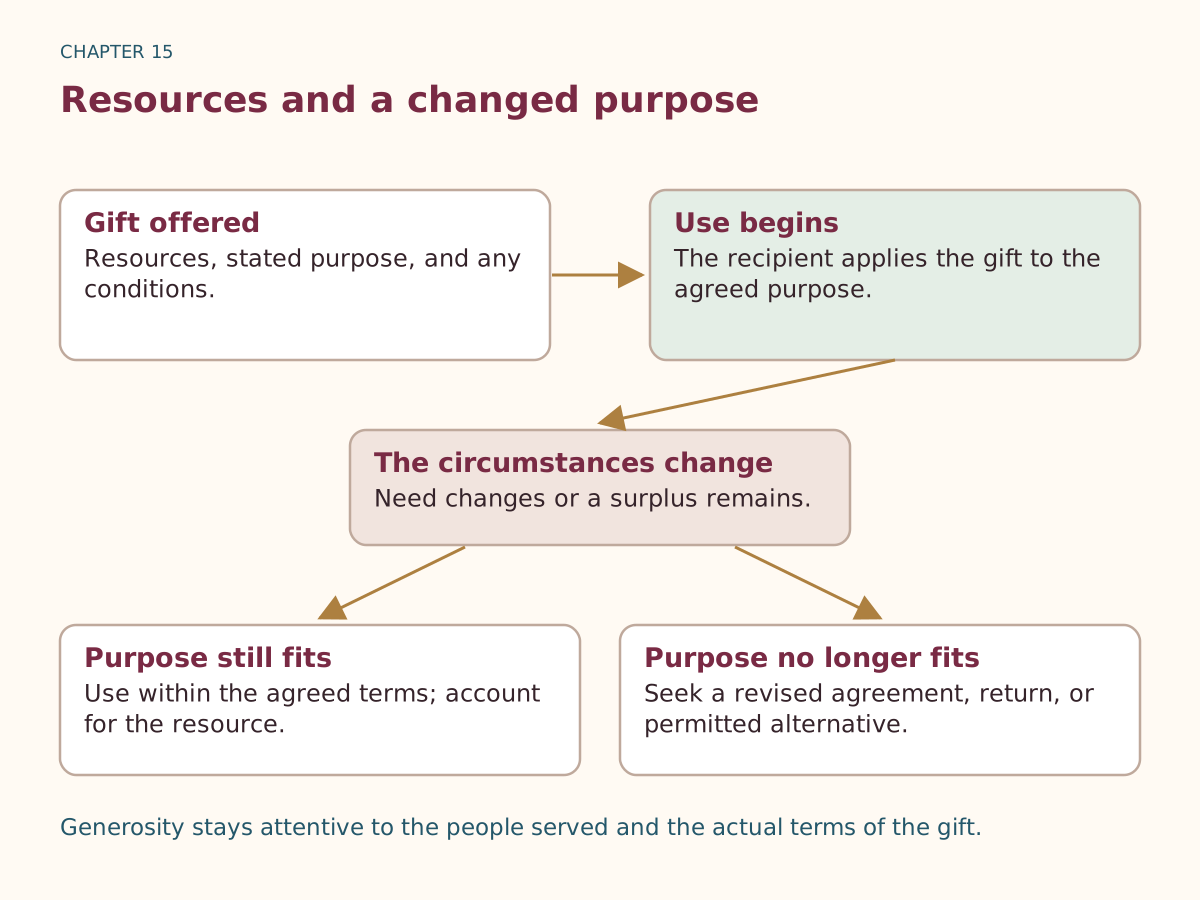
The revised account says what was delivered, what will not occur, and which costs were already committed. It distinguishes materials already used, unopened books, and money not yet spent. The organizer checks the agreements attached to the remaining resources and gives each affected contributor the relevant update. A proposal for a changed use stays a proposal until the required agreement is reached. If no suitable agreement is possible, the group must resolve the unused resources consistently with its commitments and applicable obligations. The ethical sequence is clear: disclose the change, account for what remains, and settle its next use honestly.
Celia is disappointed. She had hoped the full series would continue and initially asks the instructors to add the missing session elsewhere. They explain that their availability does not permit it. Her wish is understandable, and the condition cannot be fulfilled. She chooses to support keeping the unopened books for the next announced series, with a further update when that use becomes definite. If she had declined the proposal, the organizers would still owe her a clear response within their agreement. Good intentions do not make a changed purpose self-authorizing.
At the remaining workshop, participants use the practice copies the instructors originally recommended. The smaller reference collection is sufficient for the planned exercise. The gift has served a real act of learning, and the canceled session remains a real loss. Both belong in the account Celia receives. Generosity gains integrity when a contribution can be described truthfully through success, limitation, and change. Its destination stays visible because the people carrying it refuse to make the story smoother than the work.