

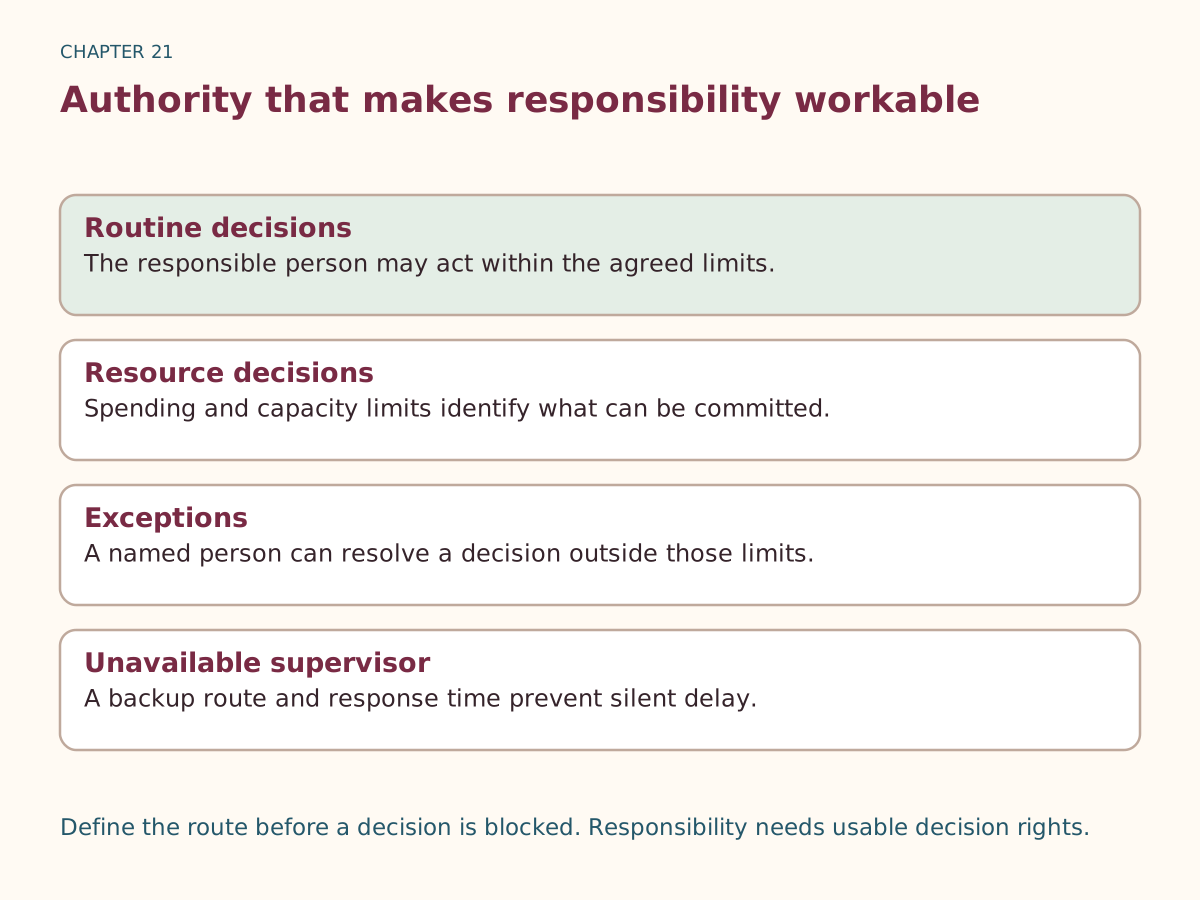
At 8:40 on Friday morning, the reading-room coordinator knows who could cover Saturday's missing shift. The person is willing, trained, and already on the approved volunteer list. The coordinator can see the gap, identify a solution, and send another request. She cannot approve the substitution. The supervisor who can approve it is unavailable until Monday. Meanwhile, the published timetable promises an open room tomorrow.
This is a fictional service with a problem that can be described precisely. The coordinator, Vivian, is responsible for reliable opening hours but lacks authority over an ordinary decision required to maintain them. Chapter 3 examined the continuing work of remembering after delegation. Here the question is different: which decisions may Vivian make, which resources make those decisions usable, and what happens when a decision reserved for someone else cannot arrive in time?
The organization will not solve the problem by praising Vivian's initiative. It needs an arrangement that can function while the supervisor is away. Nor will it solve the problem by giving her unrestricted authority. Some choices affect commitments she is not equipped or authorized to change. A useful division of authority must reach the level of actual decisions, including the exceptions that put an otherwise reasonable arrangement under pressure.
First Peter describes gifts as entrusted for service to one another. 1 Peter 4:10–11 A practical application of that stewardship is to take the conditions of an assignment seriously. A willing person needs a role that can be carried. Spiritual encouragement can strengthen that person while the organization supplies decisions, resources, and dependable support appropriate to the work. One kind of support does not substitute for the other.
Four decisions on an ordinary Friday
The substitute is the first decision. Under the existing arrangement, Vivian must ask her supervisor even when both volunteers are already approved and the opening hours will remain unchanged. The supervisor had kept this rule during the room's first month, when Vivian was learning the role. Six months later, nobody has reconsidered it. A temporary protection has become a permanent bottleneck because the decision about it was never revisited.
At 10:15, Vivian discovers that the room needs replacement paper and ordinary labels. The expense is small and falls within the monthly supply allowance, but the only account holder is the absent supervisor. Vivian has previously paid herself and waited to be repaid. She is not willing to continue doing that. The organization has nominally provided a budget while leaving access to it dependent on her personal money. The missing resource is a workable payment route.
At 11:10, a volunteer asks whether the reading room can host a new evening discussion group. That request is different. It would add public hours, require staffing, and create expectations beyond the present service. Vivian can collect the proposal and explain the review process. She should not approve it merely because the person asking is enthusiastic or because she now wants greater freedom to act. Her request for routine authority must preserve the distinction between carrying an existing commitment and creating a new one.
At 2:30, the proposed substitute withdraws. Vivian can no longer meet the room's agreed staffing arrangement for Saturday. She needs a decision about reduced hours or closure, and the time for informing visitors is running out. This fourth question shows why a role description limited to ordinary approvals is incomplete. The organization also needs a planned response when an essential condition of service cannot be met and the usual decision maker is absent.
These four situations call for different answers. Treating all of them as matters of initiative gives too little guidance. Treating all of them as requests for supervisor approval makes the service dependent on one person's continuous availability. Vivian brings the four examples to the governing committee after the immediate Saturday problem has been addressed through the service's existing responsible contacts. The examples allow the committee to redesign the decision arrangement without debating her personality.
A division that can be used
The committee places decisions into three practical groups. Vivian may act within defined limits and record the action afterward. She must consult an identified person before taking some actions. Other decisions remain reserved for the committee or supervisor. The groups are useful only because each receives examples drawn from the room's actual work. A heading such as routine discretion cannot settle whether a new public event is routine.
An exchange between two current approved volunteers becomes Vivian's decision when the agreed preparation and staffing conditions remain satisfied. She records the change in the shared schedule and informs those affected. Adding a new volunteer to the approved list remains a separate process. The distinction allows her to maintain the present service without deciding who is qualified to join it. She can act promptly while preserving a meaningful boundary.
Ordinary supplies become another delegated decision. In this fictional agreement, Vivian may approve an individual purchase up to seventy-five dollars within an approved monthly allowance of one hundred eighty dollars. New equipment, recurring subscriptions, and commitments beyond the month remain reserved. These numbers illustrate the form of an agreement; they are not recommended amounts for other organizations. The important feature is that both the single purchase and the total available amount are visible.
A spending limit must be interpreted as a real limit. Vivian cannot divide a larger purchase into smaller orders to make each appear permissible. Nor can several people spend independently from the same allowance while assuming the whole amount remains available to each. The committee provides a shared balance and a simple record of commitments already made. Authority becomes usable when the person acting can see what remains, including expenses approved but not yet paid.
The proposed discussion group remains a reserved decision because it changes the room's public commitment. Vivian can explain what information the committee needs and when it will consider the request. She can also decline to advertise dates before approval. This is an active part of her role. Carrying a proposal accurately to the right decision maker is useful work, even when the power to approve it belongs elsewhere.
For an unresolved staffing shortfall, the committee defines a specific response. Vivian first contacts the named deputy by the stated notification deadline. The deputy may approve a listed alternative within the service's existing arrangements. If no authorized alternative is available, Vivian follows the agreed closure procedure and communicates through the designated channels. The policy is established before the next difficult Friday. Silence is no longer something she must interpret according to whichever choice feels least likely to be criticized later.
The organization does not treat this policy as a substitute for judgment in every circumstance. An unfamiliar or urgent issue may require a different responsible contact. The written agreement identifies those routes without pretending that the coordinator can resolve every eventuality. Its purpose is to answer recurring decisions clearly and to show how exceptional decisions reach someone able to carry them.
The resources behind permission
The supply authority immediately exposes a practical gap. Vivian still cannot use the approved account. A committee member initially suggests that she continue paying and submit receipts because the amounts are small. Vivian explains that reimbursement is not the same as access to an organizational resource. The committee arranges a purchase process she can actually use. The agreement is incomplete until an ordinary purchase can move from need to payment without relying on her private funds.
Communication access receives the same examination. Vivian is expected to update the public opening notice, yet the supervisor controls the page and the notice template contains an old contact address. The committee gives Vivian appropriate access to the part she maintains and confirms a backup. She rehearses a routine change in the agreed setting, including the point at which the update becomes visible to visitors. The exercise discovers the outdated address before it is needed during a closure.
Time is another condition of authority. A new record of spending, substitutions, and exceptions will take attention. The committee chooses a short shared record that answers its actual oversight questions. It also removes a duplicate weekly report that had repeated the same information in another format. Giving Vivian more decisions while adding reporting to an already full assignment would move the bottleneck into her working hours. The redesign must account for the whole task.
Advice should remain available without quietly becoming another required approval. Vivian may consult an experienced volunteer about a difficult scheduling conversation while still holding the routine decision. If the adviser believes the matter falls outside her authority, that concern should be stated explicitly. Otherwise, every consultation can become a new place where action waits. Support works best when people know whether they are offering information, sharing judgment, or holding the decision itself.
The supervisor also has a responsibility to maintain the promised response route. If neither she nor the deputy will be available, she names another suitable arrangement or narrows what the service will offer during that period. An absence should be planned at the point where the authority resides. It should not become a puzzle passed to the coordinator on the afternoon when visitors need an answer.
The first mistake under the new agreement
Three weeks later, Vivian approves a sixty-dollar supply order. Eighty dollars has already been paid that month, and fifty more has been committed but has not yet been paid. Only fifty dollars remains available within the one-hundred-eighty-dollar allowance. Vivian checks that the new order is below her seventy-five-dollar individual limit and overlooks the pending commitment. The combined total reaches one hundred ninety dollars. The mistake is hers to report. The committee must then decide what the ten-dollar excess actually reveals.
One member wants to restore supervisor approval for every purchase. That would prevent Vivian from repeating this particular error, but it would also recreate the absence problem. Another member wants to overlook the expense because the excess is modest. That would leave the meaning of the limit unclear. The committee instead examines the cause, the immediate consequence, and the control that would address it at an appropriate scale.
The record shows that committed spending appears on a separate tab from completed spending. Vivian had read the visible balance as the amount still available. She acknowledges that she should have checked the full commitment record. The committee arranges an authorized response to the excess and changes the display so that remaining funds include commitments already made. It also asks Vivian to confirm that balance before the next several purchases. The correction is connected to the failure, not to a general conclusion that she cannot exercise judgment.
Suppose the same limit were repeatedly ignored after it had been clarified. That would raise a different question about whether the authority remained appropriate. Suppose the record were impossible to access. That would direct attention to a different condition. Accountability requires distinguishing misunderstanding, missing information, unsuitable process, and disregard of an understood limit. They may appear in the same episode, but they should not receive an automatic identical response.
The way the committee handles this mistake affects the credibility of its original delegation. Vivian needs to know that an honest report will be examined fairly. The committee needs accurate information about how the authority is used. If the only acceptable report is one without errors, oversight becomes less reliable. A clear response to a specific mistake can strengthen both responsibility and trust.
When the supervisor wants a different answer
Authority faces another test when a choice is permitted but not preferred. Vivian approves a schedule exchange that the supervisor would have arranged differently. The staffing conditions are met, both volunteers agree, and the public hours remain unchanged. The supervisor is tempted to reverse it because she knows another arrangement she finds neater. Reversal would communicate that Vivian's authority exists only when her judgment matches an unspoken preference.
The supervisor allows the exchange to stand. She explains her concern about a pattern that might matter in later scheduling and asks Vivian to consider it next time. If that concern should become a genuine rule, they will discuss and record it prospectively. Vivian receives useful judgment without having a legitimate decision retrospectively treated as unauthorized. This is one way a person who delegates can remain involved without reclaiming every choice.
Vivian, in turn, should not use the written agreement to dismiss every question. Authority permits action; it does not make the action immune from examination. She can explain her reasons, hear the volunteers affected, and recognize when repeated exceptions suggest the arrangement needs revision. The record helps the committee ask such questions from shared facts instead of relying on who remembers the strongest anecdote.
The next difficult Friday is still difficult. A volunteer withdraws, a question arrives late, and the supervisor is away. This time Vivian can approve an ordinary replacement, obtain routine supplies, and identify the request that must wait for a reserved decision. If the staffing condition fails, she knows the agreed response. The service has not become independent of human judgment. It has given that judgment places where it can be exercised, supported, and examined.
Your role may require a similar conversation. Bring the decisions that repeatedly stop the work, the resources those decisions need, and the consequence of an answer arriving too late. Ask for a division of authority that can survive an ordinary absence and a specific mistake. Responsibility becomes more honest when the person carrying it can act within known limits and can reach someone dependable when those limits are reached.