
Several interpretations around one table
In this fictional scene, a small group is discussing the relationship between everyday work and spiritual gifts. One member describes becoming frustrated when a volunteer association leaves decisions unclear. She wants the group to know what has been agreed, who carries the next action, and when the decision will be reviewed. A friend suggests administration. Another hears leadership. A third wonders whether the concern reflects a form of spiritual discernment. The suggestions are offered warmly, yet they remain interpretations of a brief account.
The member feels a pull toward certainty. Each description would give a name to something she has found difficult to explain. The group's facilitator asks a slower question: “What have people actually received when you act on this concern?” The conversation shifts toward specific service. The member recalls a decision note that helped colleagues proceed and an occasion when her repeated questions made a meeting feel crowded. Both experiences belong in the inquiry.
Discernment benefits from a setting in which competing interpretations can be considered without becoming competing verdicts about a person. The group can appreciate her desire to serve while acknowledging what it does not know. It can distinguish an observed capacity from a possible gift interpretation and identify a modest opportunity through which further understanding may develop. The immediate aim is a faithful response to the situation before her.
Scripture, prayer, service, and the judgment of a mature community can provide a context for that response. These are related practices, each with a distinct contribution. They should not be treated as a machine that produces certainty on demand. A person may undertake them seriously and still need to say that the best description remains unclear. There is room to continue serving responsibly within that uncertainty.
Scripture gives the inquiry its setting
Begin by attending to the passages in their own context. Romans places differing gifts within humble participation in a shared body. First Corinthians relates gifts to the common good and mutual dependence. Romans 12:3–8 1 Corinthians 12:4–31 These themes establish a larger horizon than the discovery of a personally satisfying label. Ask how a proposed interpretation affects your participation with others and whether it directs attention toward their good.
Read the passages beyond the term that first attracts you. If leadership catches your attention, continue into the surrounding account of differing contributions. If a reference to prophecy interests you, include the passages concerned with strengthening others and communal weighing. 1 Corinthians 14:1–5, 29–33 A single word separated from its context gives too little guidance for a claim that may influence how you relate to other people.
The group recognizes that its use of the word discernment needs care. First Corinthians includes discerning spirits among its diverse spiritual gifts. 1 Corinthians 12:4–31 The member's observation that a decision lacks an owner is an ordinary, assessable claim about the meeting. Its accuracy would not by itself establish that particular gift. The group can examine the practical observation and continue the theological discussion with their different questions clearly identified. Suspicion about someone's motives likewise cannot settle a claim to discerning spirits.
Where Christians differ in their understanding of particular gifts, name the difference respectfully and consult mature people within the relevant church community. This book welcomes consideration of prophetic gifts with biblical testing and accountability. First Thessalonians calls for openness to spiritual activity together with examination and the retention of what is good. 1 Thessalonians 5:19–22 A welcoming posture can therefore include careful questions, patient evaluation, and a willingness to withhold a conclusion.
Prayer with an open question
Prayer gives your desire for clarity a place before God. You can ask for wisdom about the people you hope to serve, humility about your motives, and willingness to receive correction. You can name a hope about a particular contribution and ask what should develop. A sincere question can remain open while you continue attending to the people and responsibilities before you.
The group member realizes that she wants a label partly because she is tired of feeling difficult. She hopes a gift description will explain why unresolved decisions trouble her so much. That longing deserves compassion. She also needs to consider whether particular questions have been accurate, timely, and considerate. Prayer can hold the longing to be understood together with the willingness to change her manner.
Disappointment may belong in this prayer too. A role may be unavailable. Feedback may challenge your preferred description. Service may require learning you hoped to have finished. Tell the truth about the desire before deciding what the disappointment means. The difficulty can become part of the inquiry without being made into an automatic sign of either divine rejection or divine endorsement.
When sharing a prayerful impression, describe what you believe you have received and welcome examination. First Corinthians calls for weighing prophetic speech; First Thessalonians holds openness and testing together. 1 Corinthians 14:1–5, 29–33 1 Thessalonians 5:19–22 Ordinary factual claims within an impression still need the relevant evidence. Sincerity and agreement among friends cannot establish them. Chapter 18 gives fuller attention to testing a specific spiritual claim and its implications for action.
Service that supplies something to consider
An actual act of service gives the inquiry a concrete setting. The member asks the association coordinator whether she can prepare decision records for the next three meetings. They agree that the notes will distinguish settled decisions from open questions, identify the next responsible person, and circulate for correction before being used. The contribution answers a real need within an existing responsibility.
She makes the first record too detailed. A colleague cannot find the decision among the discussion notes. The member initially explains why every detail matters. Then she tries reading the document as someone who needs to act. She moves the agreed decisions to the beginning and gives the background a separate place. Her second record becomes easier to use.
This experience supplies several observations. She can summarize accurately, cares about context, and can revise when she sees a recipient's difficulty. It also reveals a tendency to defend the effort already invested. The inquiry has become richer than the original account of frustration. It now includes work, response, correction, and a second attempt.
Choose a contribution small enough to examine without making every difficulty a verdict on your identity. An existing duty may offer a suitable place; a new activity may require agreement from those responsible. The exercise serves people while supplying material for discernment. It does not produce a spiritual score, and people should not have to carry an unnecessary project merely to satisfy your wish for an answer.
Skills, desires, and responsibilities
Several kinds of information belong in the conversation, and they answer different questions. A skill describes something you can do with a particular degree of competence. A preference describes what you enjoy or readily choose. A responsibility describes what you have agreed or are authorized to carry. A possible spiritual gift interpretation considers the contribution within a Christian understanding of grace and service. These distinctions help you avoid asking one observation to establish more than it can.
You may enjoy teaching before you have learned to explain a subject clearly. You may be competent at organizing work while feeling unwilling to accept another organizing role in the present season. You may have an ordinary responsibility to give accurate information regardless of whether you identify with a particular gift. Each situation invites a different response. Training, boundary setting, and faithful performance of a duty all have a place.
The member enjoys producing the decision notes and discovers that her first version is too detailed. The coordinator asks for a shorter format. Her response to that request is relevant. Does she listen to the person who needs to use the record? Can she preserve essential information while changing her preferred style? The usefulness of the contribution depends partly on whether she can adapt it to its intended recipients.
Avoid making ease the sole indicator of fit. An unfamiliar task may require effort that becomes more manageable with practice. A familiar task may feel easy while offering little benefit in the present setting. Look at the purpose, the available competence, the actual response, and the cost of continuing. The inquiry is richer when these considerations are held together without becoming a rigid formula.
What confirmation can responsibly mean
Community confirmation is most useful when people explain what they have observed. “You have a gift” may encourage while leaving its basis unclear. A recipient who describes how your explanation clarified a decision supplies a more particular account. A mature Christian leader can help consider its theological significance. A friend can identify a pattern across your life. These perspectives contribute different kinds of knowledge.
The group member brings a mixed response from those using her notes. Two people found the next responsible person easier to identify. Another says the separation between settled decisions and open questions has improved. A fourth wants fewer notes because the meetings themselves need to become clearer. Their comments can coexist. The notes may be useful without resolving the deeper decision problem.
Seek comments from people who have encountered the service, including those whose experience differs from yours. Ask what helped, what hindered, and what changed over time. A recipient does not need to choose a spiritual label in order to give valuable evidence. Keep practical observation available even where theological interpretations differ.
The freedom of the person responding matters. Someone who depends on your approval may find it difficult to challenge your preferred description. Avoid asking that person for a sweeping endorsement. Give them room to report a particular experience, decline the conversation, or use an appropriate independent route. Confirmation gains credibility when disagreement remains possible.
You can receive encouragement without demanding unanimity. One member of the small group sees administration; another thinks the strongest evidence concerns patient teaching. Both can explain their reasons. Their disagreement invites a more exact reading of the experience and the relevant passages. It does not require either person to withdraw the appreciation that the actual contribution deserves.
An inquiry that remains accountable
Love belongs within discernment. First Corinthians makes it central to the meaningful exercise of gifts. 1 Corinthians 13:1–7 The people helping you consider an interpretation should be able to remain companions when they ask unwelcome questions. A description that requires them to suppress what they observe is being protected at their expense.
Keep the responsibilities of the setting intact. A possible gift of leadership still needs an appropriate role in which direction can be given. Teaching needs truthful material. A prophetic claim belongs within communal weighing. 1 Corinthians 14:1–5, 29–33 Conviction can motivate participation; it does not settle every permission, factual question, or consequence attached to a proposed action.
At work, colleagues may not share your faith or wish to discuss it. Explain a proposal through its purpose, evidence, and responsibilities. The member therefore introduces her revised notes by describing how they can help the association act. Her small group considers their spiritual meaning. Each conversation remains honest about the question it is equipped to address.
Three statements with different weight
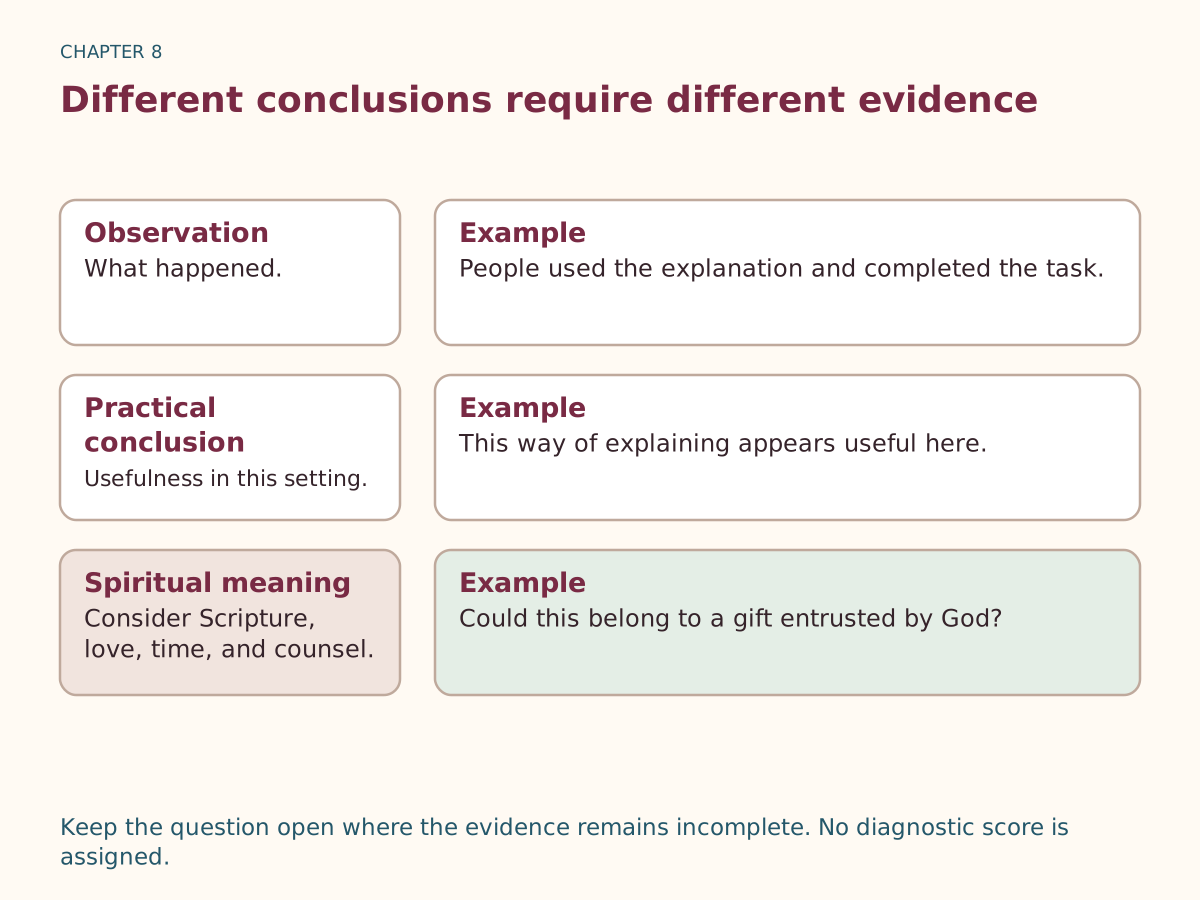
At the end of three meetings, the member writes three separate statements. First, the notes identified agreed actions and recipients reported particular improvements. This is an account of what happened. Second, she appears able to offer useful administrative help in this setting, provided she keeps the record concise. This is a practical conclusion supported by the experience. Third, administration may be a fitting spiritual description to explore with her church. This remains a theological interpretation.
The first statement does not contain all the evidence needed for the third. Keeping them separate makes it easier to act with confidence where confidence is warranted. She can accept another limited period of useful service while continuing the spiritual inquiry. She can also revise the practical arrangement if the association changes its process.
The group sets aside its earlier suggestion that noticing an unassigned action establishes discerning of spirits. That observation concerns an ordinary feature of a meeting. They remain open to a fuller theological conversation about the named gift on its own terms. Setting aside a weak inference leaves the useful observation intact.
A conclusion with its reasons
The group does not reach a unanimous label. It does agree that the member has made a useful contribution and shown a capacity to receive correction. She leaves with a clearer account of what she can offer and why the description of giftedness remains open. The inquiry has produced a responsible next action without pretending to have produced a complete identity.
Your own conclusion can name what is established, what remains plausible, and what should be set aside. Include the reasons. This allows a later experience to change the conclusion without erasing everything you previously learned. A role can become unsuitable while an underlying capacity remains useful elsewhere. A new observation can strengthen an interpretation; a concern about manner can require repair regardless of the label.
First Peter places the use of entrusted gifts in service to others and dependence on the strength God supplies. 1 Peter 4:10–11 That orientation can guide the next act while the inquiry develops. Pray, read, serve, and seek counsel with attention to their actual contributions. You are seeking a truthful understanding that helps you participate faithfully with others. The life of service continues while that understanding grows.