
A decision can be clear before its outcome is knowable. The purpose may be settled, the person responsible identified, and the available options understood. Yet one option depends on help that is not confirmed; another relies on an assumption about what participants can manage. Waiting could improve the information or merely consume the time needed to act. Wisdom serves this uncertain interval by asking what the choice depends on and which commitment the present knowledge can support.
This chapter follows a fictional committee deciding how to offer an adult learning program. The available budget and room can support six weekday evenings or two longer Saturday workshops. The evenings would allow practice between meetings. Saturdays would require fewer journeys. Registration opens in ten days. Tessa has been asked to prepare the recommendation. She initially favors Saturdays because several interested people have described difficulty arranging transport.
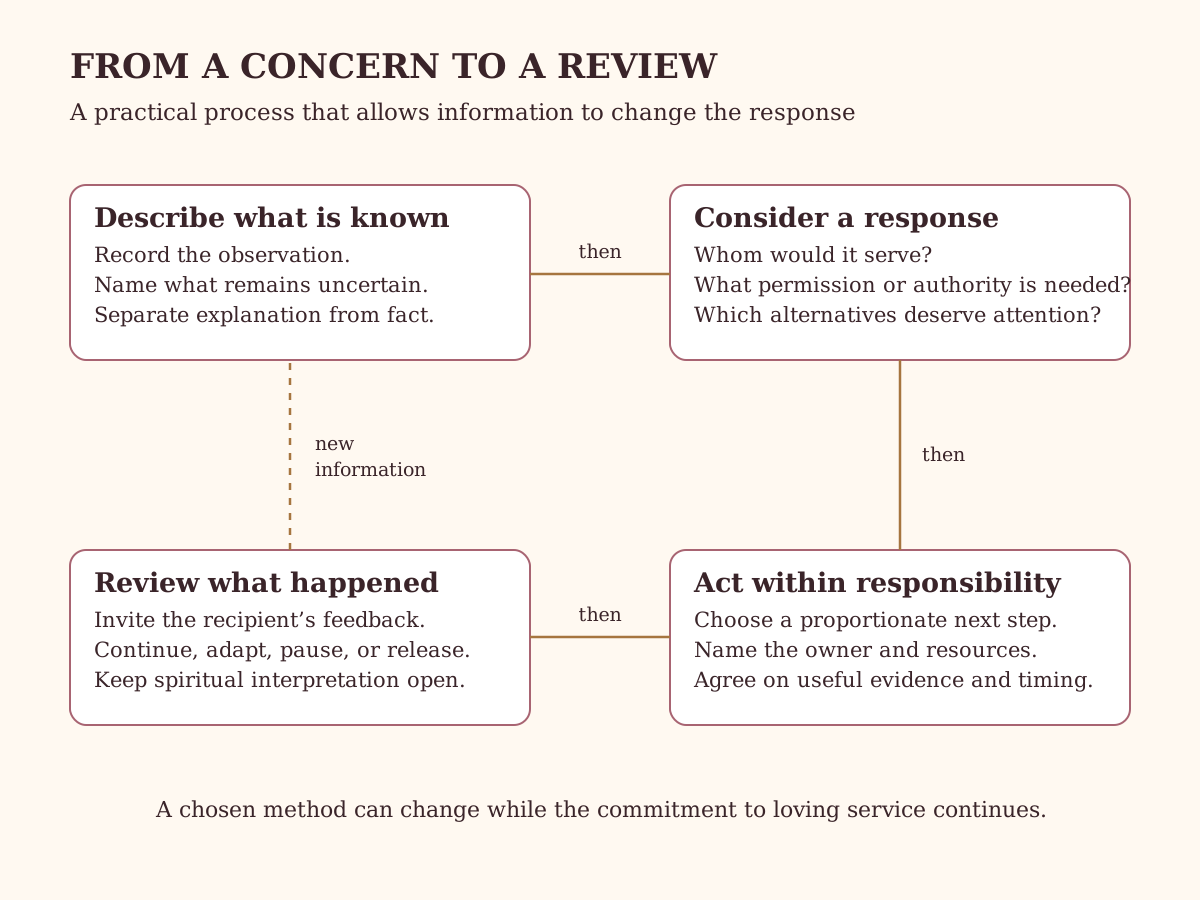
Chapter 9 examined how direction turns a discussion into an actionable choice. The question here is the quality of the judgment beneath that choice. Tessa needs to know which assumption could overturn her recommendation, what would be worth finding out before deciding, and how much should be committed while an essential answer remains open. She will also need a fair way to learn from the result without pretending that she could have known it in advance.
First Corinthians names a message of wisdom among the manifestations of the Spirit and places these contributions within service for the common good. 1 Corinthians 12:4–31 That setting gives wisdom a communal destination. The practical reasoning developed here is an application to a particular decision, not a test that identifies the spiritual gift. Chapter 8 provides the broader approach to discerning gifts. Here the work is to help a community use its knowledge honestly when it must act before every uncertainty is resolved.
Find the assumption carrying the choice
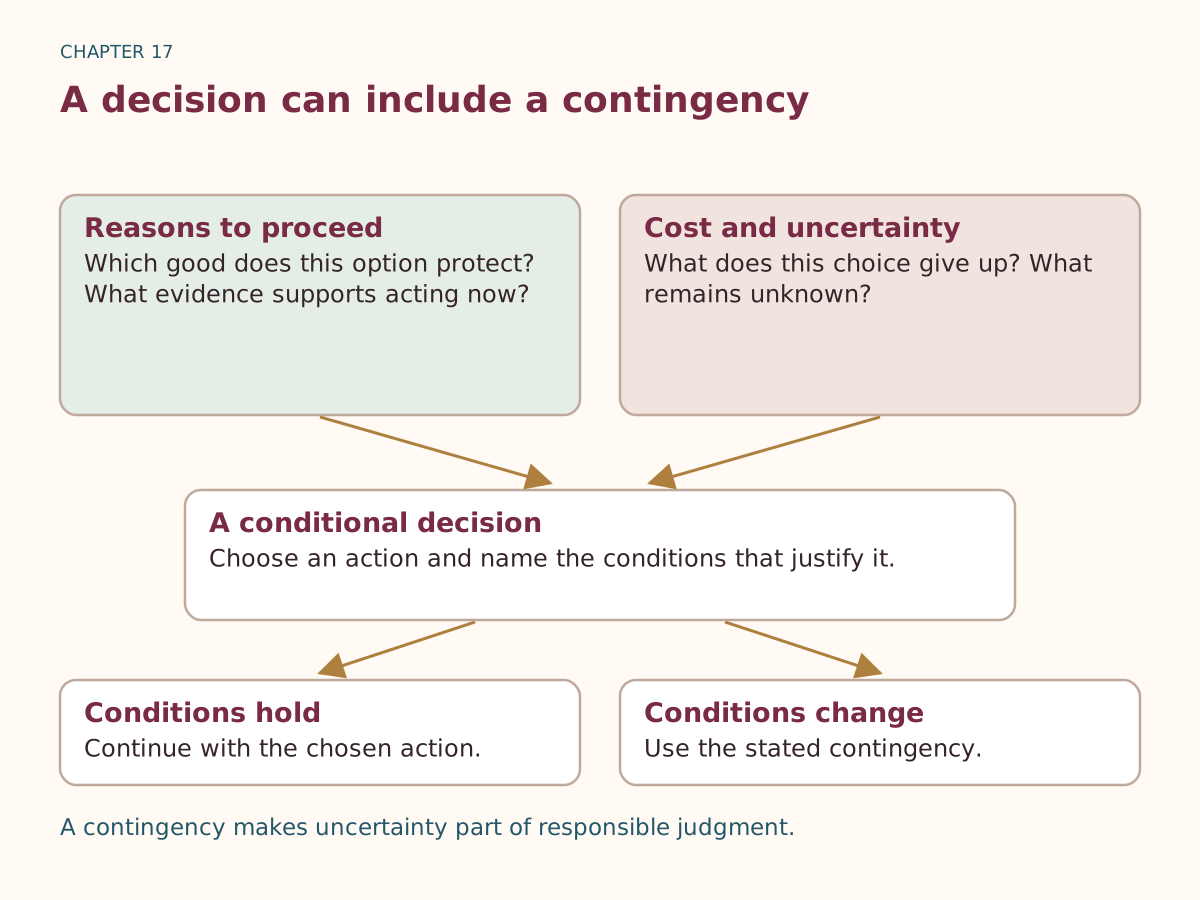
The committee has already settled its purpose, budget, and decision process. Reopening those questions would make this meeting broader without making the immediate uncertainty clearer. Tessa writes the two feasible formats beside the conditions each requires. She distinguishes a preference for a format from a condition without which that format could not responsibly be offered. A shorter journey is a benefit. Enough teaching help to support the promised exercises is an essential dependency.
The Saturday plan depends on two teaching volunteers remaining for the necessary practice sessions. Both have expressed willingness to help, but nobody has confirmed the actual hours. One expects to teach an introductory portion. The other has another commitment later in the day. The evening plan has a different weakness: participants would need to return repeatedly, and the team has heard directly from only a few about whether that is practical. These unknowns cannot be settled by expressing general confidence in the program.
Tessa asks the teacher to walk through the proposed Saturday curriculum. The teacher can support a smaller set of tasks in the available hours, provided a second person assists with practice. This answer changes the recommendation's shape. Saturday remains possible, but only with a narrower advertised purpose and confirmed help. The committee is now considering the option it could actually deliver, not a full curriculum imagined inside an attractive timetable.
An assumption becomes easier to examine when its consequence is stated. If the second volunteer is unavailable, the Saturday plan cannot meet its present teaching commitment. If fewer people prefer Saturday than Tessa expects, the plan could still run but might serve fewer participants. The first uncertainty can defeat the option. The second affects its likely usefulness. They both matter, but they do not call for the same action before registration.
The teacher also identifies a limit that neither format removes: some learners may need more practice than this program can provide. The committee includes a truthful description of the program's scope. It cannot make the uncertainty disappear by promising that one schedule will suit everyone. Its obligation is to offer a coherent opportunity and understand the most consequential ways that opportunity could fall short.
Ask which inquiry could change the answer
Tessa has time for several calls, not a comprehensive study of neighborhood preferences. She first asks what an answer would change. Confirming the second teaching volunteer could establish whether Saturday is feasible at all. Contacting people who previously requested weekday access could expose a serious obstacle in the recommendation. Asking more people whether the idea sounds appealing would supply less useful information unless their answer also clarified whether they could participate.
Her initial preference information has a narrow origin. Most of it comes from people who attended an earlier Saturday event. Their accounts are relevant to their own circumstances, but they say little about people who could not attend that event. Tessa does not discard what she heard. She directs the next inquiry toward the missing experience most capable of changing her recommendation. The point is to improve the comparison at the place where its evidence is weakest.
A call reveals that one interested person can attend neither Saturday date. That loss deserves acknowledgment, but it does not by itself settle the whole program. Tessa asks whether this represents a broader access condition the committee has overlooked or one limit it will need to accept in this offering. She has no basis for declaring either answer certain. The account she brings back preserves the specific need and the question still open.
She also tests how firmly her preference depends on the number attending. Suppose the workshops attract a small group while the evenings would have attracted several more. Would Saturday still be defensible because it provides access for people unable to make repeated journeys? Suppose the reverse occurs. Would a fuller room compensate for a format that cannot support the promised learning? These questions expose the judgment beneath her preference. They do not require invented attendance probabilities.
Tessa tries a scoring sheet and gives points to access, continuity, preparation, and cost. Saturday wins by two. When a colleague asks why access received one weight and learning another, she cannot appeal to the total as an answer. The number has compressed judgments that still need reasons. She keeps the considerations and explains their relative importance in words. A comparison should make the basis of judgment easier to examine, not allow an unexplained calculation to stand in for it.
Further inquiry also has a cost. Waiting another week could leave insufficient time to prepare the selected format and communicate it accurately. Tessa therefore identifies the questions that can be answered before Thursday and the uncertainties the group must carry into action. A reasonable stopping point for inquiry comes when the remaining available information is unlikely to change the present choice enough to justify the delay. That is a judgment to explain, not a claim that no more could ever be learned.
Commit in stages that preserve a responsible alternative
The program lead chooses Saturday if the necessary teaching help is confirmed by Thursday afternoon. If that condition fails, the team will use the evening format. Both sets of room dates have been checked, and the teaching plan for the alternative remains available. This is a usable contingency because the second course can actually be taken. Calling an unprepared or unavailable option a backup would leave the group with reassuring language and no way to respond.
The team separates the work it can begin now from the promises that should wait. Common teaching material can be drafted. The invitation can be prepared with the format and dates still open. Publishing unconfirmed dates would create a different kind of commitment: participants could arrange journeys, work hours, or care responsibilities around them. Reversal would then cost more than correcting a file. The effect on other people's plans belongs in the timing of the announcement.
Tessa asks the printing volunteer to show which decisions are needed at each stage. The common pages can be prepared immediately. The final schedule can wait two days without losing the production slot. After that point, a change would require a different delivery arrangement. This sequence gives the committee a concrete answer to the question of how long it can preserve both options. Flexibility has a deadline because the work itself has dependencies.
A condition should not remain open indefinitely through hopeful language. On Thursday, the second volunteer confirms the required hours. The program lead records that the condition has been met, approves the revised invitation, and allows registration to open. If the answer had not arrived, the evening alternative would have proceeded under the agreed decision. The group does not need a new debate every time the stated condition reaches its deadline.
Some uncertainty remains after the commitment. The teacher is still unsure whether participants will find the first practice sequence too demanding. The team can place a pause before the final exercise and prepare a shorter version. This response differs from the earlier staffing question. It concerns an adjustment the teachers can make during the workshop without changing the whole public offering. Planning at the scale of the consequence keeps a manageable uncertainty from becoming a reason to postpone everything.
The member who prefers evenings accepts the decision while retaining a concern about continuity of practice. Tessa preserves that reason in the record and asks what observation during the workshops would help the committee examine it. The answer is specific: whether participants can return to the task after an interval and whether they ask for further guided practice. Dissent now contributes a question the experience can illuminate. Its existence does not require the group to repeat the decision before the work begins.
Learn from the result without rewriting what you knew
The first workshop attracts fewer participants than hoped. One person leaves early because the session is tiring. Several complete the exercise; another asks for more time with a teacher. Tessa feels the pull of a simple verdict: perhaps choosing Saturday was a mistake. A committee member reaches the opposite verdict because several participants say the session helped them. Both accounts move too quickly from an observed result to a judgment about the whole decision.
The group knows what happened under the format it offered. It does not know how the same people would have responded to six evenings. A claim that the alternative would certainly have been better needs information this experience does not provide. The committee can still learn. It can examine which assumptions were supported, which were weakened, and which new questions the workshop revealed. Comparison with an unobserved alternative should remain a reasoned possibility, not a result the group pretends to have measured.
One error is clear. The team placed too many activities before the break after the teacher had already raised that concern. The information needed to make a better choice was available and was not given sufficient weight. Tessa acknowledges this directly. The group changes the sequence for the second workshop. Admitting a specific error supplies a more useful lesson than declaring that either the whole plan was wrong or every difficulty was unavoidable.
The request for more guided practice addresses a larger question. It supports the concern that the shorter format leaves less space for returning to the task over time. The team can offer only the follow-up already within its capacity. It records the remaining need as an important consideration for a future program. A later decision may favor evenings on that basis. Such a change would reflect what the group has learned, not proof that its earlier uncertainty was dishonest.
Paul's account of love includes patience and freedom from self-seeking. 1 Corinthians 13:1–7 Applied to this review, that teaching asks Tessa to care more about learning from the workshop than about preserving her reputation for good judgment. It also asks the person who preferred evenings to contribute what he sees without enjoying her discomfort. A useful review makes accurate information easier to offer, including information that unsettles the person who proposed the choice.
Decision quality and outcome belong in the same account without becoming interchangeable. A well-considered decision can encounter a difficulty the available information did not reasonably reveal. A poorly considered decision can produce a welcome result. The review should therefore ask both what happened and how the choice was made. Otherwise, a fortunate result can teach confidence in a weak process, while a disappointing result can discourage judgment that was responsible under the circumstances.
Tessa preserves a short record of the choice: the conditions checked, the uncertainty carried, the reason for stopping inquiry, the commitments made in stages, and what experience changed. This gives the next committee a starting point more useful than the memory that Saturday succeeded or failed. They can identify what now deserves a different question and which part of the earlier reasoning remains sound.
Your own contribution of wisdom may take this practical form. Find the assumption carrying the choice. Seek the information that could materially alter it. Match commitment to the knowledge available and the cost of changing course. Afterward, let the result teach you without pretending that uncertainty was absent when you decided. A community can act with conviction and still preserve an honest account of what it knew, what it hoped, and what it learned.