
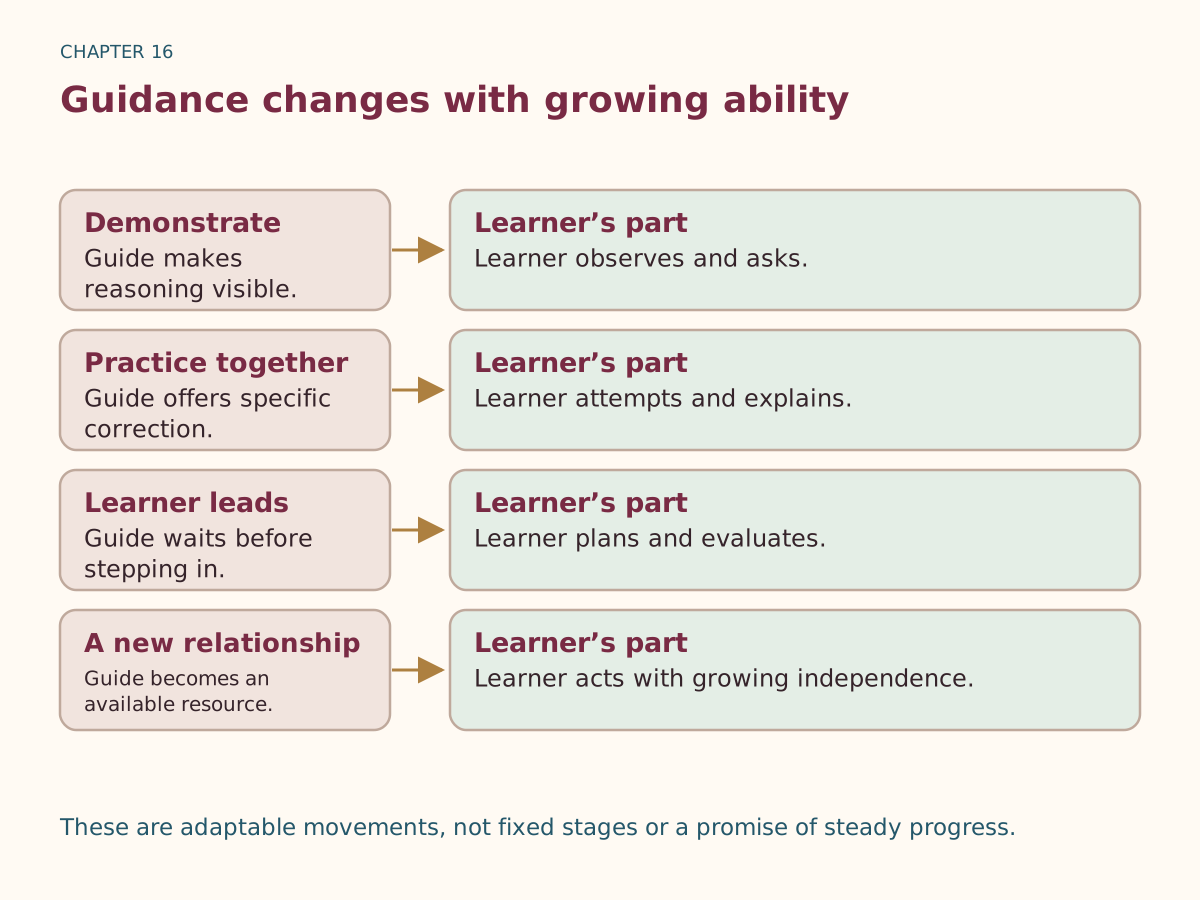
Continuing guidance has a changing task. A newcomer first needs orientation, then an opportunity to exercise judgment, then increasing room to carry the work. The experienced person must notice these transitions and adjust the help accordingly. The relationship becomes fruitful through attention over time, including the willingness to speak less as another person's contribution grows.
Consider this fictional neighborhood reading circle hosted by a congregation and open to interested adults. An experienced volunteer, Miriam, agrees to accompany a newcomer named Leah as she learns to help coordinate the gatherings. Leah is comfortable discussing books and uncertain about managing the practical responsibilities around a meeting. Miriam offers to meet briefly before and after the first few sessions. She explains what she can help with and asks whether that arrangement would be useful. Leah accepts, and they agree to review it after several gatherings.
Equipping across a changing relationship
Ephesians names pastors and teachers among ministries associated with equipping the saints and describes growth through the contribution of the body's parts. Ephesians 4:11–16 The passage concerns the church and particular forms of ministry. The application here is limited: an experienced volunteer can guide another person's participation without occupying a pastoral office or acquiring authority over that person's life. Miriam's work concerns the agreed reading-circle role. The analogy draws attention to growth that enables others to contribute.
That purpose gives the relationship a direction across time. At the beginning, Leah may need orientation. Later, she may need a place to test her judgment, question a custom, or work through a mistake. As she becomes more capable, Miriam's contribution must change. Continuing the original level of intervention could prevent the very participation it was meant to develop. An attentive guide watches for the point when yesterday's help becomes today's interruption.
Miriam also brings assumptions that need examination. She learned the role through close supervision and expects frequent correction to feel reassuring. Leah learned to organize informal groups by making decisions and then reviewing them. Neither account settles what this new relationship needs. Their first agreement is a beginning they can revise as the work reveals its demands. The guide's experience provides material to offer, while the learner's experience supplies knowledge about how that offer is received.
The beginning: making participation intelligible
At the first gathering, Miriam walks through the role with Leah before participants arrive. They review the purpose of the circle, the shape of the session, and the practical decisions Leah may make. Miriam identifies who can answer questions about room arrangements and who should receive a concern about the program. This introduction gives Leah a map of responsibilities. She can see where she belongs and how to ask for help without needing to infer the group's expectations from scattered comments.
Miriam asks what Leah already knows and what she hopes to learn. The question prevents experience from becoming a one-way account in which the newcomer is treated as empty. Leah has organized informal reading groups before, although she has never coordinated a program with several volunteers. Her experience gives them a useful starting point. Miriam can connect familiar responsibilities with the additional coordination involved here. Accompaniment respects the history and judgment a person brings, even when the setting is new to them.
Their early agreement includes a small responsibility Leah can carry: preparing questions and facilitating the opening discussion for one session. They discuss what a successful opening needs to accomplish, and Leah prepares an approach of her own. Miriam offers earlier examples without asking her to reproduce them. A real responsibility contains room for a decision that could have been made differently. If the newcomer may only imitate the experienced volunteer, observation has not yet become participation.
The beginning also calls for ordinary permission to ask basic questions. Leah wonders whether a volunteer can suggest a different book or whether the selection is already fixed. Miriam explains the current arrangement and identifies when proposals for the next series will be discussed. The answer gives Leah information and a place for her judgment to enter later. A caring guide should help newcomers distinguish established commitments from practices they are welcome to question and improve.
The first mistake and the tempting rescue
Leah's first opening question is too broad for the group. Several people speak at once, and a quieter participant loses the opportunity to answer. Miriam feels the familiar impulse to take over. Instead, she waits through a short pause while Leah restates the question and invites one response at a time. The discussion becomes manageable, although the first ten minutes have been awkward. The later review can now examine a decision Leah made and a correction she attempted, not merely an occasion Miriam rescued.
Miriam describes the observable problem and asks what Leah noticed. Leah identifies the competing voices and admits that she was slow to respond. She also explains why she chose an open question: earlier sessions seemed to steer people toward a preferred interpretation. Miriam had not considered that effect. They discuss how a question can remain open while giving the conversation enough shape. The learner's mistake and her legitimate concern can both receive attention. Correction should not require abandoning the judgment that made the attempt worth considering.
At the next meeting, Miriam interrupts twice to refine Leah's wording. Afterward, Leah says the interruptions made it harder to recover her own line of thought. Miriam first explains that she was trying to help. Leah agrees about the intention and repeats the effect. They then distinguish an error that needs immediate correction, such as announcing an unconfirmed cancellation, from an ordinary difference in facilitation style. The first may affect what participants do before they leave; the second can be discussed afterward. Miriam changes when she intervenes, giving their agreement a practical meaning.
This change requires Miriam to tolerate a style different from her own. Leah leaves longer silences and sometimes follows a participant's unexpected question. Miriam prefers a more predictable order. The coordinator confirms that both approaches can serve the circle's purpose. Miriam must now decide whether she is guiding Leah's responsible participation or trying to preserve her own method through another person. The answer will appear in what she allows Leah to carry differently.
Growth also brings additional requests. Leah starts preparing questions, welcoming visitors, and arranging refreshments. She tells Miriam that she wants to continue facilitating and reduce the setup tasks. They prepare a clear account for the coordinator, who redistributes the work. The guidance is useful because it helps Leah speak directly about the role she is developing. Miriam does not need to become the private manager of every request. Her contribution is to strengthen a conversation Leah can increasingly carry herself.
The relationship now contains disagreement without collapse. Miriam thinks one discussion format is too ambitious. Leah chooses to try a shorter version after consulting the facilitator, and the session works well. Miriam acknowledges what she learned. Had the attempt failed, Leah would still have deserved a fair review of the result. A guide serves growth by making room for responsible judgment beyond the guide's own preference, including outcomes that challenge the guide's prediction.
Faith within an accountable relationship
Because the reading circle is hosted by a congregation, prayer and spiritual reflection may be welcomed within the relationship. Miriam asks whether Leah wants that conversation and keeps ordinary role support available on the same terms whatever Leah answers. If they pray together, they can ask for wisdom and faithful service without treating Miriam's preference as God's instruction. A shared faith can deepen the relationship while preserving the distinction between spiritual reflection and the program's actual responsibilities.
The distinction matters during disagreement. Miriam cannot settle a question about Leah's discussion method by suggesting that a faithful volunteer would accept her guidance. She can explain her practical concern, listen to Leah's reason, and use the program's ordinary decision process. Specific spiritual claims receive their fuller treatment in Chapter 18. Here, the central task is to prevent experience, affection, or religious language from making the guide's opinion impossible to question.
Paul places love at the center of gifts, and Galatians describes fruit that includes gentleness and self-control. 1 Corinthians 13:1–7 Galatians 5:22–26 Applied to guidance, these qualities include the restraint needed to hear correction from someone with less experience. Miriam's willingness to change the way she intervenes expresses care more concretely than a general declaration of support. The relationship becomes more dependable when either person can name what is happening within it.
Leah also remains free to seek other counsel. Miriam can identify the coordinator for program questions and welcome relationships with other experienced volunteers. Personal concerns may belong with a trusted friend, pastor, or appropriate professional elsewhere. Where a role-related concern must be shared, Miriam explains the responsibility and the intended communication clearly. The guide supports one part of the person's participation; she does not become the necessary interpreter of every part of the person's life.
Growth changes the shape of care
Miriam and Leah reduce the frequency of their meetings after discussing the work Leah can now carry. They keep one review after the next series and an ordinary route for requesting help. This lighter arrangement gives Leah more room to act while preserving a known place for an unfamiliar question. The change has a reason in her demonstrated participation.
Before reducing their meetings, they look at what Leah has actually encountered. She can prepare and facilitate an ordinary session, respond to a wandering discussion, and bring a program question to the coordinator. She has not yet managed a last-minute cancellation. Miriam walks through that situation with her and identifies the existing contact route. Their conclusion is specific: Leah can carry ordinary sessions, with a known source of help for an unfamiliar interruption. Readiness does not require having lived through every possible difficulty.
The next season brings a reversal. The circle begins including participants who join remotely, and Leah has experience with a format Miriam has never used. Leah explains the participation arrangements and asks Miriam to try them before the first meeting. Miriam becomes the learner for this part of their shared work. Their earlier relationship does not lose its value because the direction of expertise has changed. The ability to receive guidance is one sign that the original guide welcomed another person's fuller contribution.
They mark the end of the initial guidance arrangement by naming what changed: Leah now prepares sessions independently, Miriam gives observations when requested or when an agreed responsibility calls for them, and both can contribute proposals to the program. Their contact becomes that of colleagues. Gratitude belongs in the conversation, yet the relationship does not need to preserve dependence to prove that the earlier care mattered. Its purpose has acquired a visible result in Leah's participation.
Miriam carries a specific lesson into her next offer of guidance: ask how the learner wants observations delivered, then examine whether the agreed method remains useful. She also remembers that a different discussion style can serve the same purpose. The next newcomer will bring another history and another way of learning. Miriam's growing skill lies partly in attending to that difference without making it a deficiency.
At a later gathering, Miriam enters while Leah is welcoming a newcomer. She hears Leah explain the evening's arrangement and ask what experience the visitor brings. Miriam takes her place in the circle. The care she offered has traveled beyond the original pair, though its next form will belong to different people. Growth has changed who asks, who explains, and who learns. Guidance has served well when it can welcome those changes and remain grateful for a contribution that no longer needs to occupy the center.