
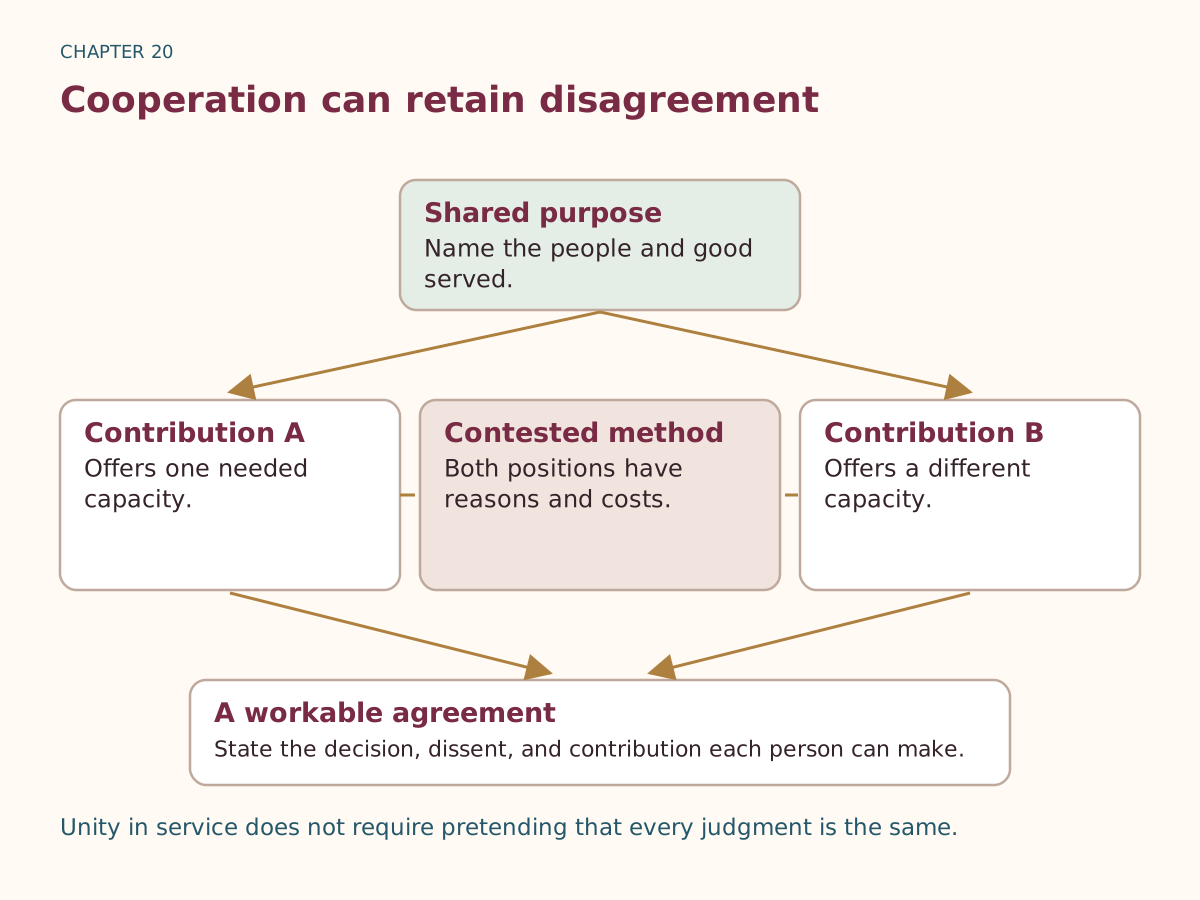
A capable group can produce a strained result when each person succeeds at the wrong expense. The explanation becomes comprehensive, but it arrives after the layout is finished. The layout becomes beautiful, but the text is difficult to navigate. The deadline is met, but the person receiving the work must explain omissions that nobody agreed to make. Cooperation asks how each contribution becomes useful to the next person and, through that person, to those the work is meant to serve.
The case in this chapter is fictional and takes place in a small design studio preparing a guide for a local exhibition. Nia writes the explanations, Leo designs the pages, and Sam coordinates production. A colleague named Farah checks whether the guide is understandable to people approaching the subject for the first time. Each has a defined professional role. Their Christian reflection on gifts occurs in appropriate personal and community settings; their colleagues are not assigned spiritual identities by the narrator.
The team's problem emerges in the final week. Nia wants to add an explanation that gives an object important context. Leo says the addition will unsettle six completed pages. Sam says the printer needs the file tomorrow. Farah points out that several existing captions already assume knowledge a newcomer may not possess. There is no spare day in the calendar and no spare person waiting to absorb the work. Everyone can explain why her or his concern matters.
Paul describes a body whose members have different functions and need one another. Romans 12:3–8 1 Corinthians 12:4–31 Applied to shared work, the image invites attention to relationships between contributions. The point is larger than appreciating different personalities. A contribution serves the common good through its effects on the whole, including the people who must receive it after its maker has finished. That is where the studio's difficulty becomes an opportunity to learn cooperation.
Four good reasons and one impossible plan
Nia fears that a short explanation will leave visitors with a false impression of the object. She has not added words merely because she enjoys writing. Leo fears that a last-minute change will create a crowded page and introduce errors elsewhere. Sam knows that missing the production slot will leave the exhibition without the promised guide on opening day. Farah knows that a polished explanation can still be unusable to someone who lacks the background it assumes. The first task is to hear each reason in its strongest fair form.
The team's initial response is to promise all four improvements. Nia will write more, Leo will make it fit, Sam will persuade the printer to wait, and Farah will examine the result late that evening. The agreement sounds cooperative because nobody has refused another person's concern. It is actually an allocation of unconfirmed effort. It depends on a printer who has made no new promise and on colleagues working hours they have not agreed to give.
By early evening, the plan has failed. The new explanation is twice the expected length. Leo has moved a caption away from its image to make room. Farah notices that the association between them is now unclear. Sam cannot reach the printer. Their willingness to help has created another round of work without settling which purpose the guide must serve at opening. The group needs a decision that recognizes its real resources.
They return to the agreed use: a visitor should be able to identify the objects, understand the central explanation, and know where to find further information. This purpose does not make every proposed addition dispensable. It does provide a basis for deciding what the opening-day guide must contain. Nia's concern about a misleading omission is essential. A longer account of the object's later history may be valuable but can belong elsewhere. The distinction has to be made on the content, not on which colleague speaks most forcefully.
Farah identifies the shortest passage that corrects the misleading impression. Nia confirms that it preserves the necessary meaning. Leo finds a way to place it without moving the caption. The longer account will be available in a later resource if the client chooses to commission it. That possibility is recorded as an option, not used as an unfunded promise to make the present compromise feel painless.
Sam explains the proposed correction and the shorter scope to the client contact who holds the delivery decision. He names what the opening-day guide will contain, what it will omit, and what the present production slot allows. The client accepts that version. The studio does not turn its internal compromise into an undisclosed change for the person receiving the work. If the client had required the fuller account, the timetable or another part of the commitment would have needed an explicit decision.
Nia remains disappointed. She believes the guide would be better with a fuller account. She accepts the production decision and does not pretend that her preference has changed. Cooperation has achieved a usable course, not complete agreement. The group can work honestly within that distinction. It does not need to interpret continuing disappointment as disloyalty.
The work between the tasks
The immediate problem reveals an earlier weakness. Nia had understood the writing deadline to mean the date when text would reach Leo. Leo had understood it to mean the date when the text was ready to place without further substantive change. Sam had allowed both meanings to remain in the schedule. Each person could say that the deadline had been met according to a private definition, while the project still lost the time it needed.
The studio therefore examines what must be true at each transfer. Before layout begins, the central explanations need a content review and the images need their associated captions. Before production review begins, the layout needs to preserve those associations and use the agreed version of the text. Before delivery, material corrections need to be incorporated and the resulting file checked. These are not interchangeable moments simply because each can be described as sending the document onward.
A useful transfer includes the unresolved issue as well as the completed work. If Nia is still deciding between two explanations, Leo needs to know before treating the page as settled. If Leo cannot fit a caption without changing its meaning, Nia needs to see the actual difficulty. If Farah finds that a visitor would be unable to identify the object being discussed, the concern needs to reach both writer and designer. Cooperation depends on relevant information crossing the boundaries of a role.
The group also distinguishes a question from a required stop. Some uncertainties can remain open while other work proceeds. Leo can establish page dimensions before every sentence is settled. He cannot accurately finish a page whose main image is still changing. Sam can reserve production time while wording is reviewed. He cannot promise a delivery date that depends on an unconfirmed exception. Seeing these differences helps the team use available time without disguising a blocked task as progress.
No single colleague owns all the connections. Sam coordinates the schedule, but Nia must say when a change affects meaning, and Leo must say when a proposed revision alters more than one page. Farah must explain the consequence of a confusing feature instead of merely marking it as unclear. Their responsibilities meet through specific information. A process becomes dependable when the people closest to the work make its effects visible to those who depend on them.
The studio makes one practical change for its next project: a short shared review before layout, using two representative pages. The meeting is early enough for each discipline to influence the approach. It replaces the assumption that a completed text can simply pass through design and become understandable by the end. This is a response to the actual failure they encountered, not an attempt to create a meeting for every possible interaction.
Whose concern is heard first?
The deadline conflict also exposes a difference in status. Nia and Leo are accustomed to explaining their professional judgments. Farah joined the project later and had been asked to check the guide only after the major choices were complete. Her contribution was being treated as a final inspection, even when her observations required earlier decisions. The team had invited her expertise while arranging the work so that it would be expensive to hear.
First Corinthians gives particular attention to members that may receive less honor and insists on their place within the body. 1 Corinthians 12:4–31 An application for this team is to examine whose knowledge becomes influential early and whose knowledge arrives only when change is unwelcome. Equal dignity does not require identical roles. It does require a fair opportunity for relevant contributions to affect the work, especially when the team has explicitly asked for them.
Farah explains that two questions could have been addressed before the pages were designed: what a newcomer would already know, and how each image should connect to its explanation. The group had discussed type size and visual style at length while leaving those questions implicit. Her point is specific enough to change the next project. It does not require the team to characterize itself as uncaring in order to acknowledge what it overlooked.
The same attention extends to work with little public visibility. Someone must confirm which file is current, notice a missing page, check the requested corrections, and prepare the delivery message. A studio can celebrate the most memorable design while treating these acts as if they occur automatically. Naming their actual contribution helps the team allocate them honestly. Recognition becomes useful when it reveals work that the schedule must support.
A person may also see beyond the role assigned to them. Leo notices a sentence that could mislead a visitor. Nia sees that an image has been placed beside the wrong description. Sam asks whether a technical term should be explained. They do not need to become responsible for one another's entire disciplines before raising a relevant observation. Respect for expertise and openness to correction belong together when the shared purpose remains visible.
Disagreement after the repair
During the rushed evening, Sam tells Nia that she always confuses completeness with usefulness. Nia replies that Sam cares only about getting work out of the door. These statements turn a particular conflict into judgments about character. The project decision will not repair that exchange by itself. They need to address the claims they made about one another.
Sam apologizes for the generalization and names the practical issue he should have raised: the new material arrived after the review stage on which the production schedule depended. Nia acknowledges that she assigned him a motive she could not know. She also explains that the late passage addressed a genuine problem and that she needs a route for such concerns. The apology and the unresolved process question can coexist. Neither person must surrender a valid concern in order to take responsibility for an unfair sentence.
Ephesians connects truth spoken in love with the growth of the body and the contribution of its parts. Ephesians 4:11–16 The application here concerns both content and manner. Sam must be able to say that a change has consequences. Nia must be able to say that the existing wording is inadequate. Each must speak in a way that allows the other to answer the actual issue. Pleasantness that conceals the problem and contempt that announces it both leave the team poorly served.
They agree on a route for material late concerns: state the error or omission, identify the consequence of leaving it, and show the smallest responsible correction. This does not guarantee acceptance of every proposed change. It makes the question examinable under pressure. If a concern cannot be resolved within the present commitment, the person holding the relevant decision must choose among delay, reduced scope, or a different delivery. The cost should remain visible to the client and the team.
The guide reaches the exhibition on time. It contains the corrected explanation and a shorter account than Nia wanted. Farah still thinks two captions could be clearer. Leo is satisfied with the pages but recognizes that the earlier plan had depended on his staying late. Sam is relieved and tired. Their review preserves this mixed result. A successful delivery does not make the rushed evening a desirable method, and remaining imperfections do not erase the work that served visitors.
The team's next project begins differently. Nia brings a sample explanation before writing the whole guide. Leo shows how the image and caption will meet. Farah asks a question while the answer can still shape the approach. Sam places time for that conversation in the actual schedule. The contributions have not become interchangeable, and the colleagues have not become perfectly agreeable. They have learned how one person's work can make another person's service more possible.