
“I believe God is warning us about this partnership.” The sentence changes the atmosphere in a room. A disagreement about terms now carries a claim about divine guidance. Someone may feel relieved that a concern has been voiced. Someone else may hesitate to ask a question because disagreement could sound like disobedience. The person speaking may be sincere and may have noticed something important. The community still needs a way to examine the claim without either granting it automatic authority or humiliating its bearer.
This chapter is the book's principal discussion of that particular responsibility. Chapter 8 addresses the wider discernment of gifts through Christian life and service. Here the question is narrower: what should happen when a person brings a specific spiritual impression into a consequential decision? The answer must protect openness, truthfulness, the people affected, and the freedom to discover that an interpretation was mistaken.
First Corinthians names prophecy and the distinguishing of spirits among spiritual gifts. It also describes others weighing prophetic speech. 1 Corinthians 12:4–31 1 Corinthians 14:1–5, 29–33 First Thessalonians places a welcome toward prophecy alongside examination and holding to what is good. 1 Thessalonians 5:19–22 These passages keep reception and testing together. They do not require a community to choose between treating every impression as a command and treating every spiritual contribution as an embarrassment.
Paul also associates prophecy with strengthening, encouragement, and comfort. 1 Corinthians 14:1–5, 29–33 A troubling partnership proposal therefore provides only one setting in which to consider spiritual discernment. Prophecy should not be reduced to detecting concealed wrongdoing. The shared discipline considered here is accurate speech, accountable examination, and a response whose moral weight does not depend on the speaker's intensity.
The sentence in the agreement
In the following fictional case, a neighborhood organization has been offered materials by a supplier for a public workshop. The supplier requests acknowledgment in the printed program. During preliminary discussion, a phrase about “ongoing access to your audience” passes without much attention. Later, a team member named Elise reads a draft that asks for the contact details of everyone who registers. The public invitation says nothing about that arrangement.
Elise has been uneasy since the meeting. During prayer, her concern becomes more distinct, and she experiences it as a spiritual warning. She tells two colleagues that the supplier may be using generosity to obtain people's information. One colleague agrees immediately. The other asks whether the disputed language came from an old template. Elise hears the question as reluctance to take her seriously. She replies that she feels certain something is wrong.
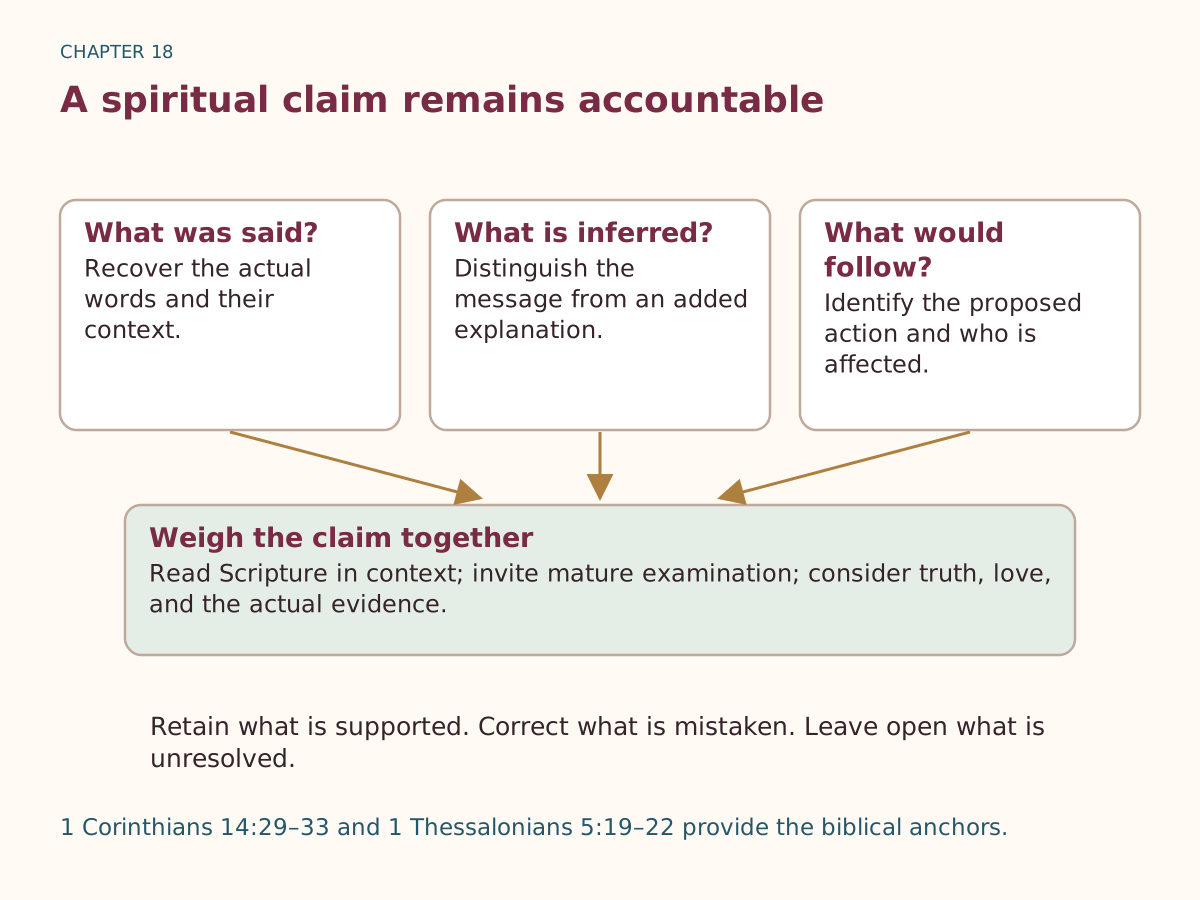
There is something concrete to examine. The draft contains a request that the organization's public invitation does not explain. There is also an inference about the supplier's purpose and an account of Elise's spiritual experience. These three elements are connected in her mind, but they do not have the same evidential status. If the group combines them into one accusation, it will make the practical question harder to answer fairly.
The program lead asks Elise to bring the exact wording to a small review meeting. The original draft is preserved. The organization pauses that portion of the proposal while it seeks clarification; it does not circulate a warning about the supplier's character. Any questions requiring contractual, privacy, or other specialist expertise go to an appropriately qualified reviewer. The discussion here concerns the team's spiritual and relational conduct, not a legal conclusion about the draft.
Elise can now state three sentences separately. The first is observable: the draft requests registrant contact details. The second is interpretive: she thinks the supplier may intend to approach participants directly. The third describes experience: she experienced an inward warning during prayer and wants it weighed. This separation strengthens the report. The concrete concern can be addressed immediately, while the interpretation and spiritual claim receive the examination appropriate to them.
A hearing that permits an answer
Testing begins with understanding what the speaker is actually claiming. Does Elise believe the group should pause, refuse this particular clause, decline the entire relationship, or judge the supplier to be deceptive? These are different proposed responses. A broad feeling of unease cannot settle all of them at once. The reviewers ask her to describe the content of the impression as faithfully as she can, including where her later reasoning may have supplied details.
She acknowledges that the inward experience did not contain a statement about the supplier's motive. Her conclusion about concealed intent developed after she read the clause. This admission matters. It prevents the weight of a reported spiritual experience from being transferred unnoticed to an accusation she formed through inference. She can continue to take the experience seriously while correcting the account of what it contained.
The Christian colleagues examining the impression consider its consistency with Scripture, the action being urged, and the manner in which the claim is being used. They ask whether the proposed response serves truth and the people affected. They also ask whether Elise is willing to hear an answer that changes her interpretation. These questions are applications of the scriptural call to examination. They are not a mechanical procedure that proves divine origin when every box has been filled.
The reviewers' freedom matters as much as their questions. One colleague helped introduce the supplier and has a personal interest in seeing the partnership proceed. She names that connection and does not become the only person deciding whether the concern deserves attention. Another person has previously disagreed with Elise about a different project. He acknowledges that history so that the current claim can be heard on its own content. Disclosure allows relevant loyalties to be considered; it does not make any participant incapable of contributing.
The group also makes room for a different conclusion from the one Elise expects. A reviewer may believe that her practical concern is well founded while remaining uncertain about the spiritual interpretation. Another may share her spiritual concern without concluding that the supplier acted dishonestly. Such distinctions are legitimate outcomes of examination. Agreement on a prudent next action does not require agreement about every possible explanation for the concern.
Elise finds this separation uncomfortable. She had hoped that the group's response would confirm she had heard correctly. The meeting offers something less emotionally conclusive and more useful to the work: the disputed request will be examined, the impression will be treated respectfully, and nobody will be required to endorse a claim beyond what they can responsibly affirm. Her contribution has been received even though her preferred interpretation has not become the group's settled position.
Three possible answers
The program lead asks the supplier what the clause means. At this point, the case can develop in three different ways. Keeping the branches distinct helps reveal whether the group's approach can actually learn. A process that reaches the same accusation regardless of the answer is defending a verdict, not examining a concern.
In the first branch, the supplier explains that an older template was used and that registrant information is unnecessary. It provides revised terms that remove the request. The team checks the revision through its ordinary review process. This answer does not erase the inconsistency in the first draft. It does change what the inconsistency can support. Elise can say that the clause required attention and that the proposed correction addresses it. She cannot fairly keep describing an unestablished hidden intention as a fact.
In the second branch, the supplier confirms that direct contact with participants is an essential part of what it wants. The organization now faces a clear practical choice. It can seek a different arrangement or decline a partnership that does not fit its commitments. The supplier's preference may be incompatible with the organization's offer without being secret. An accurate explanation can name that incompatibility. It need not enlarge the disagreement into a statement about every aspect of the supplier's character.
In the third branch, the supplier gives inconsistent answers and will not clarify the written terms before the workshop deadline. The organization may decide it cannot responsibly proceed. That decision can rest on an unresolved responsibility. It does not require proof of misconduct. “We could not establish terms we were prepared to accept” communicates a different conclusion from “We discovered that the supplier intended to deceive us.” The second claim would need evidence the uncertainty itself does not provide.
Declining the partnership in either of the last two branches would leave the workshop short of materials. The team would have to reduce what it offered, find another confirmed source, or change its plans. That cost belongs in the decision. Integrity does not become a demonstration that careful examination always preserves the attractive opportunity. The organization must be willing to describe and carry the consequence of refusing terms it cannot responsibly accept.
For the remainder of this case, the first branch occurs. The clause is removed, and the supplier accepts acknowledgment in the booklet as the full arrangement. Elise still feels unsettled. She is free to describe that experience. The continuing feeling does not cancel the information received or entitle her to prevent a decision indefinitely. The group may proceed while acknowledging that it has not reached a shared interpretation of her impression.
This is a demanding place for accountable discernment. Testing is comparatively easy to welcome when it confirms the warning. Its substance becomes clearer when the response is mixed. Elise's attentiveness served the organization. Her statement about motive exceeded what she could establish. The spiritual meaning of the initial impression remains open. All three conclusions can be held without forcing the episode into a story of either complete vindication or complete failure.
Correcting the account that traveled
Elise remembers the two colleagues who heard her first interpretation. She tells them what the supplier clarified and identifies the part of her earlier statement she cannot support. The correction reaches the audience that received the overstatement. Quietly adopting more careful wording in future meetings would leave the earlier impression in place. Integrity includes attending to the actual path by which one's words have traveled.
She also speaks to the colleague whose question she dismissed. She acknowledges that the suggestion about an old template was reasonable and that she treated it as resistance to a spiritual concern. The apology does not ask the colleague to reassure her that nothing harmful occurred. It names the pressure her response created and gives the colleague room to say how it affected the conversation. Elise's later willingness to answer questions will give the apology practical substance.
If a group has acted publicly on an inaccurate claim, the repair must address that public effect. The form depends on what was said and who was affected. A corrected record may be needed. A responsible leader may need to explain why a decision has changed. The aim is a truthful account with appropriate care for those involved, not a display of the speaker's humility. Repair should answer the error that occurred.
First Corinthians describes love as rejoicing with the truth and refusing delight in wrongdoing. 1 Corinthians 13:1–7 Applied here, love attends both to a concerning clause and to the reputation of the people discussed. It does not require the team to ignore a problem to preserve cordiality. It also gives no satisfaction in portraying another person as exposed. The desired result is truthful conduct and faithful service, even when the truth is less dramatic than the first suspicion.
A mistaken interpretation should not make future concerns impossible to raise. The program lead can thank Elise for reading carefully while being direct about the overstatement. The team can recognize her correction without asking others to forget the pressure they experienced. Both forms of accountability matter. A culture that punishes every partly mistaken concern discourages useful reporting; a culture that exempts spiritual language from correction makes truthful reporting harder to trust.
The community after the claim
The episode leaves practical learning. Partnership language will be reviewed before the invitation is circulated. Material requests will be stated plainly. The team knows who can receive a concern when the usual decision maker is involved in the matter. These changes arise from a specific weakness the case revealed. They do not require turning every future partnership into a reenactment of this dispute.
It also leaves a spiritual question. Elise and trusted Christian counsel may continue reflecting on what she experienced, what she inferred, and how she responded. They can consider the benefit of her attentiveness and the need for growth in receiving questions. The meaning of an experience can remain under consideration while the organization makes a practical decision. Neither conversation needs to consume the other.
No one appoints Elise as a permanent detector of hidden danger. Her service includes more than suspicion, and the community's responsibility to examine concerns belongs to the community. A person welcomed for spiritual contribution should also be welcomed as someone who can learn, apologize, rest, and receive care. First Corinthians places diverse manifestations within the common good of the body. 1 Corinthians 12:4–31 That belonging is larger than the reputation attached to one difficult meeting.
You can bring a concern with courage and describe it accurately. You can welcome spiritual impressions and preserve the freedom to question them. You can pause a commitment for a concrete reason without accusing someone whose motives remain unknown. When correction comes, you can carry it back to the people who heard the first account. Integrity becomes visible in these precise acts, especially after the intensity of the original moment has passed.