

The meeting ends with renewed agreement that the work matters. Everyone has spoken with conviction. Several people have offered ideas, and someone has promised to circulate notes. Yet the next morning leaves the same question on the table: what, exactly, may anyone begin? A person troubled by that question may be attending to a need for direction. The concern becomes useful when it moves beyond impatience with discussion and asks which choice would allow the group to act responsibly.
Consider this fictional scholarship committee preparing to select recipients for a small community education award. The committee has received more eligible applications than it can support. Its members care about access to education, and their discussion reflects that care. One member emphasizes financial need. Another wants to recognize sustained community service. A third worries that an elaborate selection process will consume the time available for notifying applicants. The committee has several worthy considerations and no agreed way to weigh them. Its sincerity has yet to become a workable decision.
The chair, Mara, arrives with a proposal she expects will end the delay: divide the available fund equally among eight recipients. The room becomes quiet. A reviewer asks whether the smaller awards would cover enough of the published educational costs to make attendance possible. Another asks why Mara brought a solution before hearing their estimates. Her first attempt at direction has made the real choice harder to discuss. She has offered a number where the group needed a reason. To lead this meeting well, she must withdraw the shortcut and attend to what each option would actually do.
A direction has a destination
Romans names leadership among the gifts exercised within the community and associates it with diligence. Its wider setting joins differing contributions with sober self-understanding. Romans 12:3–8 That connection gives leadership a demanding texture: purpose needs sustained attention, and other members remain participants in the work. Here, diligence will require Mara to distinguish the decision before the committee from the conclusion she would enjoy announcing.
Direction begins with an answerable question about destination. In the committee, “support education” is a meaningful aspiration, yet it cannot settle every disagreement. Does this particular award aim to relieve immediate financial barriers, recognize prior service, or develop emerging community leadership? An award can serve more than one good, but its decision process needs some account of their relative importance. Otherwise, each reviewer may evaluate applications against a different private definition of success and experience the others as inconsistent.
Mara asks the committee to return to its published purpose and the commitments already made to applicants. This matters because direction must respect the work's existing obligations. A leader's desire for clarity does not authorize an attractive new purpose halfway through selection. Where earlier wording leaves room for interpretation, the committee can state that interpretation together and apply it consistently. Where a proposed change would alter what applicants were promised, the group needs a separate decision about a future cycle. Present responsibility includes honoring the ground on which people have already entered.
The choice within the conversation
Some discussions contain several decisions disguised as one. The committee is trying to decide its selection criteria, its review procedure, its timetable, and its response to unsuccessful applicants at the same time. Every contribution opens another branch. Mara writes these decisions separately and asks which must precede the others. This simple act changes the meeting's work. A concern about notification no longer has to defeat a concern about fair assessment; the committee can give each concern a place in the sequence.
A useful choice carries enough explanation for others to judge it. “We will use this process because I have decided” may identify authority, yet it offers little shared understanding. Mara instead proposes two independent readers for each eligible application, followed by discussion of cases where their assessments differ substantially. She explains how this approach could reduce the burden on any one reviewer while making disagreements visible. Members can now evaluate an actual proposal. They can revise its details, identify a missing safeguard, or explain why another approach would better serve the purpose.
Leadership includes accepting that a clear proposal may receive a clear objection. The objection is information about the work and the people responsible for it. In the meeting, one reviewer observes that two readers will still be insufficient if each interprets “community contribution” differently. Mara pauses the procedural decision and invites the committee to describe acceptable evidence. Her willingness to change the proposal protects its usefulness. Direction remains steady in purpose while its immediate form becomes more accurate through other people's attention.
Pace belongs to the purpose
Frustration with delay can carry a legitimate concern for people waiting on an answer. It can also carry discomfort with uncertainty, a preference for quick closure, or fatigue after a long day. These possibilities may coexist. Before treating urgency as a leadership signal, ask what would be harmed by waiting and what could be harmed by proceeding. The question makes room for both timeliness and care. It also prevents a personal feeling of pressure from quietly becoming the committee's governing rule.
The scholarship applicants need time to plan. The reviewers need time to read attentively. The committee needs time to resolve difficult cases. A responsible pace gives these needs explicit space. Mara proposes dates for initial review, discussion, and notification, then asks members whether their actual availability supports those dates. A calendar based on imagined capacity offers little direction. A calendar that names workable commitments creates an honest basis for action and for recognizing when circumstances require an adjustment.
The notification date has a consequence beyond the committee's comfort. Applicants need to know whether they can make the educational commitment described in their applications. Mara asks the group to identify the latest date on which an answer would still be useful, then works backward through the review. The resulting timetable has a reason applicants could recognize. If it becomes impossible, the group must communicate the delay while people can still consider their options.
A genuine information gap can still justify a pause. The committee agrees that an application affected by its own filing error should receive a fair chance to be considered. Finding the missing record becomes a specific task within the remaining time. The pause serves the same purpose as the deadline: an applicant should receive a timely decision based on the information the committee was entrusted to review.
Choosing means giving something up
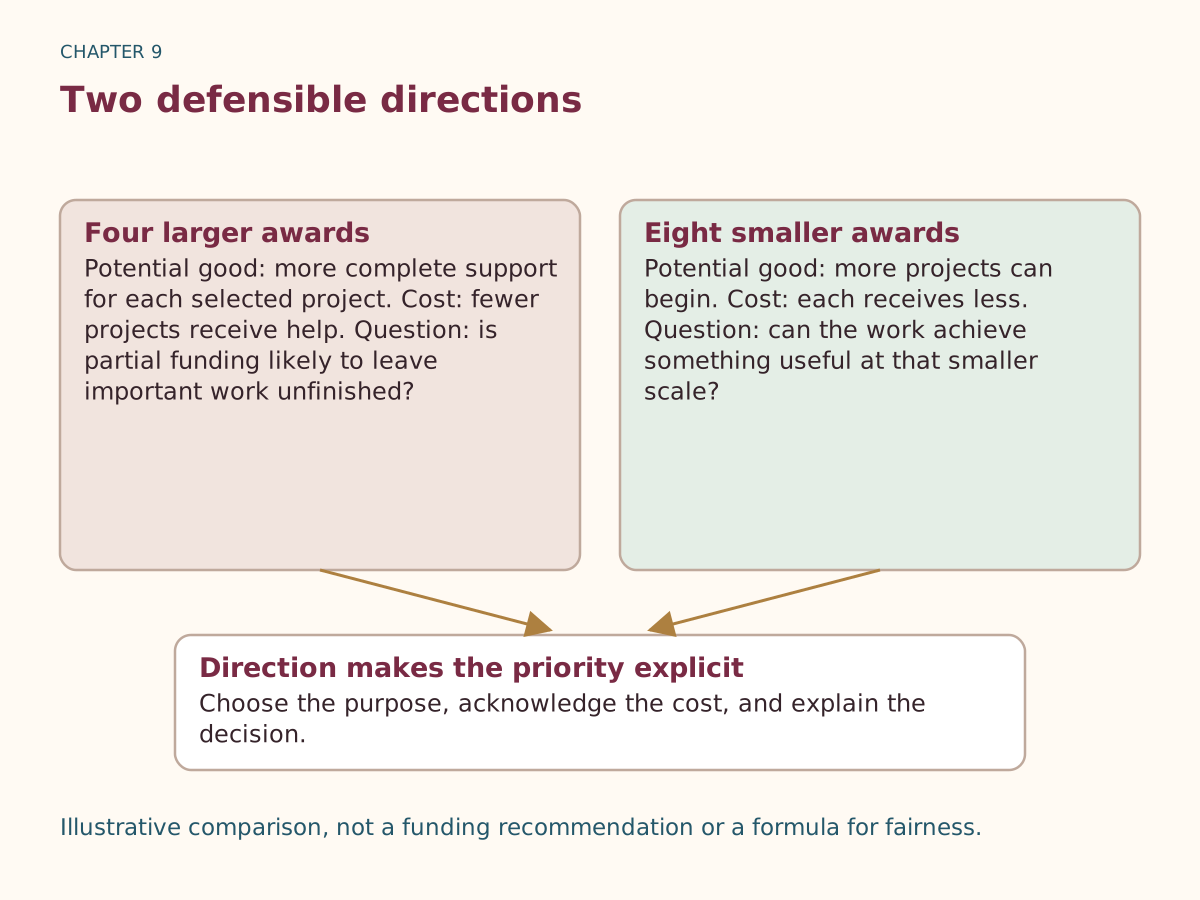
Once the criteria and timetable are separated, a harder issue becomes visible. The committee can make four larger awards or eight smaller awards from the same fund. The larger awards could remove a substantial barrier for fewer students. The smaller awards could reach more students but leave some of them with a gap they cannot fill. Both proposals express a recognizable good. Neither becomes responsible merely because its advocate speaks more warmly about opportunity. Mara asks the reviewers to explain who would benefit from each choice and what each choice would leave undone.
They work through two fictional applicant examples drawn up for this discussion. In one, a partial award combines with an already secured contribution and completes the cost. In the other, the same amount still leaves an enrollment barrier. The examples do not decide the real applications in advance. They expose the difference between distributing a resource and accomplishing its intended purpose. Counting recipients supplies one kind of information; understanding whether an award can be used supplies another. The committee has to choose which information should govern this particular fund.
One reviewer argues for smaller awards because the program has promised to widen access. Another argues that an award which cannot be used does little to honor that promise. Mara repeats both reasons accurately before proposing a decision. This is a practical act of leadership: each member should be able to recognize their concern in the account, even when their preferred option loses. Accurate representation also prevents an easy moral division between generous people and supposedly narrow people. The disagreement concerns the use of a limited fund, and its seriousness deserves language equal to the problem.
The published terms permit different award amounts within the stated limit, and the application already asks for the relevant educational cost. The committee chooses to consider the remaining barrier described in each eligible application and make fewer awards if necessary to meet that purpose. It states the interpretation before the reviewers score individual cases. This prevents the method from changing to favor a person whose story has already persuaded the room. The choice still has a cost: some eligible people will receive nothing this year. Mara names that loss plainly.
The member who preferred eight awards continues to disagree. The chair asks whether the reviewer can carry out the selected process fairly under the committee's agreed decision rule. The answer is yes. Agreement about how to proceed coexists with a reasoned preference for another choice. That position deserves to be stated accurately. The reviewer has committed to the work without pretending that the cost they identified has disappeared.
The committee also rejects a tempting compromise: selecting four recipients now and implying that four more awards will follow if fundraising succeeds. There is no further funding commitment. Presenting a hope as part of the current offer would shift the uncertainty to applicants trying to plan their education. Mara can encourage future fundraising in its proper place, while keeping this year's promise within the resources actually available. Direction includes resisting a sentence that makes agreement easier today by making someone else's situation less clear tomorrow.
Proceeding without pretending agreement
Mara writes the decision in language the reviewers can use: “Eligibility remains as announced. We will consider the remaining educational barrier described in each eligible application and vary award amounts within the published limit. The reason is to support an educational commitment the recipient can actually undertake.” The note names the immediate review tasks and records the preference for smaller awards that remained in the room. It also identifies a reason to return to the choice: material information showing that the method conflicts with the published terms or has been applied to an inaccurate account of need.
This distinction between a standing disagreement and a reason to reconsider is easy to overlook. If every expression of disappointment restarts selection, the committee may never reach the applicants. If no new information can reopen a choice, it may carry a known mistake forward in the name of resolve. Mara gives both action and correction a place. The resulting steadiness concerns the purpose and the decision rule, while remaining responsive to information that changes the basis of the choice.
The record is tested before the meeting ends. One member reads it as permission to change eligibility requirements. Another understands that only award amounts may vary within the existing terms. Mara corrects the wording: eligibility is unchanged; the agreed approach governs the use of the limited fund among eligible applications. A decision that exists differently in different minds has not yet become shared direction. Asking what the choice permits reveals a misunderstanding that a general request for agreement could miss.
Two days later, the reviewer who preferred smaller awards identifies a missing cost document in an application. Mara initially feels that the settled decision is being challenged again. She reads the message carefully and sees that it concerns a factual omission, exactly the kind of issue the committee agreed to revisit. She thanks the reviewer and arranges the required check. The person who dissented remains a contributor whose attention serves the work. Treating dissent as a permanent mark against someone would have made the decision less reliable.
Leadership also has a public consequence after the room has emptied. The unsuccessful applicants deserve a clear account of the process and accurate information about any available reconsideration route. They do not need the committee's private account of how hard everyone worked. Mara helps prepare a message that names the limited award capacity and the selection method without comparing applicants' personal circumstances in public. The committee's difficult choice has now reached people who did not participate in its conversation. Their experience belongs within its responsibility.
Paul's treatment of gifts places love at the center, including patience, kindness, and a refusal of self-seeking. 1 Corinthians 13:1–7 For Mara, that directs attention beyond her success in ending a meeting. She must speak truthfully to the people who lost the argument and to the people who will not receive an award. The quality of direction includes how those consequences are carried. An efficient decision can still require repair if its explanation dismisses people whose hopes it cannot fulfill.
The next decision is enough to begin
The committee has not resolved the larger problem of unequal educational opportunity. It has made a defensible choice about one entrusted fund, identified the loss within that choice, and given reviewers a process they can carry. The chair's first proposal failed; her later contribution was stronger because she let the failure expose the missing question. Leadership here is neither personal certainty nor universal approval. It is diligent attention that allows a real decision to become responsible action.
For the reader, a useful beginning is to find the decision hidden inside a circling conversation. State the purpose already entrusted to the group. Put two plausible choices beside each other, including the good each protects and the cost each imposes. Ask which choice the group can actually make, and explain what follows. You may leave the meeting with less applause and greater clarity. That can be a faithful service to the people waiting for the work to move.