
What happens before the welcome
In this fictional Christian fellowship, a shared meal follows an afternoon of music and conversation. When guests arrive, the room looks simple and welcoming. Tables are set, serving areas are marked, and someone is ready to explain where people may sit. Much of the labor that made this possible has already happened. Volunteers confirmed the room, arranged transport for supplies, checked the equipment, and prepared a plan for clearing up. The visible welcome rests on a network of contributions.
During the opening remarks, the coordinator thanks the speaker and the musicians. She intends to thank the rest of the team later. The evening becomes busy, and the closing acknowledgment never occurs. Several volunteers remain to clean the room while most guests leave. One person folds a table and feels the familiar frustration of necessary work that seems to disappear once it has been done. His concern raises a question about how the fellowship recognizes the good produced by different members.
First Corinthians describes varieties of gifts and service in relation to the same divine source and the common good. 1 Corinthians 12:4–31 It also develops the image of one body with many members. These themes place the contribution within a shared life. A gift's meaning reaches beyond the person's satisfaction in exercising it. The inquiry includes what the community receives and how its members relate to one another through their participation.
The meal offers a setting for examining a community's attention. What does it celebrate? Whose knowledge enters its decisions? Who receives care when there is no visible achievement to applaud? These questions reach beyond the distribution of tasks. They concern the kind of shared life those tasks are meant to sustain.
Whose good is being served
The phrase common good deserves a clear object in practice. Who is meant to benefit, and what good are they meant to receive? For this meal, the purpose might include a welcoming opportunity for fellowship, a manageable occasion for volunteers, and responsible use of the host's room. Each part affects the plan. A crowded schedule that leaves no time for conversation may undermine one purpose even if every performance goes well.
The people carrying the work belong within the scope of that good. If two volunteers remain in the kitchen throughout the gathering, the team should consider whether they have freely accepted that role and how they will share in the occasion. They may prefer a practical task and be content with the arrangement. They may also need relief that no one has thought to provide. Ask them, and plan with their answer available. Agreement should remain revisable when the actual burden differs from what was described. A group's preference for convenience should not settle what an individual is required to carry.
A community can also overlook the people who struggle to enter its familiar routines. An arriving guest may not know where to sit or whom to ask for information. Clear signs and an attentive welcome may help in this particular setting. The purpose of these arrangements is access to the gathering, with room for guests to express their own preferences. Hospitality becomes more specific when planners examine the experience of someone who does not already know how everything works.
Avoid defining the good entirely through the most easily counted result. Attendance can describe how many people came. It cannot by itself tell the team whether newcomers understood the invitation, whether volunteers carried an appropriate load, or whether the gathering offered the promised opportunity for conversation. Use measures in connection with their meaning, and invite accounts that illuminate aspects a simple total cannot contain.
The coordinator in the fellowship therefore asks a different set of questions after the meal. Did people know where to go? Were the responsibilities clear? Which tasks needed more help? What did guests find welcoming or confusing? These questions give the shared purpose a practical shape. They also invite contributions from people whose work placed them far from the microphone.
The members you rarely notice
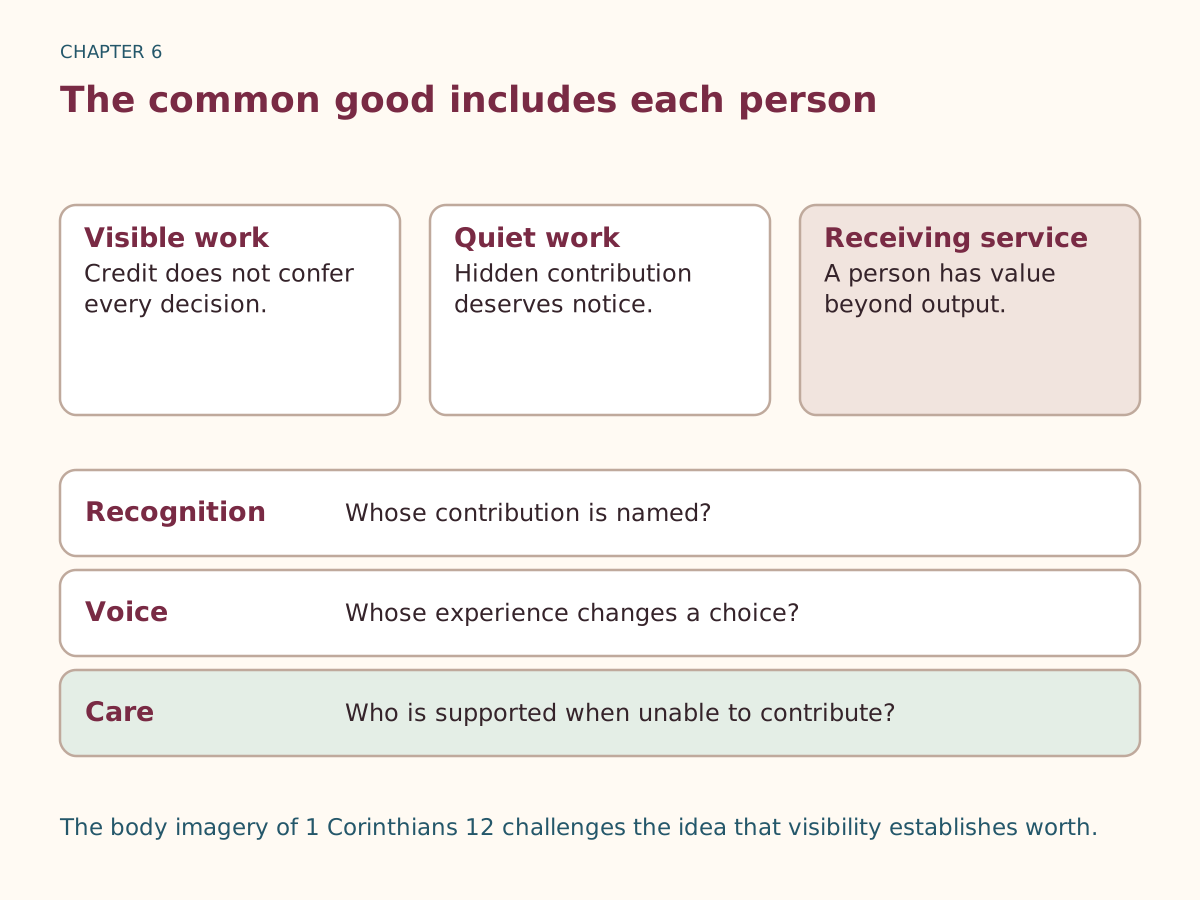
Paul's body image includes attention to members that might be regarded as weaker and to the honor given within the body. 1 Corinthians 12:4–31 The passage challenges a ranking of belonging according to visible prominence. Applied carefully to shared work, it invites a community to examine whose contribution it assumes, whose absence it would quickly notice, and whose needs receive little attention until something goes wrong.
In the meal, the person who manages the building keys receives few questions when the doors open on time. His work becomes conspicuous if the room remains locked. That asymmetry offers a useful point for reflection. The team can acknowledge a contribution while it is functioning well. It does not need to wait for an interruption before recognizing that someone has been carrying a necessary responsibility.
Acknowledgment can be accurate and proportionate. Name the work and its relationship to the event: the access arrangements allowed the team to prepare the room; the serving plan gave guests clear choices; the cleanup rota allowed everyone to leave at an agreed time. This language offers more substance than a general declaration that everyone was wonderful. It helps members understand how their different actions supported the same occasion.
Recognition also involves listening. A volunteer may know that a serving table was difficult to reach or that the equipment list was incomplete. If only the most visible participants are invited to evaluate the event, this knowledge can remain unavailable to the next team. The people who carried a task should have an opportunity to describe it and propose changes within the relevant decision process.
An unseen contribution does not have to remain unseen in order to be humble. Nor does acknowledgment require placing every act on public display. Some people prefer private appreciation, and some work appropriately remains discreet. Ask what would be fitting. The aim is a truthful recognition of contribution and a fair opportunity to be heard, with respect for the person's wishes and the context.
A voice changes what the group thinks it needs
After the meal, the planning team has enough money for one substantial improvement. Some members want a sound system that makes the spoken program easier to hear. Others want transport for members who cannot readily reach the hall. Both proposals concern participation. The team cannot settle the choice by naming one side caring and the other selfish.
The first discussion takes place among people who attended. They assume that those absent would choose transport. Before committing the money, a coordinator speaks with several members who have missed recent meals. One would use a ride. Another cannot attend at that hour because of a responsibility at home. A third explains that the formal program leaves little time for the conversation she most values. One proposed answer has met three different experiences.
The sound system remains a real need. A speaker explains that people at the back struggled to follow the remarks. The transport proposal also remains worthwhile for those who could use it. Listening has complicated the decision without making either concern disappear. The common good now requires a choice among particular goods whose beneficiaries and limits can be described.
For the next meal, the group arranges a small transport trial and shortens the spoken program while using available equipment. It also schedules a separate afternoon conversation that a member at home can join by telephone. These arrangements do not resolve the sound problem permanently. The team records that need for a later decision and explains why it chose the present combination.
One musician disagrees. She believes clearer sound should have come first and points out that people who already attend should also receive care. The coordinator acknowledges the cost left with them. She does not convert the disagreement into a verdict about the musician's generosity. A choice can be responsible while leaving a legitimate claim unmet. That claim should remain visible after the decision.
Notice what changed the quality of the conversation. The people whose absence had been discussed gained a voice in describing it. The group learned that its first account was incomplete. Their participation in the decision mattered even where the final plan could not satisfy every preference. Honor became more than a thank you delivered after others had decided what they needed.
Receiving when you cannot contribute as expected
Mutual dependence also means making room for members who currently receive more practical assistance than they provide. Someone may arrive unable to help with the room or leave before clearing because of another responsibility. The community can ask for honest communication about commitments without measuring the person's belonging by the number of tasks completed that evening. The body image directs attention to shared membership as well as varied function. 1 Corinthians 12:4–31
You may find receiving difficult if your familiar place is to be useful. At a shared meal, you might scan the room for a task because sitting with others feels less secure. Consider whether you have permission to participate in the occasion you helped create. If your work is complete and another person has accepted the next responsibility, receiving the welcome can be an appropriate part of the shared life.
In the fellowship, a volunteer who usually manages the tables comes only as a guest during a demanding season. The coordinator confirms in advance that the role is covered. At the meal, no one repeatedly asks him to solve minor questions merely because he knows how. Another member carries the responsibility. This allows the familiar volunteer to receive what the group offers and allows the new volunteer to exercise real ownership.
Receiving also includes allowing others to give in ways different from your own. A quiet conversation may be the contribution available from someone who cannot remain for the whole event. A thoughtful suggestion may improve the next gathering. These possibilities can be welcomed without pressuring every interaction to prove usefulness. Relationships need room to exist beyond a tally of practical outputs.
Care that does not need an achievement to justify it
Paul's body image connects one member's suffering with the others and also connects one member's honor with shared rejoicing. 1 Corinthians 12:4–31 The community is invited to attend to what happens among its members. This reaches beyond noticing the work that keeps an event running. It includes receiving news that brings no useful assignment and making room for a person's life without turning every encounter into a request.
A member comes to the next meal carrying a disappointment that she does not want announced. She has no story of success to tell and no desire to undertake a task. A friend sits with her during the quieter part of the evening. Their conversation will never appear in the event's attendance or volunteer figures. It belongs to the good the fellowship hoped to make possible.
Another member receives recognition for work outside the congregation. Friends rejoice with him without immediately asking how his new influence might benefit their program. Shared gladness can honor a person without converting their achievement into an institutional resource. The direction of attention matters in both scenes.
This is a useful question for a group that values service: can a person come among you without needing to produce, explain, or repay something? A community can invite contributions and still give relationships room to breathe. It can appreciate quiet labor and also notice the member who currently has little labor to offer. Its account of common good becomes more humane when both are held within the shared life.
A whole larger than its most visible part
The fellowship revises its planning conversation before the next meal. It begins with the intended experience of guests and volunteers, names the tasks required, and asks what capacity is actually available. The speaker still needs preparation. The musicians still need equipment. The people handling access, welcome, serving, and clearing now have a clearer voice in the plan. The event's visible features remain connected to the contributions that make them possible.
A shared purpose can help members discuss competing preferences. A longer music program may reduce conversation time. An elaborate table arrangement may increase preparation and clearing work. A larger guest list may exceed the available room. The team can consider these tradeoffs openly. Mutual dependence gives each relevant perspective a place in the decision without promising that every preference will be adopted.
As you consider your own contribution, ask what it enables for other people and what it requires from them. An explanation may give clarity and also require attentive time. A new system may solve a problem and also require training. An offer of supplies may be generous and also need storage. Looking at both sides helps you place the contribution within the actual community receiving it.
The common good becomes more visible through these relationships. A table is ready because several people accepted particular responsibilities. A visitor finds a place because someone considered their arrival. A volunteer leaves on time because the remaining work has an owner. Each act is modest enough to describe accurately. Together, they give the community an opportunity to practice the mutual care and interdependence that Paul's image commends. 1 Corinthians 12:4–31