
The shelves are orderly. A newcomer still needs to know whom she may ask. The items are labeled. A volunteer still needs to be able to say that the next season will exceed her available time. The borrowing record is current. The committee still needs to hear that its collection hours suit established groups better than people arriving for the first time. A useful arrangement can bring a community to the beginning of further learning.
This chapter follows a fictional shared collection at a neighborhood hall through its first year. Several groups have made signs, display stands, folders, and other ordinary materials available to one another. A small team has clarified what may be borrowed and how items are collected and returned. Those arrangements matter. The larger question is what the people become able to carry together through using, questioning, and changing them.
The project began when a volunteer named Sara grew frustrated by useful materials remaining inaccessible. She helped the committee establish the collection and became its first coordinator. By the third month, the service is functioning. Its next stage will test something that an orderly cabinet cannot demonstrate on its own: whether people can receive a newcomer, share influence, remember a difficult lesson, and sustain useful work when its founder is no longer at the center.
Ephesians describes equipping for service, growth toward maturity in Christ, and a body building itself up in love through the work of its parts. Ephesians 4:11–16 For a Christian reader, this gives communal service a horizon beyond the successful completion of an object or event. The hall project is a practical illustration, not a claim that organizational competence establishes spiritual maturity. It allows us to examine particular ways people learn to carry truth, care, and responsibility together.
A newcomer changes the question
A new group organizer, Beatrice, asks to borrow a display stand. The collection offers pickup on weekday afternoons, when a committee member is usually present. Beatrice works elsewhere during those hours. Sara suggests that she ask someone she knows to collect it. Beatrice replies that she has just joined the hall's activities and does not yet know anyone who can do that for her. The arrangement that feels simple to established members contains an unstated requirement: access to their relationships.
Sara recognizes the problem reluctantly. The afternoon hours were chosen for a reason. Nobody has offered to remain at the hall every evening, and Sara cannot add another weekly commitment. Beatrice's request therefore does not have an effortless answer. The committee must decide whether it can provide another reliable route, who would carry it, and what it would mean to leave the present arrangement unchanged.
One member says that people have always helped one another informally. That may accurately describe his experience. It does not answer Beatrice's account of entering the community without those connections. Another member proposes keeping the cabinet open throughout the week, which would create difficulties the collection has already encountered. The conversation becomes useful when the group hears both the newcomer's obstacle and the responsibilities behind the existing practice.
A volunteer who attends a regular evening meeting offers a collection time immediately before that meeting twice a month. This is a workable addition within an activity she already carries. The committee makes the arrangement visible to everyone. Beatrice can borrow the stand through the stated process, and future newcomers can use the same route without requiring a private favor. The improvement is modest and consequential: a relationship has helped create a practice through which people without that relationship can also participate.
Beatrice later notices that the labels use the names longtime members give to rooms. The names on the public hall map are different. She offers a short list of the mismatches. Sara initially hears the list as another complaint arriving after the team has worked hard. Then she remembers her own frustration when she first proposed the collection. The newcomer's unfamiliarity is supplying knowledge the experienced members no longer have.
The group corrects the labels. It also invites Beatrice to contribute to a review without assuming that she wants an ongoing volunteer role. Her place in the community does not depend on converting every useful observation into an assignment. She can be someone who borrows, questions, contributes occasionally, and receives help. A community becomes easier to enter when belonging offers more possibilities than immediate usefulness to its existing workload.
First Corinthians portrays the members of the body as needing one another and directs attention to those who might receive less honor. 1 Corinthians 12:4–31 Applied to this situation, the teaching asks whose contribution the group is prepared to recognize. Beatrice has not built the collection. Her question nonetheless helps it serve people the founders had unintentionally made less visible. Receiving that contribution expands the community's understanding of what it already thought it knew.
A later request tests whether that welcome changes influence as well as access. An established group expects priority for a busy date because its members helped buy the stand years earlier. A newer group requested the same date first. The earlier contributors had agreed that the item would enter the shared collection without a continuing priority. The committee follows that agreement, helps the established group consider an alternative, and accepts that some members remain disappointed. Remembering a contribution gratefully does not require quietly changing the terms of shared use when its giver asks. The community learns that a welcome has substance when its stated arrangements can withstand the preferences of influential members.
What survives a difficult season
During a busy month, two groups request the same display stand. The coordinator has accepted both requests by mistake. One group has organized its event around the assumption that the stand will be available. The other has already collected it. Sara discovers the conflict on the afternoon before the first event and feels an immediate desire to solve it quietly so that nobody will think the collection is unreliable.
She finds an alternative that partly meets the first group's need, but it requires the group to change its display. The organizer is upset and says so at the next committee meeting. Sara begins by explaining how many requests she has managed successfully. The explanation is true and poorly timed. The organizer needs the committee to understand the effect of this particular failure, not to balance it against a list of occasions when other people were satisfied.
Sara stops and acknowledges the double booking and the disruption it caused. The committee examines the record and sees that one request was confirmed in a message but never entered in the shared calendar. A volunteer had offered to maintain the calendar, while Sara continued answering requests from her own inbox. Responsibility had been divided in words without a dependable connection between the two actions. The failure reveals a place where the work still depends on her memory.
The team changes how confirmations are made and practices the revised process with two pending requests. More significantly, Sara allows another volunteer to handle the next ordinary booking without checking every message privately afterward. Sharing responsibility requires her to receive a different method within the agreed arrangement. If she continues maintaining a hidden parallel record, the collection will remain dependent on her while appearing to have distributed the work.
The disappointed organizer does not immediately become enthusiastic about the collection again. She uses her own materials for the next event. The committee respects that choice and continues to make the corrected service available. Repair can establish a more trustworthy practice without controlling how quickly another person feels ready to rely on it. The response remains responsible even while the relationship carries the effect of what happened.
The community's memory of the episode also matters. If the story becomes “the organizer was difficult,” it will teach newcomers to conceal complaints. If it becomes “Sara cannot be trusted,” it will reduce one person's work to one error. The useful account preserves the actual sequence: two confirmations, a missing entry, a disrupted event, an acknowledged mistake, and a changed process. Such a memory gives future members something they can learn from without inheriting a grievance as their guide.
Paul describes love as patient, rejoicing with the truth, and taking no account of evil. 1 Corinthians 13:1–7 The application here concerns the purpose for which a failure is remembered. The group can preserve the facts needed for repair and learning. It can also refuse to use the episode as a permanent weapon against the person who made the mistake. An accurate record helps people change the work; a grievance repeatedly used to diminish someone keeps demanding payment after the responsible repair has been made. Charity and truthful memory can support the same continuing growth.
A contribution that makes another possible
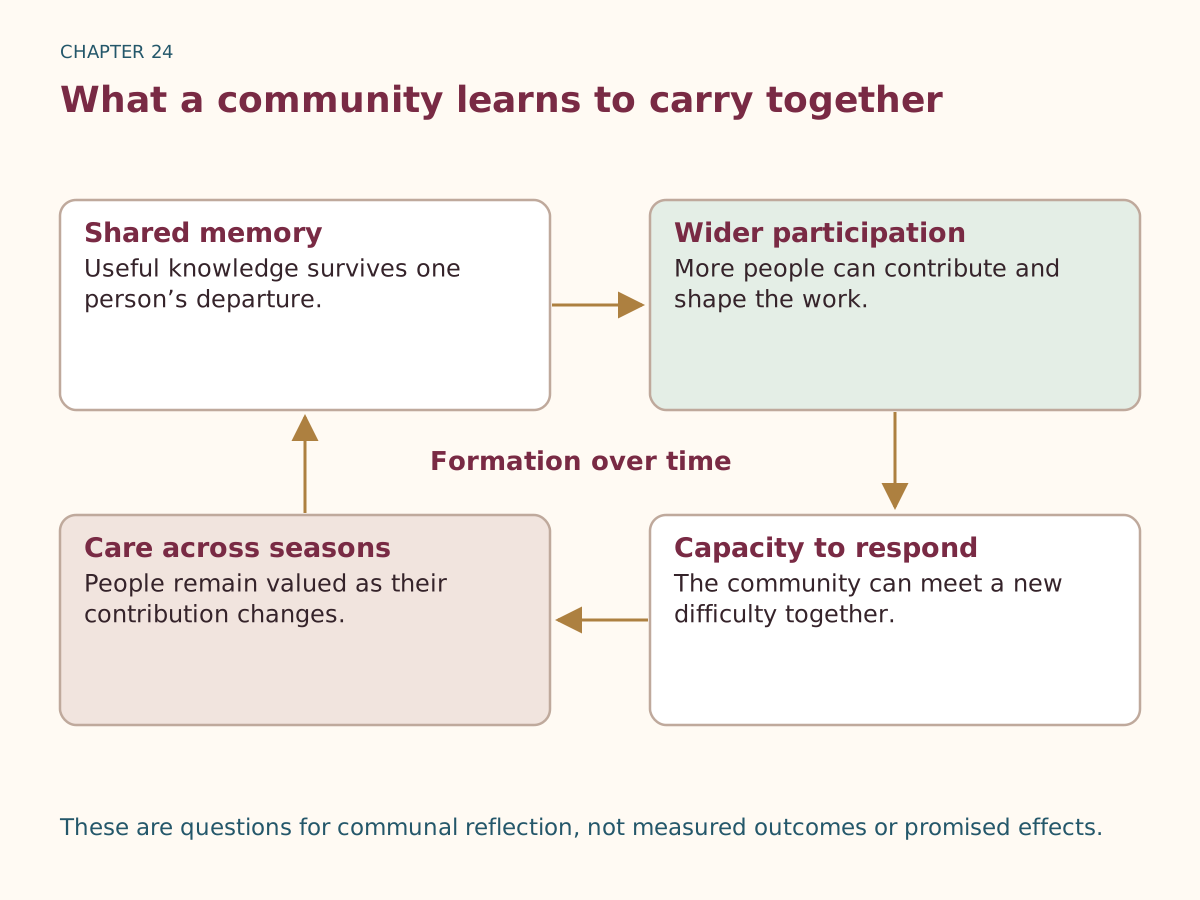
As the year continues, the collection develops abilities that no single shelf displays. A second volunteer can answer a routine request. A borrower can explain a confusing instruction without fearing that the question will be treated as ingratitude. A new organizer can find the same collection hours as an established group. A committee member can identify why an arrangement was adopted and which part could be changed. These are concrete capacities in the shared life of the service.
Their development is uneven. Some volunteers still avoid disagreement with Sara because she began the project. Some members still contact a friend privately instead of using the common route. The committee does not need to announce that these habits have disappeared. It needs to notice where they continue to affect access, workload, and decisions. A community can recognize real progress while keeping the next unfinished responsibility in view.
One donor offers to fund a larger collection. The offer is generous, and several members are excited by what could be added. The volunteers who maintain the present service explain that more items would require more storage, checks, and collection time. The group decides to improve the current arrangement before expanding. The donor chooses to support that work. The outcome shows a relationship in which generosity can be received through a truthful account of what the community can sustain.
Another opportunity involves teaching. Beatrice offers to show a new organizer how the request process works. She remembers which terms were unfamiliar when she arrived and explains them plainly. The person once helped by the changed collection hours now makes the service more understandable to someone else. Her contribution has grown from her experience of receiving. The community did not need to predict that development when it first made room for her question.
Ephesians links equipping with the contribution of each part. Ephesians 4:11–16 An application is that service can strengthen another person's ability to take part, instead of requiring every useful act to pass through the original helper. Teaching a process, sharing the reason for a decision, and receiving a newcomer as someone who may contribute all help participation spread. The aim is neither identical work nor equal visibility. It is a shared life in which varied contributions can reach one another.
For Christian members reflecting on spiritual gifts, these developments provide specific material for prayer and counsel. They can describe a person who explains patiently, someone who helps a disagreement become answerable, and someone whose practical generosity keeps the service available. They can also examine how those contributions are received. Gift discernment belongs within the life of the community, including the way the community makes room for service and offers correction with care.
The hall includes people whose spiritual convictions differ. Their participation in the collection does not require them to accept the Christian members' interpretation of gifts. The practical purposes and decisions remain understandable to everyone involved. Christian reflection can deepen the believer's manner of serving while respecting the actual relationships through which the work is shared. The person borrowing a stand should encounter a truthful, welcoming service.
The founder is away
Near the end of the first year, Sara is unavailable for several weeks. She has prepared the agreed transfer, and the committee has named the person responsible during her absence. She still feels the temptation to check each request from a distance. The earlier double booking has made her aware of genuine weaknesses; it has also made it easy to justify remaining involved in every detail. She follows the arrangement and lets the receiving team carry the ordinary work.
During the second week, an unusual request arrives. The temporary coordinator does not know whether an item may be used outside the hall. She finds the relevant decision in the collection's record and sees that the permission applied only to a particular earlier event. She brings the new request to the appropriate committee member. The important result is not that she knew every answer. She knew how to discover the boundary of what had already been agreed and where a new decision belonged.
An ordinary error also occurs: a collection time is copied incorrectly into a message. The receiving volunteer notices, corrects it with the borrower, and updates the shared record. Sara hears about the incident later. The correction has already been made. The service can now acknowledge and repair a small mistake without summoning its founder to restore order. Its reliability includes people who know how to respond when the first attempt is imperfect.
When Sara returns, the collection has changed slightly. A shelf is arranged differently, and a short explanation she wrote has been replaced by a clearer one. She asks about the reasons and hears how people used the materials while she was away. Her earlier concern has become a shared practice capable of receiving contributions she did not direct. She remains valuable to it, and it has become valuable beyond her continuous presence.
First Peter speaks of serving one another as stewards of God's varied grace. 1 Peter 4:10–11 That image can accompany a contribution from its first concern through its release into shared life. What has been received can be offered with skill and care. What has been made can become useful in other hands. A community can remember the giver, sustain the service, and welcome the next person whose attention reveals something it has yet to learn.
The year ends with an ordinary loan. A newcomer asks for a sign, a volunteer explains the return arrangement, and the exchange takes only a few minutes. Behind those minutes stand questions that were heard, mistakes that were repaired, and responsibilities that several people can now carry. More needs remain than the collection can answer. There is still room for a concern to be spoken clearly and for another willing contribution to begin.