

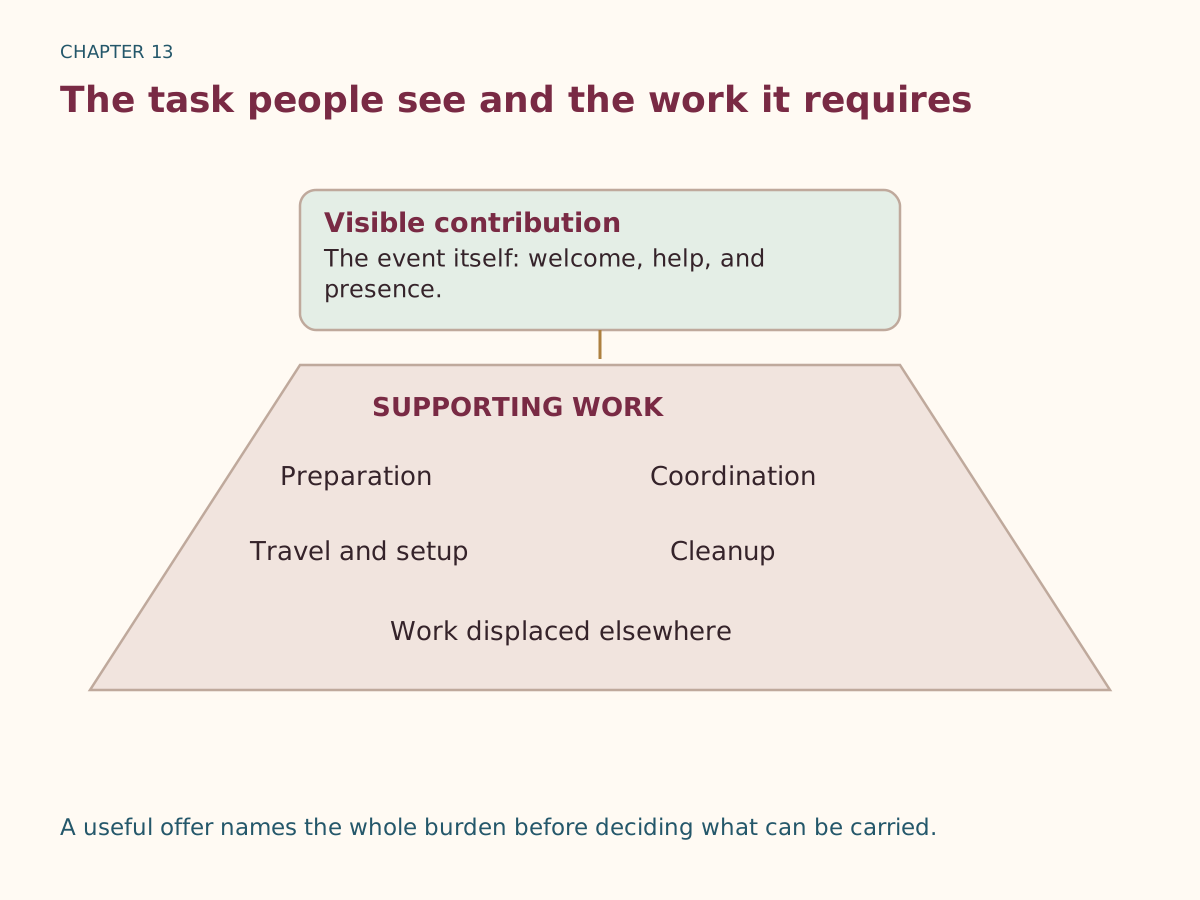
Before a useful event opens its doors, someone has usually performed tasks that will receive little attention once the event begins. Materials have been counted. Tables have been placed. Instructions have been checked against the actual room. The work has an ordinary quality, yet it carries part of the event's promise. A reader who feels troubled when everyone discusses the mission while necessary tasks remain untouched may be noticing a place where practical service could make a meaningful contribution.
Consider this fictional school-supply distribution evening. Families have been invited to collect materials requested through a community program. Volunteers have gathered the supplies, and the coordinator has prepared the assignments. Two hours before opening, several boxes remain unmarked, the welcome table lacks its information sheets, and the people preparing collection packets are waiting for a corrected list. A volunteer named Noor sees many things she could do. The difficulty is choosing help that serves the actual plan and can be carried through responsibly.
Noor's first impulse is to open the boxes and begin making packets. Before doing so, she asks the coordinator which list is current and what is delaying the team. The answer changes her proposed contribution. The supplies are ready, but the coordinator needs someone to compare the revised quantities with the available stock. Noor can do that task while another volunteer prepares the welcome materials. Her willingness to act becomes more useful through a brief understanding of what the work presently requires.
Help begins with the person's task
Romans names service among the differing contributions of the community, and First Corinthians includes helps in its account of gifts and the body. Romans 12:3–8 1 Corinthians 12:4–31 Necessary practical work belongs within this picture of shared service. In this chapter, the question is how to offer that work without losing sight of its actual weight. What appears to be a spare pair of hands may be providing judgment, preparation, physical effort, and a substantial portion of the event's reliability.
Useful help begins with an understanding of whose task is being supported and what that person needs. At the distribution evening, the coordinator is responsible for ensuring that the prepared packets correspond to the agreed requests. Noor can offer a concrete contribution to that responsibility. If she independently creates a different packing method because it seems faster, she may generate additional work for the people who must reconcile the result. Good intentions deserve the company of a clear question about the task they intend to serve.
Noor asks what the completed count must show. The coordinator needs the available quantity of each item and a separate note of damaged materials before deciding what each packet can contain. Noor begins with the revised list. A second volunteer wants to start packing from an older printed list and argues that counting first will lose time. They compare the two lists and find a changed notebook requirement. The disagreement is resolved by the work's actual dependency: packing before the count would make a neat pile of packets that would later need to be reopened.
Initiative belongs within this work. Noor can arrange the cartons so both counters can reach them and report a missing label. When an action would change what a family receives, she brings it to the coordinator. The distinction follows the consequence of the choice, leaving room for useful action near the task.
The helper should also distinguish a necessary correction from a personal preference. Noor might prefer a different folding method for the packets or a more elaborate arrangement of labels. If the existing method meets the agreed need, redoing that work would consume time and could unsettle another volunteer's contribution. She can ask whether an alteration would solve an actual problem before changing it. Practical service includes receiving work that has been completed competently by someone else, even when the result carries a different style from the helper's own.
The request that interrupts another promise
While Noor sorts the notebooks, the registration volunteer asks her to take over the welcome desk. The volunteer has been called away unexpectedly and sees Noor nearby. Noor wants to help. She also has half a count and two open cartons that nobody else understands yet. If she simply moves to the desk, the event gains a welcoming presence and loses the information needed for packing. A useful response has to make that exchange visible.
She tells the coordinator what is complete, what remains, and why leaving now would delay the packets. The coordinator first says that everyone needs to be flexible. Noor agrees that the plan can change, then asks which task should stop and who will finish the remaining count. Her question is specific enough to resist becoming a dispute about generosity. The event cannot spend the same twenty minutes of her attention twice. Naming that fact gives the coordinator a real choice to make.
The coordinator arranges for another volunteer to welcome arrivals and keeps Noor on the stock check. The reception will have one person for the first few minutes instead of two. Some families will wait briefly, and the coordinator prepares to explain that honestly. This is an imperfect answer under the time available. Refusing to make the tradeoff explicit would not spare anyone the consequence; it would merely allow the waiting to appear as a surprise. Practical service includes helping a group see what its requests actually cost.
Noor also declines a different request: moving a heavy display with equipment she does not know how to use. The display would improve the room's appearance, but opening does not depend on it. The team leaves it in place and changes the table arrangement. Her refusal preserves attention for the task she can perform responsibly. Willingness has a stronger contribution when it is joined to an honest account of competence and the importance of the proposed work.
First Peter describes serving one another as stewardship of received gifts and refers to the strength God supplies. 1 Peter 4:10–11 This language gives service a source and a purpose; it does not make one helper the entire supply of strength for a community. Noor's participation belongs among the contributions of others. A group can receive her effort gratefully while still answering for the tasks it has promised to perform. Faithfulness calls for an honest offer, not a fictional account of unlimited human availability.
The distinction becomes especially important when the most willing person is always nearest to an unfinished task. Noor has offered to stay until opening because she has a later commitment. Leaving then will be visible; the preparation she has already completed will be less visible. The coordinator needs an accurate account of both. A person's departure time does not tell the whole story of their service. The work already given should not vanish from view when the next need appears.
The weight hidden inside a small request
Some requests sound small because their preparation remains invisible. “Could you put out the packets?” may require locating a current list, arranging the room, labeling different materials, and checking what has already been promised. Before agreeing, a helper can ask what the request includes. This is a way of understanding the responsibility. It also helps the person making the request see the actual work involved. A clear account allows the group to divide the task fairly and give it enough time.
The notebook count exposes more work than the original request named. Three types are mixed in identical cartons. A count requires sorting, matching the types to the revised requests, setting damaged books aside, and then counting what can actually be used. Noor writes these steps beside the task before reporting the delay. This small description changes the discussion. The group can see why “count the boxes” was an inaccurate name for the work and why two people are now needed to complete it before opening.
The same care applies to cleanup. The public event may end at seven, while the room must be restored and unused materials recorded afterward. These tasks deserve an explicit place in the volunteer plan. A community should be cautious about relying on whoever finds it hardest to walk away from unfinished work. Practical service is valuable enough to be scheduled, shared, and acknowledged. The helper's willingness should enrich the arrangement without becoming a substitute for the group's responsibility to organize the necessary effort.
When another volunteer brings corrected labels, Noor gives them a place in the count. The labels distinguish usable supplies from damaged materials, allowing both counters to record the same categories. Receiving the contribution improves the result and shares the understanding behind it. The helper's own work becomes more dependable through what someone else brings.
Help can carry judgment
Practical service is sometimes described as though it requires only a willing pair of hands. Yet the helper may be the first person to notice that the plan does not match the situation. Noor discovers that the current count cannot supply every packet as specified. She has information the coordinator needs before making the next decision. The helping role should include a route for such information to be heard. Receiving that observation respectfully allows the group to benefit from the attention exercised close to the task.
Noor reports the item, the usable quantity, the damaged quantity, and the difference from the revised request. She shows where the count is recorded. This gives the coordinator information with which to decide what to promise families. Noor leaves the cause of the shortage open until the group has evidence about it. An accurate count is already a substantial contribution; adding an unsupported accusation would make the problem harder to address.
The shortage itself requires a distinction between inventory and allocation. There are enough notebooks for the original list but too few for the revised request. Noor recounts the relevant carton with another volunteer and reports the usable total. The coordinator decides how to adjust the packets and what families should be told. Noor does not quietly vary packets according to whichever box she reaches. Her judgment supplies dependable information; the allocation decision addresses the commitments made to the families.
A helper may also need to challenge an unfair expectation. If the same person is repeatedly assigned the least visible tasks while others receive development opportunities, the arrangement deserves examination. Noor can describe the pattern and ask for a more balanced division. That conversation concerns the stewardship of people as well as work. A community that honors varied contributions should be able to value necessary service while also allowing those who provide it to learn, lead, and express other capacities.
Leaving a stronger plan behind
Noor works alongside a new volunteer who learns the count by checking one carton with her and then completing another. Their independent numbers disagree. They retrace the work and discover that one person included the damaged notebooks while the other excluded them. The discrepancy becomes a useful question about the result the team needs. They label the categories clearly and record both totals. Working together has improved the information and given the newer volunteer a reason for the distinction.
This learning does not require Noor to take over every uncertain movement. Once the categories are clear, the other volunteer completes the next carton. Noor continues a different portion of the count. The work becomes shared through a manageable explanation and an actual opportunity to act. At opening, the coordinator receives a record that both volunteers understand. The result no longer depends on Noor remaining beside the cartons to translate it.
The event still begins later than planned. Several families wait while the last packets are finished. The coordinator explains the delay accurately. At the later planning conversation, Noor brings her full task description. The coordinator first observes that every event has unexpected work; Noor asks which steps were genuinely unexpected. Sorting mixed supplies and restoring the room were foreseeable. The next plan gives both tasks time and people of their own. Her contribution includes the count and the evidence that improves the group's understanding of its labor.
Paul describes love as patient and kind and as taking no account of evil. 1 Corinthians 13:1–7 In this application, Noor can document recurring omissions factually and seek correction while refusing to cultivate a private account of everyone's inadequacy. Naming the work gives the group something it can address. It offers a more truthful path than agreeing outwardly while allowing resentment to grow around responsibilities nobody has discussed.
For the reader, begin by tracing one request all the way through preparation, execution, and restoration. Which work does its short name conceal? Which earlier promise will a new request displace? What observation from the task could improve the next plan? These questions give practical help its full dignity. The contribution reaches beyond finishing an unattended object; it helps a community understand what its promises require and how that effort can be carried together.