
In this fictional community studio, three records describe the same afternoon differently. A volunteer's notebook reserves the room for an exhibition installation. A workshop leader's message confirms a children's drawing class. The calendar near the door contains neither arrangement because nobody has updated it. At three o'clock, the two groups arrive with materials and reasonable expectations. The confusion has a human destination: people must now wait while volunteers reconstruct promises that should have been clear before anyone traveled to the studio.
Elias helps the two groups arrange separate portions of the afternoon, but the compromise costs both of them. The exhibition installers lose preparation time, and the drawing class starts late. He adds every booking to a shared calendar that evening, expecting the problem to be solved. A week later, a room change reaches the calendar but not the volunteer holding the key. The first repair has gathered information into one place without making changes dependable. Elias now has a more precise administrative question: how does a record remain trustworthy as people revise the promises it contains?
What the arrangement is for
Administration begins by asking what people need to be able to count on. In the studio, workshop leaders need a confirmed room and enough time to prepare it. Participants need accurate arrival information. Volunteers need to know who will open, who will close, and whom to contact if plans change. The studio also needs a reasonable account of how its limited hours are shared. These needs give the administrative work its purpose. They are more useful starting points than a wish to create an impressive collection of forms.
Elias invites two workshop leaders and a volunteer who opens the space to walk through a recent booking from request to departure. They describe where information became uncertain. One leader thought a conversation counted as a reservation. Another assumed the person accepting a booking would also arrange a key. The opener had received a time without a contact name. Their accounts reveal several missing connections. Elias can now design around the actual work, including the assumptions that each person reasonably made from their own position.
This approach gives people a role in shaping the order they will use. It also allows a proposed system to be tested against a concrete day. A reservation method may look clear to its creator while leaving a volunteer uncertain about a changed arrival time. Inviting that volunteer to trace the process is a form of respect for their knowledge. Administrative service becomes stronger when it treats the people at each handoff as contributors who can identify what the arrangement requires.
The useful minimum
The studio chooses one shared schedule and a short reservation record. Each record contains the activity, responsible contact, room, start and finish times, preparation interval, access arrangement, and confirmation status. These fields have a reason: each supports an action or resolves a predictable ambiguity. The record leaves out details that nobody needs to carry out the booking. A useful system earns its complexity through the work it supports. Every requested item should have an intelligible destination in the process.
A distinction between requested and confirmed bookings addresses the first recurring confusion. Anyone may enter a request, while a designated coordinator confirms that the room and access arrangements are available. A request does not silently become a promise. The person asking for the space receives a clear response, and other volunteers can see the status without reconstructing an earlier conversation. This small distinction protects both welcome and honesty. The studio can respond warmly while remaining accurate about what it has actually agreed to provide.
Order becomes burdensome when it asks people to perform steps whose purpose they cannot understand. Elias therefore explains the booking method through the situations it prevents. Preparation time protects the next group from arriving before a room is ready. A named contact allows a volunteer to resolve a question without searching through unrelated conversations. Confirmation status protects participants from an invitation based on an unapproved request. These explanations help people judge the process intelligently and suggest improvements when a step no longer serves its intended purpose.
The studio can add a field when a new responsibility needs it and stop requesting a detail whose purpose has ended. The question is which decision each item supports. A growing collection of records should remain an intelligible account of the work.
Information carries a responsibility
Some information exists to coordinate a task; other information belongs to a person's private circumstances. Administration should attend to that difference. A studio volunteer may need to know that a participant requires a particular entrance to be available. The volunteer does not necessarily need the participant's personal history. Collecting and sharing information should follow the needs of the work and the permission of the person concerned. The studio can explain why it requests each detail, who will receive it, and how the person can correct an inaccurate account. These ordinary questions keep the proposed arrangement accountable to the people described by its records.
In the studio, a workshop leader writes a long personal explanation about a participant into the public schedule. Elias recognizes that the useful operational detail is much narrower. He asks the leader to confirm what arrangement the participant wants and moves the private explanation out of the shared booking view. The appropriate record says which access arrangement has been agreed and who will prepare it. The person remains more than a note in a calendar, and the volunteers receive what they need to act respectfully.
Language changes the usefulness of a record. Calling a workshop leader “difficult” leaves the next volunteer with an interpretation to inherit. Recording the agreed contact method and the unresolved booking question gives that volunteer an action to take. Elias asks whether each entry describes the arrangement fairly enough that the person concerned could recognize it. Where a judgment is needed, its basis belongs with the people responsible for making it.
A record can also outlive the reason for collecting it. The studio keeps operational details only for a defined purpose and reviews whether older entries still belong in the active view. Historical booking information may help explain an earlier commitment; private background should not accumulate merely because a form has room for it. Elias separates the current schedule from restricted records that serve a continuing responsibility. This is a practical design choice within the studio, not a claim that one retention rule fits every organization.
What changes when the record changes
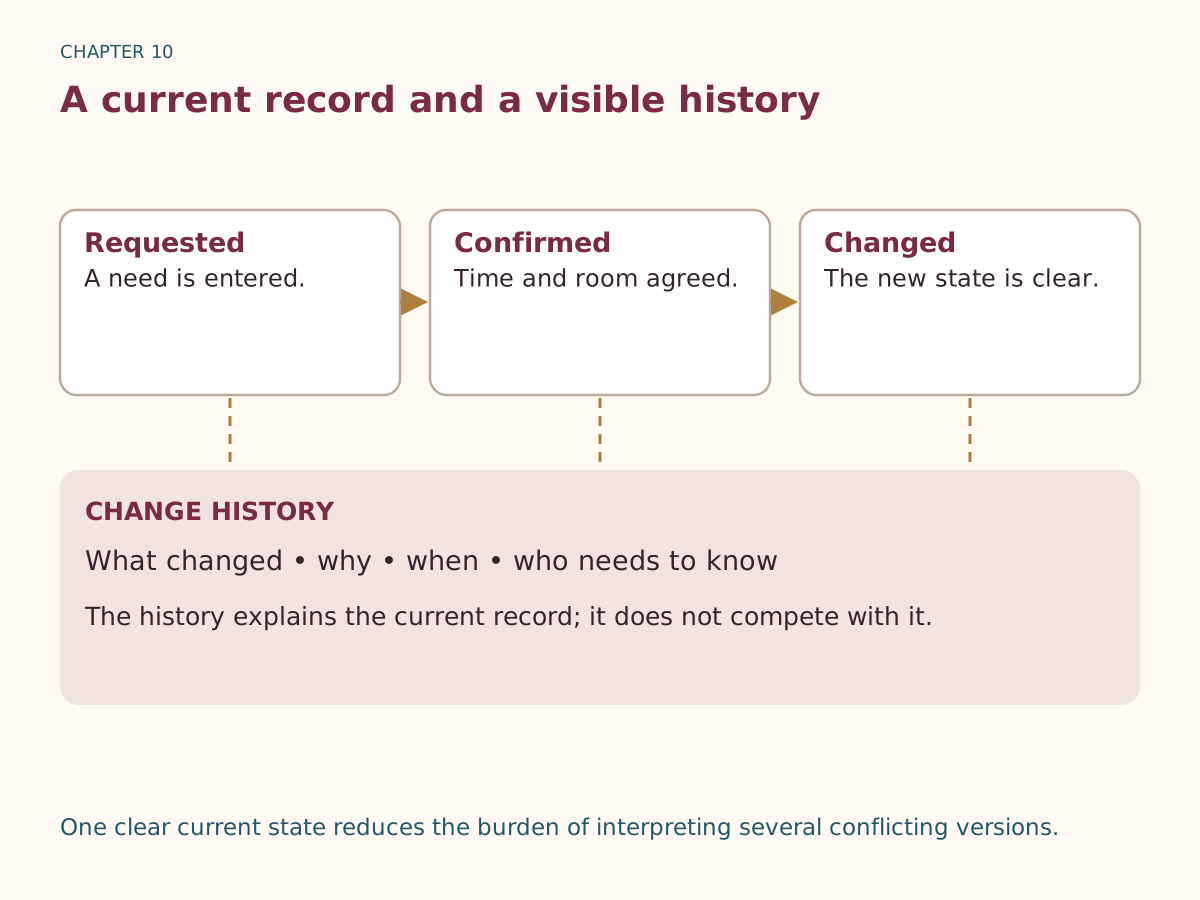
The studio learns to distinguish three things: the current arrangement, the history of how it changed, and the message needed by someone whose next action is affected. The calendar answers which room is booked now. A short change note explains that the earlier room became unavailable and records who confirmed the replacement. A direct message reaches the key holder before arrival. These functions belong together, yet one cannot simply stand in for the others. A perfect history cannot open the correct door if nobody learns about the change in time.
Elias gives each booking a stable reference, so a change to its title or room does not make it appear unrelated. The record distinguishes a request, a confirmed booking, a pending revision, and a cancellation. When a new room is proposed, the last confirmed arrangement remains visible until the revision is accepted. A person checking the record can see what is promised now and what is still being discussed. These labels should explain the next responsible action. A status whose meaning only the administrator understands adds uncertainty.
The group tests a changed booking from both ends. The coordinator moves a workshop in a practice copy and drafts a notification: “The workshop is confirmed in Room B. Please use the Room B key and acknowledge that you have the revised arrangement. The start time is unchanged.” The opener explains the action this requires. The workshop leader notices that the earlier invitation still names Room A and prepares a correction for participants. The test has traced the change beyond the calendar into the promises already circulating.
The date of an event and the date when its record changed answer different questions. The first tells someone when to arrive. The second helps explain whether a printed schedule could be out of date. Elias adds a visible last-updated note to the weekly printout and includes a contact for late changes. A volunteer who works from paper can now tell which version they hold and how to check it. Accessibility here includes a workable route for a person who cannot consult the online calendar at the door.
At a later session, the internet connection is unavailable. The opener uses the latest printed list and calls the designated contact about a handwritten addition. The contact confirms what was agreed and checks for a conflict. When access returns, the addition enters the common record with its actual confirmation time and a note that it was entered later. The temporary method has a way back into the shared account. A later reader can distinguish when a promise was made from when it became visible online.
Correction needs similar care. If the record says the exhibition ended at four when it actually ended at five, quietly replacing the time may conceal why another group was delayed. Elias distinguishes a clerical correction from a change to the actual commitment. The history should remain sufficient to explain what people were told, while the active view should show what they need now. Preserving that distinction helps a group learn from a mistake without making every user study its entire past.
The difficult week between two systems
A new calendar does not make the old notebook disappear from people's habits. Before introducing the revised method, Elias and the coordinator reconcile the confirmed bookings in every existing record. They contact the few leaders whose arrangements conflict. Each current booking receives one agreed entry. The original records are preserved as historical material, clearly separated from the source that now governs future reservations. This prevents a technological change from canceling an earlier promise merely because its holder missed the announcement.
During the first week, a familiar workshop leader sends a request through an older message thread. The coordinator answers there and records the request in the new system, explaining where confirmation will appear. This bridge is temporary and visible. The group names an end date for accepting routine requests through scattered channels, while retaining a clear alternative for people who need help using the shared form. Transition becomes a task with a finish, not an indefinite expectation that everyone will eventually notice.
Elias initially designs a single dense view containing every field. The opener reports that the room and contact are hard to find among purchasing notes and background details. The coordinator needs those additional fields; the opener does not. They create two views of the same record. The underlying booking stays consistent, while each person sees the information relevant to the decision in front of them. Order serves people through useful differences as well as shared standards.
The studio's administrative work remains a human contribution. First Corinthians names helps and a contribution rendered as “governments” in the linked translation, within its account of the interdependent body. 1 Corinthians 12:4–31 That text provides the biblical connection for considering administration here. The studio is a practical application: a useful arrangement makes other people's participation more dependable. The shared work is the destination of the detail, even when the person who prepared it receives little notice.
Maintenance then becomes more specific than asking whether everyone is being organized. The group checks a sample of records: does a canceled event still appear on a printed list; does a former volunteer retain responsibility for an upcoming booking; has a temporary workaround become routine; does an unused field still demand attention? Each question concerns a recognizable way that information can drift away from the work. The answer may call for a correction, a clearer instruction, or removal of an unnecessary future requirement while retaining the past record.
No system can remove every disappointment or careless action. Its reasonable contribution is to make important commitments legible, changes traceable, and errors discoverable while correction can still help. Elias can assess the arrangement through those purposes. A beautiful calendar that nobody can use has missed them. A plain record that supports the next person's judgment may fulfill them well. Administrative care earns its form through the actions it makes possible.
At the next exhibition installation, the room assignment has changed again. This time, the leader receives the correction, the key holder acknowledges it, and the posted arrival notice directs visitors accurately. The absence of confusion is no longer dependent on one volunteer reconstructing three conversations at the door. It comes from an arrangement that carries its own changes honestly. For the reader drawn to order, this is substantial work: helping shared information remain worthy of the reliance people place upon it.