
There is a particular frustration in watching an explanation fail to become understanding. The instructions have been given. The demonstration has been repeated. A document contains the steps. Still, a colleague hesitates at the same point, and the person explaining begins to wonder whether anyone is listening. Before that concern becomes an accusation, it can become a teaching question: what does the learner need to understand in order to use what has been explained?
Consider this fictional editorial team preparing a collection of community resource guides. Its members are learning an unfamiliar digital tool that allows them to comment on a draft, mark a question for review, and indicate when a concern has been resolved. An experienced editor named Lena demonstrates the sequence confidently. She opens a guide, selects a sentence, adds a comment, and changes its status. The team watches. When members try the process themselves, several choose the wrong status, and one closes a question that still requires an answer.
Lena could repeat the sequence more slowly, and that might help with some difficulties. Yet the mistake about status suggests a deeper gap. The team has seen where to click without understanding what each status means for the shared work. A person who marks a question resolved is communicating something to every later reader. Teaching now requires an explanation of that meaning, an opportunity to practice the decision, and a way to see whether the distinction has become usable.
Begin with the work a learner must do
Teaching appears among the differing gifts described in Romans. Romans 12:3–8 In this chapter, the practical question is what a teacher contributes between a correct explanation and another person's ability to reason with it. Lena knows the tool well. Her next work is to make the distinctions behind her actions available to people whose experience is different from her own.
A useful teaching purpose describes what someone should be able to do with their understanding. “Learn the tool” leaves a large and indistinct task. In the team, a more helpful purpose is to enable each reviewer to raise a clear question, find the response, and judge whether that response addresses the concern. This purpose guides the demonstration. Lena can leave advanced features for another occasion because they do not serve today's responsibility. Selecting a manageable purpose is part of respecting the learner's attention and the work's immediate needs.
The purpose also determines what counts as evidence of learning. Watching a demonstration is evidence that a person was present for it. Successfully following a sequence while someone prompts every step shows a particular level of supported performance. Independently choosing the appropriate action in a slightly different example shows something further. These distinctions offer a practical way to avoid asking a single learning activity to prove too much. A teacher can appreciate progress while remaining precise about what the learner has actually had an opportunity to practice.
Lena asks the team to describe the review process as they currently understand it. One member thinks comments are suggestions that a writer may accept or ignore. Another believes every comment represents a required correction. Their different assumptions explain why the same button carries different meanings. The team must first agree on how questions, suggestions, and required corrections will be distinguished. Teaching sometimes uncovers a decision the group has never made. An explanation cannot make an unsettled process clear until someone takes responsibility for settling it.
Make the reasoning visible
A knowledgeable person may move through a task using distinctions that have become familiar enough to remain unspoken. To teach the task, that person can bring those distinctions into view. Lena selects an example in which a draft lists an opening time without a source. She explains why she is raising a question, what information would answer it, and who is responsible for supplying that information. The tool's sequence now sits within an intelligible act of review. Each action serves a reason the learner can examine.
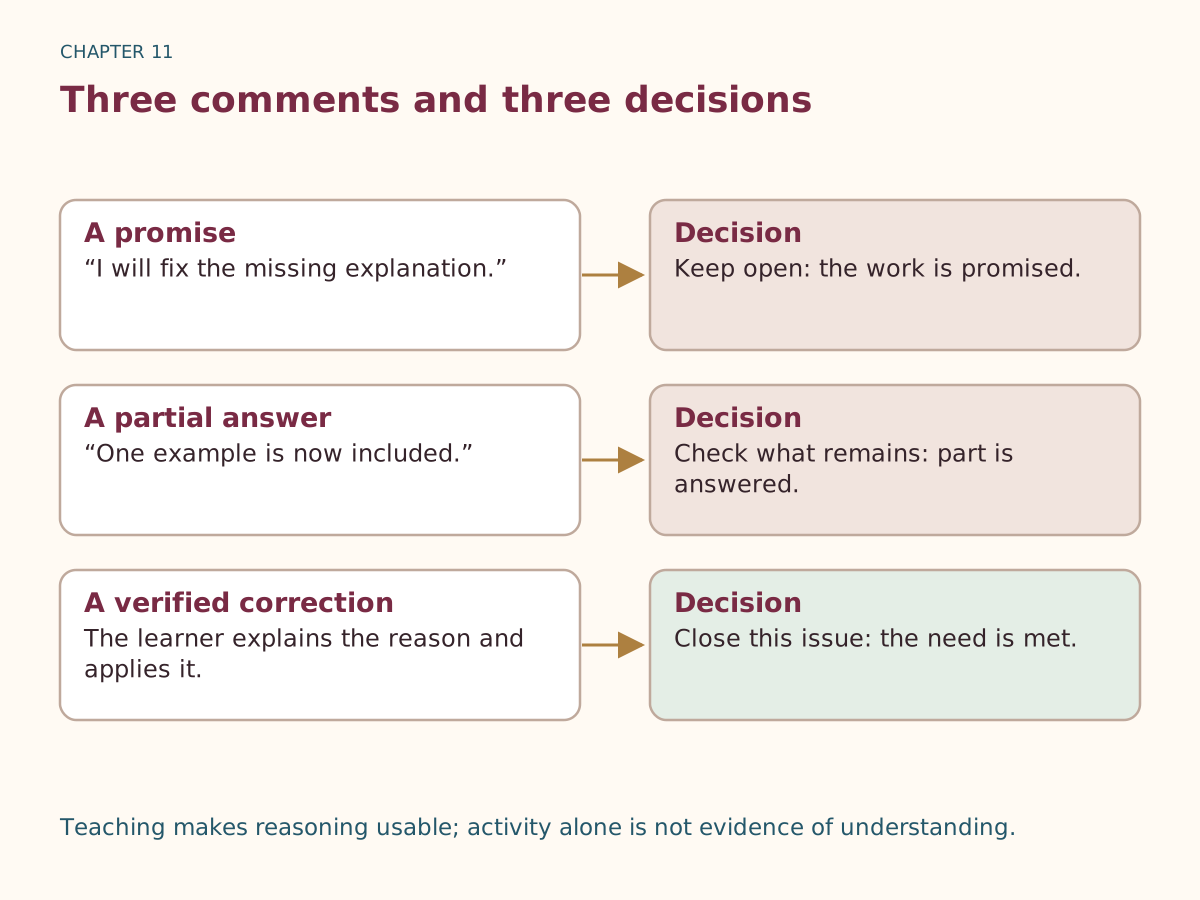
Lena prepares three short review exchanges. In the first, the writer replies, “I will check the opening time tomorrow.” In the second, the writer supplies a source for the weekday hours but leaves the weekend hours unanswered. In the third, the writer corrects both sets of hours and supplies the relevant source. All three replies are cooperative. Only the third provides the information required to complete the review. The reviewer must still check the source against the revised text before closing the question. A source's presence and a verified answer are distinct stages.
Clear language matters at this point. A term such as “resolve” may sound ordinary while carrying a particular meaning in the team's workflow. Lena defines it in the context of the task: the concern has received an adequate response, and the responsible reviewer has checked that response. She also names what the term leaves open. Resolving one comment does not certify the accuracy of the whole guide. This boundary helps the learner understand the scope of the action and prevents a small signal from acquiring a larger meaning than the group intended.
An explanation can use more than one form without becoming an overwhelming collection of materials. Lena provides a brief written example showing the original question, the response, and the reason the concern can now be closed. She walks through it aloud and allows people to follow at a pace they can manage. If a team member needs a different way to access the material, they discuss an appropriate arrangement. Teaching serves the learner by making the relevant understanding available through a usable form.
Lena then presents a fourth case: the source is unavailable. The reviewer can describe the missing evidence and leave the concern open. This extends the lesson beyond choosing among successful replies. A person who understands the work can recognize when the present information does not support closure and formulate the precise question that remains. The correct use of a tool may preserve uncertainty visibly while the group seeks an answer.
Give understanding a place to show itself
After the demonstration, Lena offers the team a practice guide created for learning. It contains a few clearly identified fictional details, so no mistaken action will change a resource intended for public use. Each person raises one question and responds to a question from a partner. The activity gives them a bounded place to attempt the task. Lena can observe where the explanation helped and where another distinction needs attention. The practice has a purpose beyond filling the remaining meeting time.
A useful learning check asks for the understanding the task actually requires. Asking whether everyone understands may produce a polite answer without showing much about the next action. Lena instead asks a reviewer to explain why a particular concern remains open. Another reviewer shows what they would do if the response answers only half the question. These invitations reveal the reasoning behind the action. They also give the teacher something specific to address, which is more helpful than assuming that hesitation signifies a lack of effort.
Lena explains that the practice is meant to reveal what needs further teaching. She identifies an error accurately without treating it as a public judgment about intelligence or suitability. The response gives learners a reason to show their actual reasoning, including the part that has gone wrong.
During the practice, one member closes the first comment because the writer has promised to respond. Lena asks what the next reader would reasonably infer from a resolved status. The member answers that the opening hours have been checked. The contradiction becomes visible in the learner's own account: the promise refers to a future action, while the status would communicate a completed one. They reopen the question. Lena has helped the learner connect the choice to its consequence, which is more useful here than another demonstration of the button.
A later check may determine readiness for independent review. Lena names that purpose and its standard before the check begins. Learners can then distinguish an opportunity to practice from a decision about responsibility. A private format remains available where it would show the required understanding more fairly.
The learner can also help evaluate the teaching. A team member tells Lena that the written directions assume everyone knows where the current version of a guide is stored. That omission occurs before any of the steps she has demonstrated. Lena adds the starting location and shows how to confirm that the correct draft is open. The explanation becomes more complete through a learner's question. A teacher willing to receive such information demonstrates that understanding the work matters more than preserving the appearance of an impeccable lesson.
When an explanation does not carry the whole burden
Repeated difficulty deserves a careful description. Which step is failing, under what conditions, and for whom? In the team, one reviewer can perform the task during practice but cannot access the relevant guide later. Another understands the procedure and has more assigned reviews than the available time permits. A third still confuses a suggestion with a required correction. These difficulties call for different responses. Access requires an access decision, workload requires a capacity discussion, and the conceptual confusion requires further teaching.
Lena brings the access problem to the person who manages permissions and asks the coordinator to revisit workload. She continues teaching the distinction between a suggestion and a required correction. These responses follow the difficulties the team actually encountered. They prevent another general training session from absorbing time while leaving the missing access and excessive assignments untouched.
A different difficulty appears when a learner can explain the distinction accurately and still chooses the wrong status in a crowded draft. Lena watches the task as it happens. The learner is responding to a row of similar icons while several comments overlap. More explanation of the concept would repeat knowledge already present. Lena simplifies the practice view and asks the learner to identify one concern at a time before returning to the fuller document. The response follows the observed difficulty: finding and acting on the relevant information amid competing signals.
Another reviewer understands the process and objects to it. He believes the writer should close every comment because the writer knows what was changed. Lena initially repeats the instruction that the responsible reviewer closes factual questions. He interrupts: “I understand that. I am asking why the writer cannot do it.” She stops teaching the sequence and addresses the reason for the rule: a second person checks that the response actually meets the concern. He remains unconvinced about minor stylistic suggestions. The group decides to distinguish their treatment. An informed objection has improved the process; it was never evidence of a learning failure.
Equipping people to continue
Ephesians describes forms of ministry that equip others for service and connects the body's growth with the contribution of its parts. Ephesians 4:11–16 As an application, a teacher can ask whether their work is increasing other people's ability to participate thoughtfully. That question is broader than whether the explanation was admired. It includes whether learners can recognize a relevant problem, use the available resources, ask a precise question, and carry appropriate responsibility when the teacher is absent. The hoped-for result is a community with more usable understanding.
Lena therefore prepares a compact reference that follows the decisions the reviewers actually make. It begins with the purpose of review, defines the three kinds of comments, and shows an example of each. It identifies where an unresolved question should go. The reference contains enough information to support ordinary work without reproducing every word of the training session. A durable teaching aid should be easy to consult at the point of need and clear about where further help can be found.
The team arranges a later opportunity to discuss questions that arise during real review. This gives learners a known place to bring difficulties without requiring Lena to watch every action. A member who has grasped the process well can help demonstrate one case, provided they are willing and their explanation has been checked. Teaching can be shared. The person who first offered an explanation may discover that another person's example makes a particular distinction easier for the group to use.
Lena also discovers that her own reference sheet used “resolved” in two different ways. One example treated the writer's response as sufficient; the later definition required review of that response. Learners who followed the first example acted reasonably on what she had supplied. She corrects the example, names the conflict in the next session, and asks the team to revisit comments closed under the earlier instruction. The work takes time that her original lesson did not budget for. Taking responsibility for a teaching error includes helping people repair its consequences, not merely presenting the improved explanation.
This correction gives the group another kind of lesson: knowledge can be stated clearly and still need revision. Lena's willingness to identify her own mistake protects the learners from carrying a false account of theirs. The love described in First Corinthians is patient and rejoices with the truth. 1 Corinthians 13:1–7 Applied here, that means caring about an accurate explanation of how the misunderstanding arose, including the teacher's part. Learners deserve correction that follows the evidence.
A recurring teaching difficulty can now be approached through three separate inquiries. What distinction has the learner not yet grasped? What feature of the setting prevents the learner from using an understanding already present? What part of the process does an informed learner believe should change? Listening to an actual attempt helps locate the difficulty. The teacher can then choose an explanation, a practical adjustment, or a discussion of the rule, giving each response a purpose the situation supports.
At the team's next meeting, a reviewer brings an unresolved question with a clear account of what is missing. Another explains why a suggestion was accepted while a required correction remains open. Their work still needs judgment and occasional help. Yet they can now speak about the process with increasing precision. Lena's teaching has found a place beyond her own voice: in the questions other people can formulate and the responsibilities they can carry with understanding.