
Grace sets the starting point
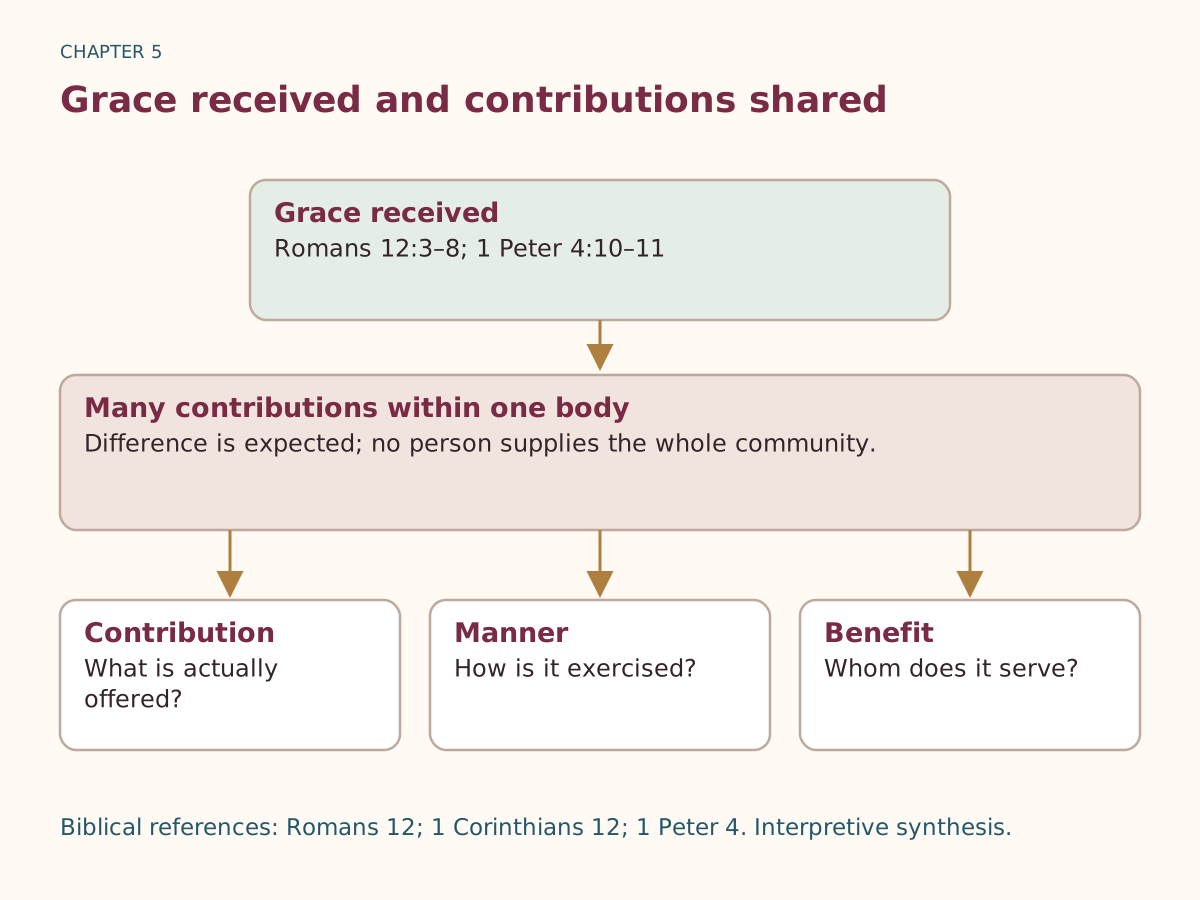
Romans speaks of differing gifts given according to grace and calls for sober judgment about oneself within a shared body. Romans 12:3–8 The passage places personal contribution within belonging. The gifts appear in a community whose members have different functions. That setting matters when you begin asking what a concern or capacity might mean. The inquiry is already connected to other people who can receive, support, and assess the service.
Grace also changes the spirit of the question. An entrusted contribution is something to receive and use responsibly. It need not become a prize that proves superior worth. You can approach discernment with gratitude for what is presently available and with curiosity about what remains undeveloped. The absence of a confident label does not prevent you from performing an ordinary act of service with care.
Consider a fictional neighborhood congregation preparing a Saturday repair morning. Residents will be able to bring small household objects for assessment by volunteers who have agreed to offer appropriate help within their competence. Around the planning table, one person immediately sees the need for a clear intake process. Another asks how newcomers will be welcomed. A third offers supplies. Someone else wants to explain simple maintenance tasks so visitors can carry useful knowledge home. The conversation contains several possible contributions before anyone names a spiritual gift.
One volunteer asks, “Which gift am I supposed to have?” The question is sincere. She wants to participate faithfully and fears choosing the wrong role. The group could answer too quickly, matching her profession to a gift or handing her a label based on one meeting. A more patient response would help her see the actual service before her, consider what she can offer, and remain open to learning with the congregation as the work unfolds.
A sober account of yourself
Romans places its discussion of gifts beside an appeal to sober judgment. Romans 12:3–8 Such judgment requires an account proportionate to the truth. You can acknowledge a well developed capacity without treating it as a reason for superior rank. You can also recognize an undeveloped capacity without pretending that nothing useful has been entrusted to you.
False modesty can obscure this truth. If others regularly receive help from your explanations, denying that you can explain anything makes an honest conversation harder. Appreciation need not become a claim of unlimited competence. “I can explain the intake process, and I need someone else to assess the repairs” gives each contribution a proper place.
The congregation includes an experienced repairer, a patient host, a person with supplies, and a newcomer willing to learn. They arrive with different histories and different capacities. A shared project brings these differences into contact. Grace gives the discussion a reason for gratitude before it becomes a comparison of performance.
To receive sober appreciation, ask what it names. Someone might be thanking you for preparation, clarity, persistence, or the courage to ask a needed question. Let the particular acknowledgment stand. You do not need to enlarge it into a permanent identity, dismiss it as politeness, or immediately explain why somebody else is better.
Different forms of contribution
Romans names prophecy, service, teaching, exhortation, giving, leading, and mercy within its discussion of differing gifts. Romans 12:3–8 These terms direct attention to varied forms of participation. Some involve speech. Some involve practical help, resources, direction, or compassionate attention. The passage's variety allows you to approach the community with an expectation that useful contribution will have more than one recognizable form.
Take care with the urge to turn this variety into a fixed personality chart. A person who teaches may also show mercy. A person who gives may offer practical service. A concern about a neglected visitor may move several members to act in complementary ways. You do not need to assign every action to a separate permanent identity. You can ask what the action accomplishes, how it is offered, and how the community understands its place.
First Corinthians names a further range of gifts, including wisdom, knowledge, faith, healings, miracles, prophecy, discerning spirits, languages, and interpretation. It places their variety alongside the same Spirit, Lord, and God, and speaks of the benefit of all. 1 Corinthians 12:4–31 The shared source and communal purpose belong in the reading alongside the distinct activities. You can welcome their diversity without forcing every term into an equivalent workplace role.
In the congregation, no one needs to decide whether every volunteer possesses a distinctive gift of service before arranging tables. The practical need is clear, and willing members can help within their capacity. Over time, certain contributions may become especially fruitful or consistently recognized. Those observations can enter prayerful discernment. The morning itself remains an opportunity to serve faithfully even when the interpretation is still developing.
Grace before an exchange
The language of grace challenges an account of service built entirely around earning a place. In Romans, gifts differ according to grace, within one body whose members belong to one another. Romans 12:3–8 The reader is invited to exercise a contribution within that shared life. The text does not describe a contest in which the most impressive performer acquires the strongest claim to belong.
This matters when usefulness has become your familiar way of entering a room. You may arrive prepared to solve something before anyone can question your presence. Appreciation can then feel necessary to establish that the effort bought its intended result. The theological movement of grace opens another possibility: receive what is entrusted, contribute it, and remain a member among members.
Such a posture leaves room to learn. A newcomer can ask how to use a tool without having to protect the appearance of expertise. An experienced person can receive instruction about a different task. Gratitude for the capacities of others helps make unfamiliarity bearable. There is less need to turn every moment into evidence that you were the best choice.
Consider the exchange implied by a sentence such as “After everything I have done, they owe me this role.” The hurt may contain a real concern about recognition or fairness. That concern should be addressed accurately. It cannot, by itself, establish entitlement to direct another person's work. An entrusted contribution is not a private currency that purchases authority over its recipients.
Receiving grace also allows you to receive care. A season of limited visible output does not erase the person who belongs to the community. Chapter 6 develops that communal implication. Here, the foundation is the order of the language: grace is received and then exercised in service. The contribution is held with gratitude because it was never the whole measure of the person.
Read the gift within its sentence
Attend also to the manner attached to the contributions: generosity in giving, diligence in leading, and cheerfulness in mercy. Romans 12:3–8 Reading the whole passage keeps the activity connected with its manner and its place among other members. A name alone supplies too little of that account.
A reader attracted to leadership can notice diligence as well as direction. A reader interested in giving can attend to the way resources are offered. A reader drawn to mercy can consider the spirit in which another person's need is received. These connections invite concrete reflection without reducing the passage to a list of personality preferences.
The distinctive terms should remain visible. Service and teaching can cooperate without becoming identical. Giving can support leadership without giving the donor every decision. Mercy can shape a difficult conversation without dissolving the truth that needs to be spoken. The variety has practical value because each contribution may bring something the others do not supply alone.
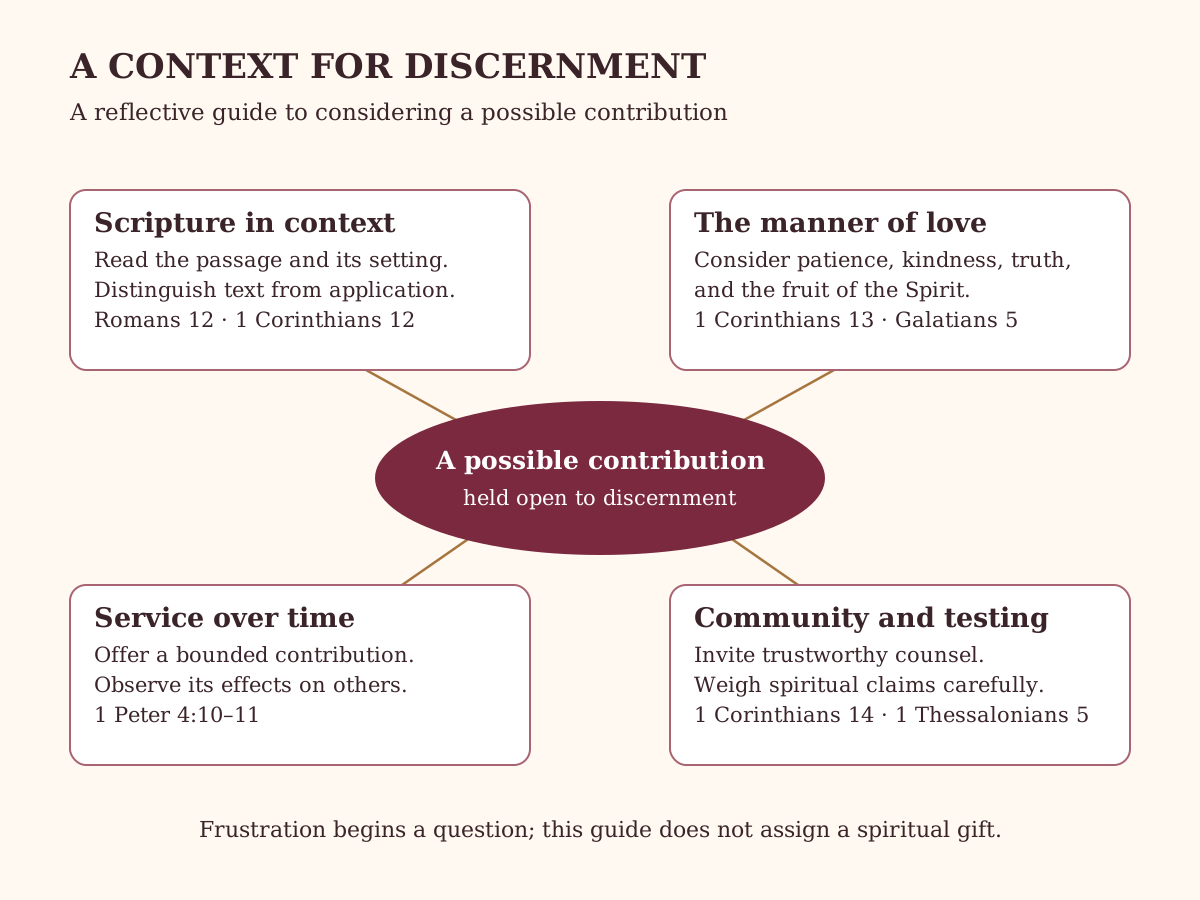
Chapter 7 examines love and the fruit of the Spirit in greater depth. For now, keep this reading habit: when a gift name draws your attention, remain with its sentence and the surrounding community. Ask what the text invites the person to do, how the contribution is to be exercised, and whom it is intended to serve.
Comparison can speak in two directions
First Corinthians gives two searching forms of comparison. A member can imagine that lacking another member's function excludes it from the body. A prominent member can also declare that it does not need another. Paul challenges both movements in the body image. 1 Corinthians 12:4–31 In one, difference becomes a reason to withdraw; in the other, difference becomes a reason to dismiss.
You may recognize the first movement when another person's fluency makes your own contribution feel small. Someone speaks clearly in a crowded room, and you begin discounting the quieter work you were ready to offer. The comparison has changed the question from “What can I contribute here?” to “Can I contribute in the way that receives the most attention?” An accurate account of your capacity can restore the first question.
The second movement can appear when experience hardens into self sufficiency. You know how to complete the task, so another person's question feels unnecessary. You have brought the resources, so a colleague's hesitation seems ungrateful. Pausing to receive what they know may reveal something your own capacity did not supply. Their difference can be useful precisely because it is a difference.
These responses need particular acts of learning. The person inclined to withdraw can name one real contribution without apologizing for its ordinary scale. The person inclined to dismiss can invite another member to explain what they see before deciding it is irrelevant. Both practices bring attention back to a shared life in which nobody carries every function.
The repair morning offers room for these discoveries. The experienced repairer needs the host who notices that visitors cannot identify the intake table. The host needs the repairer's judgment about what the team can undertake. Their cooperation does not require equal skill at the same task. It requires each to allow the other's contribution to matter.
Receiving the contribution of another
Gift discernment includes learning to receive what someone else brings. You may appreciate an organizer's clarity until their schedule limits a spontaneous idea you wanted to pursue. You may welcome a teacher's explanation until it exposes something you have misunderstood. You may value generosity until accepting help requires you to acknowledge a need. These moments invite reflection about the place you allow other people in the shared work.
Receiving does not mean suspending judgment. You can ask whether the schedule serves the event, whether the explanation is accurate, and whether the offered resource fits the need. The task is to assess the contribution fairly, without making agreement with your first preference the sole measure of its value. Another member may see a practical or spiritual concern that your attention has passed over.
In the planning meeting, the person arranging supplies proposes a smaller number of repair stations. The coordinator initially feels disappointed. On discussion, the group sees that each station needs an appropriately experienced volunteer, and the available people cannot cover the larger plan. Receiving this contribution means accepting a more modest event. The change allows the congregation to offer a service within the competence and capacity it actually possesses.
First Corinthians describes mutual dependence among members with different functions. 1 Corinthians 12:4–31 That picture can encourage a posture of grateful receptivity. You can make a contribution and also need correction, resources, care, or explanation from others. The community's life is larger than the role through which you most readily understand yourself.
A more generous first question
After the repair morning, the volunteer who wanted a settled label remembers a particular encounter. A visitor could not tell which table to approach. She explained the intake process and walked with him to the place where someone could assess his object. The contribution was modest and received. She has an actual act of service to consider.
First Peter describes using a received gift to serve one another as stewardship of God's varied grace, and speaks of serving with the strength God supplies. 1 Peter 4:10–11 That orientation directs attention to what has been entrusted and how it reaches others. It can accompany an ordinary contribution before the person has developed an exhaustive account of giftedness.
The morning also required contributions she did not provide. Someone understood the repairs; someone gathered supplies; someone recognized when an object required help beyond the available competence. She can appreciate her part while giving thanks for theirs. The shared result offers a reason to receive variety with generosity.
“What has been entrusted to me here?” is a fruitful beginning. It draws attention to the people, responsibilities, resources, and opportunities presently before you. The question leaves room for both confidence and learning. Chapter 8 will consider how observations become part of careful discernment. This chapter establishes the ground on which that inquiry stands: grace received, a community shared, and contributions offered for another's good.