Text, meaning, and visual reflection
Scripture and Visual Atlas
Consult the primary passages, consider the visual concepts, and return to the book through the chapter links. Biblical summaries and practical applications remain distinct.
Nine primary passage families
Primary text: World English Bible, updated edition. The book principally paraphrases. The linked text uses “faith” in Galatians 5:22, a word commonly rendered “faithfulness.” Translation and public-domain information.
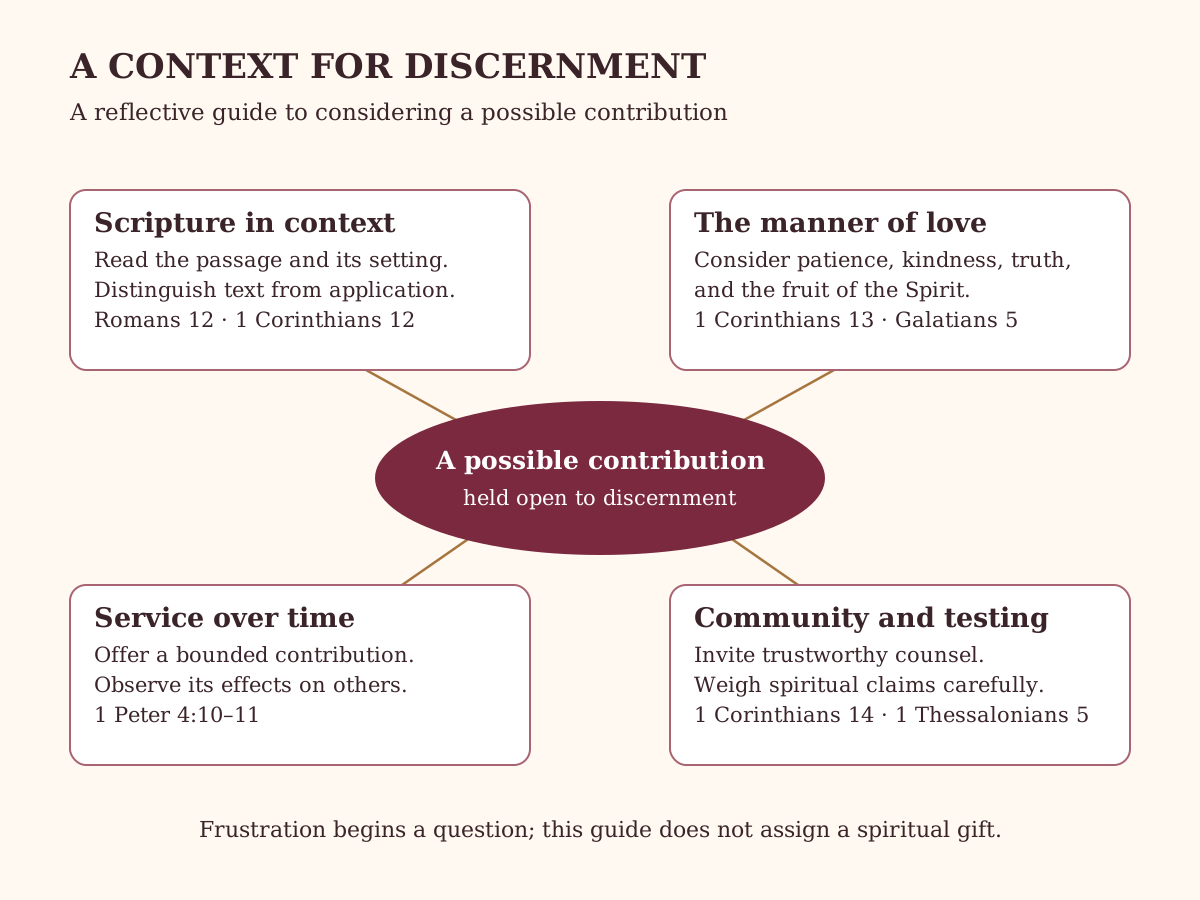
Differing gifts are situated within humility, grace, and membership in a shared body. The passage names prophecy, service, teaching, exhortation, giving, leadership, and mercy.
Reading practice: Read the whole paragraph before selecting an individual gift. Ask how the surrounding emphasis on humility changes the way a label is used.
Suggested thematic connections: chapter 5, chapter 8, chapter 9, chapter 11, chapter 12, chapter 13, chapter 14, chapter 15
Varied gifts and forms of service come from the same Spirit. Their purpose includes the benefit of others. The body image develops interdependence, care, and the value of members whose contribution may be less visible.
Reading practice: Distinguish the passage’s communal purpose from a workplace role chart. A practical analogy can illuminate service while leaving gift identification open.
Suggested thematic connections: chapter 6, chapter 8, chapter 10, chapter 17, chapter 18, chapter 19, chapter 20, chapter 24
Paul places love at the center of the discussion of gifts. His description includes patience, kindness, truth, and freedom from self-seeking or resentment.
Reading practice: Examine the manner of a contribution. A useful result and a loving process both deserve attention.
Suggested thematic connections: chapter 7, chapter 14, chapter 18, chapter 20
The passage connects prophecy with strengthening, encouragement, and consolation, and calls for other people to weigh what is spoken.
Reading practice: Welcome spiritual discernment with accountable testing. Do not convert an ordinary suspicion into a claimed prophetic message.
Suggested thematic connections: chapter 8, chapter 18
The passage describes equipping the saints, growing toward maturity, speaking truth in love, and the contribution of each part.
Reading practice: Use accompaniment and equipping as reflective applications. A professional mentoring role alone does not establish a pastoral office.
Suggested thematic connections: chapter 11, chapter 16, chapter 20, chapter 24
The fruit of the Spirit includes love, joy, peace, patience, kindness, goodness, faithfulness (rendered as faith in the linked translation), gentleness, and self-control. The passage also warns against conceit and provoking or envying one another.
Reading practice: Keep character and gifting conceptually distinct. Fruit concerns the quality of life and relationships across every form of service.
Suggested thematic connections: chapter 7, chapter 8, chapter 16, chapter 23
Received gifts are to be used in service to one another as stewardship of God’s varied grace. Service is associated with the strength God supplies.
Reading practice: Ask what has been entrusted, whom it serves, and how responsibility is shared without making exhaustion a measure of faithfulness.
Suggested thematic connections: chapter 5, chapter 13, chapter 15, chapter 21, chapter 22, chapter 24
The text encourages perseverance in doing good and making use of opportunities to do good. Its harvest language does not supply a timetable for a particular professional project.
Reading practice: Distinguish steadfastness in doing good from a promise that a chosen method will succeed by a preferred date.
Suggested thematic connections: chapter 19, chapter 23
The passage holds openness to prophecy together with testing, holding to what is good, and abstaining from evil.
Reading practice: Keep both welcome and examination present. A statement can be considered respectfully while its meaning and implications are still being weighed.
Suggested thematic connections: chapter 8, chapter 18