
Before anyone receives a label
Picture an imagined neighborhood congregation preparing a Saturday repair morning. Residents will be able to bring small household objects for assessment by volunteers who have agreed to offer appropriate help within their competence. Around the planning table, one person immediately sees the need for a clear intake process. Another asks how newcomers will be welcomed. A third offers supplies. Someone else wants to explain simple maintenance tasks so visitors can carry useful knowledge home. The conversation contains several possible contributions before anyone names a spiritual gift.
One volunteer asks, “Which gift am I supposed to have?” The question is sincere. She wants to participate faithfully and fears choosing the wrong role. The group could answer too quickly, matching her profession to a gift or handing her a label based on one meeting. A more patient response would help her see the actual service before her, consider what she can offer, and remain open to learning with the congregation as the work unfolds.
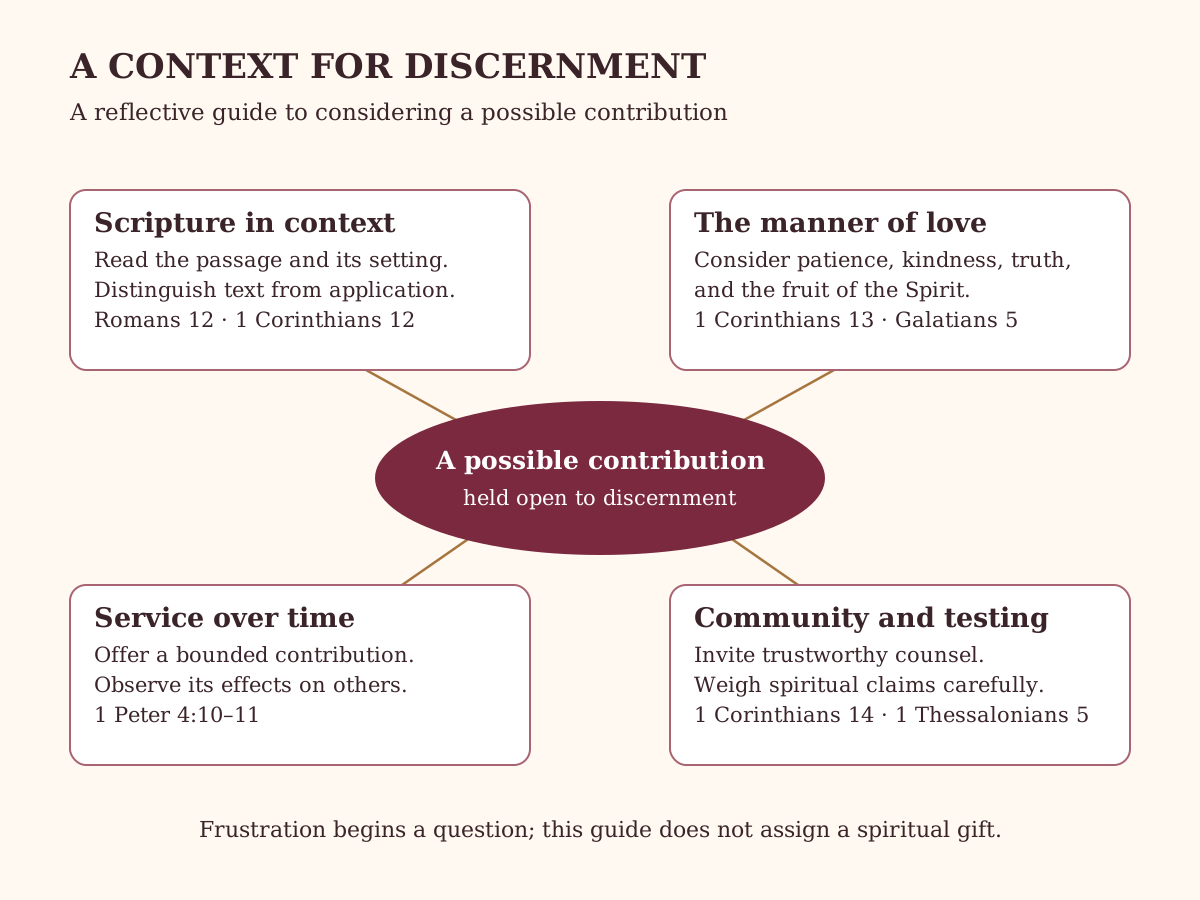
Romans speaks of differing gifts given according to grace and calls for sober judgment about oneself within a shared body. Romans 12:3–8 The passage places personal contribution within belonging. The gifts appear in a community whose members have different functions. That setting matters when you begin asking what a concern or capacity might mean. The inquiry is already connected to other people who can receive, support, and assess the service.
Grace also changes the spirit of the question. An entrusted contribution is something to receive and use responsibly. It need not become a prize that proves superior worth. You can approach discernment with gratitude for what is presently available and with curiosity about what remains undeveloped. The absence of a confident label does not prevent you from performing an ordinary act of service with care.
A sober account of yourself
Sober judgment requires more than modest language. It asks for an account that is proportionate to what you know. If you have helped organize one event, you can say that you enjoyed the work and that the team found part of it useful. You cannot yet know how the contribution will function across every setting. A careful description gives the experience its real weight while leaving room for correction and further development.
False modesty can also obscure the truth. You may have a well developed capacity that others consistently rely upon. Refusing every acknowledgment can make it difficult to discuss where you should contribute or what support you require. A sober account can receive accurate appreciation without turning it into a claim of unlimited competence. “I can coordinate this schedule, and I will need someone else to assess the technical repairs” is a useful statement of both capacity and limit.
The imagined congregation needs this kind of honesty. One member has extensive experience repairing lamps. Another enjoys welcoming visitors and has little interest in electrical work. A third can manage the registration list but cannot remain for the entire morning. Their different capacities and circumstances shape the plan. None of these facts alone identifies a spiritual gift. All are relevant to the responsible service they are considering.
It is helpful to separate what you can do, what you are authorized to do, and what the present community needs. These may overlap without being identical. A capable organizer may need to serve within decisions made by the event coordinator. A generous person may offer materials the event does not require. A gifted explanation may arrive at a moment when a visitor needs a simple answer and space to leave. Judgment includes attention to the setting.
The gift question can therefore begin with a practical offering: “Here is what I am able to contribute; would it be useful?” This gives others a real opportunity to respond. Their answer may affirm the offer, modify it, or point toward a more pressing need. Such an exchange keeps discernment connected to service that people can actually receive.
Different forms of contribution
Romans names prophecy, service, teaching, exhortation, giving, leading, and mercy within its discussion of differing gifts. Romans 12:3–8 These terms direct attention to varied forms of participation. Some involve speech. Some involve practical help, resources, direction, or compassionate attention. The passage's variety allows you to approach the community with an expectation that useful contribution will have more than one recognizable form.
Take care with the urge to turn this variety into a fixed personality chart. A person who teaches may also show mercy. A person who gives may offer practical service. A concern about a neglected visitor may move several members to act in complementary ways. You do not need to assign every action to a separate permanent identity. You can ask what the action accomplishes, how it is offered, and how the community understands its place.
The named forms also deserve their own integrity. First Corinthians directs communal weighing of prophetic speech, and First Thessalonians combines openness with testing. 1 Corinthians 14:1–5, 29–33 1 Thessalonians 5:19–22 Within this book's welcoming view of prophetic gifts, those instructions call for accountable consideration of any proposed message. Teaching involves a responsibility toward what is communicated. Giving requires attention to what is entrusted. Leadership carries consequences for the people directed. A broad welcome to diverse gifts should deepen accountability for their exercise.
In the imagined congregation, no one needs to decide whether every volunteer possesses a distinctive gift of service before arranging tables. The practical need is clear, and willing members can help within their capacity. Over time, certain contributions may become especially fruitful or consistently recognized. Those observations can enter prayerful discernment. The morning itself remains an opportunity to serve faithfully even when the interpretation is still developing.
A gift within a life
Your occupation, training, interests, and spiritual life meet within one person's experience, yet their relationship requires thoughtful interpretation. A professional skill can serve a congregation. An interest can lead you toward a useful opportunity. A demanding job can also limit what you are available to offer outside working hours. None of these facts should be ignored in pursuit of a gift description that sounds impressive and proves impossible to carry.
Suppose a member of the imagined congregation manages logistics throughout the week. The group assumes that she should coordinate the repair morning. She may be willing. She may also explain that she wants to participate in a quieter role because her present responsibilities already occupy her organizing capacity. Her answer deserves a hearing. Ability does not create an unlimited claim on her time, and the congregation can explore other ways for the work to be shared.
A gift label can become burdensome when it is treated as an assignment that never expires. Someone known for encouragement may be expected to sustain every discouraged person. Someone recognized for generosity may receive every financial request. Discernment should include the manner and scope of participation. A person can be willing to serve while declining a particular request or asking that a responsibility be shared.
There are also seasons of learning and change. You may have less time during a demanding family responsibility. You may discover a new skill through patient practice. A setting may close, and another may become available. A careful understanding of giftedness should leave room for these realities. The person remains a member of the community when the form or amount of contribution changes.
This view protects the dignity of people whose service is currently difficult to see. Participation in a congregation includes receiving care, asking questions, and being present in relationships. A gift discussion should be wary of measuring belonging by visible output. The shared body described in Scripture gives the inquiry a relational setting in which contribution and need can be acknowledged together. Romans 12:3–8 1 Corinthians 12:4–31
What grace asks of the manner
Romans connects particular forms of service with qualities such as generosity, diligence, and cheerfulness. Romans 12:3–8 The attention to manner deserves careful notice. The passage is concerned with how contributions are exercised, as well as with their variety. An impressive capacity offered carelessly can burden the people meant to benefit from it. The manner belongs within any honest evaluation of the service.
For the imagined repair morning, diligence might include arriving when promised and checking that supplies are available. Generosity might include giving materials without seeking control over every decision. Cheerful mercy might involve welcoming a visitor without making them feel troublesome for needing assistance. These are reflective applications to the fictional setting. They illustrate how an orientation can become visible through concrete choices.
The same attention reaches into professional life. You can make an explanation clearer, keep a commitment, acknowledge another person's contribution, or revise a plan when the evidence changes. These actions can be considered in prayer without requiring you to claim that a workplace is identical to a congregation. The original biblical discussion has its own communal setting. Your application should preserve that setting while asking how its moral direction informs the work you do elsewhere.
When an offered contribution repeatedly causes confusion or distress, investigate the concern. The label attached to the activity cannot settle whether the activity is being carried well. Invite specific feedback about the words, decisions, or effects involved. Consider whether the scope is appropriate and whether further learning is needed. Gratitude for an entrusted capacity can include the humility to change its expression.
Receiving the contribution of another
Gift discernment includes learning to receive what someone else brings. You may appreciate an organizer's clarity until their schedule limits a spontaneous idea you wanted to pursue. You may welcome a teacher's explanation until it exposes something you have misunderstood. You may value generosity until accepting help requires you to acknowledge a need. These moments invite reflection about the place you allow other people in the shared work.
Receiving does not mean suspending judgment. You can ask whether the schedule serves the event, whether the explanation is accurate, and whether the offered resource fits the need. The task is to assess the contribution fairly, without making agreement with your first preference the sole measure of its value. Another member may see a practical or spiritual concern that your attention has passed over.
In the imagined planning meeting, the person arranging supplies proposes a smaller number of repair stations. The coordinator initially feels disappointed. On discussion, the group sees that each station needs an appropriately experienced volunteer, and the available people cannot cover the larger plan. Receiving this contribution means accepting a more modest event. The change allows the congregation to offer a service within the competence and capacity it actually possesses.
First Corinthians describes mutual dependence among members with different functions. 1 Corinthians 12:4–31 That picture can encourage a posture of grateful receptivity. You can make a contribution and also need correction, resources, care, or explanation from others. The community's life is larger than the role through which you most readily understand yourself.
When the opening you hoped for is unavailable
You may believe you have something useful to offer and find that the desired role is already filled. Treat that circumstance as information about an opportunity. It does not provide a complete verdict about your giftedness or worth. You can ask what other contributions would help, seek a future opportunity, or continue developing the relevant capacity. The response should respect the responsibilities already entrusted to the people serving in that place.
In the imagined congregation, two members want to explain repairs to visitors, and only one teaching space is available. They agree that one will lead the first demonstration while the other listens for questions and helps revise the explanation. Their shared work gives each person a meaningful contribution without creating a contest for the most visible position. On another occasion, the roles can change according to readiness, availability, and the purpose of the event.
There may also be an occasion when a congregation asks you to undertake something you cannot responsibly carry. Explain the limit plainly and offer an alternative if one is appropriate. A community discerning gifts should be able to hear such an answer. The needs of a program deserve attention, and so do the competence, consent, and actual circumstances of the people being asked to serve.
Keep room for a developing answer even when the present answer is no. You can continue participating through other appropriate forms of service and receiving counsel about the concern you have raised. A gift inquiry becomes more trustworthy when it can tolerate ordinary limits without interpreting every closed opportunity as opposition to God's work. Humility includes acknowledging how much remains unknown about the best setting and timing for a particular contribution.
Leaving room for a developing answer
After the imagined repair morning, the congregation gathers to reflect. The member who worried about her gift describes helping visitors understand the intake process. Others noticed that she gave clear explanations and remained patient when the same question was asked several times. This is useful feedback. It names an observed contribution and its manner. The group can encourage her to explore similar service without announcing a complete account of her spiritual identity.
They also discuss difficulties. One explanation was too technical. A visitor waited without knowing which station would assist them. A volunteer took on more than he could finish. These observations belong beside the appreciation. A truthful reflection makes the next act of service more informed. It gives discernment something richer than either praise alone or a list of disappointments.
You can adopt this posture in your own inquiry. Keep a modest account of the opportunities you accepted, what you actually did, and what others received. Ask for specific comments from people who understand the context. Read Scripture within its larger argument, pray for guidance, and remain willing to learn. The process should support faithful participation even while the answer about a particular gift remains tentative.
The question “What has been entrusted to me here?” may serve you better at the beginning than a demand for an exhaustive label. It draws your attention to the people, resources, responsibilities, and opportunities presently before you. You can respond to those realities with care. Further understanding can grow in the course of offering, receiving, and sharing the work with others.
Grace entrusted to many creates a generous horizon for discernment. Your contribution matters within a life that also contains the contributions of people you need. The imagined congregation leaves its planning table with a task to undertake together. You can enter your own setting with the same willingness to offer what you can, receive what others bring, and remain answerable for the way your service touches their lives.