
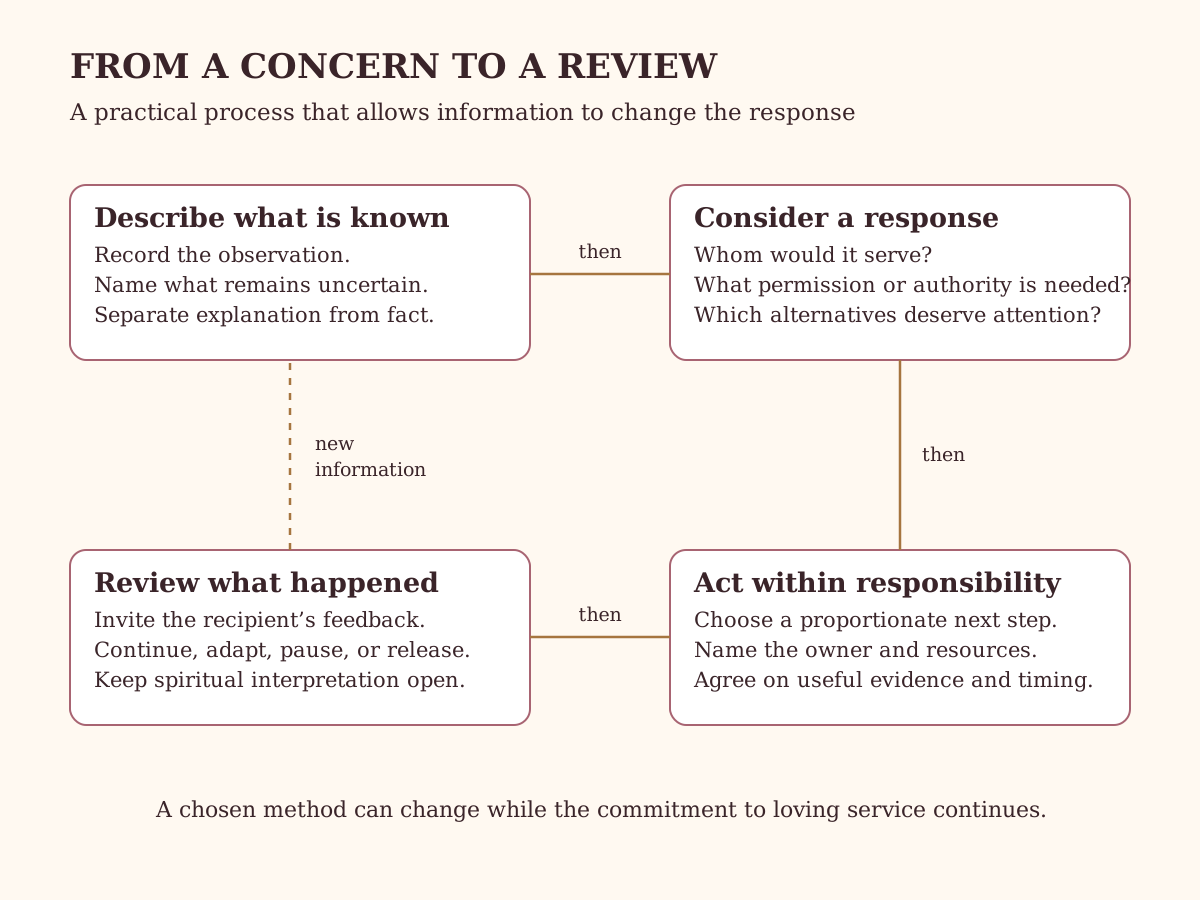
The room can become quiet at the moment a discussion must become a decision. Possibilities have enjoyed generous treatment. Each has attracted a story about what could be accomplished. Now someone must select a course, commit resources, and accept that several worthwhile alternatives will remain unrealized. A person who has spoken confidently about possibilities may become cautious when asked to name a choice. Someone who has listened patiently may feel an urgent desire to end the discussion. Wisdom must serve the work at precisely this narrowing place.
Consider an imagined committee planning a learning program for adults in its neighborhood. It can afford either six weekday evening sessions or two longer Saturday workshops. The evening format offers continuity and room for practice between meetings. The Saturday format requires fewer journeys and may suit people whose work schedules change during the week. The available room cannot support both. Registration will open in ten days, and the printing volunteer needs an answer tomorrow. Every participant in the discussion can identify a real good worth protecting.
The committee has asked a member with experience organizing classes to recommend a format. She feels the pressure of a familiar frustration: discussion keeps returning to the same preferences, while the practical deadline approaches. Her concern may invite a contribution of judgment, careful listening, or clear direction. It cannot, by itself, establish that she possesses a particular spiritual gift. The question before her is immediately useful: how can she help these people make an honest decision together?
Paul includes a message of wisdom among the manifestations of the Spirit, placing the varied contributions within an account of service for the common good. 1 Corinthians 12:4–31 That setting resists the image of wisdom as private superiority. For the purposes of this chapter, a wise contribution is one that helps a community consider what is true, what matters, and what its choice will require. Such a contribution may include spiritual insight. It also remains answerable for how it handles information and how it treats people who will live with the result.
Giving the decision a usable shape
The committee first needs a sentence that describes its actual decision. “What should we do for the neighborhood?” is too broad to settle tomorrow. “Which of these two formats should we offer during the coming term, within the room and funding already available?” gives the conversation a boundary. The sentence identifies the choice, the period, and the existing limits. It leaves larger questions available for another discussion without allowing them to swallow the present one.
You can offer this kind of clarity without occupying the highest position in a group. Ask what has already been decided, what remains open, and who has responsibility for the choice. An invitation to advise differs from permission to commit funds. A request to propose a timetable differs from authority to promise a room. Making those differences visible protects the people who are contributing ideas and the people who must carry the decision into practice.
In the imagined committee, the room reservation is fixed, the program budget is approved, and the choice of format belongs to the program lead after consultation. The member preparing a recommendation writes these conditions at the top of her notes. She also names two boundaries: the program must remain within the approved spending amount, and the volunteer team must be able to deliver what it advertises. A format that depends on unconfirmed volunteers cannot be treated as ready simply because its timetable looks attractive.
Boundaries deserve reasons. A funding limit may reflect a commitment already made elsewhere. A staffing limit may protect people from being assigned hours they have never agreed to give. When a limit has no clear reason, it can be examined. When it has a sound reason, endless argument about its existence wastes the attention needed for the remaining choice. Wisdom can distinguish between a boundary that should be respected and a habit that has acquired the appearance of a rule.
The scale of the choice also matters. Choosing a format for one term permits a different degree of experimentation from committing the same program to a year of fixed dates. Before treating uncertainty as intolerable, ask how much can be learned through a bounded commitment. In this imagined case, the committee can describe the coming term as its first use of the selected format. That description should accompany a real plan to learn, with no implication that participants are responsible for rescuing an unfinished offering.
Separating what is known from what is hoped
Next, the committee needs to sort its statements. The room is available on the proposed dates. That is confirmed information. Several potential participants have expressed a preference for Saturday. That is useful testimony from a particular group. The Saturday format will attract twice as many people. That is a prediction. The evening format feels more serious. That is an impression shaped by a person's understanding of learning. These statements may all belong in the discussion, but they deserve different weights.
A recommendation becomes clearer when the speaker identifies the kind of statement being offered. “Four people who contacted us requested Saturday” gives the group something it can examine. “People want Saturday” turns a limited observation into a claim about everyone. “I would find the evening format easier to teach” is a legitimate disclosure of preference. “Evenings are the only responsible option” adds a judgment that needs further support. Careful language makes room for correction before a choice hardens around an exaggeration.
Memory needs similar care. Someone may recall that an earlier evening program attracted many people, while another remembers several early departures. Both recollections could describe different parts of the same event. Ask whether a record exists and what the remembered example can reasonably establish. A different topic, season, or invitation may limit the comparison. Experience remains valuable when its particulars are preserved. Its usefulness diminishes when one remembered occasion becomes a rule for every future circumstance.
In the imagined discussion, a volunteer realizes that the preference information comes entirely from people who attended an earlier Saturday event. The information still has value, but it cannot settle the needs of people who were absent. The committee has time for a modest additional inquiry: it will contact several people who had previously asked about weekday access. This inquiry does not promise a complete picture. It addresses a specific gap that could meaningfully alter the choice.
There is a point at which gathering information becomes a way of postponing responsibility. You need not know everything to decide faithfully. You do need to know which uncertainties matter, whether they can be reduced before the deadline, and how you will respond if your assumptions prove mistaken. A missing detail about the color of the handout should not receive the attention owed to an unresolved question about transportation. Wisdom orders inquiry according to consequence.
Allowing the costs of each good to speak
Some decisions remain difficult after the facts are clarified because the competing goods are real. Repeated evening sessions could give learners a rhythm of returning, practicing, and asking questions. Two Saturday workshops could reduce the number of journeys required. Neither benefit erases the other. A truthful recommendation names the good it seeks and the good it may leave less fully served. This honesty allows people to disagree about priorities without being described as careless or spiritually deficient.
The committee member draws two simple columns in her working notes. Under each format she records likely benefits, practical burdens, and questions still open. She resists giving every consideration a numerical score. A number would imply a precision that the available information does not support. The purpose of the columns is to expose the judgment being made: fewer journeys are being given substantial weight because several interested participants have specifically named travel as a difficulty.
Those who bear a cost deserve an opportunity to describe it. The person arranging transport may know that a Saturday return journey would overlap with another commitment. A teacher may explain that a full day requires an assistant for the practical portions. A participant may say that a long workshop would be impossible because of family responsibilities. Their contributions need not produce unanimous agreement. They should help the group see the people contained within words such as access, capacity, and efficiency.
You can ask a particularly revealing question: what must someone absorb for this proposal to appear workable? A plan may seem inexpensive because it quietly assumes unpaid preparation. A quick decision may depend on a person remaining available throughout the weekend. A beautifully simple timetable may move complexity into the life of a participant. Bringing these costs into view allows the community to choose with greater honesty, including when it decides that a particular burden is acceptable and willingly shared.
The distribution of benefits deserves equal attention. A choice might serve the largest number while repeatedly excluding the same small group. You may still have reasons to choose it for a particular occasion, but the exclusion should remain visible in future planning. The committee could record that a weekday option deserves consideration during the next term. Such a record is a commitment to remember a need. It becomes misleading if it is presented as a promise before the resources for another program exist.
Counsel that can change the recommendation
Seeking counsel has substance when the answer could affect the proposed action. Inviting comments after a choice has become untouchable offers people little meaningful influence. The person preparing the recommendation should be able to say which questions remain open. She might ask whether she has misunderstood a constraint, overlooked a group, or proposed a level of work the team cannot sustain. These questions make consultation specific enough to receive useful answers.
The imagined committee member initially favors Saturday. When she asks the teaching volunteers about preparation, she learns that one long session would require additional equipment that the program does not own. A colleague suggests shortening each workshop, which would reduce practice time. Another suggests borrowing equipment, but the lender has not agreed. The recommendation now needs to acknowledge a condition: Saturday is workable only if the necessary equipment and assistance are confirmed by a stated date.
Conditional recommendations can be a form of responsible clarity. They explain what the decision depends on and what will happen if the condition remains unmet. They become evasive when the conditions are so numerous or vague that no one can tell whether a decision exists. Keep the condition tied to a real dependency. Name the person who will check it, the time available, and the alternative course. A clear contingency allows uncertainty to be carried without allowing it to govern every conversation.
Counsel also includes attention to the manner of the discussion. A technically useful proposal can be advanced through impatience, dismissal, or embarrassment. First Corinthians places love at the center of its teaching about gifts, describing a manner of life that includes patience and freedom from self seeking. 1 Corinthians 13:1–7 In a meeting, that teaching can become a practical discipline: let a question be completed, acknowledge a correction, and refrain from treating your experience as the end of inquiry. These acts keep expertise available to others.
Where disagreement remains, preserve its actual content. A colleague who favors evenings may accept the authorized decision while continuing to believe that repeated practice matters greatly. The record can retain that concern without describing the colleague as resistant. Cooperation after a decision need not require everyone to revise a sincere judgment. It requires clarity about the action being undertaken and freedom to report what happens when the choice meets experience.
Choosing, explaining, and remaining teachable
The program lead eventually chooses the Saturday workshops, subject to confirmed equipment and assistance. She states the reasons in ordinary language. Fewer journeys address a concern raised by several interested participants. The teaching team believes the material can be organized responsibly into the available hours. The equipment question will be resolved within two days. If the necessary arrangements fail, the team will offer the evening format and explain the change before registration opens.
She gives the printing volunteer a decision about preparation by the requested deadline and explains the remaining condition. The volunteer can prepare the common material immediately, while the format and dates wait for confirmation before printing. The schedule still leaves time before registration opens. This small adjustment prevents a conditional internal choice from becoming an unconditional public promise.
The explanation includes what the choice cannot fully provide. There will be less opportunity for repeated conversation across several weeks. To address that limitation within existing capacity, the teachers will provide a single opportunity for written questions between the workshops. This response does not pretend to recover every benefit of the other format. It shows that a recognized cost has received attention. People can assess the decision more fairly when its reasons and limits are stated together.
After a choice, the group needs enough stability to act. Reopening the decision at every expression of discomfort can consume the time required to deliver it. Stability, however, does not require ignoring material new information. Agree beforehand about the kinds of changes that would justify reconsideration. Loss of the room might qualify. A newly discovered safety requirement might qualify. A preference already considered would usually remain part of the record without initiating the entire discussion again.
The group also chooses a point for review after the workshops. It will examine attendance, the questions participants raise, the work volunteers actually perform, and the usefulness of the format as described by those involved. These observations will inform the next decision. They will not turn the first choice into a moral verdict on its proposer. A decision can be responsible when made and still reveal limitations that call for adjustment. Teachability allows experience to become useful without requiring a story of personal failure.
Wisdom does not remove the weight of choosing. It gives that weight a more faithful distribution: evidence receives its place, affected people receive a hearing, authority remains visible, and consequences can be examined. The person contributing wisdom may still feel uncertainty when the meeting ends. What has changed is the quality of the community's commitment. People know what they have chosen, why they have chosen it, and what they will do when the work begins to answer them.