
Three people, three meanings of ready
In this fictional case, a team is preparing a handbook for new volunteers. The writer believes it is complete because every section has been drafted. The coordinator believes it is incomplete because no one has checked the contact details. A volunteer who will use the handbook opens it and cannot find instructions for the first day. All three are responding to the same document. Each has a different meaning of completion in mind, and none of those meanings has yet been made sufficiently clear to the others.
The writer feels that the finish line keeps moving. Every conversation produces another request. The coordinator feels that obvious requirements are being overlooked. The new volunteer simply wants to know where to arrive and whom to ask for help. The disagreement has become personal before the team has defined the result it is trying to deliver. A more useful conversation begins with the people who will receive the handbook and the actions it should enable.
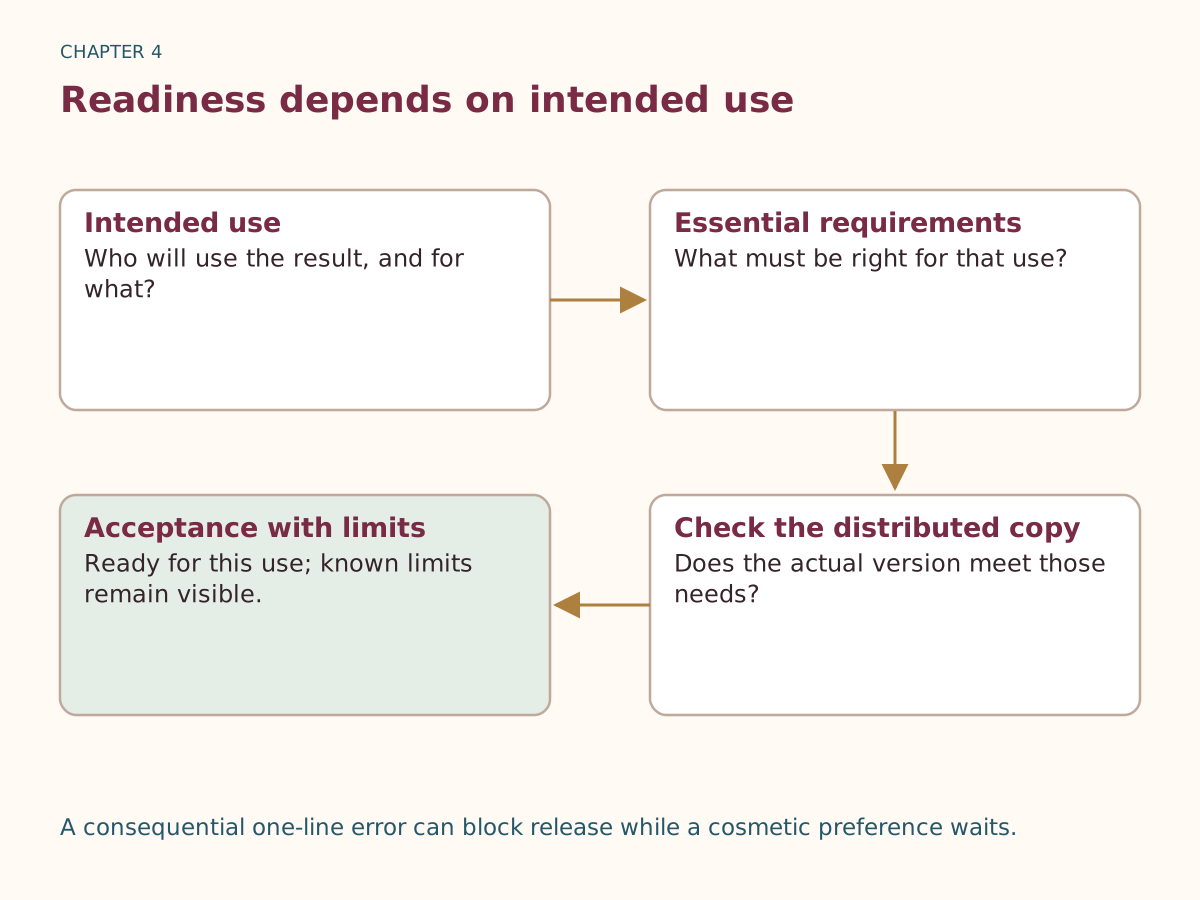
Completion needs an object. Complete for whom, for what use, and under which conditions? A document can contain all its planned sections while remaining unsuitable for its intended purpose. It can also be useful before every possible improvement has been made. The task is to establish a sufficient standard that the responsible people can understand, assess, and revise deliberately when circumstances change.
Without such a standard, finishing can depend on whoever happens to feel satisfied last. That arrangement leaves contributors unable to predict what remains. A defined standard makes room for judgment while reducing avoidable uncertainty. It gives the writer a concrete obligation, gives reviewers a common basis for feedback, and gives the recipient an outcome the team is prepared to stand behind.
Begin with the use
The team asks what a newcomer should be able to do with the handbook during the first week. They identify a few essential actions: prepare for arrival, understand the basic role, locate the relevant contact, and know how to raise an unresolved question. These uses provide a center for the material. An attractive account of the organization's history may enrich the document, yet it cannot substitute for instructions the newcomer needs on the first morning.
Describe the intended use in ordinary language. Avoid a phrase so broad that every possible addition seems necessary. “Help volunteers succeed” expresses an aspiration. “Allow a new volunteer to find the arrival time, location, and supervisor without a separate message” names an assessable function. Several such functions can form the basis for review. Their specificity also makes it easier to see which material belongs in another resource.
Audience matters within this description. A handbook for experienced volunteers joining a new location can assume knowledge that a first volunteer does not possess. State the assumptions that materially affect the instructions. Then look for places where those assumptions leave a reader without the information needed to proceed. The goal is a document that serves the intended reader with dignity and clarity.
You can ask a representative reader to attempt a few relevant tasks using the draft. Watch where they look and what they can locate. Invite them to explain confusing language. Treat their response as information about this draft and this reader, with appropriate limits. A small review can reveal a particular obstacle; it does not prove that every reader will have the same experience or that every possible difficulty has been found.
In the handbook review, the new volunteer searches for the first day instructions under a heading called “Getting Started.” The writer has placed them within “Our Shared Commitments.” The team can fix the location without treating the reader's difficulty as a character flaw. The intended use has provided a practical way to decide between two headings. The choice becomes answerable to the reader's task.
Standards that distinguish necessity from preference
An acceptance standard should make clear which features are necessary for release. The handbook must give accurate locations and current contacts. It must explain the essential responsibilities consistently. It must be readable in the format the team plans to distribute. A favorite shade of green may be optional. The team can still care about presentation while giving different requirements their appropriate weight.
The reasons for a requirement help determine its weight. A missing contact may leave a newcomer unable to seek help. An unclear arrival instruction may cause someone to come to the wrong entrance. An uneven decorative border has a different consequence. Reviewing in relation to consequences helps the team use its time responsibly. It also allows the writer to understand why a requested change matters.
Agree how a requirement will be checked. A person with access to the current schedule can verify arrival times. The coordinator can confirm role boundaries. A newcomer can attempt the first day tasks. A technical review can establish whether links work in the distributed file. Each check needs an appropriate owner. Merely saying that the handbook must be accurate leaves unanswered who will verify the details and what information they will use.
Make room for judgment when a rigid rule would misrepresent the task. Clear writing cannot always be reduced to a single number. Reviewers can use examples, explain the confusion they experienced, and propose language that preserves the intended meaning. The standard should guide the conversation without pretending to replace human judgment. Where reviewers disagree, identify the decision maker and the basis for the decision.
The reviewer should be able to distinguish the work from their relationship with its creator. A close colleague can still raise an essential correction respectfully. An unfamiliar reviewer can still explain a concern without implying that the creator lacks care. Ask reviewers to point to the relevant passage, describe the consequence for the reader, and connect the requested change to the agreed purpose. This gives the writer feedback that can be acted upon and gives the approver a basis for resolving disagreement.
The writer also needs a route to clarify a correction. If a requested change would create a contradiction elsewhere, that information belongs in the review. If two reviewers provide incompatible instructions, the writer should not have to guess which authority prevails. Resolve the conflict openly, record the decision where it can be found, and allow the resulting standard to guide the remaining work.
This approach also protects contributors from an endless accumulation of preferences. A reviewer can suggest an improvement and state whether it prevents release. The writer can ask how a new requirement relates to the agreed purpose. If the answer reveals a genuine missing necessity, the plan can change. If the suggestion is optional, it can be recorded for later consideration without obscuring what remains essential now.
A stopping point with integrity
You may feel uneasy defining a sufficient standard because you can always imagine a better version. That imagination can be valuable during development. It also needs a relationship to the present obligation. The team has promised a usable handbook to people beginning work next week. Holding the document indefinitely for possible refinements would have its own consequence. A responsible stopping point considers both the quality required and the use waiting to occur.
In the project, the team agrees that the handbook can be released once essential instructions are verified, navigation supports the first week tasks, and the named reviewer accepts the current version. Several optional photographs can wait. A more extensive account of the organization's history can become a separate resource. These decisions preserve the purpose while giving completion a clear enough meaning for the writer to reach it.
This does not make the present version immune to correction. A newly discovered incorrect address should be repaired promptly. A changed procedure may require an update. Completion describes a product accepted for a defined use at a particular point. It can coexist with continued maintenance. The distinction matters because creation and maintenance are different responsibilities and may belong to different people.
There is a moral seriousness to saying what a resource can and cannot presently do. If a section remains provisional, label its status and explain the permitted use. If an essential instruction is missing, the team may need to delay release or provide a clear alternative. The approver should identify that alternative and confirm how a newcomer will receive it before accepting the handbook. Record any unresolved essential requirement as open; a reassuring status label cannot supply the missing instruction. Calling a resource complete should communicate something truthful to the person who relies on that description.
The pressure to finish can tempt a team to blur an unresolved issue. The pressure to improve can tempt a team to treat every possible addition as indispensable. Bring both pressures back to the agreed use and the consequences of the remaining gap. What does the reader need to proceed responsibly? Who has authority to accept the current state? What obligation remains after release? Those questions make the stopping point more defensible.
A necessary correction meets a real deadline
Two days before distribution, a reviewer notices that the first day contact number belongs to a former coordinator. The writer has copied it accurately from an older approved document. The team has completed several careful reviews, yet none of those reviews verified the current contact. Their effort cannot establish a fact they did not check.
The writer asks whether the old number can remain because the handbook is otherwise ready. The approver answers by returning to the promised use: a newcomer must be able to reach the person responsible on arrival. An unusable contact prevents that action. The number is an essential correction even though it occupies only one line.
The correct number is available by the next morning. The team updates it in the actual distribution copy and verifies the link attached to it. Meanwhile, a reviewer proposes replacing six photographs. Those changes might improve the book's appearance, but no one identifies a failed first week task they would repair. They move to the improvement list.
The different decisions do not rest on whose request arrived first or who sounded most insistent. They rest on the consequence for the intended use. One small correction blocks release until it is completed; a larger attractive revision can wait. This is why a meaningful acceptance standard cannot be a tally of remaining edits.
If the number had remained unavailable, the team would have needed an actual alternative, such as a staffed arrival point described in the welcome message. A promise to invent a workaround later would leave the requirement open. The approver's responsibility is to know what newcomers will be able to do when the resource reaches them.
Changing the standard openly
Sometimes the original standard was incomplete. Perhaps the team discovers that volunteers will use the handbook on a phone, although the draft was designed for print. This is a meaningful change in the conditions of use. The appropriate response is to discuss its effect on the work, the schedule, and the review. Treating it as a tiny correction may conceal the additional effort required.
Describe a changed requirement in terms of its reason and its cost. The mobile version may need shorter navigation paths or a different file format. Someone must decide whether the first release will include both formats, whether a temporary alternative is acceptable, or whether the date should change. The writer should have an opportunity to explain the work involved. The person responsible for the service should decide with that information available.
An open revision of scope preserves accountability better than a silent expansion. It allows the team to remember what was originally agreed and why the plan changed. It also makes room to remove lower priority work when new necessities appear. If every addition simply enlarges the assignment, the date may remain unchanged only on paper while the burden quietly shifts onto the contributor.
Some new requests belong to a future edition. Record them with a brief reason so they remain available without dominating the current review. A dated improvement list can serve this purpose. The list should have an owner and a realistic review point; otherwise, it becomes another collection of intentions. A future possibility is most useful when the team distinguishes it clearly from a present promise.
Acceptance is a statement that can be examined
Someone must be prepared to say what has been accepted and on what basis. “Looks good” offers little guidance to a reader who will rely on the handbook. “The arrival instructions, current contacts, and first week tasks have been checked in the distributed copy” makes a narrower, more useful statement. It tells the team which promises their review supports.
The accepted copy must be the one that was checked. If the writer repairs a link after review, the correction should appear in the file that incoming volunteers actually receive. A correct working draft cannot establish the condition of an older download. Compare the release copy with the approval record before announcing that the resource is available.
An acceptance record can remain short. Name the version, intended audience, essential requirements checked, and any limitations communicated to the reader. Give unresolved necessities an explicit disposition. A temporary workaround counts only when the team has arranged it and made it available to the people who need it. “Someone will explain later” is an unfilled dependency.
Responsibility for later updates needs an owner, but that ongoing role is a separate agreement. Acceptance concerns the product being offered now. Keeping that distinction clear gives both reviewers and contributors a truthful account of what this release establishes.
A correction has a meaning
During the handbook's first week in use, a newcomer asks about an unfamiliar term. The team clarifies it. The correction may reveal one ambiguous sentence, a mistaken assumption about the audience, or a larger failure in the instructions. These possibilities deserve different responses. Identify what the new evidence changes about the acceptance decision.
An isolated correction does not automatically invalidate every earlier check. Equally, the fact that a resource passed review does not make later problems unimportant. The team can preserve an accurate account of what was verified while investigating what has now become visible. Completion remains a claim about defined use, supported by particular evidence and open to correction.
At the end of the review, the writer has a usable resource and a record of the promise it can support. Emotional release, rest, and allowing others to change a contribution receive fuller attention in Chapter 22. The work here is to give “ready” a meaning that the creator, reviewer, and recipient can all examine.