
The task that stayed behind
Consider a fictional volunteer archive that preserves photographs and programs from a neighborhood's public events. Its longtime coordinator asks another volunteer to organize a newly donated collection. The assignment sounds straightforward: label the folders, record the contents, and place the materials in the appropriate cabinet. The second volunteer agrees. Several weeks later, the coordinator is still checking which folders are complete, looking for missing labels, and remembering that the donor expects an acknowledgment. The physical work has moved. Much of the responsibility for remembering remains with her.
Her frustration may seem difficult to explain because help is clearly being offered. The second volunteer spends several afternoons sorting photographs. The coordinator appreciates that effort. Yet she continues to carry the question of whether the collection will ever become usable. She knows the outstanding pieces and keeps fitting them around other commitments. Calling the entire arrangement a successful delegation would conceal an important part of what she is still doing.
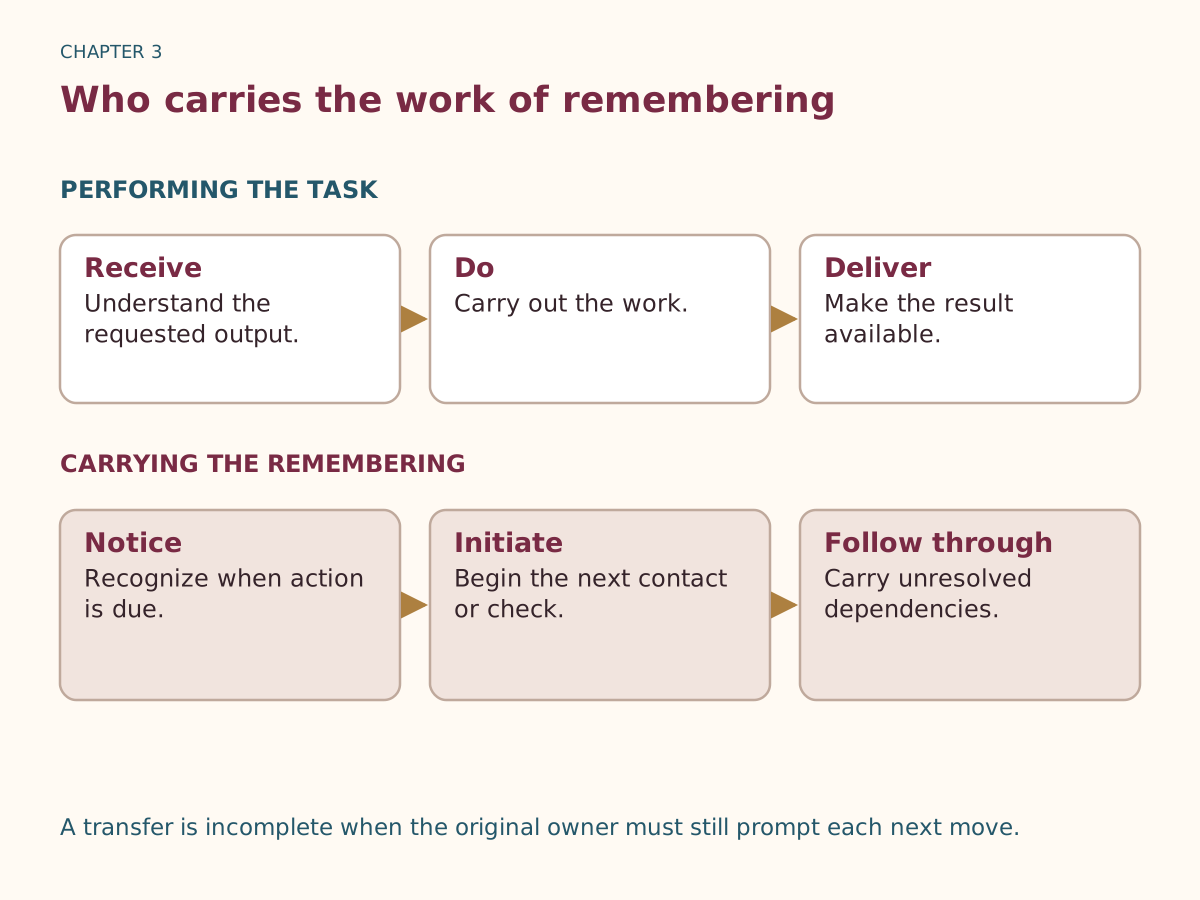
This situation invites a distinction between performing a task and carrying responsibility for its progress. Both involve work. Someone must remember the next action, notice a missing dependency, communicate a difficulty, and recognize when the assignment is ready for review. These activities may belong to one person or be divided among several. What matters is that the division becomes explicit enough for each person to understand the responsibility accepted.
If you are repeatedly reminding people after delegation, begin by describing what you retained. You may still hold the deadline, the contact information, the standards, and the only complete picture of the desired outcome. The recipient may have accepted a narrower assignment than you believe you gave. That possibility deserves a careful conversation before the pattern becomes a conclusion about their willingness or competence.
Naming the labor of remembering
Remembering is easiest to see when you translate it into observable actions. Who keeps the list of outstanding items? Who checks whether an expected response arrived? Who knows when another person's work can begin? Who tells the coordinator about a delay? These are practical responsibilities that can be assigned, learned, and reviewed. Leaving them unnamed makes it possible for two people to hold incompatible pictures of the same agreement.
The archive coordinator writes down the actions she performed during the previous week. She located the donor's notes, clarified two dates, asked about the label order, and reminded the volunteer to reserve cabinet space. The list reveals that some responsibilities were never transferred. The volunteer lacked access to the donor correspondence and did not know that cabinet space needed to be reserved. Other actions, including checking the labeling progress, might reasonably become part of the volunteer's role.
Classify each reminder by the gap it reveals. An incomplete handoff calls for the missing instruction. An inaccessible resource calls for restored access or an alternative. A missed commitment calls for acknowledgment and a workable new agreement. The coordinator can provide the donor correspondence, explain the cabinet process, and ask the volunteer to own the next dated update. Recording which response belongs to which gap keeps the repair specific. Accountability can then rest on an agreement both people can actually meet.
Consider your own part in keeping a task mentally active. You may continue checking even after another person has accepted the full responsibility and established a reliable way to report. In that case, a discussion about monitoring may need to include your habits. Ask what information would allow you to stop checking between agreed points. If no amount of reliable evidence would satisfy you, the arrangement may need a broader conversation about trust and authority.
The purpose of naming this labor is a fair division of work. It gives the recipient an opportunity to accept a complete responsibility with open eyes. It gives the delegating person a basis for releasing what has been accepted. It also shows where a role remains too large for the time or resources available. A fair agreement can be smaller than the original wish and more dependable because of that honesty.
What the recipient actually accepted
The archive coordinator remembers saying, “Please organize the collection.” The volunteer remembers agreeing to label and sort the photographs during three afternoons. Both recollections may be accurate. The words left the responsibility for tracking progress unstated. The coordinator now needs to ask what he understood, without presenting her fuller expectation as a commitment he knowingly broke.
Their conversation begins with the work currently being performed. He sorts materials; she holds the list of missing dates and checks the cabinet. They agree that he will maintain the outstanding items list and initiate an update after each afternoon. She will retain donor correspondence. The distinction gives each person a particular action to perform when new information arrives. Neither needs to guess whether the other is still attending to it.
A request to carry the remembering deserves a response of its own. The recipient might accept it, need a way to learn it, or offer practical help without accepting coordination. That third answer is useful. It means the delegating person must retain or separately assign the monitoring. Treating every helper as a failed owner conceals the difference between the two contributions.
Access and available time shape this agreement. Here, the volunteer receives the relevant catalog and a place to record open questions. Detailed decisions about approval, spending, and escalation belong to the authority discussion in Chapter 21. The immediate question is narrower: who will notice that something remains unfinished and bring that fact forward?
Learning to notice the next action
Some people can perform a task competently before they can reliably oversee the sequence around it. Labeling a photograph and noticing that its uncertain date affects three catalog entries are different acts of attention. The latter can be taught through a worked example. It should not be treated as a personal quality that the recipient either possesses completely or lacks forever.
The coordinator and volunteer review the first five folder records. She asks him to describe what he would need to notice before starting the next group. He identifies missing names and dates but overlooks the space required for finished folders. They add that dependency to his working note. The lesson is about anticipating what the task will require, with the actual collection in view.
At the next review, he brings an open question without a reminder. That action matters even though he does not yet have the answer. He has begun carrying the obligation to notice and communicate. A supervisor who responds only to completed tasks may miss this evidence of learning and unintentionally make uncertainty harder to disclose.
Learning has a cost for the coordinator. Name the time spent explaining and reviewing while estimating the handoff. A transfer that initially requires teaching can still reduce dependence later. When close monitoring will remain necessary indefinitely, describe the arrangement honestly as supervised assistance. The description helps both people understand the contribution they are actually making.
A promise with a memory attached
Once a recipient accepts the monitoring, repeatedly waiting for a reminder leaves part of the agreement unmet. Address that part directly. “You completed the labels after I asked. We had also agreed that you would tell me what remained each Thursday.” This identifies the missing action without dismissing the physical work or inventing a motive for the silence.
A new promise should address the reason the first one failed. The volunteer may need to connect his update to the moment he returns the cabinet key, when he is already closing the afternoon's work. He may discover that the assignment exceeds the afternoons available. He may explain that he is willing to sort photographs but cannot carry the catalog as a continuing responsibility. These answers lead to different arrangements.
The coordinator has an obligation too. If she keeps a second private list and acts from it without telling him, his record cannot become dependable for the shared work. She must identify the information she has retained and bring it into the agreed account. Delegation is weakened when one person nominally owns the task while another remains its undisclosed source of truth.
When a plainly accepted obligation remains unmet, the role may need to change. A smaller, reliable contribution can be valuable. Reassignment should name what is changing, including who will carry the unfinished monitoring. Otherwise the same work returns to the coordinator without ever becoming visible.
When the reminder becomes the real starting signal
The first Thursday passes without the agreed update. On Friday, the coordinator asks for it and receives a careful account within an hour. The volunteer believes he has responded promptly. The coordinator experiences another reminder added to her week. Their disagreement concerns the starting signal for the same action.
Previously, her message had meant it was time to report. Their new agreement placed that initiative with him. Saying “You knew the date” would name the expectation without explaining the pattern. They talk about what will prompt him to act when her message no longer arrives. He decides to write the update before returning the cabinet key at the end of his final session each week.
Two weeks later, someone else returns the key, and he nearly omits the update again. He notices the gap that evening and sends a candid note: the catalog is current, one question remains, and the promised report is late. The new habit is imperfect. Crucially, she did not have to restart it. He recognized and repaired the missed action himself.
Look for this kind of change when evaluating a transfer. A person who notices an omission, names it, and restores the next step is carrying more of the remembering than a person whose polished response appears only after repeated prompts. Both quality and initiative matter; they are different things to observe.
The coordinator still needs awareness of the collection's effect on the wider archive. Delegation does not remove every connected responsibility from her role. It can remove the need to reconstruct this task each day. A realistic aim is a defined transfer of attention, with the wider obligations still honestly acknowledged.
An interruption does not settle ownership
A donor requests a photograph before the collection is complete. The coordinator retrieves it because she is present. She records what left the cabinet and tells the volunteer who will obtain its return. Her intervention is specific. It does not silently restore her responsibility for checking every folder.
Exceptional help can blur a handoff when its meaning remains unstated. After helping, name the continuing responsibility: “I handled this request; please include the photograph in your outstanding items until it returns.” If ownership must change, say that directly. The person still listed as responsible should be able to tell whether the assignment actually remains theirs.
The same clarity matters when the recipient asks for assistance. Asking for help with an uncertain date need not mean surrendering the entire collection. The recipient can receive an answer, update the record, and continue carrying the next action. Independence includes knowing when another person's contribution is needed.
Room for another person's judgment
First Corinthians describes members with different functions who need one another. 1 Corinthians 12:4–31 As an application to delegation, this invites room for a recipient to contribute judgment. The archive volunteer devises an index that differs from the coordinator's example and makes the collection easier to browse. She can assess its usefulness without requiring him to reproduce her preferred sequence of steps.
His initiative also changes the coordinator's experience. She is accustomed to being the person who remembers everything. A sound handoff makes some of her familiar reminders unnecessary. Feeling the impulse to check is not itself evidence that the recipient needs another check. She can consult the agreed record before acting on that impulse.
There is a corresponding freedom for the recipient: carrying a responsibility does not require becoming a copy of the person who delegated it. He must honor the actual commitment. Within it, his own attention, habits, and ingenuity have a legitimate place.
The work no longer waits to be remembered
Several weeks later, the coordinator opens the catalog and finds the volunteer's latest update already present. Three uncertain dates are listed with the next action beside each. She still needs to make one decision about donor correspondence. She can now see that decision without reconstructing the entire collection in her own memory.
The revealing change occurred before the catalog was finished. The volunteer began noticing what was open, bringing it forward, and returning to it after a decision. Chapter 4 considers how the finished product is accepted. Here, the measure of the handoff is that the ongoing responsibility has an actual carrier.
Examine the work that continues after your next instruction is spoken. Someone will keep track, notice an absence, and initiate the next conversation. Say who that person is. If the responsibility is shared, describe the division. The task can then travel with the remembering it requires.