

The silence between milestones
Consider a fictional publication project. A small professional association has commissioned a guide for people entering its field. The outline is approved, the contributors are chosen, and a release date appears on the calendar. During the first week, messages arrive frequently. Someone proposes an illustration. Someone else resolves a question about terminology. The work feels alive because it keeps becoming visible. Then the messages slow. The project coordinator opens a shared folder and sees the same three documents she saw on Monday. By Thursday, she is wondering whether anyone is doing anything.
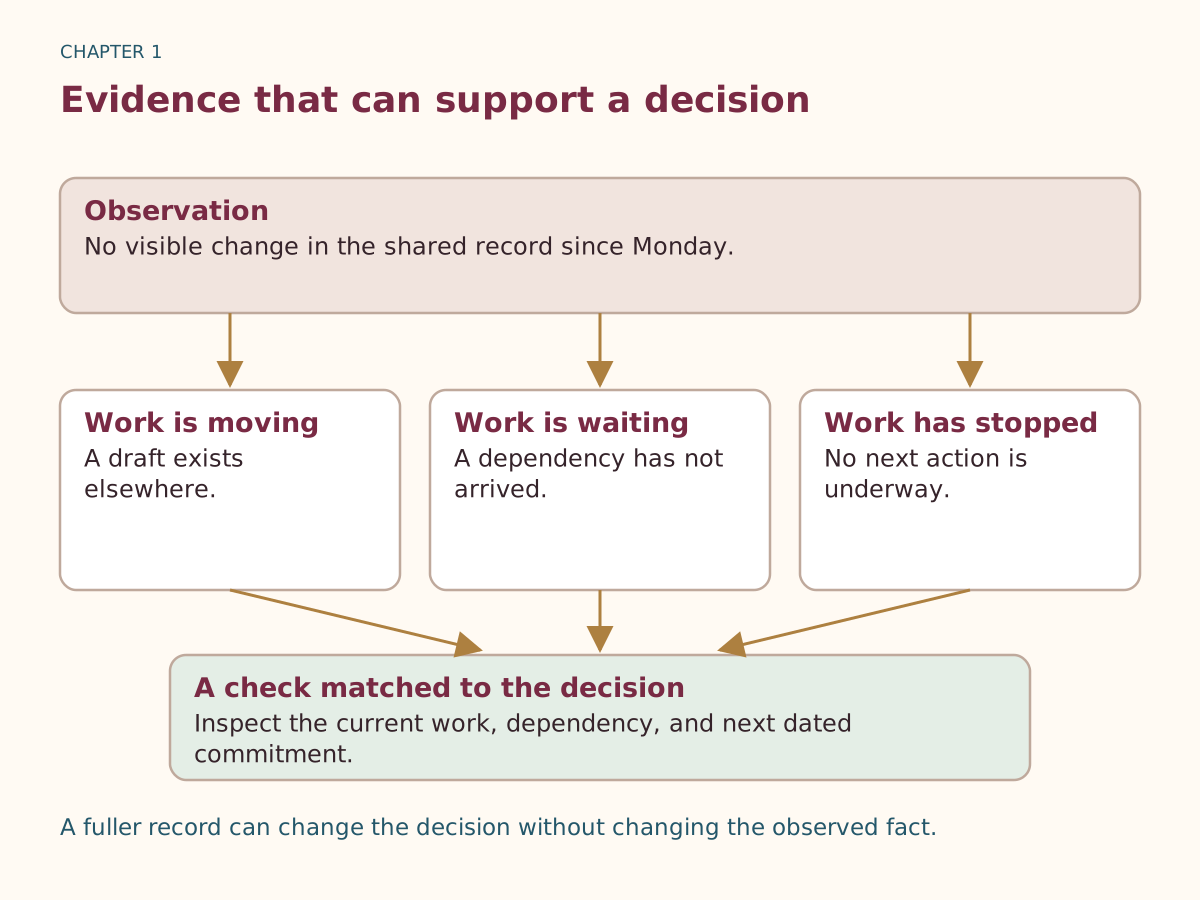
Her concern may contain useful information. The deadline is approaching, and other people are relying on the guide. Yet the unchanged folder cannot tell her everything she wants to know. A contributor might be checking a quotation, reconsidering a confusing explanation, or waiting for a permission decision. Another might have forgotten the assignment. These possibilities require different responses. The coordinator has one observation, several interpretations, and a rising feeling that threatens to combine them into a single verdict.
You may recognize the moment even when your own work has nothing to do with publishing. An inquiry receives no reply. A task disappears into someone else's queue. A decision remains under consideration after you expected action. You begin to carry the absent information yourself, making predictions and preparing contingencies. The effort is real, even when the predictions remain uncertain. A useful first practice is to give each part of the experience its own name: what you can observe, what you are inferring, and what you need to know next.
That distinction creates room for accurate concern. You do not have to persuade yourself that everything is going well. You can say, “The agreed update has not arrived, and I cannot yet tell whether the work is delayed.” This sentence protects two truths at once. An expectation has gone unmet. The present state of the work remains unknown. Both truths belong in the conversation that follows.
Evidence that can carry a decision
The most useful evidence depends on the decision before you. If you need to arrange printing, a contributor's enthusiasm is insufficient. You need a realistic date for the manuscript. If you need to decide whether the explanation is understandable, a word count offers little help. You need a sample that a reader can follow. An update becomes valuable when it reduces uncertainty about an actual choice. Activity can be plentiful while the evidence needed for that choice remains absent.
In the project, the coordinator could ask every contributor to describe the hours spent working. That might explain effort, yet it would still leave her unable to schedule review. She could instead ask for the current section, the remaining questions, and the next deliverable date. The second request has a clearer relationship to her responsibility. It also gives contributors an opportunity to disclose work that has occurred outside the shared folder without pretending that every hour has produced a finished paragraph.
There is a gentle discipline in asking only for information that serves the work. A frightened coordinator can multiply requests until reporting becomes a second project. A considerate coordinator still needs evidence, and she chooses evidence proportionate to the decision. A short excerpt may establish that the approach is sound. A complete draft may be necessary before another person can begin editing. The scope of the request should follow the dependency, the stakes, and the time available.
Try making the hidden question explicit before seeking an update. Perhaps you need to know whether to reserve a room, adjust an announcement, or help resolve a difficult passage. Naming that decision changes the tone of the exchange. “I need to confirm the printing date tomorrow” offers a concrete reason for asking. The contributor can see what the information will enable. The request is easier to answer because its purpose is visible.
What an unfinished interval asks of you
Some work includes intervals in which the next outward sign arrives slowly. Reflection, discussion, and revision can occupy such an interval. Their presence should be established through communication when other people depend on them. Their possible presence should also keep you from treating silence as complete proof of negligence. A fair account leaves space for explanations while continuing to ask for what responsible cooperation requires.
The difficult task is to remain with uncertainty long enough to investigate it. You may feel an urge to settle the matter immediately: the person is careless, the system is broken, the project is doomed. Such conclusions offer a temporary sense of order. They also guide what you do next. If you treat an untested explanation as established, your message may carry an accusation that the recipient cannot answer without first defending a character judgment.
A more exact message describes the observable gap. “We expected the chapter on Tuesday. It is Thursday, and I cannot locate it. Please tell me whether it is ready for review and what remains.” This language allows a delayed contributor to acknowledge the delay. It allows a contributor who uploaded to the wrong location to correct the mistake. It also creates a record clear enough to support escalation if the answer never comes.
Accuracy does not require an emotionally flat voice. You can acknowledge the burden: “The uncertainty is making it difficult to coordinate the next stage.” The sentence connects your concern to a practical consequence. It gives another person something they can help resolve. An unsupported declaration about their motives would give them a different problem, one that could distract both of you from the missing chapter.
A checkpoint with a purpose
The coordinator in this project arranges a brief checkpoint for Friday. Each contributor will show the portion available for review, name any unresolved dependency, and propose the next date. She sends this request with enough context to explain how the material will be used. One contributor shares a nearly complete chapter. Another reveals a question that has held up an entire section. A third acknowledges that the assignment has not begun. The project now contains three distinct situations instead of one cloud of anxiety.
A checkpoint should have a recognizable outcome. Someone leaves knowing what proceeds, what needs help, and what requires a changed commitment. A meeting that only repeats intentions can leave the central uncertainty untouched. Ask what evidence would make the next decision possible, who can provide it, and when it becomes useful. These questions can support a conversation, a shared note, or a short exchange of messages. The format matters less than the decision it enables.
A checkpoint that passes without evidence leaves the decision unresolved. The coordinator therefore treats a missing draft as a fact to report, alongside the drafts she receives. She cannot promise the printer a complete manuscript merely because the review meeting occurred. The next decision must reflect what the checkpoint actually established.
Treat a checkpoint as an opportunity to revise the plan in contact with reality. A newly discovered obstacle may justify a new sequence or a smaller initial release. A contributor may need to relinquish part of an assignment. The work becomes more trustworthy when these adjustments are named openly. Preserving an attractive schedule after the evidence contradicts it can transfer the cost to everyone waiting downstream.
The work of making progress legible
You might be the person waiting for evidence. You might also be the person whose work is difficult for others to see. From that position, a useful update includes enough substance for another person to understand the present state. “I am working on it” may express sincerity while leaving every practical question unanswered. “The examples are drafted, the introduction needs revision, and I need a decision about the audience by Wednesday” gives the listener a way to cooperate.
You can make partial progress visible without presenting it as finished. Label an early draft clearly. State which parts are ready for comment and which remain unsettled. Explain the kind of feedback that would help. This protects reviewers from assuming that every rough sentence is an overlooked mistake. It also protects you from waiting until the whole product is polished before discovering that a central choice needs to change.
Visibility has limits. Some work involves confidential information, private deliberation, or material that cannot yet be shared broadly. A responsible update can still describe the stage, the dependency, and the next permitted point of communication. People do not need unrestricted access to every detail in order to receive an honest account of an obligation. The question is what can appropriately be communicated to those whose decisions depend on it.
Making progress legible is an act of consideration. It acknowledges that another person is carrying a timetable, a promise, or a decision connected to your contribution. First Peter describes gifts as entrusted for service to others, with service dependent on the strength God supplies. 1 Peter 4:10–11 An update is a modest practical expression of that orientation. The passage does not prescribe a reporting system; it supplies a larger reason to consider how your contribution reaches the people it is intended to serve.
Keeping the evidence honest
The way you receive unwelcome information becomes part of the reporting arrangement. In the project, a contributor who admits that a section has not begun has provided essential information late. The coordinator needs to address the missed commitment. She also needs that candor to remain possible. If every disclosure meets humiliation, the next update may become carefully optimistic while the underlying difficulty continues. A clear response can acknowledge the honesty and address the obligation in the same conversation.
Beware of measures that reward an attractive appearance. Ten completed pages may contain unanswered questions that prevent publication. A short section may already be accurate, clear, and ready to use. Count what serves a decision, and pair the count with an appropriate account of quality. Where quality remains uncertain, say so. A progress measure should help you understand the work sufficiently to act; it cannot carry every judgment about the work at once.
You can make room for correction in the update itself. Ask the contributor to distinguish what is complete, what is provisionally complete, and what still requires another person's decision. Those distinctions give reviewers permission to disagree about readiness. They also make it easier to discover where an apparently small task depends on an unresolved larger choice. Honest categories are more useful when everyone understands what they mean in this particular project.
When a date changes, retain the reason in a simple shared record. This helps the team distinguish a newly discovered requirement from an avoidable missed commitment. It can also reveal whether the original estimate needs revision. The purpose is a more accurate plan and a fair account of responsibility. People can learn from a changed date when its meaning remains available after the immediate pressure passes.
When a true measure supports the wrong conclusion
At the checkpoint, the coordinator discovers a second difficulty. A contributor reports that seven sections are drafted. The statement is true. Only two sections contain the examples the guide needs, and neither has been checked for consistency with the others. A green mark beside “drafting complete” has encouraged the coordinator to expect a reviewable manuscript. The measure answered a different question from the one she needed to decide.
She initially responds by requesting a percentage complete. The contributor reasonably asks what the percentage should count: sections, examples, unresolved questions, or hours remaining. More precision in the number would not settle the missing definition. The coordinator withdraws the request and asks which sections can enter review without waiting for another decision.
The answer is two. That narrower result changes the plan. Review can begin there, but the printer cannot yet receive a dependable completion date for the whole guide. The coordinator tells the association that the release announcement needs to wait. A decision she hoped to avoid has become necessary because the evidence is now more useful.
This distinction matters whenever a report travels farther than the observation supporting it. A sample may show that an approach works in one section. It does not establish that every section uses the approach. A count may establish quantity while leaving readiness unresolved. State both the result and the boundary of the result. “Two sections are ready for review; five are drafted without completed examples” gives the next person something solid to plan around.
The contributor has not been asked to make slow work appear fast. The coordinator has stopped asking one number to carry several judgments. Their exchange has become more demanding in substance and simpler in form: show what can be used for the next stage, and say what still prevents the rest from reaching it.
The next honest sign
Return to the publication project after the Friday checkpoint. The coordinator has fewer finished pages than she hoped. She also has a more accurate view of the work. Two sections can move into review. Among the remaining sections, one needs a decision and another must be reassigned. The project may still require a changed date, yet its next steps are visible. Her concern now has places to go: a question to answer, a colleague to support, and a commitment to revise.
The important change is the quality of her participation. She can speak plainly without pretending to know what happened during every silent hour. She can offer help without taking every unfinished section into her own hands. She can explain the situation to others using evidence they can examine. If confidence returns, it will have something substantial beneath it. If further difficulty appears, the team has a clearer means of responding.
Your own next honest sign may be small. It could be a dated excerpt, an agreed decision, a named obstacle, or a candid acknowledgment that work has not started. Choose the sign that will support the next responsible action. Then establish how it will be shared and what will happen if it does not appear. This is enough to begin restoring movement without making claims beyond what you know.
There is room for prayer in this ordinary precision. You can ask for patience with what remains hidden, courage to address what has become clear, and humility about your interpretation of another person's effort. You can place the work before God while continuing to attend to its dates, people, and promises. The next faithful act may be a short question whose answer allows everyone involved to carry their part with greater understanding.