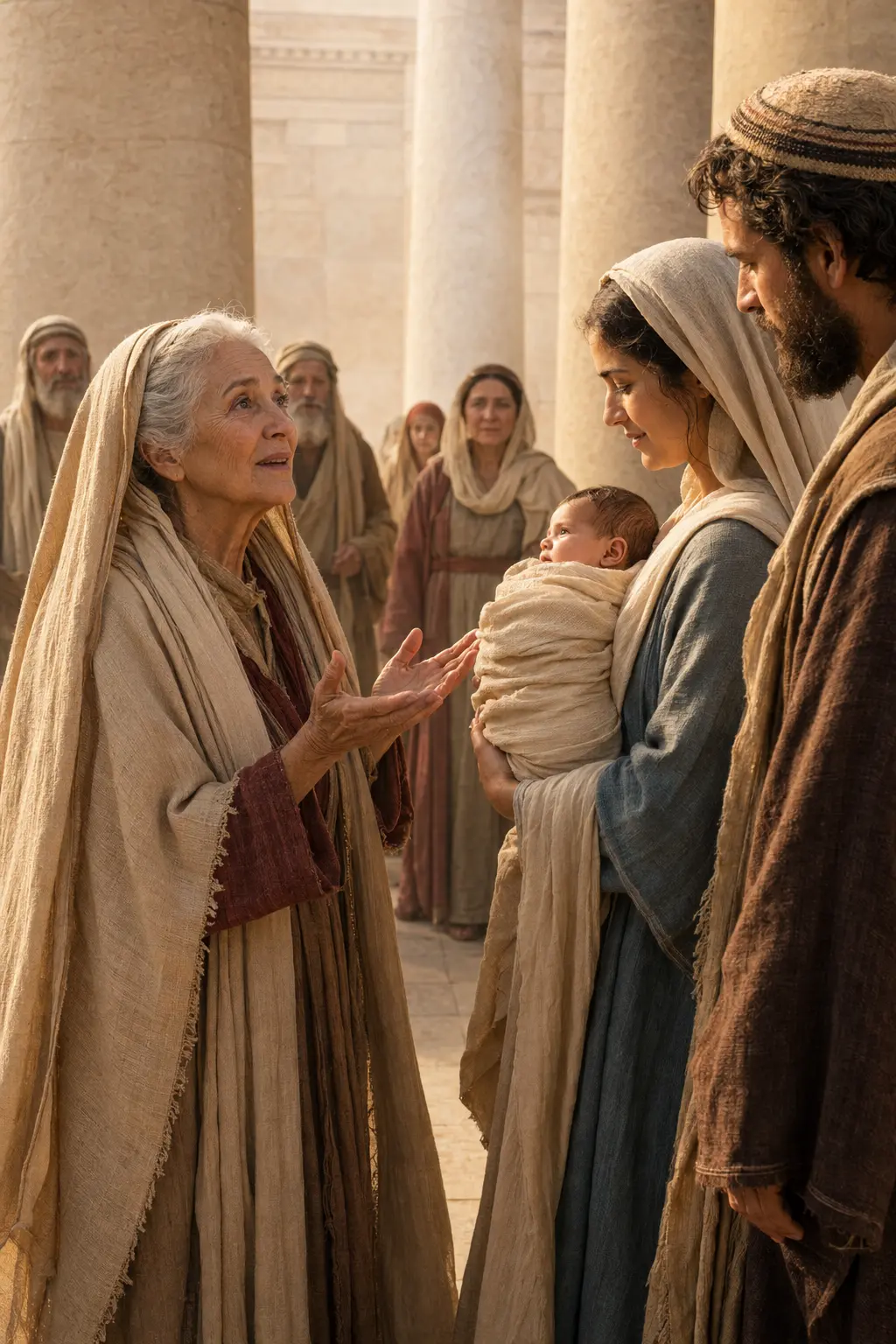
Learning Watchfulness, Recognition, and Faithful Witness from Anna of Asher
Dr. Sherry-Ann Brown
Anna enters Luke’s Gospel in three verses. Her long faithfulness opens a spacious invitation into prayer, discernment, mature calling, and the courage to speak when hope draws near.
Anna enters the Gospel of Luke in three verses. She arrives without a recorded conversation, without a preserved sermon, and without a scene devoted entirely to her. Yet the few lines that carry her name possess the density of a life that has ripened for decades. Luke tells us who her father was, which tribe held her ancestry, how grief marked her early adulthood, where she gave her remaining years, and what she did when the promised Christ came within reach. A whole interior world stands behind those details.
This book lingers at that doorway. It asks what kind of heart can recognize God in an ordinary-looking arrival. It considers how long faithfulness shapes perception, how loss may deepen a life without becoming its final definition, and how worship prepares a person to speak when the hour comes. Anna offers a theology of mature attention. Her story suggests that spiritual sight develops through a thousand quiet returns to the presence of God.
Luke names her a prophetess before describing her practices. Her calling and her formation belong together. She fasted. She prayed. She worshiped. She remained near the Temple. Then, at the precise moment when Mary and Joseph brought Jesus into that sacred space, Anna came forward. She gave thanks to God and spoke about the child to all who were looking for the redemption of Jerusalem. The sequence matters. Her public witness rose from a deeply cultivated private life.
Readers often meet Anna during Advent, beside Simeon, in the tender glow surrounding the presentation of Jesus. Her witness deserves sustained attention in every season. She speaks to people whose lives have included detours, long stretches of obscurity, grief that changed the map, and callings that became clearer with age. She also speaks to communities that celebrate speed while overlooking ripeness. Anna reminds the church that heaven measures preparation through faithfulness, intimacy, and readiness.
The reflections that follow remain close to the biblical text. Where Scripture speaks, we will listen carefully. Where history offers context, we will treat it as context. Where imagination helps us feel the human weight of the scene, it will remain reverent imagination. The goal is encounter: with the Christ whom Anna recognized, with the God who sustained her, and with the invitation to become watchful in our own generation.
Each chapter closes with a prayer and questions for reflection. Move slowly. Let the questions stay open long enough to reveal what hurry conceals. Anna spent years preparing for a moment she could not schedule. Her life invites us into the same holy patience.
Movement I
Chapter One
A Name Kept in the Story
Scripture preserves many faithful lives without preserving their names. Luke gives us Anna. The name is related to the Hebrew Hannah and carries the sense of grace or favor. We should handle such meaning gently, allowing the text to lead. Still, there is beauty in the fact that a woman acquainted with sorrow is introduced to generations through a name associated with grace.
Being named in Scripture does not make Anna important; it allows readers to see the importance God had already placed upon her life. Her worth had been present through every unrecorded morning. The years before Luke’s scene were largely invisible to the future audience of the Gospel, yet none of them were invisible to God. The public record is brief because divine attention never depended upon public documentation.
Many people carry a quiet fear that obscurity means absence. They serve, pray, learn, care for others, and endure while visible outcomes remain small. The modern world trains us to translate visibility into significance. Anna’s life offers another measure. She became ready in a place where daily devotion mattered more than applause. Her name reached the page after her character had been formed beyond the page.
God’s remembering is deeper than human recognition. Throughout Scripture, to be remembered by God signals covenant attention and purposeful action. The Lord remembered Noah upon the waters. God remembered Rachel in her longing. Israel cried beneath oppression, and God remembered his covenant. Divine remembrance does not imply previous forgetfulness; it announces that hidden faithfulness remains held within active love.
Anna’s name also locates her within relationship. She is the daughter of Phanuel. She belongs to Asher. Her identity is personal, familial, communal, and covenantal. The Gospel does not present her as an isolated spiritual phenomenon. She stands within a people and a promise. Mature calling often develops this way. God addresses a person intimately while placing that person within histories, responsibilities, communities, and hopes larger than the self.
Perhaps you have wondered whether the most important years of your life have been witnessed. Perhaps your finest offerings have taken place beyond the rooms where records are kept. Anna’s presence in Luke answers with quiet strength: God sees the years behind the moment. When the moment arrives, it carries the accumulated weight of every faithful return.
Prayer
God who knows my name, gather every hidden season into your gracious purpose. Free me from measuring my life by visibility. Teach me to live faithfully before you, to receive my identity as gift, and to trust that every quiet act of love remains known. Amen.
For Reflection
Which parts of your life feel unseen?
What would change if divine attention became your primary measure of significance?
Which people, communities, and promises have helped shape your identity?
Movement I
Chapter Two
Daughter of Phanuel
Luke calls Anna the daughter of Phanuel. This single detail gives her a lineage and gives the reader a father’s name. Phanuel is related to the biblical name Peniel, the place where Jacob declared that he had seen God face to face. Luke offers no explanation connecting Anna’s father to Jacob’s encounter, so certainty would reach beyond the text. The resonance, however, is spiritually evocative: a woman known for recognition carries a family name that recalls the face of God.
Lineage can function as inheritance, question, burden, blessing, or all four at once. Every person receives a story already in motion. Families hand down language, faith, fear, resilience, wounds, expectations, and ways of seeing the world. Some inherit strong spiritual foundations. Others become the first in their line to cultivate them with intention. Grace can honor what was life-giving and redeem what remained unfinished.
Anna’s prophetic identity did not erase her human origins. She was still someone’s daughter. Spiritual maturity rarely requires the denial of our beginnings. It invites us to bring those beginnings into the light of God, allowing inherited material to be sifted, healed, and consecrated. We learn gratitude for what nourished us. We develop courage to name what diminished us. We become responsible for what we will carry forward.
The mention of Phanuel also protects Anna from becoming a religious abstraction. She had a childhood. She learned customs and prayers. She entered adulthood with a personal history. Before she became the elderly prophetess in the Temple, she was a girl whose future remained unknown to her. Calling often looks clearest in retrospect. God forms a life through stages whose significance appears only after many years have been gathered together.
This matters for readers whose own lives contain several distinct worlds. A person may carry family roots from one place, adulthood in another, professional formation across institutions, service among nations, and spiritual development through many communities. Integration arrives as God gathers these streams into a coherent offering. Mature vocation does not require every stream to perform the same function. It allows each to contribute its particular depth.
Anna stands before us as both daughter and prophetess. The two descriptions coexist. Her calling did not make her less human; it made her humanity available to God. The same grace remains open to us. We can bring our ancestry, education, grief, labor, relationships, and unanswered questions into the presence of Christ. There, biography becomes material for faithful service.
Prayer
God of generations, receive the story that formed me. Bless what carries life, heal what carries pain, and teach me to steward my inheritance with wisdom. Gather every chapter of my history into an offering that serves your purposes. Amen.
For Reflection
What gifts have come to you through your family or formative communities?
Which inherited patterns require healing or transformation?
How might your varied life experiences converge in service to God and others?
Movement I
Chapter Three
From the Tribe of Asher
Luke identifies Anna as belonging to the tribe of Asher. By the first century, this was a striking detail. Asher was one of the northern tribes of Israel, associated in the ancestral blessings with abundance, rich food, strength, and royal provision. The tribe’s historical visibility had faded across centuries of conquest and dispersion, yet Luke names Anna’s connection with confidence. A line that history could have treated as lost remained present in a faithful woman.
Asher’s story begins with Leah’s servant Zilpah bearing Jacob a son. Leah responds with happiness and imagines that other women will call her blessed. Later, Jacob blesses Asher with rich food fit for kings. Moses speaks of blessing, favor, strength, and feet dipped in oil. These images created an inheritance of fruitfulness and provision. They also acquired layers of interpretation over generations. We should receive them as biblical poetry before turning them into personal promises.
Anna embodies a form of abundance that resists shallow definitions. Luke does not describe wealth, status, or ease. He describes a woman rich in devotion, strong across years, and ready to offer the knowledge needed at a decisive hour. Her life suggests that covenant abundance may appear as spiritual capacity: enough oil for the vigil, enough hope for the waiting, enough clarity for recognition, and enough courage for proclamation.
Her tribal identity also carries a message for people who fear that parts of their inheritance have disappeared. God can preserve a thread through centuries. A calling may travel quietly through generations before becoming visible in a particular life. The apparent smallness of the surviving thread does not diminish the faithfulness of the One who keeps it.
For contemporary readers, Asher invites reflection on the stewardship of blessing. Blessing in Scripture flows toward participation in God’s purposes. Bread becomes provision. Strength becomes service. Favor becomes responsibility. Oil becomes consecration. Royal imagery becomes wisdom for serving beyond familiar rooms. Mature believers learn to ask how every gift can nourish people who are waiting for hope.
Anna’s life offers a vital correction to the hunger for spectacle. Her abundance had become interior. Decades of prayer had made room within her. When Christ appeared, she possessed the spiritual vocabulary to respond. Her inheritance flowered as recognition and witness.
Prayer
God of covenant faithfulness, teach me to receive blessing as sacred stewardship. Develop within me the richness of prayer, the strength of endurance, the generosity of service, and the clarity to recognize Christ. Let every gift entrusted to me become nourishment for others. Amen.
For Reflection
Which forms of abundance has God cultivated within you?
Where might blessing be inviting greater responsibility?
What apparently lost thread in your history may still carry purpose?
Movement I
Chapter Four
The Years After Loss
Luke tells us that Anna lived with her husband for seven years after marriage and then became a widow. The text gives no account of the husband’s death, the circumstances of her widowhood, or the emotions that followed. It gives the fact with spare tenderness. A life once imagined in one direction turned sharply toward another.
Loss changes the grammar of time. Before loss, the future may feel like a sentence already underway. After loss, familiar verbs disappear. Plans lose their subjects. The mind returns to former rooms and finds that memory can preserve a voice while remaining unable to restore its presence. Grief asks the soul to inhabit a world whose shape has changed.
Anna’s devotion should never be used to minimize this human passage. The biblical text does not say that grief was easy because she became prayerful. It shows that sorrow and consecration eventually occupied the same life. Her wound became part of her formation without becoming the whole of her identity. She remained a widow, and she became known as a prophetess.
There is dignity in that conjunction. Faith does not require people to erase the names of what they have lost. It creates space in which loss can be carried toward God. Prayer may begin as lament before it becomes expectancy. Fasting may express longing before it becomes discipline. Worship may first sound like a trembling decision to remain.
Some readers carry losses that involve death. Others carry the ending of a vocation, a relationship, a community, a place, a bodily capacity, or an expected future. Such losses differ in kind and should retain their particular names. Anna’s witness offers companionship across them: a changed life can still become a consecrated life. The future may emerge through a form that earlier years could not have predicted.
Her story also honors the long interval between rupture and recognition. Luke moves quickly across decades because narrative time is compressed. Human time was lived day by day. Anna did not leap from bereavement to the presentation of Jesus. She walked the middle years. She woke, prayed, fasted, worshiped, grew older, and continued. The miracle of her life includes that continuing.
Prayer
God who remains near the brokenhearted, meet me within every changed landscape. Give me permission to grieve honestly and grace to continue faithfully. Form within me a future spacious enough to carry memory, love, calling, and hope. Amen.
For Reflection
Which loss changed the expected direction of your life?
How has grief influenced the way you pray?
What new capacity may be forming within the life you now inhabit?
Movement I
Chapter Five
The Hidden Middle
Between Anna’s early widowhood and her appearance beside the infant Jesus lies a vast hidden middle. Scripture passes over it in a phrase. She did not depart from the Temple, serving God with fasting and prayers night and day. The sentence summarizes decades through repeated practices. It tells us little about individual days and everything about their direction.
The hidden middle is where many lives are actually lived. Beginnings receive ceremonies. Fulfillments receive testimonies. The years between them often arrive without a name. They contain work, waiting, learning, repair, service, disappointment, and ordinary faithfulness. Their power is cumulative. A single day may feel small while thousands of aligned days shape a person capable of carrying a significant moment.
Anna’s hidden years challenge the assumption that preparation must always feel dramatic. Formation frequently occurs beneath conscious measurement. Prayer adjusts the heart’s attention. Fasting exposes competing appetites. Worship relocates the center of meaning. Community reveals both love and limitation. Repetition becomes depth when the practice remains alive with surrender.
There is also mystery in Anna’s location. Luke’s description may communicate extraordinary devotion rather than a literal claim that she never crossed the Temple boundary. Either way, the theological portrait is clear: her life had become oriented toward the presence and purposes of God. The Temple was the center of her spiritual geography.
Every reader has a spiritual geography. Certain places, rhythms, relationships, and Scriptures serve as coordinates by which the soul finds its way. A kitchen table can hold intercession. A hospital corridor can summon compassion. A laboratory can awaken wonder and responsibility. A long journey among communities can school the heart in listening. Sacred ground appears wherever life is continually offered to God.
For those whose vocation unfolds across medicine, science, leadership, ministry, service, and international experience, the hidden middle may feel fragmented. Yet years of disciplined attention can gather these domains into a unified posture: to see clearly, care deeply, discern wisely, and respond faithfully. The biography remains secondary; the principle belongs to everyone. God can shape diverse experience into mature availability.
Prayer
God of the hidden years, consecrate my ordinary days. Give coherence to the experiences that seem scattered. Teach me to honor small practices, sustained service, and quiet growth. Form me in the middle so that I may be ready when the hour arrives. Amen.
For Reflection
Which season of your life feels like a hidden middle?
Which repeated practices are shaping your spiritual perception?
Where is God gathering seemingly separate experiences into coherent service?
Movement I
Chapter Six
Night and Day
Luke describes Anna’s service as continuing night and day. The phrase communicates fullness. Her devotion was woven through the whole cycle of time: hours of light, hours of darkness, public rhythms, quiet watches, seasons of energy, and seasons of weariness. The life of prayer had become the climate in which she lived.
Night carries several meanings in Scripture. It can be the hour of fear, testing, revelation, deliverance, or intimate communion. Jacob wrestled through the night. Israel watched for morning. Samuel heard his name while the lamp of God still burned. Jesus later withdrew to pray through the night. Darkness can narrow vision, making distant landmarks disappear. It can also refine attention until the faintest light becomes visible.
Day brings its own demands. Noise returns. Duties gather. People enter the space. Devotion that flourishes only in seclusion remains incomplete. Anna’s worship embraced both night and day, suggesting a faith able to remain attentive through silence and activity. The mature spiritual life learns different forms of presence for different hours.
Some seasons require the prayer of the night: sparse words, honest lament, stubborn trust, and waiting for dawn. Other seasons require the prayer of the day: gratitude, discernment amid movement, service among people, and faithful action. Both belong. A person who has prayed through the night may carry unusual tenderness into the day. A person who has served through the day may enter the night with names and needs gathered for intercession.
Anna’s rhythm also speaks to vigilance. Watchfulness is neither anxiety nor constant intensity. It is a settled readiness born from relationship with God. An anxious watcher scans for threats. A faithful watcher attends for presence, invitation, and responsibility. Anna’s long devotion trained her to notice the arrival of hope in a form others could easily overlook.
The invitation is practical. Choose rhythms that return attention to God across the day’s natural thresholds: waking, beginning work, pausing at midday, ending labor, entering rest. These moments can become small gates of remembrance. Over time, remembrance becomes recognition.
Prayer
God of every hour, meet me in brightness and darkness. Teach me the prayer appropriate to each season. Quiet anxious vigilance and cultivate faithful watchfulness. Let the rhythms of my days return my attention to you. Amen.
For Reflection
Which form of prayer belongs to your present hour?
How does your attention change between activity and silence?
Which daily threshold could become a regular moment of remembrance?
Movement I
Chapter Seven
The Discipline of Desire
Anna served with fasting and prayers. Fasting gives bodily expression to spiritual desire. It creates a chosen emptiness through which deeper hunger may be named. In Scripture, fasting accompanies grief, repentance, intercession, discernment, preparation, and longing for God. Its meaning arises from the heart and purpose that carry it.
For Anna, fasting belonged to a long life of worship. Luke does not provide her schedule or method. Wisdom therefore resists inventing details. The text allows us to see a woman whose desires had been disciplined toward the hope of Israel. She practiced making room.
Desire itself is part of human dignity. We long for love, meaning, healing, justice, belonging, fruitfulness, beauty, and the fulfillment of promises. Unexamined desire can scatter attention. Suppressed desire can harden into numbness. Consecrated desire becomes available for transformation. Fasting can help reveal which hunger is speaking and what it seeks.
Christian fasting is centered upon God, shaped by grace, and practiced with wisdom. Health, age, pregnancy, medication, eating disorder history, metabolic needs, and clinical conditions matter. Food fasting is one expression among several. Some people may fast from noise, entertainment, purchasing, habitual commentary, or other forms of consumption while maintaining appropriate nutrition and medical care. The essential movement is intentional space offered to God.
Anna’s disciplined desire prepared her for joy. This is easy to miss. Fasting can sound severe when separated from its horizon. Her long hunger met the infant Christ. The practice had trained her desire toward a Person. When fulfillment entered the Temple, she possessed the capacity to receive it with thanksgiving.
Our age offers endless ways to dull longing through rapid consumption. Anna invites us to let holy desire become articulate. What redemption are we seeking? Whose healing are we carrying? Which promise keeps returning in prayer? What appetite consumes attention that could be released toward love? The disciplined heart becomes spacious enough to answer.
Prayer
God of holy desire, reveal the hungers shaping my life. Teach me practices that create room for your presence and purposes. Give me wisdom for my body, honesty about my appetites, and joy in Christ, the fulfillment toward whom every faithful longing moves. Amen.
For Reflection
Which desire currently carries the greatest emotional weight for you?
What form of wise, health-conscious fasting could create space for discernment?
How might longing become intercession rather than distraction?
Movement I
Chapter Eight
A Heart Trained to Notice
Recognition appears sudden in Luke’s scene. Mary and Joseph arrive. Simeon receives the child. Anna comes forward at that very moment. She gives thanks and begins to speak. Yet sudden recognition usually rests upon long preparation. The moment was brief; the capacity behind it had taken years.
Spiritual attention develops through relationship, Scripture, prayer, wisdom, community, and obedience. It also develops through humility. We learn that our first interpretation may require testing. We welcome counsel. We examine fruit. We distinguish the voice of fear from the leading of peace, personal preference from loving responsibility, and urgency from genuine timing. Mature discernment grows both tender and accountable.
Anna recognized Jesus before his public ministry, miracles, teaching, cross, and resurrection. She encountered an infant held by ordinary parents fulfilling the requirements of the law. The glory was present within humility. This pattern continues throughout the Gospel: God’s kingdom arrives like seed, leaven, touch, table fellowship, and a child placed among adults.
Many divine invitations enter our lives without spectacle. They appear as a person to hear carefully, a responsibility to accept, a boundary to honor, an idea to steward, a community to serve, or a truth to speak with love. Recognition asks more than perception. It asks response. Anna came near, gave thanks, and spoke.
Her example offers a vital word for people whose training has sharpened analytical judgment. Expertise can become a servant of discernment when joined with prayer and humility. Careful observation, pattern recognition, evidence, consultation, and spiritual attentiveness need not compete. They can mature together under the lordship of Christ. Wisdom tests responsibly while remaining open to wonder.
The heart trained to notice is also trained to love. Spiritual perception separated from love becomes self-important. Anna used recognition to give thanks and to encourage people who were waiting for redemption. Her insight moved outward as worship and hope.
Prayer
God who comes near in humility, train my heart to notice. Refine my perception through Scripture, prayer, wisdom, community, and love. Give me courage to respond with gratitude and to share hope in ways that serve others. Amen.
For Reflection
Which quiet invitation may be present within your current circumstances?
How do you test spiritual impressions with humility and accountability?
Does your discernment produce gratitude, love, and hope for others?
Movement II
Chapter Nine
The Prophetess in the Temple
Luke calls Anna a prophetess. The title deserves both reverence and restraint. Scripture gives no transcript of her earlier prophetic words, no account of formal recognition, and no catalog of signs attached to her ministry. Luke nevertheless names her plainly. Her prophetic identity is part of the inspired record.
Across Scripture, prophets receive and communicate what God entrusts. Their service includes proclamation, warning, encouragement, interpretation, intercession, and the faithful naming of what God is doing within history. The prophetic vocation carries moral weight because words can guide, strengthen, expose, or wound. Mature prophetic ministry therefore requires character, humility, testing, and accountability.
Anna’s portrait places devotional life beside prophetic identity. Her authority does not emerge through performance. It rests within a life of prayer, fasting, worship, endurance, and covenant hope. Luke gives readers the roots before showing the fruit. Her practice had cultivated a person capable of bearing truthful witness.
This integration matters in every generation. Gift can open a moment; character determines how the moment is carried. Sensitivity can perceive something real; wisdom discerns how, when, and whether to speak. Courage gives voice; love governs the purpose of that voice. Anna’s scene holds these qualities together. She recognizes Christ, gives thanks to God, and speaks to people already longing for redemption.
Her prophetic ministry is profoundly Christ-centered. The revelation directs attention toward Jesus. The response produces worship. The communication strengthens hope. These movements offer a durable framework for evaluating spiritual speech. Does it honor Christ? Does it accord with Scripture? Does it produce faithful fruit? Does it serve the hearer? Can it remain accountable within Christian community?
Anna also expands the reader’s imagination about age and calling. Her designation as prophetess stands in the present tense of the story. The years had deepened her usefulness. She carried history without being trapped by nostalgia. She stood in an ancient sacred place and recognized a new movement of God.
Prayer
God of truth and grace, shape every gift within the character of Christ. Refine my motives, govern my words, and deepen my accountability. Let spiritual insight lead toward worship, wisdom, courage, and hope. Amen.
For Reflection
Which forms of character must accompany the gifts you carry?
How do Scripture, community, and fruit help you test spiritual insight?
Does your speech direct attention toward Christ and strengthen others?
Movement II
Chapter Ten
The Place of Continual Return
Anna’s life remained closely joined to the Temple. This was the center of Israel’s worship, sacrifice, prayer, memory, and expectation. Pilgrims arrived with offerings. Priests carried their appointed duties. Families entered for rites commanded in the law. The Temple gathered personal stories into the covenant life of a people.
Luke’s description of Anna dwelling there communicates extraordinary constancy. The exact practical arrangements remain beyond what the text explains. The devotional meaning is luminous: she organized her life around repeated return to God.
Return is one of the quiet mercies of faith. Attention wanders, and we return. Grief rises, and we return. Success creates noise, and we return. Questions remain unresolved, and we return. The mature life is built through this movement more often than through uninterrupted intensity. Anna’s constancy was likely made from countless returns.
Sacred practice also places us among others. The Temple was filled with human complexity: reverence and distraction, generosity and ambition, longing and routine. Devotion in community asks us to love God amid imperfect people. It trains us to distinguish disappointment with human behavior from abandonment of divine presence.
Many readers inhabit several vocational rooms. Work occurs in clinics, classrooms, laboratories, offices, homes, sanctuaries, online communities, and unfamiliar cities. A life centered in God can travel among them. The center is carried through ordered love, daily remembrance, and practices that restore orientation.
Continual return protects calling from fragmentation. It reminds the caregiver that every person exceeds a diagnosis. It reminds the leader that people exceed their function. It reminds the scholar that knowledge carries responsibility. It reminds the minister that spiritual authority remains service. At the center, Christ gathers the scattered self.
Prayer
God of abiding presence, teach me to return. Establish rhythms that restore my attention and gather every part of my life around your love. Make me faithful within community and centered across every place of service. Amen.
For Reflection
Which practice most reliably restores your spiritual orientation?
What tends to draw your life away from its center?
How can continual return bring greater coherence to your varied responsibilities?
Movement II
Chapter Eleven
She Came at That Very Moment
Luke marks the timing of Anna’s arrival with remarkable precision: she came forward at that very moment. Simeon was blessing God over the child. Mary and Joseph stood within the Temple carrying the wonder and vulnerability of new parenthood. Anna entered the scene at the intersection of promise, obedience, recognition, and praise.
Divine timing is often described after the fact. In lived experience, the path toward a significant moment may feel ordinary. Anna could not have controlled the family’s arrival. Mary and Joseph could not have arranged the presence of every witness. Their separate acts of faithfulness converged within a moment God had prepared.
This kind of convergence does not excuse passivity. Anna’s readiness had been active. Mary and Joseph had obeyed the law. Simeon had responded to the Spirit. Each person carried a faithful part. Timing gathered their obedience into a scene none of them could have created alone.
We sometimes burden ourselves with the belief that every outcome depends upon perfect personal coordination. Anna offers relief. Our responsibility is faithful presence, wise preparation, and responsive obedience. God remains capable of arranging intersections beyond our reach.
The phrase also dignifies punctual spiritual response. Anna did not postpone gratitude until she possessed a full explanation. She recognized the significance of the child and answered the moment she had been given. Mature discernment includes timing: patience before the hour and courage within it.
Some doors remain open briefly. A word of encouragement belongs to a particular day. An apology ripens and should be spoken. An invitation arrives within a narrow season. A person needs to be seen while standing before us. The watchful heart neither forces the moment nor sleeps through it.
Prayer
God of seasons and moments, form patient readiness within me. Release me from the illusion that I control every convergence. Give me wisdom to wait, clarity to recognize the hour, and courage to respond while the invitation is present. Amen.
For Reflection
Where is faithful preparation currently more important than visible movement?
Which present invitation may require a timely response?
How can you distinguish patient waiting from avoidant delay?
Movement II
Chapter Twelve
Christ in Ordinary Arms
The Messiah entered the Temple in the arms of a young mother. Joseph stood beside her. The family came to fulfill the law, carrying an offering associated with modest means. Nothing in Luke’s description suggests a public procession. Heaven’s promise arrived clothed in ordinary family faithfulness.
Anna’s recognition therefore involved spiritual perception. She saw beyond scale. The infant had delivered no sermon and performed no public miracle. His kingship was concealed within dependence. His strength was carried. His voice had yet to command the wind. The One through whom all things were made entered sacred space as a child needing warmth, nourishment, and protection.
The incarnation teaches us to attend to humble forms. God’s action may arrive through beginnings too small to impress us: a conversation, an emerging vocation, a faithful local community, a first act of obedience, a quiet idea entrusted for stewardship. Mature faith learns to honor seed before harvest.
This posture differs from romanticizing smallness. Every beginning requires discernment, care, and truthful evaluation. Anna’s recognition was grounded in her relationship with God and Israel’s hope. The lesson is attentive humility: significance cannot always be measured by present size.
Christ in ordinary arms also sanctifies human care. Mary held the One who held creation. Joseph’s protective presence participated in a mystery larger than he could manage. Their practical faithfulness surrounded the holy. Feeding, carrying, traveling, presenting, and obeying became part of the Gospel’s early movement.
People who care for bodies understand this sacred particularity. Love often takes the form of noticing breath, pain, fatigue, hunger, fear, and hope. Spiritual ministry also attends to embodied life. Anna’s worship did not draw her away from the human scene; it enabled her to recognize God within it.
Prayer
God revealed in Jesus Christ, give me reverence for humble beginnings and ordinary faithfulness. Teach me to see sacred purpose within embodied care. Keep my attention tender enough to recognize glory carried quietly. Amen.
For Reflection
Which small beginning in your life deserves patient stewardship?
How does the incarnation shape your understanding of practical care?
Where might significance be present in an unimpressive form?
Movement II
Chapter Thirteen
She Gave Thanks
Anna’s first recorded response is thanksgiving. Before Luke tells us what she said to others, he tells us how she turned toward God. Recognition opened into gratitude.
Thanksgiving is more than courtesy at the end of fulfillment. It is a spiritual act that names God as the source of grace. Anna had waited within the long hope of Israel. When she saw the child, gratitude gathered personal longing and communal promise into worship.
Her thanksgiving also protected the moment from self-importance. She did not place herself at the center as the person perceptive enough to recognize what others missed. She gave thanks to God. Mature spiritual insight redirects honor toward its source.
Gratitude can coexist with unfinished circumstances. Jesus was still an infant. Roman power remained. Jerusalem’s redemption had entered history while its full unfolding lay ahead. Anna thanked God at the beginning of fulfillment. Her praise recognized the faithfulness already present within a promise still moving toward completion.
This is a vital practice for long callings. Some answers arrive as completed outcomes. Others arrive as first light. Gratitude helps us receive beginnings without demanding that they immediately display their final form. It allows joy to enter before every question has been resolved.
Thanksgiving also clarifies memory. It traces the path by which grace has carried us: people who prayed, doors that opened, wisdom gained through difficulty, protection discovered later, and capacities formed across years. Remembered grace strengthens present courage.
Prayer
Faithful God, let recognition lead me into gratitude. Guard me from making spiritual insight about myself. Teach me to give thanks for first light, unfolding answers, and grace remembered across the years. Amen.
For Reflection
Which beginning deserves thanksgiving before its full outcome appears?
How does gratitude protect spiritual insight from self-importance?
Which remembered grace strengthens your courage today?
Movement II
Chapter Fourteen
She Spoke to Those Who Were Waiting
After giving thanks, Anna spoke about Jesus to all who were looking for the redemption of Jerusalem. Her witness had an audience defined by longing. These were people who carried hope through occupation, disappointment, and delay. Anna recognized both the child and the community prepared to hear about him.
Faithful communication considers the hearer. Anna’s message met an existing hunger. She did not speak merely to display knowledge. She served people whose prayers had prepared them to receive hope.
The text does not preserve her exact words, which invites restraint. We know their center: she spoke about the child. We know their audience: those awaiting redemption. We know their setting: Jerusalem. Within those boundaries, her proclamation shines as one of the earliest public witnesses to Jesus.
Redemption is larger than private relief. Jerusalem represented a people, a history, worship, promise, conflict, and hope. Those waiting for its redemption longed for God’s restoring action. Anna announced that this hope had taken flesh within their own generation.
Her example helps readers consider the relationship between discernment and mission. What we receive from God may carry a community in view. Insight can become encouragement, teaching, intercession, wise counsel, creative service, clinical care, public leadership, or faithful presence. The form varies; love remains the governing purpose.
Anna’s mature voice had been prepared by listening. She knew the language of longing because she had inhabited it. Those who speak hope responsibly must learn to hear pain, history, and expectation. Proclamation carries greater tenderness when it has passed through intercession.
Prayer
God of redemption, teach me to speak in ways that serve people who are waiting. Give me language shaped by listening, truth governed by love, and courage centered in Christ. Let every entrusted word carry hope with integrity. Amen.
For Reflection
Which community’s longing has God taught you to hear?
How can your words serve rather than display spiritual knowledge?
What form might faithful witness take within your present sphere of responsibility?
Movement II
Chapter Fifteen
The Company of Those Who Longed
Anna spoke to people already looking for redemption. Luke lets us glimpse a quiet community of expectation within Jerusalem: men and women who had kept hope alive through prayer, Scripture, worship, conversation, and daily faithfulness. They may never have appeared together on an official list. Their shared longing nevertheless made them a spiritual company.
Communities are often formed before they are organized. People recognize one another through the questions they carry and the future for which they pray. A repeated hope becomes a meeting place. Anna knew where to take the news because she knew who had been waiting.
Waiting in company protects hope from isolation. Alone, a person may mistake delay for abandonment. Within community, another voice remembers what weariness has forgotten. One person carries courage while another grieves. One holds the promise while another rests. Shared expectation creates a larger vessel than individual strength could sustain.
Such communities also require wisdom. Shared longing can intensify speculation. People may begin assigning dates, interpreting every event as confirmation, or rewarding certainty more than humility. Faithful expectancy stays rooted in God’s character and open to correction. It creates room for mystery while remaining responsive to genuine fulfillment.
Anna’s announcement entered a community prepared to test hope through covenant memory. The child before her belonged to Israel’s story. Her witness joined personal discernment with communal expectation. This joining remains essential: private insight finds safety and depth when brought into mature, prayerful relationship.
Prayer
God who gathers those who long for your purposes, place me within communities of patient hope. Teach us to remember together, test wisely, encourage faithfully, and recognize Christ with humility. Amen.
For Reflection
Who helps you sustain hope across long seasons?
Which shared longing is forming community around you?
How can expectation remain humble, grounded, and accountable?
Movement II
Chapter Sixteen
Redemption Larger Than Relief
The people around Anna were seeking the redemption of Jerusalem. Redemption carries the language of release, restoration, rescue, and belonging reclaimed. In the biblical story, it reaches beyond a temporary improvement in circumstances. It concerns God acting faithfully for a people whose life has been constrained by sin, suffering, oppression, exile, and death.
Relief matters. Scripture never treats human pain as trivial. Hungry people need food. Captives need freedom. The sick need care. The grieving need comfort. Yet redemption reaches through immediate need toward restored relationship with God and renewed participation in divine purpose.
Jesus entered this hope as both fulfillment and surprise. His path would move through teaching, healing, confrontation, suffering, crucifixion, and resurrection. The infant Anna celebrated carried a redemption whose shape would challenge political expectation and transform the meaning of victory.
The church must hold this fullness. Spiritual language cannot replace practical care, and practical care cannot exhaust the Gospel’s horizon. Christian witness attends to bodies, communities, systems, souls, truth, forgiveness, justice, and eternal hope. Redemption gathers the whole person beneath the lordship of Christ.
Anna’s thanksgiving began before the cross and empty tomb were visible. She recognized the Redeemer at the opening of the story. Readers stand later in the narrative, able to see how costly and comprehensive that redemption would be. Her early praise invites our deeper gratitude.
Prayer
Redeeming God, enlarge my understanding of your restoring work. Teach me to serve immediate needs with compassion while bearing witness to the full hope revealed in Jesus Christ. Amen.
For Reflection
Where are you currently seeking relief?
How might God’s restoring purpose reach deeper than the outcome you first imagined?
How can spiritual hope and practical care remain joined in your service?
Movement III
Chapter Seventeen
Age as Spiritual Depth
Luke emphasizes Anna’s great age. The wording of Luke 2:37 can be understood as describing her as eighty-four years old or as having lived eighty-four years as a widow; interpreters have long discussed the grammar. Either reading presents a woman advanced in years. The central truth remains clear: age had not moved her beyond meaningful service.
Contemporary culture often treats youth as the primary home of possibility. Scripture offers a broader imagination. Abraham and Sarah encounter promise in old age. Moses begins a defining public assignment after decades of preparation. Caleb still speaks of strength and inheritance. Elizabeth carries joy after long disappointment. Anna stands among these witnesses to divine fruitfulness across the lifespan.
Age alone does not guarantee wisdom. Years may deepen tenderness or reinforce rigidity. The spiritual question concerns how years are inhabited. Anna had offered hers through worship, prayer, and disciplined longing. Time had ripened attention.
Her life also honors elders within the church. Communities lose memory when they overlook people who have prayed through previous seasons. Elders may carry pattern recognition, historical perspective, tested faith, and a freedom from urgency that younger leaders need. Their contribution deserves relationship, opportunity, and respect.
Every stage carries its own grace. Youth offers energy, imagination, and fresh sight. Middle years may carry responsibility, integration, and tested capacity. Later years can offer distillation: fewer illusions, deeper roots, and a clearer sense of what endures. The body changes; vocation may change form; calling can continue to bear fruit.
Prayer
God of every generation, teach me to receive each season as material for faithful service. Give your church reverence for elders, openness to youth, and relationships through which wisdom and courage can travel in both directions. Amen.
For Reflection
Which assumptions about age have shaped your view of calling?
Whose seasoned wisdom deserves greater attention in your life?
What quality is your present season inviting you to cultivate?
Movement III
Chapter Eighteen
A Woman Whose Voice Remained
Luke preserves Anna’s voice by telling us that she spoke. Her exact sentences are absent, yet her act of proclamation remains permanently visible. Within a world where women’s public authority could be constrained, the Gospel names an elderly woman as prophetess and witness to Christ.
Luke’s opening chapters repeatedly honor women as recipients and carriers of revelation. Elizabeth interprets Mary’s arrival with Spirit-filled blessing. Mary sings of God’s reversal and mercy. Anna recognizes Jesus and speaks to those awaiting redemption. Their voices help announce the meaning of the incarnation.
Anna’s presence invites the church to receive the gifts God entrusts to women. This reception involves more than admiration at a distance. Communities must cultivate spaces where women can learn, discern, speak, lead, serve, and mature with sound formation and mutual accountability.
Her example also carries tenderness for women whose voices have been overlooked. Silence can be imposed through dismissal, fear, exclusion, or repeated interruption. Recovery may require healing, wise community, and gradual courage. A faithful voice need not imitate aggression to possess strength. Anna’s proclamation appears grounded, timely, and directed toward hope.
The purpose of voice is service. Christian speech seeks truth, love, freedom, repentance, courage, and recognition of Christ. Its strength arises from alignment with God rather than domination of the room.
Prayer
God who gives voice, strengthen every person whom you call to speak. Heal the wounds created by dismissal, form courage through wisdom, and teach your people to receive truth with humility. Amen.
For Reflection
Where has your voice been strengthened or diminished?
How can your community cultivate women’s gifts with integrity?
Which truth are you prepared to express with courage and love?
Movement III
Chapter Nineteen
Prayer as Public Service
Anna served God with prayers. Luke’s language presents prayer as ministry, not retreat from useful work. Her intercession belonged to the spiritual life of Jerusalem and to the hope surrounding the Messiah’s arrival.
Prayer serves the world by bringing persons, communities, leaders, wounds, and possibilities before God. It trains the intercessor to remain near realities that are easy to avoid. Sustained prayer listens beneath headlines. It learns names. It carries complexity beyond quick judgment.
Intercession also changes the one who prays. Repeatedly asking for mercy can soften contempt. Praying for justice can expose personal complicity. Holding leaders before God can replace gossip with responsible concern. Carrying the sick can deepen compassion. Prayer becomes a school of participation.
This service should lead toward faithful action when action is entrusted. The person who prays for the lonely may be called to visit. The one who intercedes for trainees may need to mentor. Prayer for a community may open a path toward practical investment. Intercession and obedience strengthen one another.
Anna’s prayer remained joined with recognition and speech. She prayed before the moment, gave thanks within it, and proclaimed afterward. Her life reveals a complete movement: carry the hope, recognize the answer, worship the Giver, and serve the waiting community.
Prayer
God who hears, deepen my intercession until it becomes loving service. Give me endurance to carry names and needs, honesty to receive transformation, and obedience when prayer opens a path toward action. Amen.
For Reflection
Which people or communities have been entrusted to your prayers?
How is intercession changing your attitudes or priorities?
Which practical response may now belong beside your prayer?
Movement III
Chapter Twenty
The Authority of a Formed Life
Anna’s authority is conveyed without title inflation. Luke calls her a prophetess and then describes a life capable of carrying the name. Her practices, endurance, recognition, gratitude, and witness form a coherent portrait.
Spiritual authority differs from control. It arises through trustworthy alignment with God’s character and purposes. People sense when words have passed through prayer, humility, truthfulness, and costly obedience. Such authority may speak quietly while carrying unusual weight.
Formation gives a gift somewhere safe to live. Insight housed within insecurity may seek constant validation. Leadership housed within unhealed ambition may use people as evidence of importance. Compassion without boundaries may collapse into exhaustion. Formation attends to the inner structures that help calling serve others freely.
This work continues across a lifetime. Success reveals areas still needing surrender. Failure uncovers hidden dependence. Community provides mirrors. Scripture renews the mind. Prayer opens motives before God. Rest restores proportion. Accountability keeps power answerable to love.
Anna’s formed life did not require a long introduction when the decisive moment arrived. Her response revealed who she had become across the years. Our most consequential actions also emerge from accumulated habits. The hour discloses the formation that preceded it.
Prayer
God of holy formation, make my inner life a trustworthy home for every gift you entrust. Purify ambition, heal insecurity, strengthen boundaries, and align authority with the servant heart of Christ. Amen.
For Reflection
Which inner structure currently needs strengthening?
How does accountability protect the gifts you carry?
What do your habitual responses reveal about your formation?
Movement III
Chapter Twenty-One
Waiting Without Withering
Long waiting can narrow a life until the delayed thing occupies every room. Hope becomes strained. Comparison intensifies. The future feels responsible for making the present worthwhile. Anna’s story offers another way to wait: with a life actively given to God.
Her practices did not function as payment for fulfillment. Prayer and fasting were relationship, service, and participation. She was living before the answer appeared. Her identity held more than the awaited moment, even while her longing remained real.
Healthy waiting keeps desire alive while allowing love to circulate in the present. It receives today’s responsibilities, friendships, work, beauty, grief, and rest. It refuses to postpone the whole self until one outcome arrives. This spaciousness protects hope from becoming an idol.
Waiting also requires honest lament. Some promises are interpreted incorrectly. Some desired outcomes never take the expected form. Some prayers remain mysterious. Christian hope rests ultimately in God’s character and the resurrection of Jesus, a foundation deeper than any single temporal result.
Anna’s life had known profound loss, yet Luke presents her at the Temple with capacity for gratitude and proclamation. She had not withered into inwardness. Years of longing had enlarged her ability to recognize and share joy.
Prayer
God of the present and the promised future, keep waiting from consuming my life. Hold my desire within your love, teach me honest lament, and preserve my capacity for service, relationship, beauty, and joy today. Amen.
For Reflection
Has waiting enlarged or narrowed your present life?
Which gift of today deserves attention alongside future hope?
Where might lament restore honesty to your prayer?
Movement III
Chapter Twenty-Two
Watchfulness Without Fear
Watchfulness can resemble anxiety from a distance because both involve attention. Their inner movements differ. Anxiety scans for danger in an effort to control uncertainty. Spiritual watchfulness rests in God while remaining ready to perceive truth, invitation, and responsibility.
Anna’s vigilance was rooted in worship. She was attentive because she loved God and carried hope, not because every shadow required interpretation. This distinction matters for people drawn to spiritual discernment. Constant alertness can exhaust the nervous system and distort perception. Rest, community, embodied care, and wise boundaries support clearer attention.
Faithful watchfulness welcomes testing. It can say, “I may be mistaken.” It does not need every impression to carry divine authority. It distinguishes intuition, emotion, observation, memory, and spiritual prompting while acknowledging that human experience can involve several at once.
Peace is not passivity. A watchful person may perceive a need for urgent action. The inner posture remains surrendered rather than frantic. Courage can move quickly without being driven by panic.
Anna’s scene is filled with peaceable readiness. She comes forward, gives thanks, and speaks. Her response is decisive without spectacle. Years near God have taught her how to recognize the hour without trying to manufacture it.
Prayer
God of peace, free my attention from fear-driven vigilance. Form in me a rested readiness that welcomes testing, honors my human limits, and responds courageously when love requires action. Amen.
For Reflection
How does anxiety feel different from spiritual watchfulness in your body?
Which practices support clear and rested discernment?
Where can you release control while remaining responsibly attentive?
Movement III
Chapter Twenty-Three
The Holy Work of Silence
Anna’s recorded words come after decades in which Scripture emphasizes prayer rather than speech. Her silence was not emptiness. It was a chamber where longing, memory, grief, and hope could remain before God without immediate explanation.
Silence reveals how quickly the mind reaches for language to control experience. We name, classify, defend, rehearse, and predict. Words are gifts, yet constant speech can keep deeper truth from rising. Chosen silence creates room to notice the movement beneath our prepared answers.
Biblical silence takes several forms. Habakkuk calls the earth to silence before the Lord. Elijah encounters a quiet voice after wind, earthquake, and fire. Mary treasures events in her heart. Jesus remains silent at moments when accusation seeks to command his response. Silence may express awe, listening, restraint, grief, or surrendered strength.
Healthy silence differs from enforced voicelessness. It should never be used to protect abuse, conceal danger, or prevent truthful testimony. Sacred silence is freely offered to God and remains compatible with courageous speech. Anna demonstrates both: long attention and timely proclamation.
In practice, silence can begin modestly. A few minutes without devices, music, reading, or formulated prayer may expose restlessness. The aim is gentle availability. We allow God to meet the unedited self.
Prayer
God who meets me beyond words, make silence a place of truthful presence. Quiet compulsive speech, deepen my listening, and prepare me to speak with courage when love requires a voice. Amen.
For Reflection
What surfaces when you enter silence?
Which kind of silence brings freedom, and which kind conceals truth?
How might listening refine your future speech?
Movement III
Chapter Twenty-Four
Scripture as a School of Recognition
Anna recognized Jesus within Israel’s long story. Luke does not describe her method of biblical interpretation, yet Temple worship, prayer, and covenant expectation were saturated with Scripture. Her recognition belonged to a people formed by promise.
Scripture gives discernment a grammar. It reveals God’s character, human complexity, covenant faithfulness, the seriousness of sin, the demands of justice, the tenderness of mercy, and the centrality of Christ. Without this grammar, spiritual impressions can become mirrors reflecting our preferences.
Reading for formation asks more than, “What information is here?” It also asks, “What kind of person is this truth calling me to be?” A text may correct our picture of God, expose a motive, enlarge compassion, or redirect action. Repeated reading places the imagination within a world governed by divine faithfulness.
Responsible interpretation honors context. A verse belongs within a paragraph, a book, a historical setting, and the whole witness of Scripture. Genre matters. Poetry speaks differently from law; proverb differently from narrative; apocalypse differently from epistle. Humility welcomes teachers and communities able to challenge private certainty.
Christians read Scripture toward Jesus, whose life, teaching, death, and resurrection reveal the center of the Gospel. Anna’s witness carries this orientation. Her insight did not terminate in an abstract idea; it recognized a Person.
Prayer
God of the living Word, train my perception through Scripture. Give me patience with context, humility before wise teachers, and a heart drawn toward Jesus. Let truth reshape my character and guide my response. Amen.
For Reflection
Which biblical passage is currently reshaping your perception?
Where might personal preference be influencing your interpretation?
How does your reading lead toward Christlike character?
Movement IV
Chapter Twenty-Five
Discernment in Community
Anna spoke within a community of people awaiting redemption. Her witness entered relationship. This setting reminds us that Christian discernment is personal without being private in the absolute sense.
Community helps test what one person perceives. Others may recognize scriptural alignment, practical wisdom, troubling assumptions, emotional pressure, or consequences the speaker has missed. Mature companions can honor spiritual sensitivity while asking careful questions.
Testing requires an atmosphere where revision is safe. If changing one’s mind is treated as spiritual failure, people will defend impressions beyond the evidence. Humility allows language such as, “This is what I sense,” “I am still weighing it,” and “I may need correction.” Such phrases can express strength because truth matters more than appearance.
Communal discernment also respects appropriate privacy. Every impression does not belong to every audience. Sensitive matters require consent, confidentiality, and careful boundaries. The purpose is faithful care rather than curiosity.
Healthy communities distribute responsibility. One person may perceive direction; another may understand timing; another may recognize risk; another may carry pastoral wisdom. Together they form a fuller picture. Shared discernment resists both authoritarian certainty and shapeless indecision.
Prayer
God who forms a people, place me among wise and trustworthy companions. Give us courage to test, freedom to revise, discipline to protect privacy, and love strong enough to seek truth together. Amen.
For Reflection
Who has permission to question your interpretations?
What conditions make revision feel safe?
Which matters require greater confidentiality or consent?
Movement IV
Chapter Twenty-Six
The Gift of Wise Counsel
People often seek counsel when several good values compete. A decision may involve calling and capacity, opportunity and timing, generosity and boundaries, courage and prudence. Wise counsel helps the heart name the real decision beneath the visible options.
Counsel differs from surrendering responsibility. A trusted advisor offers perspective, questions, knowledge, and prayer. The person deciding remains responsible before God for the choice. This protects both parties from unhealthy dependence.
The best counselor is not always the most affirming voice. Faithful counsel may identify a risk, slow an urgent plan, or ask whether a beautiful idea has adequate support. It may also strengthen courage when fear has disguised itself as wisdom. Discernment considers the counselor’s character, competence, relationship to the issue, and freedom from hidden interest.
Anna’s maturity suggests the value of counsel ripened through long attention. People who have lived prayerfully across seasons can recognize patterns invisible to those inside a crisis. Their wisdom may arrive through a simple question rather than a dramatic declaration.
Receiving counsel requires listening without becoming passive. We can record what was said, examine it through Scripture and reality, pray, gather further information, and allow time to reveal fruit. Wise decisions often emerge through convergence rather than a single persuasive voice.
Prayer
God of wisdom, guide me toward counselors of character, understanding, and courage. Teach me to receive questions without defensiveness and to retain responsible ownership of my decisions. Amen.
For Reflection
Which decision would benefit from informed counsel?
What interests or limitations might shape a counselor’s perspective?
Are you seeking wisdom, permission, reassurance, or relief from responsibility?
Movement IV
Chapter Twenty-Seven
The Body Belongs in Discernment
Anna’s devotion included fasting, a bodily practice. Her story reminds us that spiritual formation occurs within embodied life. Sleep, nourishment, illness, pain, hormones, medication, trauma, and exhaustion can influence perception. Attending to these realities strengthens discernment.
The body communicates through sensation: constriction, ease, agitation, heaviness, warmth, fatigue, and alertness. Such signals offer information rather than automatic verdicts. Peace may accompany wisdom, while calm can also accompany avoidance. Anxiety may warn of danger, while it can also arise from an old wound. Bodily awareness becomes useful when joined with Scripture, reason, community, and clinical care where appropriate.
Honoring the body includes accepting limits. A person can carry genuine calling and still require rest. A meaningful opportunity may exceed present capacity. The need for sleep or treatment does not diminish spiritual devotion. Creaturely limits are part of human faithfulness.
Fasting therefore requires wisdom. People with medical conditions, pregnancy, medication needs, metabolic vulnerability, or eating disorder history should seek appropriate guidance and choose practices that protect health. God is honored through responsible stewardship.
The incarnation gives profound dignity to embodiment. Jesus entered human life through a body, received care, experienced hunger and fatigue, touched the sick, suffered, died, and rose bodily. Christian spirituality makes room for the whole person.
Prayer
God who formed the body, teach me to receive its signals with wisdom. Give me humility about limits, courage to seek appropriate care, and practices that support clear, faithful attention. Amen.
For Reflection
Which bodily condition may be shaping your present perception?
Where is rest part of faithful stewardship?
What guidance would support a safe spiritual practice?
Movement IV
Chapter Twenty-Eight
Leadership That Recognizes Before It Directs
Anna’s first action in the decisive scene is recognition. She perceives what God is doing before she tells others about it. This sequence offers a pattern for leadership: attend, interpret, respond, and communicate.
Leaders often feel pressure to produce direction quickly. Speed can be valuable during emergencies, yet habitual urgency reduces the space needed to notice people, context, and unintended consequences. Recognition asks the leader to see what is already present: emerging capacity, quiet harm, overlooked wisdom, changing conditions, and the human meaning beneath metrics.
Prophetic leadership does more than forecast. It names reality truthfully and helps a community respond faithfully. Such leadership requires listening to people whose experience differs from the leader’s own. It combines vision with stewardship.
Anna directs attention away from herself and toward Christ. This is a crucial test of Christian leadership. Influence should help people encounter truth and assume mature responsibility rather than increasing dependence upon the leader’s personality.
Recognition also includes knowing when another person should carry the next step. A leader may perceive the season while a colleague holds the technical skill, relational trust, or local knowledge needed for action. Shared leadership honors the distribution of gifts.
Prayer
Servant King, teach me to recognize before directing. Give me patience to see, humility to listen, courage to name reality, and wisdom to release responsibility to the people prepared to carry it. Amen.
For Reflection
What present reality requires fuller recognition before action?
Whose perspective is missing from the decision?
Does your leadership increase mature participation in others?
Movement IV
Chapter Twenty-Nine
Boundaries That Protect the Oil
Anna’s life appears concentrated. She had chosen a center and ordered her practices around it. Concentration requires boundaries because every yes carries an unseen no.
Boundaries protect attention, health, relationships, integrity, and calling. They define what belongs to us, what belongs to another person, and what must be returned to God. Without them, compassion can turn into chronic overfunctioning. A person begins carrying responsibilities that others are meant to hold.
This pattern often grows from love. We want to protect family, rescue colleagues, preserve institutions, or prevent disappointment. Yet constant carrying can obscure God’s care for other people and deprive them of necessary agency. Releasing responsibility may feel like abandonment when it is actually truthful stewardship.
Boundaries need tenderness and clarity. They can include time limits, role definitions, compensation agreements, confidentiality, rest, appropriate referral, and the freedom to decline assignments beyond capacity. A boundary is strongest when communicated before resentment accumulates.
Spiritual language should never be used to dissolve wise limits. Calling does not erase consent. Service does not require unlimited access. Generosity flourishes when it is freely offered within sustainable form.
Prayer
God of ordered love, show me what is mine to carry and what belongs in other hands. Give me courage to establish clear limits, release false responsibility, and serve from freedom rather than compulsion. Amen.
For Reflection
Which responsibility have you assumed without clear assignment?
Where would a boundary protect love from resentment?
What can you return to God’s care today?
Movement IV
Chapter Thirty
Responding Without Needing the Whole Map
Anna recognized Jesus at the beginning of his earthly life. She could not yet see the full path toward Calvary, resurrection, Pentecost, or the worldwide church. Her response was faithful within the revelation available to her.
We often delay obedience while asking for a complete map. Certainty feels safer than trust. Yet many callings unfold through the next faithful step: begin the conversation, study the question, make the apology, create the boundary, serve the person, test the idea, or wait for further clarity.
Partial knowledge requires humility rather than paralysis. We name what we know, what we infer, and what remains uncertain. We choose reversible steps when risk is high. We seek counsel. We monitor fruit. Responsible action can be both courageous and revisable.
The next step should fit the light received. Grand action may exceed the assignment. Quiet obedience may carry greater integrity. Anna gave thanks and spoke to those who were waiting. Her response matched the moment.
Trust grows through such steps. Looking back, we may see a path formed through decisions that once felt small. God’s guidance often resembles dawn: enough light for movement, with the horizon gradually revealed.
Prayer
God who guides in living time, give me enough light for the next faithful step. Keep me humble about what remains unknown, responsible about risk, and willing to move when clarity is sufficient. Amen.
For Reflection
Which next step is already clear?
What uncertainty can remain unresolved for now?
How can you make the response both courageous and responsible?
Movement IV
Chapter Thirty-One
Seeing the Person Before the Assignment
Anna addressed people who were waiting, not an abstract audience. Their longing had faces, histories, disappointments, and prayers. Her witness served persons before it served a platform.
Purpose-driven people can begin viewing every encounter through function. A colleague becomes a collaborator, a trainee becomes future capacity, a patient becomes a clinical problem, and a neighbor becomes a potential participant. Mission then reduces people to their usefulness within our plans.
Jesus repeatedly restores personhood. He asks questions, receives interruptions, touches bodies others avoid, and allows hidden pain to enter the conversation. Christian service follows this attentiveness. We learn names, listen for meaning, and honor agency.
Seeing someone does not require assuming responsibility for the whole of that person’s life. Compassion and boundaries can stand together. We offer the care genuinely entrusted while respecting the other person’s choices, relationships, and resources.
Anna’s proclamation carried hope because she understood the longing of those before her. The content mattered, and so did the human context into which it was spoken.
Prayer
God who sees each person fully, cleanse my vision of utility and hurry. Teach me to honor dignity, listen for meaning, and serve within truthful limits. Amen.
For Reflection
Where have tasks begun to obscure people?
What would it mean to honor agency in your present service?
Which person needs attentive presence more than immediate direction?
Movement IV
Chapter Thirty-Two
Listening for the Story Beneath the Words
Words carry more than their surface meaning. A question may contain fear. Anger may guard grief. Silence may express caution, exhaustion, resistance, or trust still forming. Listening seeks the story beneath the sentence without presuming to know it.
Good listening is disciplined curiosity. It asks clarifying questions and allows answers to change our first interpretation. It notices tone, pace, context, and what remains difficult to say. It resists turning another person’s disclosure into an opportunity for our own story.
Spiritual listening also avoids claiming divine certainty about another person’s inner life. An impression may invite a gentle question rather than a declaration. Consent matters. People deserve room to accept, weigh, or decline what is offered.
Anna knew the people who awaited redemption because she had likely shared their world of prayer. Listening across time had acquainted her with communal longing. When she spoke, her words entered prepared ground.
Deep listening is itself a ministry of recognition. It tells the speaker that experience can be held without haste. In a noisy age, such attention can feel like shelter.
Prayer
God who hears every unspoken cry, make me a careful listener. Restrain assumption, deepen curiosity, honor consent, and help my responses arise from love rather than haste. Amen.
For Reflection
Which listening habit most needs refinement?
Where are you tempted to interpret before clarifying?
How can you create greater safety for another person’s story?
Movement V
Chapter Thirty-Three
Care Across Difference
Jerusalem gathered people across regions, languages, social positions, and religious experiences. Anna’s witness belonged to a public sacred space where difference was unavoidable.
Serving across difference begins with humility. Good intentions cannot substitute for local knowledge. The caregiver must learn how history, culture, power, economics, gender, language, and faith shape a community’s experience. Listening precedes design.
Cross-cultural service also requires reciprocity. Communities possess wisdom, leadership, resilience, and spiritual gifts. People receiving one form of assistance may simultaneously become teachers, hosts, interpreters, and partners. Mutuality protects mission from becoming a story in which one group imagines itself as the sole giver.
Practical preparation expresses respect. Language access, informed consent, safe housing, appropriate partnerships, and sustainable follow-through matter. Spiritual zeal gains credibility through operational care.
The Gospel crosses boundaries while honoring persons. Christ meets humanity within particular places and bodies. Faithful mission therefore carries both universal hope and local attentiveness.
Prayer
God of every people and language, form humility within my service. Teach me to listen locally, honor reciprocal wisdom, prepare responsibly, and carry the hope of Christ with cultural care. Amen.
For Reflection
Which cultural assumption may be shaping your approach?
Who holds local wisdom that should guide the work?
What practical preparation would communicate deeper respect?
Movement V
Chapter Thirty-Four
The City as a Field of Prayer
Anna spoke to those seeking Jerusalem’s redemption. Her hope was attached to a city: streets, households, worship, commerce, governance, memory, inequality, beauty, and conflict. Prayer for Jerusalem embraced a living social world.
Cities concentrate human possibility and pain. Hospitals stand near shelters. Universities rise beside neighborhoods with limited opportunity. Government decisions affect bodies far from the rooms where policy is written. Congregations, businesses, families, and civic organizations shape a shared ecology.
Prayer for a city becomes more informed when we learn its realities. We can study health outcomes, housing patterns, transportation, education, environmental conditions, public safety, and the experiences of local residents. Evidence can deepen intercession by giving suffering and possibility a more accurate name.
Intercession may then lead toward partnership. A congregation joins a clinic. Researchers listen to community leaders. Entrepreneurs create pathways for livelihood. Mentors accompany students. The forms differ, while the prayer remains: let restoration take root here.
Anna’s witness reminds us that redemption carries public dimensions. Hope enters personal hearts and moves through communal life.
Prayer
God of cities and neighborhoods, teach me to pray with knowledge and compassion. Reveal the people already serving faithfully, and guide me toward partnerships that nourish lasting good. Amen.
For Reflection
Which realities define the place where you live or serve?
What evidence could make your prayer more informed?
Which local partnership might embody shared hope?
Movement V
Chapter Thirty-Five
Vocation as a Place of Witness
Anna’s vocation was visible through worship, intercession, discernment, and proclamation. Many readers serve God within work whose language appears less explicitly spiritual: medicine, science, education, law, technology, business, administration, or caregiving.
Christian witness within professional life begins with integrity. Competence matters. Commitments matter. Confidentiality, evidence, informed consent, fair treatment, and responsible stewardship become forms of neighbor love. Spiritual language cannot compensate for careless work.
Vocation can also train perception. Clinicians learn to notice patterns in symptoms and risk. Scientists learn disciplined uncertainty. Teachers learn to recognize emerging capacity. Leaders learn how systems shape individual experience. Offered to God, these skills can deepen service without being converted into religious performance.
Witness may appear through courage, compassion, ethical clarity, prayerful presence, or respectful conversation when welcomed. The workplace includes people with diverse beliefs and power relationships. Wisdom honors consent and avoids coercion.
Anna teaches us that a life oriented toward God can recognize sacred significance within ordinary responsibilities. Vocation becomes a field where truth and love take practical form.
Prayer
God of every honest vocation, receive my skill, judgment, labor, and influence. Make integrity luminous, compassion practical, and every expression of faith respectful and wise. Amen.
For Reflection
Which professional standard expresses love for your neighbor?
How has your work trained your perception?
What form of witness fits your role with integrity and consent?
Movement V
Chapter Thirty-Six
Hope That Has Passed Through Grief
Anna’s gratitude did not arise from an untouched life. Widowhood belonged to her history. The hope she announced had passed through loss.
Hope formed through grief has a different texture from optimism. It does not require circumstances to appear easy. It has learned that love and sorrow may occupy the same heart. It can sit beside pain without rushing toward explanation.
Grief changes across time. Anniversaries, family transitions, places, music, or unexpected memories can reopen emotion. Continuing bonds with the person who died may include gratitude, questions, unfinished feelings, and a changed sense of responsibility. Processing grief is rarely linear.
Faith gives language for lament and companionship through Christ, who wept and entered death. It also permits appropriate human support: trusted relationships, pastoral care, grief groups, and professional therapy. Receiving help can be an act of courage.
Anna’s story does not tell us how she processed every layer of loss. It shows that sorrow did not eliminate her capacity for recognition, thanksgiving, or service. Hope had grown roots deep enough to draw water from hidden places.
Prayer
God who accompanies grief, meet me within memory, love, anger, questions, and change. Give me patient companions and let hope grow with roots deep enough for every season. Amen.
For Reflection
How has grief changed your understanding of hope?
Which support would serve your present processing?
What continuing bond carries love forward in a healthy way?
Movement V
Chapter Thirty-Seven
The Stranger at the Sacred Threshold
Temple courts welcomed people whose journeys had begun far away. A sacred threshold often gathers strangers: people arriving with different histories who share a moment before God.
Hospital waiting rooms, airports, conferences, shelters, worship gatherings, and public transportation create similar crossings. Most remain brief. Yet a single encounter can carry unusual weight when someone offers attention, practical help, or a well-timed word.
Hospitality begins by making room. It notices confusion, accessibility needs, language barriers, fear, and fatigue. It offers orientation without intrusion. The host does not demand disclosure as the price of care.
Spiritual sensitivity toward strangers requires strong boundaries. Safety matters. Power differences matter. Personal information should be protected. A brief encounter may be complete in itself; every meaningful moment does not require an ongoing relationship.
Anna’s public witness reached people linked by hope rather than prior intimacy. Her example invites readiness for encounters that are significant precisely because they belong to one sacred threshold.
Prayer
God who meets travelers and strangers, make me hospitable, discerning, and safe. Teach me to offer what belongs to the moment and release what belongs beyond it. Amen.
For Reflection
Which public threshold frequently places strangers in your path?
How can hospitality protect dignity and privacy?
When might a brief encounter be complete without continuation?
Movement V
Chapter Thirty-Eight
A Moment Faithful to the Years
Anna’s encounter with Jesus lasted a small portion of a long life. Yet the moment was faithful to the years that formed her. She prayed, watched, recognized, gave thanks, and spoke. Nothing in her response felt foreign to the person she had been becoming.
Defining moments rarely create character from nothing. They reveal patterns already practiced. Pressure exposes the reflexes of the heart. Opportunity reveals whether gift has been joined with stewardship. Recognition shows what attention has learned to value.
This truth brings both sobriety and hope. Our daily choices are shaping future responses, while formation remains open today. We can practice truth before a crisis, rest before exhaustion, generosity before abundance, apology before estrangement, and listening before leadership.
The goal is not flawless preparation. Grace meets limitation. The goal is increasing congruence: a life whose private practices and public response tell the same story.
Anna’s final appearance in Luke leaves us with such congruence. Her decisive moment was luminous because it gathered decades into a simple, faithful answer.
Prayer
God of all my days, align hidden practice with public response. Form truthful reflexes, deepen faithful habits, and let the moments entrusted to me carry the quiet integrity of years lived near you. Amen.
For Reflection
Which daily practice is shaping your future response?
Where is greater congruence needed between private life and public service?
What faithful answer are your present years preparing you to give?
Movement V
Chapter Thirty-Nine
Legacy as Living Transmission
Legacy is often imagined as something left behind after a person’s life or leadership ends. Anna offers a more active picture. Her legacy began moving while she was present, speaking hope into people who would carry the news beyond her hearing.
Spiritual legacy travels through formation. It appears in the courage someone gained through our encouragement, the wisdom a community learned through our restraint, the ethical standard preserved through our choices, and the hope renewed through our witness. Much of it remains uncredited.
This hidden quality can purify motive. We may plant truths whose fruit another generation gathers. We may build systems that serve people who never know our names. Faithfulness becomes an offering released from the need to supervise every outcome.
Legacy also requires transfer. Knowledge held too tightly disappears when the holder leaves. Mature servants document, teach, mentor, delegate, and create access. They allow others to adapt what they receive for a changing world while preserving the deepest values.
Prayer
God of generations, make my life a living transmission of truth, courage, wisdom, and love. Teach me to release knowledge generously and trust you with fruit I may never see. Amen.
For Reflection
What knowledge should you begin transferring now?
Which value deserves deliberate preservation?
Can you bless fruit that carries another person’s name?
Movement V
Chapter Forty
Mentoring Without Making Copies
Mentoring invites another person into wisdom while honoring the distinct life God is forming. Its purpose is maturity, not replication.
An experienced guide can share frameworks, mistakes, questions, practices, and perspective. The learner brings gifts, context, and possibilities the mentor may never possess. Mutual respect keeps the relationship alive.
Control enters when mentors require loyalty to personal style, withhold opportunity, or interpret independence as rejection. Healthy mentoring celebrates differentiation. It creates graduated responsibility, truthful feedback, and room for the learner’s voice.
Anna’s long formation positions her imaginatively among those whose presence could strengthen younger generations. Luke does not describe mentoring relationships around her, so we leave biography unfilled. Her mature witness nevertheless raises the question of how seasoned faith can serve emerging calling.
The strongest mentor eventually becomes less necessary. Influence remains through internalized wisdom rather than ongoing dependence.
Prayer
God who forms each person uniquely, teach me to share wisdom without controlling outcomes. Give mentors generosity and learners courage, humility, and responsible freedom. Amen.
For Reflection
Where might guidance be drifting toward control?
Which responsibility can be transferred to an emerging leader?
How can difference be celebrated within mentorship?
Movement VI
Chapter Forty-One
When Generations Recognize Together
Luke places elders and a young family within the same sacred scene. Simeon and Anna carry long expectation. Mary and Joseph carry immediate responsibility for an infant. Jesus embodies the promised future. Several generations gather around one act of God.
Intergenerational community widens discernment. Elders contribute memory and tested perspective. Younger people bring fresh questions, cultural understanding, and energy for emerging forms. Children restore wonder and expose the future consequences of present choices.
Conflict can arise because generations differ in pace, language, risk tolerance, and relationship to institutions. Love seeks translation. Elders explain the values beneath inherited practices. Younger leaders explain the realities requiring adaptation. Each listens for truth carried in unfamiliar form.
Unity does not require uniformity. It asks generations to recognize Christ together and to receive one another as participants in the same unfolding story.
Prayer
God of Abraham, Isaac, and Jacob, gather generations around your presence. Give us patience for translation, honor for memory, courage for change, and shared recognition of Christ. Amen.
For Reflection
Which generation’s perspective do you need to hear more carefully?
What value lies beneath a contested practice?
Where can generations collaborate around a shared purpose?
Movement VI
Chapter Forty-Two
Joy as Evidence of Freedom
Anna gave thanks. Her response carries joy, the release of a heart encountering the One for whom it had waited.
Joy is more than visible enthusiasm. It can be quiet, tearful, spacious, or fierce. It may arrive beside grief because its source reaches deeper than circumstance. Christian joy recognizes grace and receives it without apology.
Some devoted people become suspicious of delight. Responsibility fills every available space. Rest feels undeserved, celebration feels premature, and beauty feels unrelated to urgent work. Yet joy renews service by reminding us that God’s goodness exceeds our labor.
Celebration also strengthens communal memory. We mark answered prayer, completed seasons, reconciled relationships, new beginnings, and faithful effort. Such practices teach communities to notice grace.
Anna’s joy moved outward through proclamation. Genuine delight often becomes generous; it wants others to share the good news.
Prayer
God of abundant joy, open my attention to grace. Teach me to celebrate without guilt, receive beauty with gratitude, and let delight renew generous service. Amen.
For Reflection
Which grace deserves celebration?
What makes joy difficult to receive?
How could communal celebration strengthen memory?
Movement VI
Chapter Forty-Three
Rest Within a Consecrated Life
Luke’s compressed portrait emphasizes Anna’s continual devotion. It should not be used to glorify exhaustion. Human beings require sleep, nourishment, companionship, and restoration. Sustainable consecration honors creaturely design.
Rest is an act of trust. It acknowledges that God remains active while we sleep. It loosens the belief that every outcome depends upon uninterrupted effort. Sabbath teaches that identity precedes productivity.
The need for rest may become especially urgent in helping professions and ministry, where genuine needs never end. A servant without limits can gradually lose tenderness, clarity, and health. Rhythms of recovery protect the quality of love.
Rest takes several forms: sleep, quiet, play, worship, time in nature, nourishing relationships, and temporary release from decision-making. Different seasons require different restoration.
Prayer
God who neither slumbers nor sleeps, receive my limits as trust. Teach me rhythms of rest that restore clarity, tenderness, health, and joy. Amen.
For Reflection
Which sign suggests that restoration is overdue?
What kind of rest does your present season require?
Which responsibility can pause without harm?
Movement VI
Chapter Forty-Four
Faithful Questions
Anna’s brief story leaves many questions unanswered. We do not know the shape of her daily life, the content of earlier prophecies, the names of her companions, or what followed her Temple witness. Scripture gives enough for its purpose while preserving mystery.
Faith matures by learning which questions require study, which require action, and which must remain open. Curiosity can deepen understanding. It can also become a demand for certainty beyond what evidence supports.
Honest interpretation distinguishes text from inference. We can say, “Luke tells us,” “historical context suggests,” or “devotional imagination invites us to consider.” These boundaries protect Scripture from being recruited into claims it never makes.
Personal discernment benefits from the same discipline. We name confirmed facts, plausible meanings, spiritual impressions, and unresolved possibilities separately. Clarity about uncertainty is a form of truthfulness.
Prayer
God of truth and mystery, make me diligent in study and peaceful with what remains unknown. Guard my imagination with humility and my convictions with honesty. Amen.
For Reflection
Which question requires further study?
Where are you treating inference as certainty?
What mystery can you entrust to God?
Movement VI
Chapter Forty-Five
Finishing a Season Without Losing the Calling
Every season has a form. A role, location, rhythm, partnership, or assignment may carry genuine calling for a time and later reach completion. Ending the form can feel like losing the purpose.
Anna’s life itself contained distinct seasons: daughter, wife, widow, Temple servant, prophetess, witness to the child. Luke does not reduce her to one chapter. Calling traveled through changing circumstances.
Faithful endings include gratitude, grief, evaluation, documentation, transfer, and release. They resist both abrupt abandonment and endless continuation. A completed assignment can be honored without being prolonged beyond its fruitfulness.
The deeper calling may then find another expression. Prayer becomes counsel. Direct leadership becomes mentorship. Travel becomes intercession. Public service becomes writing. The river continues while the channel changes.
Prayer
God of seasons, give me wisdom to recognize completion. Help me honor what has been, release its form with peace, and receive the next expression of faithful service. Amen.
For Reflection
Which season may be approaching completion?
What needs documentation or transfer?
Which deeper purpose may continue through a new form?
Movement VI
Chapter Forty-Six
The Oil Carried Forward
Moses’ blessing over Asher speaks poetically of feet dipped in oil. Across Scripture, oil carries associations with provision, healing, hospitality, consecration, and the setting apart of people for service. Anna’s Asher lineage gives this imagery a gentle resonance, while Luke himself makes no explicit connection.
Oil must be stewarded. What is poured continually without replenishment runs dry. What is hoarded never serves its purpose. Spiritual maturity learns the rhythm of receiving and giving.
The oil carried forward includes prayer habits, scriptural understanding, ethical courage, compassionate skill, and hard-earned wisdom. These gifts can nourish households, churches, institutions, and communities when shared with discernment.
Yet the source remains God. We are vessels rather than originators of grace. This knowledge protects service from pride and despair. We neither claim ownership of the gift nor imagine that its future depends entirely upon us.
Anna poured out thanksgiving and testimony at the appointed hour. Her witness still nourishes readers centuries later.
Prayer
God of enduring provision, replenish what you ask me to pour. Keep me generous, humble, and wise, and carry every faithful gift farther than my own reach. Amen.
For Reflection
What gift currently needs replenishment?
Which wisdom are you ready to share?
How can you release ownership while retaining faithful stewardship?
Movement VI
Chapter Forty-Seven
Hope When Sacred Places Disappoint
Anna remained near the Temple, a place of worship that was also marked by human limitation. Scripture never tells us that every person within its courts was wise, just, or spiritually awake. Her devotion was directed toward God, not toward an idealized institution.
Many believers eventually encounter disappointment in a church, ministry, or trusted community. A leader fails. A process favors power over truth. A sincere concern is dismissed. The pain can feel especially sharp because the setting carried sacred meaning.
Faithful hope does not require denial. It names harm accurately, seeks accountability, and respects the difference between forgiveness and restored trust. In serious situations, wisdom may require reporting misconduct, receiving professional care, establishing firm boundaries, or leaving an unsafe environment.
At the same time, institutional failure does not possess the authority to redefine God. Christ remains trustworthy when representatives prove unworthy. This distinction can preserve faith without excusing wrongdoing.
Anna teaches us to locate our deepest allegiance beyond the building. Sacred places can serve communion with God, yet they cannot contain or control him. Hope survives disappointment when it is rooted in the character of the Lord.
Prayer
Faithful God, meet those wounded in sacred places. Give courage for truth, wisdom for safety, and grace to distinguish your character from human failure. Restore hope without erasing justice. Amen.
For Reflection
Which disappointment needs honest naming before God?
What boundary or accountable process would serve truth?
Which attribute of God remains steady in this pain?
Movement VI
Chapter Forty-Eight
Courage Under Misunderstanding
Public witness rarely guarantees public understanding. Anna spoke about the child to those awaiting redemption, but Luke does not record every response. Some may have welcomed her testimony. Others may have passed by without recognizing the hour.
Misunderstanding can tempt us toward two extremes. We may silence a necessary word to preserve approval, or we may become harsh and call the resulting conflict courage. Christian courage follows another way. It joins clarity with love, conviction with humility, and boldness with a willingness to listen.
Before speaking, we can ask whether the message is true, timely, ours to deliver, and shaped for the hearer’s good. After speaking, we can release the demand to manage every interpretation. A faithful witness remains responsible for integrity, not for universal agreement.
Some misunderstandings should be clarified. Others must be endured. Discernment notices the difference. Repeated explanation can become a hidden attempt to control reputation, while premature silence can abandon relationship. Peace comes from knowing we have acted truthfully and remain teachable.
The goal is not to appear fearless. It is to love God and neighbor more than the comfort of being perfectly understood.
Prayer
God of truth and love, purify my motives when I speak. Give me courage without hardness, humility without retreat, and peace when faithful words are misunderstood. Amen.
For Reflection
Which truth are you reluctant to communicate?
Does this situation require clarification, listening, or release?
How can love shape both the content and tone of your witness?
Movement VII
Chapter Forty-Nine
The Grace Hidden in Interruption
The holy moment entered Anna’s day without an announced schedule. Mary and Joseph arrived carrying Jesus, and she came near at that very time. Her life of attention had made room for an encounter she could not have placed on a calendar.
Interruptions are not automatically divine assignments. Some are distractions, boundary violations, or demands that belong to someone else. Yet a life organized too tightly can miss grace because every unplanned moment is treated as an enemy.
Hospitality to interruption begins with a pause. What is happening here? Who is before me? What does love require, and what do my actual responsibilities permit? The answer may be a conversation, a practical kindness, a later appointment, or a gracious refusal.
Jesus repeatedly received people who appeared along the road: a blind man calling from the crowd, a woman reaching through it, children brought near. His availability was purposeful rather than limitless. He also withdrew, continued onward, and declined expectations that would have diverted his mission.
We become interruptible by holding plans with open hands. The schedule remains a tool, never a sovereign. Attentiveness allows us to recognize when an apparent detour is the place where love has arranged to meet us.
Prayer
Lord of every hour, make me attentive within my plans. Teach me to welcome holy interruptions, refuse harmful demands, and recognize the person you have placed before me. Amen.
For Reflection
Which kind of interruption usually provokes impatience in you?
What question could help you discern an unexpected request?
Where might a small margin create room for love?
Movement VII
Chapter Fifty
The Ethics of Spiritual Influence
Anna’s authority arose from a formed life and a truthful witness. She did not need spectacle to make the child significant. She pointed beyond herself.
Spiritual influence becomes dangerous when devotion is used to secure access, loyalty, money, secrecy, or dependence. Charisma cannot replace character. A gifted person remains accountable, and a vulnerable person never owes unquestioning obedience to someone who claims divine authority.
Ethical influence honors consent, welcomes appropriate questions, protects confidentiality, discloses conflicts of interest, and refuses exploitation. It does not turn private pain into public content without permission. It does not confuse pastoral care with professional expertise or use prayer to bypass needed medical, legal, or psychological support.
Healthy leaders make their guidance examinable. They distinguish Scripture from personal interpretation and invitation from command. They build structures in which concerns can be raised without retaliation. Their influence increases another person’s capacity for wise responsibility.
The clearest test is direction. Does attention terminate on the leader, or does it move toward Christ, truth, freedom, and mature community? Anna’s brief appearance leaves the center undisturbed. Jesus is seen; God is thanked; waiting people receive hope.
Prayer
Holy God, make every influence I carry safe, truthful, and accountable. Protect the vulnerable, expose manipulation, and teach your servants to direct attention toward Christ. Amen.
For Reflection
Where do you carry influence over another person?
Which safeguard would make that influence more accountable?
Does your guidance increase freedom and mature responsibility?
Movement VII
Chapter Fifty-One
The Mercy of Course Correction
A watchful life is not an errorless life. Discernment matures partly through correction: a motive is exposed, an assumption fails, a word causes harm, or a chosen path proves unwise. Mercy meets us there with an invitation to return.
Repentance is more substantial than embarrassment. It names what happened without self-protection, receives truth from those affected, and changes direction. Where possible, it includes repair. An apology becomes trustworthy when it releases excuses and accepts that forgiveness cannot be demanded on a timetable.
Some people resist correction because they fear it will erase every good thing they have done. The gospel offers a sturdier identity. Because grace is not earned by appearing flawless, we can confess without collapsing. God’s kindness leads us toward truth.
Communities also need practices of repentance. Policies can be revised, authority redistributed, records corrected, and harmed people supported. Public failures often require public accountability. Spiritual language should never be used to make consequences disappear.
Course correction is evidence that formation continues. A vessel can be turned while still in the Potter’s hands. Humility keeps the heart responsive enough to become wiser than it was yesterday.
Prayer
Merciful God, give me courage to receive correction. Free me from excuses, lead me into repair, and form in me the humility that changes direction with hope. Amen.
For Reflection
Which correction have you been resisting?
What would a complete apology or repair require?
How does grace make honest repentance possible?
Movement VII
Chapter Fifty-Two
Keeping Watch for the Vulnerable
Watchfulness is not only inward attentiveness. It also notices who is at risk. In every community, differences in age, health, wealth, status, language, or power affect whose voice is heard and whose suffering is easily hidden.
Anna herself belonged to categories that ancient societies could render precarious: she was a widow and an elderly woman. Luke presents her with dignity, identity, vocation, and public speech. She is never reduced to need, yet her story invites the church to examine how it regards people whom society may overlook.
Protection begins by believing that vulnerability deserves concrete care. Safe communities establish clear conduct standards, screening, supervision, reporting paths, financial controls, and responses centered on the harmed person rather than the institution’s image. Compassion becomes credible through structure.
Care must also preserve agency. Protecting someone is not the same as speaking over them. We listen, offer accessible choices, respect lawful confidentiality, and involve qualified help when circumstances exceed our competence.
To keep watch is to pay attention before crisis becomes visible to everyone. It asks who is missing, who seems afraid, who carries an unreasonable burden, and who cannot safely challenge the person in power.
Prayer
God who sees the overlooked, train our attention toward those at risk. Give communities wise safeguards, courageous accountability, and care that honors both safety and agency. Amen.
For Reflection
Who may be unheard within your community?
Which safeguard needs review or strengthening?
How can care protect agency as well as safety?
Movement VII
Chapter Fifty-Three
Faithfulness Before the Outcome
Anna’s years of prayer preceded the visible answer. During most of those years, she could not point to the Temple scene as proof that her devotion mattered. Faithfulness had to possess value before the outcome arrived.
Modern life often trains us to measure worth through rapid evidence: attendance, income, reach, response, publication, promotion, or visible change. Measures can inform stewardship, but they become cruel masters when they define obedience.
Kingdom fruit often grows underground. A truthful conversation may mature years later. A child may remember a prayer long after the adult who offered it is gone. An act of restraint may prevent harm that will never be counted. Hidden faithfulness is still real.
This does not mean outcomes are irrelevant. Love evaluates whether its actions actually serve people and adjusts when they do not. The distinction lies between responsible assessment and anxious self-justification. We examine fruit while refusing to make immediate success the condition of our peace.
God sees the seed, the soil, the season, and the harvest. Our task is to offer the next faithful act with skill and surrender. Results remain important, but they are never the whole measure of a life.
Prayer
Lord of seedtime and harvest, steady me when evidence is slow. Make me responsible in evaluation, free from anxious striving, and faithful before the outcome can be seen. Amen.
For Reflection
Which delayed outcome is testing your peace?
What evidence would support responsible adjustment?
What is the next faithful act available today?
Movement VII
Chapter Fifty-Four
A Life Beyond Applause
Anna enters the Gospel without introduction from a crowd. No title is announced beyond the identity Luke gives her. She recognizes Jesus, gives thanks, speaks to waiting people, and then recedes from the narrative. The light remains on Christ.
Applause is not inherently corrupt. Encouragement can confirm gifts, strengthen weary servants, and celebrate shared grace. The danger begins when recognition becomes the fuel without which obedience cannot continue.
A life beyond applause cultivates private roots. It practices goodness that cannot be posted, generosity that will not be credited, prayer that no audience hears, and truthfulness when public reward is unlikely. Such hiddenness is freedom, because the self no longer needs every act to become evidence of importance.
Criticism also loses some of its power when applause is no longer sovereign. We can learn from valid concerns without allowing every opinion to determine identity. Both praise and blame are brought before God for examination.
The final question is not whether we were widely noticed. It is whether love became more truthful, neighbors were served, Christ was recognized, and the entrusted work was carried with faithfulness. Anna’s few recorded sentences of biography continue to bear witness because her life pointed beyond itself.
Prayer
God who sees in secret, free me from dependence on recognition. Let encouragement become gratitude rather than identity, and make my hidden life as faithful as my visible service. Amen.
For Reflection
Where has recognition become too important?
Which hidden practice could deepen freedom?
What would faithfulness look like if no one applauded?
Movement VII
Chapter Fifty-Five
Memory Made Fruitful
Anna carried a long history into the Temple courts. Every season had deposited something within her: affection, sorrow, endurance, prayer, and the growing language of hope. At the appointed hour, memory became a reservoir from which thanksgiving could rise.
Memory serves faith when it helps us recognize the character of God across time. We remember provision during lean years, guidance received through Scripture, companions who carried us, and courage that arrived when our own supply felt small. Such remembrance gives present trust a history.
Nostalgia can preserve an earlier season as the preferred measure of every new work. Fruitful memory moves with God. It gathers wisdom from the past and offers that wisdom to the present without requiring today to resemble yesterday.
Communities need this kind of remembrance. Testimonies, journals, oral histories, photographs, prayers, and carefully kept records can transmit identity across generations. The record remains truthful when it includes lament, correction, and lessons learned alongside celebration.
Anna's witness carried ancient promises into a new moment. Her memory had become spacious enough to welcome fulfillment in an unexpected form: an infant held by ordinary parents. Mature remembrance recognizes continuity while receiving the fresh shape of grace.
Prayer
God of every generation, make memory a servant of living faith. Help me preserve wisdom, tell the truth about the journey, and welcome the fresh forms through which your grace arrives. Amen.
For Reflection
Which memory strengthens present trust?
What part of your community's story deserves careful preservation?
How can yesterday's wisdom serve today's form of obedience?
Movement VII
Chapter Fifty-Six
Discernment at the Speed of Grace
Anna came forward at the right moment. Her response suggests readiness without frenzy. Years of formation allowed her to move with an hour that arrived quickly.
Some decisions invite patient study. Others arrive with a narrow window: a person needs help, a truthful word must be spoken, an opportunity opens, or a danger requires immediate action. Wisdom learns several speeds.
Preparation makes timely response possible. Values clarified in advance reduce confusion under pressure. Communities can establish emergency procedures, ethical boundaries, trusted advisers, and decision principles before urgency arises. A practiced heart spends less energy inventing its character during the crisis.
Grace also steadies the body. A brief breath, a short prayer, a question asked aloud, or a moment of silence can create enough interior space for clarity. Speed becomes faithful when it remains connected to love, truth, responsibility, and the limits of available knowledge.
After a rapid decision, reflection completes the process. What did we perceive accurately? What did we miss? Who experienced the consequences? What should be carried into the next response? Review turns one urgent moment into lasting wisdom.
Anna's swiftness was the flowering of patience. The hour moved quickly because the heart had been prepared slowly.
Prayer
God of perfect timing, form my judgment before urgency arrives. Give me calm for swift decisions, patience for weighty ones, and humility to learn from every response. Amen.
For Reflection
Which decision principle deserves clarification in advance?
What helps your body settle during urgency?
Which recent response could yield wisdom through review?
Movement VIII
Chapter Fifty-Seven
Patience With Unfinished People
Every person in the Temple scene stood within an unfolding story. Mary and Joseph were learning the weight of their calling. The child Jesus would grow in wisdom and stature. Those awaiting redemption carried varied measures of understanding. Anna met a moment filled with people still becoming.
Patience sees development without lowering the value of the person. It allows room for questions, awkward beginnings, uneven skills, and gradual maturity. It remembers how much grace accompanied our own learning.
This patience requires truthful expectations. Love can name responsibility, establish consequences, and protect others while still believing in growth. Clear feedback becomes a gift when it describes behavior precisely, explains impact, and identifies a constructive next step.
Leaders often shape unfinished people by the atmosphere they create. Fear makes learners hide mistakes. Wise safety invites early disclosure, teachable reflection, and repair. Growth accelerates when people can bring emerging work into the light before small errors become deep patterns.
Patience also honors individual pace. Formation includes seasons of visible progress and seasons of hidden rooting. We offer support, maintain appropriate standards, and entrust the inward work to God.
The people around us are chapters in progress. A mature heart reads them with hope.
Prayer
Patient God, teach me to honor the people you are forming. Give me truthful expectations, gracious speech, and hope that makes room for responsible growth. Amen.
For Reflection
Whose growth requires greater patience from you?
How can your feedback become clearer and more constructive?
Which environment would help emerging gifts grow safely?
Movement VIII
Chapter Fifty-Eight
Communion Across Disagreement
Those who waited for Jerusalem's redemption likely carried different expectations about how deliverance would come. Anna spoke of Jesus within a community joined by longing, even as its members may have imagined different futures.
Shared devotion can hold sincere disagreement. Christians differ in interpretation, worship, culture, politics, strategy, and pace of change. Communion deepens when people approach one another as fellow bearers of dignity and fellow disciples under the authority of Christ.
Listening begins with accurate understanding. We ask a person to explain the concern, value, experience, or scriptural conviction beneath a position. We summarize what we heard and invite correction. This discipline slows the instinct to answer an argument we have constructed ourselves.
Discernment then asks what kind of disagreement is present. Some differences permit generous coexistence. Some require careful teaching. Some involve safety, injustice, or essential conviction and call for clear action. Wisdom refuses to place every conflict in the same category.
Prayer protects the relationship from becoming a contest of identities. At the table of Christ, each person receives grace. Humility allows conviction to remain strong while contempt loses its place.
Communion becomes a witness when love remains visible through honest difference. The world sees a community whose unity has depth enough to carry truth.
Prayer
Lord Jesus, govern my speech and attention within disagreement. Give me accurate listening, courageous conviction, and love that honors every person before you. Amen.
For Reflection
Which value lies beneath a present disagreement?
What category best describes this difference?
What action could preserve both truth and human dignity?
Movement VIII
Chapter Fifty-Nine
Words Worth Carrying
Luke tells us that Anna spoke about the child. Her words were entrusted to people who had carried hope through waiting. The message matched the moment and served the hearers.
Speech has weight. A sentence can clarify calling, restore courage, expose danger, welcome a stranger, or remain in a person's memory for years. Spiritual maturity treats words as gifts requiring stewardship.
Before speaking, we can pass a message through several questions. Is it grounded in truth? Does love govern its purpose? Is the setting appropriate? Does this person have the capacity and consent to receive it? Should another person, professional, or authority be involved?
Confidentiality gives speech a moral boundary. Stories entrusted in care belong to the person whose life they describe. Permission should be specific, freely given, and revisited when context changes. Public platforms increase the need for restraint because reach multiplies both benefit and harm.
Wise speech also knows the power of brevity. A few clear words may serve more deeply than an extended explanation. Silence can leave room for another person's voice, for grief, or for God.
Anna's recorded proclamation is concise, yet its echo crosses centuries. Words become durable through faithfulness rather than volume.
Prayer
God who speaks life, consecrate my words. Make them truthful, timely, compassionate, and safe. Give me restraint, courage, and reverence for every story entrusted to me. Amen.
For Reflection
Which conversation requires greater care in timing or setting?
Whose permission is needed before a story is shared?
Where could fewer words create greater space for grace?
Movement VIII
Chapter Sixty
Rooted Through Changing Times
Anna lived through decades of social, political, and personal change. Rulers shifted, generations turned, and public hopes rose and fell. Her life found continuity through worship, prayer, and expectation.
Change can unsettle the inner world even when it carries promise. New technology reshapes communication. Institutions reorganize. Communities move. Roles evolve. Familiar language gives way to emerging forms. A rooted person can engage these changes with curiosity and moral clarity.
Roots draw life from enduring sources: Scripture, prayer, communion, truthfulness, embodied care, and trustworthy relationships. Strong roots support flexible branches. Practices may adapt while the love of God and neighbor continues to guide their purpose.
Resilience grows through rhythms of orientation. We pause to name what has changed, what remains steady, what needs grief, what invites learning, and what responsibility belongs to the present hour. This simple inventory transforms vague unease into prayerful attention.
Communities serve people well when adaptation includes those most affected. They invite diverse voices, test accessibility, examine unintended consequences, and revise with humility. Innovation becomes humane when it remains accountable to dignity.
Anna's long devotion offers an image of rooted movement. She remained anchored deeply enough to recognize God arriving in a form the world had yet to understand.
Prayer
Unchanging God, root me in your love through changing times. Give me curiosity, moral clarity, resilient rhythms, and wisdom to shape change toward human flourishing. Amen.
For Reflection
Which present change needs clear naming?
What enduring practice gives you orientation?
Whose perspective should inform the next adaptation?
Movement VIII
Chapter Sixty-One
Blessing a Future You October Never See
Anna saw the infant Christ and spoke to those awaiting redemption. She received a glimpse of fulfillment while much of its earthly unfolding remained ahead. Her blessing reached toward a future beyond the span of her own life.
Many faithful acts mature after the person who began them has left the scene. Teaching enters a student's vocation. Care shapes a child's sense of safety. Research becomes a foundation for later discovery. A prayer accompanies descendants whose names the intercessor will never know.
To bless the future is to invest without requiring possession. We plant trees beneath whose shade others may sit. We document knowledge, develop people, fund durable work, protect creation, and build institutions worthy of trust. Each action declares that lives beyond our immediate horizon matter.
This posture also changes planning. We ask whether today's choices preserve possibility for those who come after us. We consider financial stewardship, environmental impact, ethical precedent, leadership succession, and the stories our systems will tell.
Hope gives this work tenderness. The future is more than a strategic abstraction; it will be inhabited by beloved people. Their flourishing can become part of our present obedience.
Anna blessed a beginning. The gospel reminds us that a faithful life can greet tomorrow with gratitude before tomorrow fully arrives.
Prayer
God of generations yet to come, enlarge my stewardship beyond my own horizon. Guide me to plant, teach, preserve, and bless with joyful trust. Amen.
For Reflection
Which future generation is affected by your present choices?
What knowledge or resource deserves durable preservation?
Which seed can you plant without needing to own the harvest?
Movement VIII
Chapter Sixty-Two
Recognition That Becomes Sending
Anna recognized Jesus and immediately turned toward thanksgiving and witness. Recognition became movement. What she saw reshaped what she offered.
Every genuine encounter with Christ carries an invitation into love. Sometimes the response is spoken testimony. Sometimes it becomes reconciliation, service, advocacy, generosity, creative work, or sustained prayer. The form emerges through calling, capacity, community, and the needs of the hour.
Sending begins close to the heart. We attend to the person already present, the responsibility already entrusted, and the truth already illuminated. Grand ambitions can wait while the next act of obedience receives our full care.
Community helps confirm direction. Trusted people can recognize gifts, test timing, reveal blind spots, and bless a step forward. Their counsel gives sending a relational home. Wise preparation then joins spiritual conviction with practical competence.
The sent life remains connected to the Source. Prayer keeps action from hardening into self-reliance. Rest sustains tenderness. Scripture renews direction. Gratitude returns the heart to grace.
Anna's moment holds a complete rhythm: she came near, recognized Christ, gave thanks, and spoke. Watchfulness reached its flowering in faithful movement. The heart that knows the hour also learns how to enter it.
Prayer
Sending God, let recognition become faithful movement in me. Clarify the next act of love, surround it with wise community, and keep every offering connected to your presence. Amen.
For Reflection
What has recent recognition invited you to do?
Which person or community can help confirm the direction?
What practical preparation will serve the next faithful step?
Movement VIII
Chapter Sixty-Three
The Humility of Receiving Care
Anna is remembered for service, prayer, thanksgiving, and witness. Her long life also required ordinary forms of care. Food had to reach her table. Safety, shelter, companionship, and human kindness mattered. Even the strongest servant lives through gifts received from others.
Receiving can feel vulnerable. Competent people often build identity around being the helper, the steady presence, or the person who finds a way forward. Need may then feel like an interruption of usefulness. The body eventually teaches a gentler truth: dependence belongs to human life.
Care travels in many forms. A friend listens without solving. A neighbor brings a meal. A clinician offers skilled attention. A community makes access possible. A younger person contributes strength while an elder offers wisdom. Each exchange can become communion.
Healthy receiving includes discernment and consent. Help should honor dignity, privacy, agency, and actual need. The receiver can name what would serve, what feels intrusive, and what requires a qualified person. Clear communication allows generosity to land well.
Grace enters through open hands. When we receive with gratitude, another person is permitted to exercise love. Mutual care transforms community from a collection of capable individuals into a living body whose members sustain one another.
Prayer
God of generous provision, soften my hands to receive. Give me wisdom to welcome care that honors dignity and grace to let others share the work of love. Amen.
For Reflection
Which form of care would strengthen you in this season?
What makes receiving difficult for you?
How can you communicate your needs with clarity and dignity?
Original visual · The hour of recognition
Movement VIII
Chapter Sixty-Four
Ambition Consecrated by Love
Anna's hope reached toward redemption, a vision larger than personal comfort. Her devotion carried desire for something worthy of a lifetime.
Ambition is the energy that moves a person toward meaningful possibility. Consecration gives that energy a holy center. It asks what the dream serves, whom it includes, how it treats people along the way, and whether the methods resemble the kingdom we proclaim.
Love refines scale. Some callings influence nations, industries, or generations. Others transform a household, a classroom, a neighborhood, or one life at a crucial hour. Reach and faithfulness answer different questions. A wide platform can carry shallow fruit, while a quiet work can alter history through people whose names remain unknown.
Consecrated ambition welcomes preparation. Skill, planning, collaboration, measurement, and perseverance become forms of stewardship. The dream receives structure strong enough to carry its purpose. Accountability guards the path from using people as instruments of achievement.
Desire can then breathe. Success becomes participation in God's goodness rather than proof of personal worth. Setbacks yield learning. Opportunities receive evaluation. Accomplishment becomes gratitude.
Anna's great longing found fulfillment in the smallness of a child. Love had trained her ambition to recognize the kingdom in seed form.
Prayer
God of holy desire, consecrate my ambitions. Purify their purpose, guide their methods, deepen their preparation, and let every dream serve love. Amen.
For Reflection
Whom does your present ambition serve?
Which method needs alignment with your deepest values?
What preparation would help the vision carry lasting fruit?
Movement IX
Chapter Sixty-Five
Integrity in the Unseen Decision
Much of Anna's formation occurred beyond the gaze of the Gospel writer. Luke records the visible moment, while the hidden decisions of decades gave that moment its strength.
Integrity is built where applause, surveillance, and immediate consequence are absent. It appears in how we handle confidential information, account for resources, describe another person's work, fulfill a promise, and speak when the subject of our words is outside the room.
The unseen decision often seems small. A number can be rounded toward advantage. A source can be omitted. A boundary can be blurred. A private message can be forwarded. Each choice shapes the inner person who will later stand in a consequential hour.
Practices support integrity. We document decisions, disclose conflicts, invite review, separate duties, preserve accurate records, and create channels for concerns. Structure helps values survive fatigue and pressure.
When failure occurs, integrity continues through prompt disclosure, correction, repair, and learning. Truth gains room to heal what concealment would deepen.
God sees the whole life without contempt. Divine attention makes hidden faithfulness sacred. The quiet choice becomes worship, and character grows strong enough to carry public trust.
Prayer
God who sees every hidden place, make my private choices worthy of trust. Give me courage for accurate records, honest disclosure, timely repair, and faithful stewardship. Amen.
For Reflection
Which unseen decision currently carries moral weight?
What structure would support integrity under pressure?
Where would prompt disclosure create a path toward repair?
Movement IX
Chapter Sixty-Six
Gratitude Beside Sorrow
Anna gave thanks as a woman whose life had known bereavement. Her gratitude carried the depth of one who had loved, lost, endured, and remained open to grace.
Sorrow and gratitude can inhabit the same heart. A person may grieve what ended while cherishing what was given. Tears may accompany a prayer of thanks. Joy may arrive quietly, asking for space beside pain.
This companionship protects gratitude from becoming performance. We can name the wound, honor the absence, and acknowledge the cost. Thanksgiving then rises from truth. It receives the grace available today while carrying tenderness for what still aches.
Rituals can help the heart hold both realities. Lighting a candle, preparing a beloved recipe, visiting a meaningful place, giving in someone's memory, or writing a letter of remembrance can gather grief and love into one act.
Communities offer support through presence. They remember significant dates, allow stories to be repeated, and follow the grieving person's pace. Their companionship communicates that sorrow has room within shared life.
Anna's thanksgiving was seasoned by years. It suggests a hope spacious enough for the entire story. Gratitude did not erase her history; it gathered that history into praise.
Prayer
God of comfort and gift, meet me where sorrow and gratitude share the same room. Receive my tears, awaken thanksgiving, and hold every beloved memory in your care. Amen.
For Reflection
Which gift remains precious within a story of loss?
What ritual could honor both grief and gratitude?
Who may need companionship around a meaningful date?
Movement IX
Chapter Sixty-Seven
The Courage to Begin in a Later Season
Anna's great age forms part of Luke's portrait. The Gospel places an elderly woman at the threshold of a new beginning. Her years qualify her to recognize the hour; they do not remove her from it.
Later seasons can carry fresh assignments. A person may study a new field, begin writing, launch a ministry, learn unfamiliar technology, deepen friendship, travel, teach, create, or accept leadership after years spent in another form of service.
Courage begins by honoring present capacity. Energy, health, finances, caregiving, and time shape the form of the undertaking. Wise adaptation allows purpose to flourish within reality. Collaboration can supply strength, expertise, and continuity.
Experience brings gifts to the beginning. Pattern recognition, relational wisdom, tested values, and freedom from certain illusions can shorten the distance between vision and substance. Beginners in one domain may carry mastery from another.
The calendar cannot determine the fruitfulness of a calling. Faith asks whether grace is present for the next step. A later beginning may become the gathering point of everything learned before.
Anna arrived in the story near the end of her years and at the beginning of the gospel's unfolding. Her life declares that God can place a doorway inside any season.
Prayer
God of every season, awaken courage for the beginnings you are giving now. Help me honor present capacity, gather seasoned wisdom, and step through the open doorway with hope. Amen.
For Reflection
Which new beginning has been stirring within you?
How can its form honor your present capacity?
Which earlier experience has prepared you for this doorway?
Movement IX
Chapter Sixty-Eight
The Accumulation of Small Obedience
Anna's defining moment lasted only a short time. The life supporting it was formed through countless ordinary acts: returning, praying, fasting, listening, and remaining available.
Small obedience gathers strength. A page read each morning becomes scriptural fluency. A weekly call becomes enduring friendship. A modest act of generosity becomes a culture of care. A boundary practiced consistently becomes safety. Repetition gives values a home in the body.
The small step also protects calling from the paralysis of scale. A great purpose can feel overwhelming when imagined only in its final form. Today offers a faithful unit: one paragraph, one conversation, one application, one apology, one hour of focused work.
Consistency grows through design. We attach a practice to an existing rhythm, reduce unnecessary friction, prepare the environment, and record progress. Compassionate recovery matters too. After disruption, the next return carries more value than self-condemnation.
Over time, these acts become a path. The person walking it changes gradually, often beyond immediate perception. Then an hour arrives that asks for courage, skill, or discernment, and the accumulated life is ready.
Anna's sudden witness was supported by steady devotion. The extraordinary moment rested upon ordinary faithfulness.
Prayer
God of daily bread, bless the small obedience before me. Give me consistency, compassionate recovery, and trust in the quiet accumulation of a faithful life. Amen.
For Reflection
Which small practice would support your present calling?
How can you reduce friction around that practice?
What simple return is available after a recent disruption?
Movement IX
Chapter Sixty-Nine
Friends Who Help Us Recognize
Anna spoke to a community of people who shared expectation. Recognition entered relationship. Her testimony became part of the way others understood the child before them.
Spiritual friendship helps us perceive the movements of grace. Such friends listen beneath performance, remember our deeper commitments, ask courageous questions, and rejoice when a calling becomes clearer. Their presence gives discernment both warmth and accountability.
These relationships grow through reciprocity. Each person receives attention and offers it. Advice yields space to curiosity. Prayer accompanies practical help. Confidentiality protects trust. Honest difference strengthens the friendship when handled with humility.
Wise friends also recognize limits. They encourage professional support when needed, honor privacy, and resist becoming the sole source of guidance. Their care expands healthy community around the person.
Friendship requires time that carries no urgent agenda. Shared meals, laughter, walks, worship, creative work, and ordinary conversation allow love to deepen. Then, when a consequential hour arrives, truth can travel along a path already prepared by trust.
We rarely recognize every important thing alone. God often places a witness nearby who sees courage emerging, names a gift, confirms a concern, or reminds us of what we once heard clearly.
Prayer
God of faithful companionship, cultivate friendships that sharpen recognition and deepen love. Make me attentive, reciprocal, trustworthy, and generous in the care I give. Amen.
For Reflection
Who helps you recognize grace with greater clarity?
Where could reciprocity deepen a spiritual friendship?
What unhurried act would nourish trust this week?
Movement IX
Chapter Seventy
The Long Yes
Anna's life can be read as a long yes to God. That yes passed through marriage, widowhood, aging, prayer, fasting, waiting, recognition, thanksgiving, and speech. Its expression changed while its direction endured.
A long yes is renewed through particular choices. It lives in the morning return, the ethical decision, the welcomed interruption, the courageous boundary, the accepted care, and the word spoken at the right hour. Commitment becomes visible through forms suited to each season.
The yes also grows wiser. Early devotion may be carried by intensity. Mature devotion includes pace, limits, accountability, tenderness, and freedom. It learns that faithfulness has many rhythms and that surrender can include both action and release.
At times, renewal needs ceremony. A quiet prayer, communion, a written covenant, a retreat, or the blessing of trusted leaders can mark fresh consent. The ritual gives language to what the heart is choosing again.
God's sustaining grace surrounds every human response. We offer willingness from within love already given. This makes perseverance relational: the faithful life answers the One who has remained faithful first.
Anna's long yes brought her to the hour she had awaited. In that hour, her whole life seemed to speak. The years became thanksgiving, and thanksgiving became witness.
Prayer
Faithful God, receive my yes again. Shape its expression for this season, strengthen it with wisdom and community, and carry it through every hour of grace. Amen.
For Reflection
What form does your yes require in this season?
Which lesson has made your commitment wiser?
How might you mark a renewed consent to God?
Movement IX
Chapter Seventy-One
Worship as Wholehearted Attention
Anna served God with fasting and prayer. Her worship involved more than a gathering or a song. It gathered attention, appetite, time, and hope around the presence of God.
Attention is one of the clearest offerings a person can give. We reveal what we treasure through what we repeatedly notice. Worship turns the gaze toward divine beauty, holiness, mercy, and truth until the heart remembers its proper center.
This attention can inhabit many forms: sung praise, Scripture, silence, communion, movement, art, generosity, and service. The form serves encounter. A familiar practice may awaken fresh wonder when entered with intention.
Distraction is part of embodied life. The mind wanders, the body tires, and unfinished responsibilities call for notice. Gentle return becomes its own devotion. Each return says that God remains worthy of our presence.
Corporate worship adds the strength of shared attention. The faith of another person can carry us through a weary hour. Different voices join one confession, and private hope receives a communal home.
Anna's life suggests worship that trained recognition. By attending to God across years, she became ready to perceive holiness in ordinary arms. What the heart beholds shapes what the heart can recognize.
Prayer
God of radiant holiness, gather my attention around your presence. Receive my wandering and my return, and train my heart to recognize your grace in every form you choose. Amen.
For Reflection
Which form of worship presently gathers your attention most deeply?
What distraction deserves a gentle plan?
How might shared worship strengthen your recognition of grace?
Movement IX
Chapter Seventy-Two
Truth During Transition
Transitions loosen familiar structures. A role changes, a home is left, a relationship takes another form, or a community enters a new chapter. The space between what was and what will be can make meaning feel unsettled.
Anna lived through defining transitions: marriage, widowhood, aging, and a vocation expressed in the Temple. Her identity remained rooted in God while the shape of daily life changed.
Truth provides handholds during movement. We name confirmed facts, present responsibilities, available resources, and unresolved questions. Clear naming reduces the power of rumor and anxious imagination.
Transitions also deserve ritual. A farewell meal, a written blessing, a final walk through a meaningful place, or a prayer with trusted companions can honor what has ended. Beginnings may be marked through dedication, practical orientation, and a deliberate welcome.
Communication becomes especially important when others are affected. People need timely information, clear ownership, appropriate privacy, and a way to raise concerns. Trust grows when leaders explain what is known, what remains under discernment, and when the next update will come.
The middle space can become fertile. Old forms release their hold, new capacities emerge, and identity grows deeper than any single assignment. God meets people in passage.
Prayer
God who travels with your people, steady me through transition. Give me truthful language, honoring rituals, clear communication, and courage for the life taking shape. Amen.
For Reflection
Which transition needs more precise language?
What deserves an honoring ritual of completion?
Which person needs clearer communication about the path ahead?
Movement X
Chapter Seventy-Three
Authority Made Compassionate
Anna carried spiritual authority shaped by long devotion. Her response to Jesus was thanksgiving and testimony. The authority of her life served recognition and hope.
Compassionate authority uses entrusted power for the flourishing of people and the protection of what is good. It listens before deciding, explains decisions when appropriate, and remains attentive to those who carry the greatest consequences.
Every role carries some measure of power. Parents, teachers, clinicians, pastors, employers, mentors, and community leaders influence access, opportunity, safety, and belonging. Awareness of that influence is part of stewardship.
Compassion strengthens standards by connecting them to purpose. A boundary protects dignity. Feedback supports growth. Accountability restores trustworthy order. Consequences communicate that actions matter within shared life.
Wise authority also welcomes review. Councils, policies, documentation, appeals, and independent oversight help leaders remain aligned with their mission. Humility gives structure to good intention.
Jesus reveals authority expressed through service, truth, healing, welcome, and sacrificial love. Those who lead in his name are invited into this pattern. Their strength creates space where people can become more truthful, responsible, and free.
Anna's witness points toward the child whose kingdom would redefine greatness. Her authority became compassionate because it made room for others to see him.
Prayer
Servant King, shape every authority I carry through compassion. Give me clear standards, listening ears, accountable structures, and strength devoted to human flourishing. Amen.
For Reflection
Where does your role influence another person's access or opportunity?
How can compassion deepen a necessary standard?
Which review structure would strengthen trustworthy leadership?
Movement X
Chapter Seventy-Four
Giving Time a Sacred Shape
Luke describes Anna's devotion through the language of time: night and day, years of widowhood, and a precise moment of recognition. Time becomes part of her spiritual portrait.
Every calendar expresses a set of loves, limits, obligations, and hopes. Sacred time stewardship begins by seeing the week truthfully. Work, worship, sleep, care, administration, relationship, and renewal all require room.
Different hours carry different kinds of energy. Some people think clearly in the morning; others become creative after sunset. Wisdom places demanding work where capacity is strongest and reserves lower-energy periods for simpler tasks.
Margin gives the calendar mercy. Travel takes longer, bodies need pauses, conversations deepen, and emergencies arise. A schedule filled to its edges transfers the cost of every disruption into stress.
Seasonal review keeps time aligned with calling. A rhythm that served one chapter may crowd the next. Monthly or quarterly reflection can identify commitments ready for completion, delegation, simplification, or renewed investment.
Time remains a gift before it becomes a resource. We receive each day from God, inhabit it with presence, and release what remains unfinished. The sacred shape of time is faithfulness held within creaturely limits.
Prayer
Lord of my days, give my time a shape that honors love, responsibility, rest, and calling. Teach me wise placement, generous margin, and peaceful release. Amen.
For Reflection
What does your current calendar reveal about your attention?
Which task belongs in your strongest period of energy?
Where would margin create greater presence and peace?
Movement X
Chapter Seventy-Five
Lament That Keeps the Heart Open
Anna's widowhood belonged to the long history she carried into worship. Scripture leaves her private prayers unrecorded, yet the Psalms show that faithful prayer has room for grief, protest, longing, and unanswered questions.
Lament speaks pain in the presence of God. It names what has been lost, violated, delayed, or left unresolved. The heart remains in relationship while telling the truth about its wound.
Biblical lament often moves through several elements: direct address, honest complaint, a request for help, remembrance of divine character, and a renewed expression of trust. These movements can unfold over many prayers. The soul may revisit one element repeatedly before another becomes possible.
Communal lament gives public language to shared suffering. Churches can mourn violence, injustice, disaster, illness, and collective failure. Such prayer resists the isolation that tells wounded people to carry sorrow alone.
Lament can also guide action. Complaint reveals what love values. The prayer for justice may lead toward advocacy, restitution, protection, or sustained care. Tears water courage.
An open heart can grieve deeply and remain capable of recognition. Anna encountered joy after years that included sorrow. Her life suggests that lament can preserve tenderness for the hour when hope appears.
Prayer
God who receives every cry, hear the truth of my sorrow. Hold my questions, strengthen communal care, and let lament keep my heart tender toward hope. Amen.
For Reflection
Which sorrow needs direct language before God?
What shared pain deserves communal lament?
Which value beneath your grief may guide faithful action?
Movement X
Chapter Seventy-Six
Peace Within Uncertainty
Anna waited for fulfillment without possessing the full sequence of events. She lived within promise and partial knowledge. Her peace grew through relationship with God rather than mastery of the future.
Uncertainty activates the mind's desire for closure. We imagine scenarios, collect information, and seek a decision that will quiet every question. Some clarity arrives through careful work. Some remains beyond reach.
Peace begins by sorting the field. What is known? What requires verification? What decision belongs to today? What can wait for further evidence? What rests outside our authority? These questions give uncertainty edges.
The body also needs care. Sleep, nourishment, movement, breathing, and supportive conversation influence the capacity to discern. Spiritual peace includes respect for the nervous system through which a human being experiences the world.
Prayer releases the future in portions. We can entrust the next hour, the next conversation, or the next necessary choice. Small surrender makes room for sufficient grace.
Peace then becomes active steadiness. It gathers information, seeks counsel, prepares wisely, and remains present to people. The unanswered question stays real while the heart stays rooted.
Anna's story invites us to live faithfully inside what has been revealed and to let God hold the horizon.
Prayer
God of the horizon, steady me within partial knowledge. Clarify today's responsibility, care for my whole being, and teach me the peace of trusting you one step at a time. Amen.
For Reflection
Which uncertainty needs to be divided into clearer questions?
What decision genuinely belongs to today?
Which practice would support embodied peace in this season?
Movement X
Chapter Seventy-Seven
The Wisdom of Enough
Fasting taught Anna the relationship between desire and limit. Through chosen restraint, appetite became attentive to a deeper hunger.
The word enough can restore proportion. Enough work for today. Enough information for this decision. Enough possessions for this season. Enough explanation for a conversation that now needs space. Discernment recognizes the point at which faithful effort becomes complete.
This wisdom protects excellence. Quality requires focused investment, while endless refinement can consume the time needed for release, learning, and the next responsibility. A clear completion standard helps a person finish with integrity.
Enough also shapes consumption. Gratitude receives what serves life and loosens the reflex toward accumulation. Generosity grows when resources are viewed as gifts capable of circulation.
In relationships, enough may mean honoring capacity. We can offer care within truthful limits, share responsibility, and allow another person to carry their appropriate part. Sustainable love has form.
Contentment gives enough its warmth. It notices sufficiency without extinguishing holy desire. We can pursue growth from gratitude, letting vision arise from love rather than scarcity.
Anna's life was rich in presence, purpose, and hope. The world may have measured her resources differently. Heaven recorded a woman whose offering was full.
Prayer
God of sufficiency, teach me the wisdom of enough. Give me clear completion, grateful consumption, generous circulation, and desire rooted in love. Amen.
For Reflection
Which responsibility needs a clear completion standard?
Where could enough restore proportion?
What resource can move toward generosity?
Movement X
Chapter Seventy-Eight
A Benediction Over Ordinary Life
Anna's few verses illuminate a life largely hidden from view. Most of her days likely carried ordinary details: waking, eating, walking, speaking, praying, and resting. The Gospel gathers those unseen days into a luminous witness.
Ordinary life is where devotion acquires texture. Patience appears in a delayed line. Hospitality enters a shared table. Integrity shapes an email. Mercy softens a response. Courage makes a necessary appointment. Holiness moves through practical choices.
A benediction speaks blessing over this daily ground. October the room where you work hold clarity. October the road you travel carry safety. October the meal nourish gratitude. October the conversation become a place of truth. October your rest restore tenderness.
Blessing trains the eye to see life as received. It does not require every circumstance to feel easy. It places the whole day beneath the care of God and asks that grace become visible within it.
We can offer benediction to others through words and actions. A thoughtful message, a prepared space, a remembered name, or a practical kindness communicates, “October goodness meet you here.”
Anna blessed an ordinary family carrying an extraordinary child. Her witness teaches us that the commonplace can become a threshold. The hour of God may enter through the door of an ordinary day.
Prayer
God of every ordinary hour, bless the places where daily life unfolds. Make my work, words, meals, journeys, relationships, and rest receptive to your grace. Amen.
For Reflection
Which ordinary setting deserves fresh attention?
What practical act could become a blessing for someone today?
Where have you recently encountered grace in commonplace form?
Movement X
Chapter Seventy-Nine
Forgiveness With Wisdom
Anna carried a long life among imperfect people. Years in any community bring occasions for disappointment, offense, misunderstanding, and the slow work of mercy. Scripture gives no private record of her relationships, yet her enduring worship invites reflection on a heart kept open before God.
Forgiveness releases personal vengeance into divine hands. It frees the wounded person from organizing life around repayment. This release may unfold gradually through prayer, grief, truthful naming, and repeated surrender.
Wisdom gives forgiveness a safe form. Reconciliation requires truth, willingness, changed behavior, and sufficient trust. Access can be limited while mercy remains sincere. Serious harm may require reporting, professional support, legal protection, or permanent distance.
Forgiveness also includes compassion toward the self. People often replay choices made with limited knowledge, fear, exhaustion, or immaturity. Grace invites responsibility and learning while loosening the grip of self-punishment.
Communities can support this work by resisting pressure for premature closure. They protect confidentiality, center the harmed person, encourage appropriate accountability, and allow healing its honest pace.
A heart shaped by mercy gains freedom for recognition. It can see the present hour without every new person being forced to carry the face of an old wound.
Prayer
Merciful God, lead me through forgiveness with truth and wisdom. Guide every boundary, repair, release, and act of care, and restore freedom to my heart. Amen.
For Reflection
Which wound needs truthful naming before release?
What boundary would give forgiveness a wise form?
Where might self-compassion support responsible growth?
Movement X
Chapter Eighty
Faithfulness at the Scale of Seed
Anna recognized redemption in an infant. The promise appeared in seed form: small, vulnerable, and carrying a future the room could scarcely imagine.
God often begins beneath the scale of our expectations. A calling arrives as a question. A community begins with two people praying. A book starts with one honest page. A work of justice begins with a single protected person or corrected practice.
Seed-sized faithfulness pays attention to conditions. Seeds need suitable soil, water, light, time, and protection. Emerging work likewise needs learning, relationships, resources, clear purpose, and a rhythm capable of sustaining growth.
Early stages benefit from proportion. A pilot can test assumptions. A small gathering can deepen trust. A limited offering can reveal genuine need. Modest scale creates room to learn before expansion multiplies both strengths and weaknesses.
The seed also teaches patience with visibility. Roots develop where observers cannot applaud them. Foundations strengthen through quiet revisions, ordinary conversations, and faithful preparation.
Anna's mature eyes perceived the kingdom within smallness. Her thanksgiving honored what God had begun before its reach became visible. Watchful faith learns to bless the seed and tend its future.
Prayer
God of beginnings, train my eyes for the grace carried in small things. Give me patience for roots, wisdom for proportion, and faithful care for every seed you entrust. Amen.
For Reflection
Which emerging work is presently in seed form?
What condition would help it develop well?
Where could a limited pilot create useful learning?
Movement XI
Chapter Eighty-One
Trust Rebuilt by Evidence
Long life in community gives trust many chapters. Some relationships deepen through reliability. Others experience rupture through secrecy, broken promises, manipulation, neglect, or harm. Anna's enduring presence invites reflection on trust as something stewarded across time.
Trust grows through evidence. Words matter, and consistent behavior gives those words weight. A person follows through, communicates accurately, honors boundaries, accepts review, and responds responsibly when concerns arise.
After rupture, repair begins with truth. The impact receives clear acknowledgment. Responsibility is accepted without transferring the burden to the harmed person. Practical change becomes visible through restitution, new safeguards, counseling, supervision, or altered access.
Time belongs to the process. The person who experienced harm retains agency over pace and proximity. Forgiveness may be offered while trust remains under discernment. Reconciliation can develop only where safety and mutual willingness support it.
Communities strengthen repair by documenting commitments, assigning accountability, and protecting people who raise concerns. Leaders demonstrate seriousness when they accept transparent processes and measurable change.
God's faithfulness becomes a steady reference point. Human trust may recover fully, partially, or in a transformed relationship. Wisdom attends to the fruit that actually appears.
Anna's formed life carried the credibility of continuity. Her public words arrived from years in which devotion had become visible evidence.
Prayer
Faithful God, guide every place where trust needs repair. Give courage for truth, patience for evidence, respect for agency, and structures worthy of renewed confidence. Amen.
For Reflection
Which behavior would provide meaningful evidence of change?
What safeguard or accountability structure belongs in this process?
Whose agency and pace require careful honor?
Movement XI
Chapter Eighty-Two
The Ministry of Being Fully Present
Anna came near at the appointed moment. Her presence allowed her to see the child, receive the significance of the scene, and speak to those who shared hope.
Presence is a form of care. It gives another person the experience of being encountered rather than processed. The listener turns toward the speaker, allows the story to unfold, and notices both words and emotion.
Full presence begins with practical choices. Devices can be set aside. Enough time can be protected. Confidential conversations can occur in suitable spaces. Questions can arise from curiosity instead of assumption.
The body communicates attention through posture, eye contact as culturally appropriate, tone, and pace. Accessibility also matters. Some people communicate best through writing, interpretation, assistive technology, or additional processing time. Hospitality adapts the encounter to support understanding.
Presence carries limits. One person cannot absorb every need. Clear time boundaries, shared care, referrals, and rest preserve the quality of attention. A fully present hour can serve more deeply than prolonged availability without capacity.
God's attention dignifies us. Prayer becomes a place where we are seen completely and held with mercy. From that receiving, we learn to offer others the rare gift of an unhurried heart.
Prayer
Attentive God, gather me into the present moment. Teach me to listen with my whole being, honor different ways of communicating, and offer care within wise limits. Amen.
For Reflection
Which habit most often divides your attention?
How could you make an important conversation more accessible?
What boundary would preserve the quality of your presence?
Movement XI
Chapter Eighty-Three
Holy Imagination and Practical Hands
Anna's prophetic identity suggests a capacity to perceive God's purpose within the present. Her recognition of Jesus joined spiritual sight to immediate action: thanksgiving and testimony.
Holy imagination sees possibility shaped by the character of God. It envisions reconciliation, healing, justice, beauty, and communities where people can flourish. Such imagination widens the field beyond familiar limitations.
Practical hands ask what the vision requires. Who will be served? What resources are available? Which permissions, competencies, timelines, safeguards, and partnerships belong to the work? A vision gains credibility through responsible form.
Testing strengthens imagination. A proposal can receive feedback. A prototype can reveal gaps. A small gathering can expose assumptions. People closest to the need can help shape the response from the beginning.
Prayer keeps implementation aligned with purpose. During the work, new information may call for revision. Humility treats adaptation as stewardship, allowing the form to mature while the deepest values remain clear.
The prophetic and the practical can move as companions. One sees what could be; the other gives that possibility a trustworthy path into shared life.
Anna saw redemption in the child before her. Then she used the means available in that moment: her voice, her gratitude, and her relationships among those who waited.
Prayer
Creator God, awaken imagination shaped by your goodness. Give my visions practical form through listening, testing, skill, safeguards, and faithful partnership. Amen.
For Reflection
Which possibility has been growing in your imagination?
Who should help shape its practical form?
What small test could reveal the next layer of wisdom?
Movement XI
Chapter Eighty-Four
The Courage of Tenderness
Anna's response to Jesus carries tenderness: she gives thanks at the sight of a child and speaks hope to people who have waited. Her strength has remained soft enough to receive wonder.
Tenderness is courageous because it stays responsive in a world that can reward numbness. It notices the fragile, listens to sorrow, welcomes delight, and allows another person's humanity to matter.
This quality grows through attention to the body. Fatigue, chronic stress, and repeated exposure to suffering can narrow emotional capacity. Rest, supportive relationships, supervision, prayer, and professional care can help restore responsiveness.
Tenderness also speaks truth. A gentle voice can name harm clearly. Compassion can establish firm protection. The purpose is love expressed with enough strength to serve reality.
Leaders cultivate tenderness by remaining close to the human consequences of decisions. Stories, direct listening, accessible feedback, and time among those affected keep policies connected to people.
Beauty renews tenderness. Music, color, nature, poetry, laughter, and shared meals remind the heart that life contains gifts worthy of reception. Joy replenishes the capacity to care.
Anna's long endurance culminated in gratitude rather than hardness. Her life offers a vision of maturity in which strength protects a heart still capable of awe.
Prayer
God of steadfast love, preserve tenderness within my strength. Restore weary places, deepen truthful compassion, and keep my heart responsive to wonder and human need. Amen.
For Reflection
Where has stress narrowed your emotional capacity?
How can tenderness shape a necessary truth?
Which form of beauty might replenish your attention?
Movement XI
Chapter Eighty-Five
Making Peace With Human Limits
Anna's age places human limitation within a story of dignity and purpose. Every body carries boundaries. Energy varies, memory changes, health needs attention, and each day contains a finite number of hours.
Peace with limits begins through accurate awareness. We notice the signs of depletion, the conditions that support clarity, and the responsibilities requiring assistance. This knowledge helps calling take a sustainable form.
Limits can guide design. Work can be paced. Travel can include recovery. Tasks can be delegated. Environments can become accessible. Technology can support memory and communication. Community can distribute care.
Grief may accompany this acceptance. A former capacity, role, or rhythm may have been deeply loved. Honoring that loss allows adaptation to arise from truth rather than shame.
Limits also create relationship. They give others room to contribute, invite mutual dependence, and remind communities to value people beyond productivity. A person remains worthy through every season of capacity.
The gospel honors embodied life. Jesus received food, sleep, companionship, and care. Christian maturity includes reverence for the body through which service is offered.
Anna's limitations did not empty her life of calling. They shaped the vessel through which her particular witness came.
Prayer
God who formed my body, teach me peace with its present limits. Give me truthful awareness, wise adaptation, supportive community, and enduring dignity. Amen.
For Reflection
Which limit is asking for more honest acknowledgment?
What adaptation would support sustainable service?
Where can another person's contribution strengthen the whole?
Movement XI
Chapter Eighty-Six
At Home in the Presence of God
Luke portrays Anna as continually returning to the Temple. The sacred courts became the setting of her devotion, yet the deepest home of her life was the God she worshiped there.
To be at home in God's presence is to live from belonging. Prayer becomes more than an emergency doorway; it becomes familiar ground. Scripture carries the sound of a trusted voice. Worship gathers the scattered self into love.
This home can travel. A hospital room, airport gate, kitchen table, quiet office, crowded street, or borrowed room can become a meeting place with God. Simple practices help the heart arrive: a breath prayer, a psalm, an open hand, a remembered promise.
Belonging also reaches outward. Those secure in welcome can create welcome for others. They notice the newcomer, explain unfamiliar customs, prepare accessible space, and protect the dignity of people at the margins.
Home includes both rest and sending. We receive safety, nourishment, correction, and love; then we carry that love into the world. Returning and going become one rhythm.
Anna came to the child as someone already rooted in divine presence. Recognition felt like arrival because her heart had long been oriented toward the One now before her.
The watchful life begins and ends here: at home with God, wherever the hour finds us.
Prayer
God my dwelling place, gather me into the belonging of your presence. Make every place receptive to communion, and let the welcome I receive become welcome offered to others. Amen.
For Reflection
Which practice helps you return to a sense of divine presence?
Where might an ordinary place become a sanctuary today?
How can received belonging become welcome for another person?
Movement XI
Chapter Eighty-Seven
Keeping Wonder Free From Cynicism
Anna had lived long enough to know how promises can appear delayed and how institutions can disappoint. Yet when Jesus entered the Temple, wonder remained available to her. Experience had given her depth without closing her heart.
Cynicism often begins as disappointed hope seeking protection. It expects hidden motives, dismisses fresh possibility, and calls suspicion wisdom. The posture can feel safer because it reduces the risk of surprise.
Discernment offers stronger protection. It examines evidence, remembers patterns, asks careful questions, and maintains appropriate boundaries. At the same time, it allows goodness to be genuine and change to be possible.
Wonder is the capacity to receive beauty, truth, and grace with reverent attention. It can be restored through children, nature, art, learning, worship, and encounters with quiet courage. These experiences remind the soul that reality remains larger than injury.
Communities protect wonder by telling truthful stories of repair, generosity, discovery, and faithful service. They celebrate without exaggeration and acknowledge complexity without surrendering gratitude.
Anna saw a child and perceived redemption. Her heart had retained enough openness to receive a holy surprise. Mature faith can carry history, caution, and wonder together.
Prayer
God of inexhaustible goodness, heal every place where disappointment has narrowed my vision. Give me wise discernment and a heart still capable of receiving wonder. Amen.
For Reflection
Where has disappointment begun to shape expectation?
What evidence would support wise discernment?
Which source of beauty could renew wonder this week?
Movement XI
Chapter Eighty-Eight
The Discipline of Completion
Anna's witness in Luke reaches a clear completion. She recognizes Jesus, gives thanks, speaks to those awaiting redemption, and leaves the center of the story to Christ.
Completion is a spiritual discipline. It gathers attention around the final faithful actions that allow a work to serve others: revision, documentation, handoff, communication, evaluation, and release.
Some people thrive in beginnings and lose energy near the final details. Others keep refining because release feels vulnerable. A clear definition of finished helps both patterns. The standard can identify required quality, responsible review, delivery format, owner, and due date.
Completion also creates memory. Records preserve decisions and lessons. A final conversation honors relationships. Celebration helps a community recognize what grace and effort have accomplished together.
Afterward, rest allows experience to settle. Reflection asks what should be repeated, revised, taught, or released. This pause turns completion into wisdom for the next beginning.
Every work carries limits. A book can be published while future insights remain possible. A season can close while love continues. A task can be finished without resolving every question in the larger story.
Anna offered what belonged to her moment and allowed the gospel to move forward. Faithful completion knows when the entrusted part has been given.
Prayer
God of beginnings and endings, give me grace to complete what you have entrusted. Strengthen final details, clear handoffs, honest reflection, grateful celebration, and peaceful release. Amen.
For Reflection
Which work needs a precise definition of finished?
What final detail would allow another person to receive it well?
How will you mark completion with reflection or gratitude?
Movement XII
Chapter Eighty-Nine
When Calling Outgrows Its First Container
Anna's calling moved through several containers: family identity, marriage, widowhood, Temple devotion, prophecy, and public witness. The form changed while her life remained oriented toward God.
A calling may begin inside one role, organization, location, or method and gradually require greater room. The original container may have served faithfully. Growth can reveal capacities and needs that were previously hidden.
Discernment begins with evidence. Is the present form constraining fruit, access, integrity, or sustainability? Are new people being served? Has responsibility increased? Does wise counsel recognize the shift?
Expansion needs preparation. Governance, resources, communication, skills, technology, and safeguards must develop alongside reach. A larger container carries greater consequence, making accountability even more important.
The transition deserves honor. We can bless the people and practices that nurtured the beginning, preserve valuable history, and communicate change with gratitude. Continuity of purpose helps others understand the movement.
Sometimes growth leads to multiplication rather than enlargement. New leaders carry the work into distinct settings. A network of faithful containers may serve more wisely than one central structure.
Anna's brief witness traveled far beyond the Temple through Luke's Gospel. A calling can outgrow its first setting while remaining true to its source.
Prayer
God who gives growth, reveal the form that present fruit requires. Guide preparation, accountability, communication, and every transition into greater service. Amen.
For Reflection
What evidence suggests that a calling needs a new form?
Which capacity must develop before expansion?
How can the original container be honored during transition?
Movement XII
Chapter Ninety
Money as a Trust
Luke tells us nothing about Anna's finances. Her widowhood and long devotion nevertheless invite awareness that spiritual lives unfold within material realities. Food, shelter, generosity, and communal care all involve resources.
Christian stewardship treats money as a trust. Income, savings, debt, spending, giving, and investment become areas for truthfulness, wisdom, and love. Accurate awareness is the beginning: what comes in, what goes out, what is owed, and what must be reserved.
A budget gives values practical form. It can protect essential needs, prepare for uncertainty, support generosity, and reveal patterns asking for change. Financial plans should respect actual circumstances, including health, caregiving, disability, irregular income, and family responsibility.
Integrity requires clear records and appropriate controls. Organizations benefit from separated duties, documented approvals, regular reporting, independent review, and transparent handling of designated gifts.
Generosity grows through freedom rather than pressure. Ethical giving honors consent and avoids promises of spiritual favor in exchange for money. Communities carry responsibility to protect people experiencing vulnerability.
Contentment and planning can live together. We receive today's provision with gratitude while preparing prudently for tomorrow. Money becomes a servant of life, mission, care, and justice.
Prayer
God of every provision, make me truthful and wise with money. Guide spending, saving, giving, accountability, and compassionate care through integrity. Amen.
For Reflection
Which financial fact needs clearer awareness?
What value deserves a more visible place in your budget?
Which safeguard would strengthen financial accountability?
Movement XII
Chapter Ninety-One
Hospitality Across Cultures
The Temple gathered people shaped by regions, languages, traditions, and social locations. Anna belonged to the tribe of Asher and lived within Jerusalem's sacred life. Her identity carried both particularity and participation in a larger people.
Cross-cultural hospitality begins with curiosity. We ask how a guest prefers to be addressed, what practices carry meaning, which foods or schedules matter, and what would make participation accessible.
Humility recognizes that familiar customs can appear universal to those who hold them. Every community has unspoken rules about time, leadership, emotion, conflict, worship, and belonging. Naming these patterns helps newcomers navigate without surrendering their identity.
Language access is a practical expression of welcome. Interpretation, translated materials, clear vocabulary, captions, and multiple communication formats widen participation. Accuracy matters because spiritual and personal language can carry delicate meaning.
Hospitality also distributes voice. People from different backgrounds help shape plans, teaching, leadership, and evaluation. Their contribution begins during formation rather than after decisions have already been made.
Cross-cultural friendship requires patience with misunderstanding and willingness to repair. Questions asked with respect can prevent assumptions from hardening.
The people awaiting redemption belonged to a story destined to bless all nations. Every table of welcome can become a small sign of that expansive grace.
Prayer
God of every people and language, enlarge my hospitality. Give me curiosity, cultural humility, accessible communication, shared leadership, and grace for repair. Amen.
For Reflection
Which unspoken custom may shape your community?
How could language access or communication improve?
Whose perspective should enter the planning stage?
Movement XII
Chapter Ninety-Two
When Many Voices Speak
Anna lived among religious teachers, worshipers, leaders, pilgrims, and people carrying strong expectations. Recognition required more than exposure to voices; it required a heart trained to discern.
Contemporary life multiplies voices through news, social media, podcasts, messages, sermons, and constant commentary. Volume can create the feeling that urgency itself is truth.
Discernment begins by slowing the intake. We identify the claim, source, evidence, context, purpose, and likely consequences. Primary sources carry special value. Reputable expertise matters when topics require specialized knowledge.
Spiritual claims also deserve testing through Scripture, character, community, fruit, and accountability. Emotional intensity, popularity, and certainty of tone offer limited evidence by themselves.
The attention system needs boundaries. Chosen periods for information, quiet intervals, trusted sources, and time away from feeds can restore clarity. The mind requires space to integrate what it receives.
Humility allows conclusions to remain proportionate to evidence. We can hold a conviction strongly, a possibility openly, and an unresolved question peacefully. Clear categories protect both courage and teachability.
Anna recognized the significant voice of a silent child amid the activity of the Temple. Watchfulness learns which signal deserves the heart.
Prayer
God of truth, guide my attention among many voices. Give me careful sources, patient testing, proportionate confidence, and quiet enough to recognize what matters. Amen.
For Reflection
Which source currently receives too much of your attention?
What primary evidence would clarify an important claim?
Where would a quiet interval support better judgment?
Movement XII
Chapter Ninety-Three
Remaining Teachable
Great age and prophetic authority did not prevent Anna from receiving something new. She approached the young family with a heart still capable of recognition. Maturity had become receptive.
Teachability is an active strength. It listens for information that can improve understanding, skill, character, or service. It welcomes a useful question even when the question arrives from an unexpected person.
Feedback becomes fruitful when it is specific. What behavior was observed? What impact followed? What change would help? The receiver can ask for examples, consider the source, and identify the next experiment.
Teaching can arrive through younger people, different cultures, new disciplines, lived experience, and those closest to a problem. Humility expands the range of voices from which wisdom can come.
Expertise remains valuable. A teachable expert brings deep knowledge and also understands its boundaries. This combination creates trustworthy leadership because confidence and curiosity remain companions.
Reflection converts learning into formation. We record insight, practice a new response, invite follow-up, and observe results. Knowledge becomes wisdom through application.
Anna's readiness allowed an ancient hope to meet a new revelation. The heart remains young in a holy sense when it can still learn how God is moving.
Prayer
God of wisdom, keep my heart teachable. Give me confidence joined to curiosity, humility across difference, and courage to practice what I learn. Amen.
For Reflection
Which feedback deserves careful reconsideration?
Who holds knowledge outside your usual circle?
What small practice could turn insight into formation?
Movement XII
Chapter Ninety-Four
Technology Under Wisdom
Anna's life unfolded in a world of face-to-face communication, handwritten texts, physical travel, and sacred gathering. Her watchfulness offers principles for an age shaped by digital tools she could never have imagined.
Technology extends human capacity. It can widen access, connect distant communities, preserve knowledge, support health, translate language, and help meaningful work travel farther. Every tool also shapes habits of attention, relationship, pace, and power.
Wisdom begins with purpose. What human good should this tool serve? Who benefits? Who bears risk? What information is collected, and who can access it? Clear answers help technology remain accountable to dignity.
Privacy deserves deliberate care. Communities can collect only what they genuinely need, explain practices in accessible language, protect sensitive information, establish retention limits, and offer meaningful choices.
Digital systems also require human review. Automated outputs can carry error or bias. Consequential decisions benefit from qualified oversight, clear appeal paths, and records that allow correction.
Personal practice matters as well. Notification boundaries, device-free meals, accessible design, careful sharing, and periods of quiet help technology serve life rather than consume attention.
Anna was trained to recognize the person before her. That ancient discipline can guide every modern tool: technology reaches its highest purpose when it strengthens truthful, compassionate human presence.
Prayer
God of wisdom and creativity, govern the tools we build and use. Guide purpose, privacy, access, oversight, and attention toward human dignity and faithful service. Amen.
For Reflection
Which tool deserves a clearer statement of purpose?
What privacy or oversight question needs attention?
Where could a digital boundary strengthen human presence?
Movement XII
Chapter Ninety-Five
The Spiritual Life of the Senses
Anna recognized Jesus within a physical scene: a child held in arms, parents standing in the Temple, voices and footsteps moving through sacred courts. Spiritual recognition arrived through embodied attention.
The senses connect us to the present world. Sight receives color and expression. Hearing notices tone and silence. Touch communicates comfort and boundary. Taste and smell gather memory around meals, seasons, and places.
Faith can become more attentive by honoring these pathways. A candle may mark prayer. Music may carry Scripture into memory. Bread and cup make communion tangible. A walk beneath trees can widen gratitude.
Sensory experience varies widely. Disability, illness, trauma, neurodiversity, age, and culture shape how people receive an environment. Accessible worship offers multiple pathways and respects needs related to light, sound, scent, movement, seating, and communication.
Attention to sensation can also support discernment. Tightness, fatigue, calm, agitation, warmth, or ease may reveal information about an experience. These signals deserve curiosity alongside evidence, counsel, prayer, and responsible judgment.
The incarnation honors the material world. God came among us in a body that could be held. Anna's recognition invites the whole human person into watchfulness.
Prayer
God who entered embodied life, awaken my senses to your gifts. Teach me reverent attention, accessible hospitality, and wisdom in receiving the signals of my body. Amen.
For Reflection
Which sense most readily awakens gratitude in you?
How could a shared environment become more accessible?
What bodily signal deserves calm and curious attention?
Movement XII
Chapter Ninety-Six
Craftsmanship as Devotion
The Temple surrounding Anna was shaped by skilled hands. Stone, wood, metal, fabric, oil, music, and written text all carried the work of people whose craft supported worship.
Craftsmanship is the patient practice of making something fit for its purpose. It joins knowledge, repetition, judgment, care, and attention to detail. Devotion enters craft when the maker offers quality as love for the person who will receive the work.
Excellent craft begins with learning. We study standards, observe experienced people, practice foundational skills, invite critique, and understand the materials involved. Mastery grows through humble repetition.
The maker also considers use. Is the object, service, document, system, or space clear, safe, durable, and accessible? Beauty deepens function when it helps people feel welcomed and oriented.
Craft needs proportion. Every project has a purpose, audience, budget, and timeline. Wisdom invests precision where consequence is greatest and completes the work at the level required for faithful use.
Many forms of craftsmanship remain nearly invisible when done well. The reader experiences clarity, the guest experiences welcome, and the patient experiences safety. Hidden skill becomes quiet service.
Anna's moment unfolded within a place built and tended by generations. Their work became part of the setting where recognition occurred.
Prayer
God of wisdom and beauty, consecrate the work of my hands and mind. Deepen skill, proportion, usefulness, accessibility, and care in everything I make. Amen.
For Reflection
Which foundational skill deserves further practice?
How can the receiver's experience guide your work?
Where would careful detail create meaningful service?
Movement XIII
Chapter Ninety-Seven
Keeping the Garden in View
Anna's tribal inheritance reached back through Israel's relationship with land, harvest, blessing, and provision. Her Temple devotion belonged to a faith that began in a garden and repeatedly called people to care for the earth.
Creation care is gratitude made practical. Air, water, soil, plants, animals, climate, and ecosystems sustain communities and future generations. Stewardship receives these gifts with responsibility.
The work can begin close to home. Reducing waste, conserving energy and water, choosing durable goods, supporting local restoration, and disposing of hazardous materials properly are small forms of care.
Institutions carry wider influence through purchasing, buildings, travel, food systems, investments, and waste practices. Measurement can reveal where change will have meaningful impact. People closest to environmental harm should help guide priorities.
Creation care also involves justice. Pollution, extreme weather, and resource scarcity often burden communities with fewer protections. Love of neighbor asks who bears the cost of collective choices.
Nature can renew spiritual attention. A sunrise, shoreline, birdcall, field, or tree reminds the heart of scale, interdependence, and gift. Wonder becomes responsibility.
The redemption Anna proclaimed reaches toward the renewal of all things. Caring for creation becomes a present sign of hope for the world God loves.
Prayer
Creator God, deepen my gratitude for the living world. Guide personal choices, institutional practices, environmental justice, and care for generations yet to come. Amen.
For Reflection
Which daily practice could reduce environmental harm?
What institutional choice deserves measurement or review?
Which place in creation renews your sense of responsibility?
Movement XIII
Chapter Ninety-Eight
Conflict That Serves Communion
Life in a sacred community inevitably includes conflict. People carry different needs, memories, interpretations, and responsibilities. The goal of mature conflict is movement toward truth, safety, understanding, and faithful relationship.
Preparation matters. Before a difficult conversation, we clarify the issue, desired outcome, relevant facts, and appropriate setting. We attend to our emotional state and choose language capable of serving the purpose.
Specific observation helps. We describe what occurred, explain its impact, ask for the other person's perspective, and identify a request. Listening for both content and concern can reveal where agreement already exists.
Some conflict benefits from a skilled facilitator. Mediation, pastoral support, organizational review, or professional guidance can provide structure. Power differences, retaliation risk, and safety concerns require special care.
Resolution may take several forms: mutual understanding, changed behavior, restitution, revised process, clear boundary, or peaceful separation. Every outcome deserves accurate documentation when responsibilities or safety are involved.
Prayer keeps the heart oriented toward dignity. It asks for courage to speak, humility to listen, and wisdom to recognize the form of peace available.
Communion deepens when conflict becomes a place for truth and growth. Love gains substance through the way a community handles strain.
Prayer
God of peace and truth, guide every difficult conversation. Give me preparation, precise speech, attentive listening, safe process, and wisdom for the form of resolution. Amen.
For Reflection
What is the clearest description of the present issue?
Which setting or support would help the conversation?
What specific request could move the situation forward?
Movement XIII
Chapter Ninety-Nine
Prayer for the Difficult Person
Jesus would later teach his followers to pray for those who mistreat them. Anna's witness points toward this child and the kingdom he would proclaim.
Prayer for a difficult person begins in truth. We can tell God what happened, name the impact, and ask for protection, justice, healing, and wisdom. Honest prayer gives pain a sacred place to be held.
Intercession then enlarges the field. We may ask that the other person encounter truth, receive conviction, choose repair, and become capable of healthier action. This prayer seeks transformation without excusing harm.
Boundaries remain part of love. Distance, reporting, documentation, or professional support may be required. Prayer can strengthen wise action by releasing the fantasy that compassion demands unsafe access.
The practice also protects the inner life from being governed by contempt. It reminds us that every person remains accountable to God and capable of change. Our own humanity stays visible within the conflict.
Some days the prayer may be brief: “God, hold this person in truth, and hold me in peace.” Simplicity allows faithfulness when emotion is tired.
Praying for a difficult person becomes an act of freedom. The heart entrusts judgment to God while continuing to choose truth, safety, and mercy.
Prayer
God of justice and mercy, hold this difficult relationship in your truth. Protect those at risk, guide wise boundaries, awaken repentance, and preserve my heart from contempt. Amen.
For Reflection
Which truth needs to enter your prayer clearly?
What boundary supports safety and peace?
Which simple sentence could carry this intercession today?
Movement XIII
Chapter One Hundred
Credibility Worth Protecting
Anna's words carried weight because her life had become known through sustained devotion. Credibility grew before the public moment arrived.
Credibility is the trust that allows people to receive a person's work, leadership, testimony, or expertise. It develops through competence, character, consistency, and truthful communication.
Public trust requires accurate claims. We represent qualifications, experience, results, relationships, and evidence with precision. Sources are credited. Limitations are disclosed. Corrections are made visibly when an error has traveled publicly.
Boundaries protect credibility as well. Confidential information remains guarded. Conflicts of interest are disclosed. Personal relationships do not bypass fair processes. Authority stays within actual scope.
During criticism, wise response begins with evaluation. A valid concern deserves attention and repair. A misunderstanding may need concise clarification. Harassment or false accusation may require documentation, counsel, and protective action.
Reputation remains partly outside personal control. Credibility rests more deeply in the ongoing alignment between values, words, and conduct. Time reveals patterns.
Anna did not arrive through promotion. Luke's brief account presents a life whose witness could stand because formation had already spoken. Credibility becomes stewardship when it helps truth travel safely.
Prayer
God of truth, make my life worthy of trust. Guide every claim, boundary, disclosure, correction, and response, and let credibility serve the good of others. Amen.
For Reflection
Which public claim deserves greater precision?
What boundary protects trust in your present role?
Does a current criticism invite repair, clarification, or protective counsel?
Movement XIII
Chapter One Hundred One
Choosing Collaborators Wisely
Anna's testimony entered a network of people awaiting redemption. Her witness traveled through relationships. Faithful work often grows through collaboration.
A strong collaborator brings aligned purpose, relevant capacity, dependable communication, and respect for shared values. Chemistry can open a conversation; clear agreement sustains the work.
Early discernment should address roles, authority, ownership, credit, compensation, confidentiality, timelines, decision processes, and exit pathways. Written agreements protect relationship by making expectations visible.
Small projects provide useful evidence. A limited collaboration can reveal pace, quality, responsiveness, conflict style, and reliability before greater responsibility is shared.
Differences can strengthen a partnership when they are complementary and understood. One person may bring vision, another operational skill, another community trust, and another technical depth. Mutual honor allows each contribution to remain visible.
Regular review keeps collaboration healthy. Partners assess progress, workload, communication, emerging risks, and continued alignment. Necessary changes can be made before strain becomes rupture.
Prayer invites God into both selection and stewardship. The right relationship serves the mission while honoring every person involved.
Anna's brief proclamation became part of a larger gospel story through faithful connection. Collaboration can carry a gift beyond individual reach.
Prayer
God of fruitful partnership, guide the people with whom I build. Give us aligned purpose, clear agreements, complementary gifts, honest review, and mutual honor. Amen.
For Reflection
Which value must be shared in a present collaboration?
What expectation deserves written clarity?
Would a limited pilot reveal useful evidence of fit?
Movement XIII
Chapter One Hundred Two
Living Toward Resurrection
Anna spoke of redemption while holding the beginning of Jesus' earthly life in view. The Gospel would move through teaching, healing, suffering, death, and resurrection. Her hope belonged to a story larger than the moment she could see.
Resurrection shapes Christian life as an orientation toward God's power to bring life from places marked by ending. It gives grief a horizon, justice a future, and faithful labor a promise beyond immediate results.
This hope deepens care for the present. Bodies matter because God honors embodied life. Truth matters because redemption restores what sin distorts. Communities matter because resurrection gathers a people into renewed relationship.
Living toward resurrection includes practices of courage: tending what appears fragile, telling truth amid pressure, beginning again after failure, and investing in work whose harvest may arrive later.
The hope remains tender toward suffering. It allows lament, medical care, safety, accountability, and grief their full place. Resurrection hope accompanies people through reality with a love strong enough to stay.
Every small renewal can become a sign: reconciliation, recovery, restored purpose, repaired trust, a community rebuilt, a seed rising through soil.
Anna gave thanks at dawn while much of the gospel story still lay ahead. Her recognition invites us to live toward the life God is bringing.
Prayer
God of resurrection, orient my life toward your renewing power. Give me courage for present faithfulness, tenderness toward suffering, and hope that invests in life. Amen.
For Reflection
Which ending needs a resurrection-shaped horizon?
What present act would invest in renewed life?
Where have you seen a small sign of restoration?
Movement XIII
Chapter One Hundred Three
The Ministry of Holy Memory
Anna carried decades into the temple. Her memory held a marriage, a bereavement, long seasons of prayer, public worship, private tears, and the slow education of hope. When she saw Jesus, the moment gathered her history into meaning. Years that may once have seemed scattered became a treasury from which recognition could rise.
Holy memory receives the past in the presence of God. It remembers gifts with gratitude, wounds with tenderness, failures with repentance, and deliverance with praise. Such memory frees experience to become wisdom rather than a room where the soul remains confined.
Scripture repeatedly invites the people of God to remember. They rehearse journeys, mark crossings, name stones, tell children, and celebrate feasts. Memory preserves testimony when circumstances shift. It reminds a frightened heart that the God encountered before remains faithful now.
The practice requires honesty. Sentiment can polish a season until its lessons disappear, while bitterness can darken every detail. Prayerful remembrance allows complexity to remain. Joy and sorrow may share the same page. Mercy can be honored without concealing pain.
A written timeline, a family story, a testimony shared at the table, or a private prayer of recollection can reveal patterns of providence. We begin to notice recurring invitations, protected thresholds, timely relationships, and strength given exactly when needed.
Anna's thanksgiving arose from a lifetime that had learned how to remember God. Her witness invites us to gather the fragments and see the faithful thread running through them.
Prayer
God of every season, sanctify my memory. Meet me within joy, grief, failure, and deliverance. Gather the fragments of my story into wisdom, gratitude, and faithful witness. Amen.
For Reflection
Which memory is ready to be received in prayer?
Where can you trace a thread of providence across several seasons?
Which testimony deserves to be preserved for another generation?
Movement XIII
Chapter One Hundred Four
Blessing the Generations
Anna stood near the beginning of a life that would bless nations. She could see only the infant before her, yet covenant promise stretched through him toward generations she would never meet. Her praise joined a future already unfolding beyond the reach of her natural years.
Generational blessing begins with faithful presence. An older believer listens without hurry. A younger believer asks with reverence. Families tell the truth about their journeys. Congregations create room for children, adults, and elders to contribute as full members of one spiritual household.
Every generation carries gifts suited to its hour. Elders may offer tested perspective, durable prayer, and memories of earlier awakenings. Younger people may bring fresh language, emerging tools, moral clarity, and courage to address inherited patterns. Mutual honor allows these strengths to meet.
Blessing includes preparation. We teach skills, explain decisions, share access, open networks, entrust responsibility, and make room for another person to develop a voice. Succession becomes a spiritual act when it transfers wisdom and genuine authority with generosity.
This work can begin in ordinary settings: a conversation after worship, a shared meal, a letter, a supervised opportunity, a story told during a car ride. Repeated moments form bridges sturdy enough to carry inheritance.
Anna reminds every generation that age can enlarge contribution. Her mature voice welcomed the One who would renew the world. Our own blessing may reach farther than our sight when we invest faithfully in those arriving after us.
Prayer
God of Abraham, Sarah, and every faithful generation, make me generous with wisdom, opportunity, encouragement, and trust. Join the generations in mutual honor and shared purpose. Amen.
For Reflection
Who has placed a spiritual inheritance within your care?
Which emerging leader could receive meaningful opportunity from you?
What practice would deepen mutual honor across generations?
Movement XIV
Chapter One Hundred Five
When Grief Becomes Shelter
Luke names Anna's widowhood with unusual care. Her loss belongs within her identity, yet sorrow does not receive the final word. Over time, the place where her heart had broken became part of the compassion with which she served.
Grief can deepen hospitality. A person acquainted with absence often recognizes the quiet ache behind another person's composure. Such recognition may appear as patience, a prepared meal, a remembered anniversary, a seat kept open, or companionship that permits silence.
Transformation follows its own pace. Grief moves through the body, calendar, imagination, faith, and relationships. Some days carry strength; others reopen tenderness. Wise care honors these rhythms and welcomes support from trusted people, pastors, clinicians, counselors, and community.
As healing grows, sorrow can become shelter without becoming identity's whole horizon. The bereaved person may gain language for lament, courage for difficult rooms, and sensitivity toward those whose lives changed in a single hour.
This ministry rarely seeks a platform. It lives in presence. It sits beside the hospital bed, remembers the empty chair, accompanies the long administrative aftermath, and keeps calling after public attention has moved elsewhere.
Anna remained available to God through the long years following loss. Her life suggests that grief offered into divine care can become a lamp beside someone else's dark path.
Prayer
God of all comfort, hold every sorrow with tenderness. Let healing mature at a wise pace, and form within wounded places a compassionate shelter for others. Amen.
For Reflection
Where does grief still ask for gentle care?
Who might need quiet companionship during a season of loss?
What form of support would honor your present capacity?
Movement XIV
Chapter One Hundred Six
The Inheritance Hidden in Asher
Luke identifies Anna as a daughter of Phanuel from the tribe of Asher. The detail anchors her within a people, a lineage, and a blessing older than her own lifetime. Though much of Asher's later history remains beyond our view, its name enters the gospel through one faithful woman.
Spiritual inheritance often travels quietly. It may arrive through a grandparent's prayer, a community's endurance, a song learned in childhood, a habit of generosity, or a conviction preserved through displacement. Some inheritances are visible; others wait for a later season to reveal their value.
Receiving inheritance calls for discernment. Every lineage contains beauty requiring stewardship and patterns requiring healing. Mature honor gives thanks for what carries life, seeks restoration where harm traveled forward, and chooses what will be handed onward.
Belonging can strengthen vocation. Anna did not appear as an isolated spiritual figure. She came from somewhere. Remembering our people can teach us whose sacrifices opened doors, which prayers preceded us, and how our calling participates in a story larger than individual achievement.
For those whose family histories contain rupture, the household of faith can become a place where sacred inheritance grows anew. Mentors, elders, friends, and spiritual communities can model practices that establish a life-giving legacy.
Asher's ancient name gleams in Luke because Anna stood ready. A lineage may become newly visible when one person embodies its finest blessing with courage and devotion.
Prayer
God of covenant faithfulness, reveal the life-giving inheritance entrusted to me. Heal what requires healing, strengthen what carries wisdom, and teach me to pass forward a generous legacy. Amen.
For Reflection
Which gift from your lineage deserves gratitude and cultivation?
Which inherited pattern is ready for healing?
What spiritual legacy are your present choices creating?
Movement XIV
Chapter One Hundred Seven
A Voice Ripened by Silence
Anna spoke when the appointed moment arrived. Luke gives no record of restless commentary during the preceding years. Her proclamation emerged from a life steeped in prayer, suggesting a voice ripened by long attention.
Silence can clarify speech. It gives emotion time to settle, motives time to surface, and language time to become precise. In silence, a person can distinguish urgency from importance and personal reaction from a message entrusted for others.
Ripened speech carries proportion. It says enough to serve the listener. It respects timing, setting, relationship, and responsibility. It can be courageous without becoming careless, tender without becoming vague, and direct without diminishing dignity.
The discipline matters in an age of immediate response. A pause before posting, sending, teaching, correcting, or advising can protect both truth and relationship. Prayer asks: Is this mine to say? Is this the right hour? Who is the proper recipient? What fruit should these words cultivate?
Silence also prepares the speaker to accept limited control. Once faithful words are offered, the response belongs to the hearer and to God. The messenger can remain grounded even when applause, agreement, or immediate evidence does not follow.
Anna's voice carried weight because her hidden life had given it depth. Words formed in communion can arrive with the quiet strength of fruit fully grown.
Prayer
God of wisdom, mature my voice in your presence. Refine my motives, guide my timing, and give my words courage, tenderness, proportion, and fruitful purpose. Amen.
For Reflection
Which message would benefit from a longer pause?
What motive is shaping your desire to speak?
How can silence prepare your next faithful conversation?
Movement XIV
Chapter One Hundred Eight
Courage for the Public Moment
Anna moved from recognition to proclamation. Her gratitude became audible, and her witness reached those gathered around a shared hope. A life cultivated in hidden devotion became ready for a public moment.
Public courage begins before visibility. It grows through private integrity, practiced skill, accurate knowledge, spiritual grounding, and repeated obedience in smaller settings. Preparation gives the heart somewhere stable to stand when attention suddenly gathers.
The public moment may be a pulpit, meeting, classroom, interview, boardroom, bedside, community forum, or family table. Its scale matters less than its consequence. Someone must name what is true, give thanks for what God is doing, protect a vulnerable person, or invite a community toward faithful action.
Courage and stewardship belong together. Responsible speech considers facts, confidentiality, safety, authority, and the needs of the audience. Preparation of this kind strengthens conviction by giving it a trustworthy vessel.
Afterward, the speaker may experience relief, trembling, scrutiny, or uncertainty. Recovery deserves care. Prayer, rest, trusted feedback, and an honest review help integrate the experience and prepare the heart for future service.
Anna met her hour with a voice ready to carry hope. Her example assures us that years of quiet formation can converge in a brief act whose influence travels far beyond the room.
Prayer
God of truth and courage, prepare me for every moment that requires faithful speech. Establish me in integrity, wisdom, compassion, and calm strength. Amen.
For Reflection
Which public responsibility may be approaching?
What preparation would help you carry it faithfully?
Who can offer wise feedback after the moment passes?
Movement XIV
Chapter One Hundred Nine
The Radiance of Faithful Aging
Anna's age receives honor in Luke's account. Her advanced years intensify the beauty of the scene: a woman seasoned by time remains spiritually awake, emotionally responsive, and ready to participate in a new beginning.
Faithful aging gathers rather than diminishes meaning. The body changes, pace may change, responsibilities may change, yet vocation can continue to deepen. Prayer may become more spacious. Counsel may become more measured. Presence may carry a peace formed through storms already survived.
Communities flourish when they honor this radiance. They design accessible spaces, invite mature voices into meaningful decisions, welcome intergenerational friendships, and resist reducing elders to symbols. Honor includes listening, shared responsibility, practical support, and room for continuing growth.
Aging also invites release. Some roles pass to others. Certain ambitions soften. Energy becomes precious and therefore more intentionally given. This refinement can reveal the essential work beneath years of activity.
Every season still contains discovery. An older person may begin a ministry, learn a technology, cultivate friendship, study Scripture afresh, mentor an emerging leader, or speak a long-held testimony. Curiosity keeps the windows of the soul open.
Anna teaches the church to expect light from seasoned lives. Her years had become a sanctuary of attention, and from that sanctuary she welcomed dawn.
Prayer
God of every age, let each season of my life carry its appointed beauty. Deepen wisdom, preserve curiosity, guide every release, and make my presence a source of light. Amen.
For Reflection
Which gift is becoming richer with time?
How can your community give mature believers meaningful responsibility?
What new learning is calling you in this season?
Movement XIV
Chapter One Hundred Ten
Leaving a Living Testimony
Anna disappears from Luke's narrative after three verses, yet her testimony continues wherever her story is read. Her legacy rests in a faithful life, a recognized Savior, thanksgiving offered, and hope spoken among people who were ready to receive it.
A living testimony extends beyond a record of accomplishments. It inhabits people. A word of encouragement becomes courage in another person's decision. A prayer becomes strength during a crisis. A practice of welcome becomes the pattern of a household. A faithfully shared truth becomes a compass years later.
Legacy grows through consistency. Grand gestures may be remembered, while daily character shapes the deepest inheritance. How a person handles power, keeps promises, repairs harm, honors hidden labor, and remains present during difficulty forms a testimony others can safely carry.
Wise stewardship preserves selected stories and teachings. Letters, recorded conversations, journals, recipes, prayers, photographs, ethical wills, and organized archives can help future generations encounter the values that animated a life. The form should serve the people who will receive it.
The most enduring testimony remains alive because it points beyond the messenger. Anna directed attention toward Jesus and the redemption he carried. Her name survived because her witness served a greater name.
Each day offers material for such a legacy. Faithfulness practiced now becomes shelter, guidance, and courage later. A life offered to God can keep speaking long after its final public sentence.
Prayer
God of enduring witness, shape my daily life into a testimony that carries truth, love, courage, and hope. Let every legacy I leave direct hearts toward your redeeming presence. Amen.
For Reflection
Which daily practice is shaping your deepest legacy?
What story or wisdom deserves thoughtful preservation?
How can your testimony direct attention toward God's redeeming work?
Movement XIV
Chapter One Hundred Eleven
A Place Made Sacred by Return
Anna returned to the temple through changing weather, changing rulers, changing faces, and the changes written upon her own body. Repeated return made the place part of her spiritual vocabulary. Its courts held the footsteps of her devotion.
Sacred place often grows through attention. A chair beside a window, a church sanctuary, a walking path, a kitchen table before dawn, or a quiet corner can become associated with prayer because a person repeatedly meets God there. The physical setting helps the body remember what the heart has chosen.
Return creates a gentle threshold. Lighting a lamp, opening Scripture, kneeling, sitting in stillness, or taking the same first breath can signal that scattered attention is gathering. The ritual carries us on days when emotion offers little assistance.
Places also hold communal memory. Sanctuaries remember baptisms, vows, funerals, songs, tears, and celebrations. Homes remember meals and reconciliations. Gardens remember seasons of waiting. Caring for these spaces can become an act of gratitude toward all that God has cultivated within them.
A sacred place remains a gift rather than a boundary around divine presence. God accompanies people into travel, upheaval, illness, and unfamiliar rooms. The practice of return trains awareness that can travel wherever life leads.
Anna's constancy gave the temple a witness within its witness. She teaches us that a place becomes luminous when faithful attention keeps arriving.
Prayer
God who meets me everywhere, consecrate the places where I seek you. Let repeated return gather my attention, steady my body, and deepen my awareness of your presence. Amen.
For Reflection
Which place already carries a history of prayer for you?
What simple ritual could help your attention gather there?
How can you carry the awareness formed there into daily movement?
Movement XIV
Chapter One Hundred Twelve
Making Room for Good News
Anna carried news from the temple encounter toward people able to receive it. Every message requires such a passage: from event to witness, from witness to hearer, and from hearing into faithful response. The listeners around her became part of the gospel scene by making room for what she brought.
Receiving good news is a spiritual capacity. Surprise can unsettle familiar assumptions, especially when grace arrives through an unexpected person or modest beginning. A receptive heart listens fully before deciding what importance the moment may hold.
Good reception includes careful attention. Hearers ask what occurred, who was present, how the message aligns with Scripture, and what response its substance invites. Their questions serve understanding. Discernment gives testimony roots strong enough to support action.
Trustworthy hearers also protect the messenger. They resist turning vulnerable testimony into entertainment. They honor appropriate privacy, preserve meaning when retelling, and separate what may be shared widely from what belongs within a smaller circle.
Once received, news can become participation. A hearer may give thanks, offer resources, change direction, gather others, or begin watching for the larger work now coming into view. Reception becomes fruitful when it awakens responsible engagement.
Anna spoke, and prepared hearts gave her witness somewhere to land. Every community needs people who can welcome a true report, weigh it with wisdom, and carry its hope with integrity.
Prayer
God of glad tidings, make me a wise and generous hearer. Give me attention for the messenger, discernment for the message, reverence for its trust, and courage for the response it asks. Amen.
For Reflection
How do you usually respond when grace arrives in an unexpected form?
What helps you receive testimony with both warmth and discernment?
Which good report may be inviting your participation?
Movement XV
Chapter One Hundred Thirteen
Spiritual Friendship Along the Years
Luke places Anna near Simeon in the same sacred scene. The text does not describe their relationship, yet their neighboring witness reveals the beauty of lives separately prepared for a shared recognition.
Spiritual friendship helps people attend to God across time. Such friends listen beneath the surface, remember important words, ask honest questions, and celebrate growth without possession. They care about the condition of the soul and the faithful use of a person's gifts.
These relationships mature through reciprocity. Each person gives and receives. Seasons may alter the balance of support, while mutual dignity remains. Friendship can include laughter, meals, work, rest, correction, prayer, and the quiet comfort of being known across many chapters of life.
Trust develops through consistency and repair. Misunderstandings are addressed with courage. Confidential matters receive care. Boundaries preserve freedom. Difference becomes an invitation to curiosity and deeper understanding.
Some spiritual friendships last for decades; others serve a particular passage. Both can carry grace. Gratitude honors what was given without requiring every relationship to hold the same form forever.
At the temple, two mature witnesses welcomed Jesus from lives rich in expectation. Their presence invites us to cherish friendships that help the heart remain awake.
Prayer
God of faithful companionship, cultivate friendships that deepen truth, joy, freedom, and devotion. Make me a trustworthy friend whose presence helps another heart remain awake. Amen.
For Reflection
Which friendship has strengthened your attention to God?
Where could greater reciprocity or repair deepen trust?
How can you become a steadier spiritual companion?
Movement XV
Chapter One Hundred Fourteen
Testing What the Heart Perceives
Anna's recognition carried unusual clarity. The child before her appeared ordinary to many eyes, while her response aligned with the redemptive meaning unfolding through him. Discernment had matured into trustworthy perception.
Spiritual impressions deserve reverent testing. The process honors both divine communication and human limitation. An impression can be brought into prayer, compared with Scripture, examined for character and fruit, and considered alongside wise counsel and relevant facts.
Timing contributes evidence. Some perceptions gain clarity through patient observation. Repeated confirmation may emerge through independent sources, changed circumstances, or a deepening peace that remains steady beyond the emotion of the first moment.
Interpretation and application require separate attention. A person may perceive something accurately while assigning it an incomplete meaning or an unsuitable response. Asking what was perceived, what it may mean, and what faithful action follows can prevent several layers from collapsing into one assumption.
Humility keeps discernment teachable. Language can reflect the measure of certainty present. Private processing may precede public sharing. Responsible leaders can help weigh matters that affect communities, relationships, health, finances, or major decisions.
Anna responded with gratitude and proclamation suited to the hour. Her example joins spiritual sensitivity with mature stewardship.
Prayer
God of truth, refine my perception and guide my interpretation. Give me scriptural grounding, patient testing, wise counsel, humble language, and faithful response. Amen.
For Reflection
Which present impression needs patient testing?
Have perception, interpretation, and application been considered separately?
Who can offer wise and spiritually mature counsel?
Movement XV
Chapter One Hundred Fifteen
Worship in the Unremarkable Hour
Most of Anna's temple hours passed without a scene preserved in Scripture. She prayed through ordinary mornings, familiar sounds, repeated duties, and days that seemed to leave no public trace. These hours formed the life capable of recognizing the extraordinary one.
Worship inhabits repetition when love remains present. Washing dishes, preparing a room, answering correspondence, tending a patient, reviewing work, commuting, or caring for a family can become an offering through attention, integrity, and gratitude.
The unremarkable hour frees devotion from dependence upon intensity. Music may stir the heart, gatherings may bring renewal, and dramatic moments may redirect a life. Daily faithfulness gives these moments roots.
Small practices sustain this worship: blessing the task before beginning, pausing to give thanks, completing work with care, speaking a kind word, restoring order, or dedicating the fruit of labor to God. The ordinary becomes spacious enough for communion.
This perspective also dignifies hidden service. Much of the work that keeps communities alive receives little recognition. Heaven sees the caregiver, custodian, intercessor, administrator, volunteer, neighbor, and worker whose quiet excellence supports the flourishing of others.
Anna's celebrated moment rose from countless hours known fully to God. Every faithful day can become part of a sanctuary built through time.
Prayer
God of this present hour, receive my ordinary work as worship. Fill repeated tasks with attention, integrity, gratitude, and love. Let hidden faithfulness prepare me for every appointed moment. Amen.
For Reflection
Which recurring task could become a conscious offering?
Whose hidden service deserves specific gratitude?
What small practice would bring worship into an ordinary hour?
Movement XV
Chapter One Hundred Sixteen
Intercession That Learns to Listen
Anna served with prayer through day and night. Her intercession likely included words, tears, silence, Scripture, and attentive waiting. A long life of prayer teaches the intercessor that communion includes both speaking and receiving.
Listening prayer begins with availability. The mind may arrive crowded with needs and proposed solutions. Stillness allows deeper concerns to surface and invites the Spirit to guide attention toward people, places, and themes that may have remained outside conscious focus.
Scripture gives listening a trustworthy language. A verse may illuminate how to pray, reveal God's character, or redirect anxiety toward promise and wise action. Written prayers can capture recurring burdens and help the intercessor observe development over time.
Listening also attends to the person being served. When appropriate, asking what support is desired protects dignity and improves understanding. Compassion becomes more accurate when it receives another person's experience rather than filling silence with assumptions.
Intercession may lead toward action: a call, a gift, an apology, advocacy, research, practical assistance, or sustained presence. The prayerful listener remains willing to become part of the answer within healthy responsibility and capacity.
Anna listened through years until the answer stood before her. Her devotion invites prayer that hears, discerns, and moves with love.
Prayer
God who speaks and hears, quiet my inner noise and guide my intercession. Teach me to listen through Scripture, compassion, wisdom, and attentive love. Amen.
For Reflection
Which burden invites a season of listening prayer?
What Scripture may guide your intercession?
Could prayer be inviting one practical act of care?
Movement XV
Chapter One Hundred Seventeen
When the Moment Asks You to Move
Anna came forward at that very hour. Her spiritual readiness became physical movement. She crossed the space before her, entered the moment, and offered the response that the occasion required.
Discernment eventually reaches the threshold of action. The next step may be a conversation, application, journey, introduction, donation, decision, boundary, act of service, or public word. Movement gives embodied form to what prayer has clarified.
Wise action can begin at the smallest faithful scale. A first appointment, draft, telephone call, scheduled hour, or carefully framed question turns intention into motion. Early steps often reveal information that reflection alone cannot provide.
The body may carry both courage and trembling. Fear does not erase readiness. Grounded breathing, prepared notes, trusted support, and a clear purpose can help the whole person move together.
Action remains responsive. New facts may refine the route. Counsel may reveal an adjustment. A closed door may redirect energy. Faithful movement includes the capacity to learn while proceeding.
Anna's step into the scene joined decades of preparation with a singular opportunity. Her movement reminds us that readiness reaches fulfillment when the heart answers the hour with its feet.
Prayer
God of the appointed moment, gather my courage into faithful movement. Show me the next clear step, guide my pace, and keep me responsive as the way unfolds. Amen.
For Reflection
Which discerned matter has reached the threshold of action?
What is the smallest faithful step available now?
What support would help your body and spirit move together?
Movement XV
Chapter One Hundred Eighteen
The Joy of Answered Prayer
Anna saw the answer and gave thanks. Years of longing opened into joy before the child Jesus. Her gratitude carried history: prayers remembered, hope sustained, and promise suddenly present within reach.
Answered prayer deserves attention. Rapid movement into the next concern can leave a gift only partially received. Pausing to name the answer allows joy to enter the body and gratitude to complete the prayer's journey.
Celebration may take many forms: a spoken testimony, a meal, music, generosity, rest, a written entry, or a gathering with those who helped carry the request. The form gives memory a vessel and strengthens future faith.
Answers sometimes arrive differently from the image first held. They may begin as a seed, a relationship, a new capacity, a redirection, or a door whose meaning becomes clearer later. Gratitude can welcome the true shape of grace as understanding grows.
Joy also belongs in community. Anna spoke among people who had waited for redemption. Shared celebration multiplies courage because one person's answer can become evidence of possibility for another person's waiting heart.
Her thanksgiving remains audible across centuries. When we receive an answer with full-hearted praise, the joy may travel farther than we can see.
Prayer
God who remembers every prayer, awaken me to the answers already arriving. Teach me to pause, receive, celebrate, and share your goodness with generous joy. Amen.
For Reflection
Which answered prayer deserves renewed celebration?
What form could give that gratitude a lasting vessel?
Who might gain courage from hearing the testimony?
Movement XV
Chapter One Hundred Nineteen
Known by Name and Lineage
Luke gives Anna a name, a father, and a tribe. In a few words, he places her within relationship and history. She enters the story as a particular woman whose identity deserves remembrance.
Being known by name carries dignity. Names allow communities to move beyond category and encounter a person. Learning a name, pronouncing it with care, and remembering the story attached to it can become a quiet ministry of recognition.
Lineage adds depth. It tells us that a life emerged through people, places, migrations, sacrifices, prayers, and unfinished stories. Even when family history contains gaps, the desire to understand where one comes from can illuminate values, wounds, resilience, and calling.
God's knowledge reaches deeper still. Divine attention includes the experiences others missed, the motives hidden beneath action, and the possibilities waiting within a person. Prayer before the One who knows us can bring scattered identities into coherence.
Communities can practice this dignity through introductions that invite meaningful detail, records that preserve accurate names, stories that honor cultural origins, and leadership that sees individuals within a crowd. Recognition creates room for belonging.
Anna's name has crossed centuries because her life was seen and her witness mattered. Her presence encourages us to become people who call forth dignity by remembering who stands before us.
Prayer
God who knows every name, deepen my sense of belonging in you. Teach me to honor the names, histories, and sacred particularity of the people I meet. Amen.
For Reflection
Which part of your name or lineage carries special meaning?
Who around you may be longing to feel personally recognized?
What practice could help you remember people with greater care?
Movement XV
Chapter One Hundred Twenty
Grace at the Threshold
The temple scene stands at a threshold. The age of promise leans toward fulfillment. An infant enters a sacred house. An elderly prophetess steps into a fresh assignment. Many beginnings meet within one hour.
Thresholds heighten awareness because familiar ground gives way to a future still taking shape. A new home, role, relationship, diagnosis, season of ministry, or changed responsibility can awaken both anticipation and vulnerability.
Grace often arrives in forms suited to crossing. It may come as timely counsel, unexpected provision, a clarifying Scripture, a practical checklist, a companion for the first steps, or strength sufficient for the present day. Receiving this grace turns transition into participation.
Threshold rituals can help the soul travel with the body. A blessing, shared meal, written prayer, day of retreat, act of gratitude, or intentional farewell gives meaning to change and honors what has been carried forward.
Every crossing deserves an appropriate pace. Some doors invite immediate action; others unfold through stages. Discernment attends to readiness, responsibility, available evidence, and the well-being of those affected.
Anna met a threshold with thanksgiving. Her response teaches us to greet a God-given beginning with reverence, courage, and an open heart.
Prayer
God of beginnings and passages, meet me at every threshold. Give me grace for release, courage for crossing, wisdom for pace, and wonder for what you are opening. Amen.
For Reflection
Which threshold are you approaching or crossing?
What grace has already appeared for this passage?
How could you mark the transition with reverence?
Movement XVI
Chapter One Hundred Twenty-One
Seeing the Person at the Edge
Temple courts gathered people with different resources, roles, histories, and degrees of visibility. Anna's own social location as an elderly widow may have placed her near the edges of ordinary power, while heaven gave her witness lasting prominence.
Spiritual attention notices the person whose presence is easily passed over. The newcomer standing alone, the caregiver at the back, the worker clearing the room, the patient waiting quietly, or the elder whose pace has slowed may carry a story and a gift worthy of welcome.
Seeing begins through unhurried observation. It continues through respectful invitation: learning a name, asking a thoughtful question, offering an accessible seat, explaining an unfamiliar process, or making an introduction that opens relationship.
Inclusion grows stronger when it shapes systems. Scheduling, physical access, language, transportation, technology, compensation, and decision pathways all influence who can participate. Compassion becomes durable when practices support the dignity they proclaim.
The person at the edge also possesses agency. Care listens for preference and consent. It invites contribution and resists making someone merely the object of another person's generosity.
Anna's story reveals how much a community can miss when visibility determines value. Watchful faith looks toward the edge and discovers people already carrying light.
Prayer
God who sees each person fully, widen my attention. Teach me to recognize dignity, welcome contribution, and shape spaces where people can participate with freedom. Amen.
For Reflection
Who may be standing at the edge of a community you inhabit?
Which practical barrier could be addressed?
How can welcome honor both dignity and agency?
Movement XVI
Chapter One Hundred Twenty-Two
Freedom from Spiritual Comparison
Anna's witness differs from Simeon's. Each responds to Jesus through a distinct life, vocabulary, and assignment. The gospel holds both without forcing either person into the other's form.
Comparison distracts attention from grace already entrusted. It measures visibility, speed, audience, eloquence, opportunity, or spiritual experience and turns another person's gift into a verdict upon one's own life.
Freedom begins with accurate gratitude. Naming present gifts, responsibilities, relationships, and growth restores attention to the field actually given for cultivation. Gratitude can celebrate another person's flourishing while remaining rooted in personal calling.
Different seasons also resist simple measurement. One person may be planting while another harvests. One may be resting after costly service while another enters rapid expansion. Faithfulness has a shape appropriate to each season.
Communities can weaken comparison by sharing credit, honoring hidden contributions, diversifying examples of maturity, and creating pathways for many kinds of service. Celebration becomes spacious when success is understood as shared fruit.
Anna offered her own response at her own hour. Her freedom invites every reader to inhabit the particular life through which love can be given.
Prayer
God of many gifts, anchor me in grateful stewardship. Let another person's flourishing enlarge my joy, and guide me to serve faithfully within the life entrusted to me. Amen.
For Reflection
Which form of comparison most often scatters your attention?
What gift in your present life deserves renewed gratitude?
How can you celebrate another person with a free heart?
Movement XVI
Chapter One Hundred Twenty-Three
Decisions Bathed in Prayer
Anna's years of prayer formed more than a devotional schedule. They cultivated a way of meeting reality. Prayer became the atmosphere in which perception, desire, and response could mature.
Important decisions benefit from such spaciousness. Prayer welcomes the whole matter into God's presence: hopes, fears, evidence, obligations, relationships, timing, costs, and possible consequences. What felt tangled can gradually become ordered.
Discernment also uses practical wisdom. Accurate information, professional counsel, financial realities, health considerations, legal duties, and the experiences of affected people may all belong within responsible prayer. Truth from every relevant source can serve faithful judgment.
A written decision page can reveal movement. It may name the question, guiding values, known facts, uncertainties, options, counsel received, emerging peace, and the next review date. The record slows impulsivity and preserves the path by which clarity formed.
Some decisions become clear through a single conviction. Others ripen through repeated prayer and careful steps. Peace may appear as settled readiness to carry the cost, rather than ease about every possible outcome.
Anna's decisive response arose from a prayer-saturated life. She reminds us that choices gain depth when they emerge from communion joined with wisdom.
Prayer
God of wisdom, receive the decisions before me. Order desire, illuminate fact, guide counsel, clarify responsibility, and establish a peace strong enough for faithful action. Amen.
For Reflection
Which decision needs more spacious prayer?
What relevant fact or counsel still deserves attention?
What cost are you becoming ready to carry faithfully?
Movement XVI
Chapter One Hundred Twenty-Four
Influence Held with Open Hands
Anna possessed spiritual influence among those awaiting redemption. People listened when she spoke. Her influence served the message and the hearers, flowing outward through gratitude rather than gathering attention around herself.
Influence is the capacity to shape attention, interpretation, choice, or action. It exists in families, workplaces, congregations, classrooms, clinics, online communities, and friendships. Formal title may enlarge it, while trust often gives it deepest force.
Open-handed influence seeks flourishing beyond personal control. It shares information, creates access, develops others, welcomes thoughtful questions, and gives credit accurately. Authority becomes fruitful when people grow in wisdom and agency through its use.
Stewardship also examines impact. A sincere intention may still produce pressure, confusion, or dependence. Inviting candid feedback and watching how people actually respond can reveal where communication or practice needs refinement.
Healthy influence includes release. A leader may open a door, offer guidance, and then allow another person to choose, adapt, and develop. This freedom honors the image of God within the people being served.
Anna's brief influence pointed beyond her own life. Her witness offers a luminous measure: influence reaches maturity when it helps others recognize and respond to redemption.
Prayer
God who entrusts influence, keep my hands open. Let my words, access, authority, and example cultivate wisdom, freedom, dignity, and faithful response in others. Amen.
For Reflection
Where do your choices currently shape other people?
What feedback would help you understand your impact?
Which person could receive greater access or agency through you?
Movement XVI
Chapter One Hundred Twenty-Five
Steadiness Under Cultural Pressure
Anna lived beneath political power, social hierarchy, religious expectation, and the accumulated tensions of her time. Her devotion formed within a real culture, and her attention remained centered enough to recognize God's work inside it.
Cultural pressure can shape desire before a person becomes aware of it. Repeated messages define success, urgency, beauty, belonging, power, and safety. Watchfulness asks which voices are training the heart and what kind of person their influence produces.
Steadiness grows through deliberate sources of formation. Scripture, prayer, wise community, historical perspective, meaningful work, embodied rest, and contact with people outside one's usual circle help restore proportion.
Faithful presence within culture includes learning its language and understanding its wounds. People communicate with greater wisdom when they listen deeply, distinguish enduring truth from familiar custom, and express conviction with clarity and respect.
Pressure may intensify when obedience carries social cost. Prepared values, trusted companions, practical contingency plans, and remembered testimony can support courage during such moments.
Anna's long attention had a center deeper than the currents around her. Her life invites a steady faith that understands its hour while drawing identity and direction from God.
Prayer
God of enduring truth, steady me within the pressures of my time. Refine the voices shaping my heart, deepen understanding, and strengthen courage for faithful presence. Amen.
For Reflection
Which cultural message most strongly shapes your present desires?
What source of formation could restore proportion?
Which conviction deserves thoughtful preparation before pressure arrives?
Movement XVI
Chapter One Hundred Twenty-Six
Peace After the Faithful Yes
Anna came forward, gave thanks, and spoke. The text leaves her after the act of obedience, allowing us to imagine the quiet that follows a fully offered response. The moment entered history, while she released its future into God's care.
After obedience, the mind may continue rehearsing details. A person wonders how the words were received, whether another approach would have been stronger, or what outcome will follow. Reflective learning has value; endless replay consumes the peace meant to accompany surrender.
A faithful review can remain simple. What was done well? What deserves repair? What lesson should be carried forward? Once these questions receive honest attention, the experience can be entrusted to God.
The body may need help completing the moment. Rest, nourishing food, movement, quiet, worship, or conversation with a trusted person can settle the nervous system after sustained courage.
Peace also makes room for hidden fruit. Many acts of obedience continue working beyond the messenger's view. Released outcomes preserve humility and protect energy for the next responsibility.
Anna's yes became part of a story far larger than she could manage. Her example invites the deep exhale of a heart that has answered its hour and placed the harvest in God's hands.
Prayer
God of every harvest, receive what I have faithfully offered. Teach me to review with honesty, repair with humility, rest with peace, and release the fruit into your care. Amen.
For Reflection
Which completed act of obedience still occupies your mind?
Is there one lesson or repair to carry forward?
What practice would help your whole person receive peace?
Movement XVI
Chapter One Hundred Twenty-Seven
The Body That Carried Devotion
Anna prayed through a body marked by age. Her feet crossed temple stones, her lungs carried words of thanksgiving, and her senses received the child before her. Devotion lived through flesh and breath.
The body participates in spiritual formation. Hunger, fatigue, pain, hormonal changes, illness, strength, and rest influence attention and emotion. Listening to these signals can deepen wisdom and support a sustainable life with God.
Embodied care includes nourishment, movement, sleep, medical attention, and rhythms suited to present capacity. These practices honor life as a gift and create conditions in which service can continue with greater steadiness.
Prayer can also become physical. Kneeling, walking, lifting hands, breathing slowly, singing, sitting in silence, or receiving communion allows belief to enter posture and sensation. The body remembers what repeated practice teaches.
Capacity changes across seasons. Faithfulness may look vigorous in one chapter and quiet in another. Adjusting pace can become an expression of discernment, especially when the body asks for recovery, support, or a different form of contribution.
Anna's aged body stood within the redemptive scene. Her presence declares that embodied limits and spiritual fruitfulness can share the same sacred hour.
Prayer
God who formed me, teach me to receive my body with gratitude and wisdom. Guide its care, honor its signals, and let embodied life become a vessel of devotion. Amen.
For Reflection
Which bodily signal deserves attentive care?
What physical practice helps you become present to God?
How might faithfulness take a form suited to your current capacity?
Original visual · Faithful through the watch
Movement XVI
Chapter One Hundred Twenty-Eight
Mercy in the Interruption
Anna's decisive encounter entered a day already in progress. Mary and Joseph had come for the purposes prescribed by the law. Simeon had spoken. Then Anna arrived. What seemed like an interruption became part of the revelation.
Interruptions reveal the flexibility of attention. A planned schedule meets an unexpected person, urgent need, delayed journey, sudden question, or inner prompting. The moment asks whether love can remain available within structure.
Merciful responsiveness begins with discernment. Some interruptions carry genuine responsibility. Others can be redirected, scheduled, or declined with kindness. Wisdom considers urgency, relationship, role, safety, and present capacity.
When an interruption receives a faithful yes, full presence matters. Pausing the divided mind, listening for the actual need, and offering the next useful step can turn a brief encounter into shelter.
Afterward, a person may return to the original task with renewed clarity. Flexible plans can include margin for recovery and adjustment, allowing compassion and responsibility to coexist within the day.
Anna entered at the right instant because she was available to the life unfolding around her. Her example invites a heart structured enough to serve and spacious enough to receive grace when it arrives unexpectedly.
Prayer
God of the unfolding day, give me wisdom within interruption. Help me recognize responsibility, offer attentive mercy, protect healthy limits, and return faithfully to the work entrusted to me. Amen.
For Reflection
Which recent interruption carried an invitation to mercy?
What helps you distinguish responsibility from distraction?
Where could greater margin make your day more responsive?
Movement XVII
Chapter One Hundred Twenty-Nine
Faithfulness Without a Spotlight
Anna's life remained largely outside the written record. Scripture preserves one public moment while decades of preparation rest in silence. The hidden years held value before anyone narrated them.
Much of Christian faithfulness unfolds beyond public view. A parent steadies a household, a professional chooses integrity, a neighbor notices need, an intercessor carries names in prayer, and a volunteer completes work that others will never trace.
Hiddenness can purify purpose. When recognition is scarce, the heart encounters its deeper reasons for serving. Love, conviction, gratitude, and responsibility can take root beyond applause.
Healthy anonymity still allows accurate record, fair compensation, and appropriate acknowledgment. Invisible labor deserves dignity. Communities grow stronger when they identify contributions that public systems frequently overlook.
The hidden season may also hold preparation. Skills deepen, character settles, and relationships form quietly. A future opportunity can draw upon years that seemed ordinary while they were being lived.
Anna's brief appearance reveals the radiance accumulated in secret. Her witness assures every faithful person that obscurity cannot diminish the value of a life fully seen by God.
Prayer
God who sees in secret, receive the work carried beyond public attention. Purify my purpose, sustain my courage, and let hidden faithfulness ripen into enduring fruit. Amen.
For Reflection
Which hidden responsibility currently carries sacred value?
Whose overlooked labor deserves acknowledgment?
What may be ripening during this quiet season?
Movement XVII
Chapter One Hundred Thirty
Generosity That Keeps Hope Moving
The temple functioned through gifts, offerings, labor, and shared provision. Anna's long presence depended upon a community in which material resources and spiritual life met in daily practice.
Generosity gives hope practical movement. It pays for a meal, opens transportation, supports teaching, sustains care, funds creative work, maintains a gathering place, and gives a person time to recover or begin again.
Wise giving attends to real need and likely fruit. It can include money, introductions, expertise, equipment, hospitality, advocacy, or time. Clear purpose and responsible stewardship strengthen trust between giver and receiver.
Generosity flourishes through freedom. Prayer clarifies capacity, timing, and motive. A sustainable gift respects existing responsibilities and allows joy to accompany sacrifice.
Receiving also belongs to the practice. Many generous people struggle to accept support. Humble reception permits another person's gift to complete its journey and reminds the community that everyone participates through changing seasons.
Anna gave words of thanksgiving and proclamation; others likely gave resources that helped sustain worship around her. The economy of hope includes every offering placed into God's redemptive movement.
Prayer
God of abundant grace, guide what I give and what I receive. Make generosity wise, joyful, sustainable, and fruitful for the hope you are bringing into the world. Amen.
For Reflection
Which form of generosity fits your present capacity?
Where could a practical gift help hope move forward?
What support may you be invited to receive with gratitude?
Movement XVII
Chapter One Hundred Thirty-One
Repair as a Form of Worship
Years of devotion do not make a person incapable of harm. Spiritual maturity includes the willingness to recognize impact, tell the truth, and participate in repair. Worship reaches relationships as surely as it reaches prayer.
Repair begins with clear acknowledgment. A sincere apology names the action, recognizes its effect, accepts responsibility, and expresses remorse without requiring the injured person to provide immediate reassurance.
Where possible, restitution gives repentance material form. It may involve replacing what was lost, correcting a public statement, restoring credit, changing a process, compensating labor, or establishing safeguards that reduce future harm.
The injured person retains freedom regarding pace, access, and reconciliation. Forgiveness, trust, and restored relationship can unfold through different timelines. Respect for these distinctions protects dignity.
Communities also need pathways for repair. Transparent reporting, fair review, pastoral care, professional guidance, and proportionate accountability help truth lead toward healing.
Anna's temple devotion points toward lives ordered before God. Such order includes the courage to mend what our choices have torn and to let changed conduct become part of praise.
Prayer
God of mercy and truth, reveal where repair is mine to pursue. Give me honest acknowledgment, responsible action, respect for another person's freedom, and conduct shaped by repentance. Amen.
For Reflection
Does any relationship or responsibility invite repair?
What material action could give an apology fuller meaning?
Which safeguard could support lasting change?
Movement XVII
Chapter One Hundred Thirty-Two
The Grace of Relinquishment
Anna's life contained profound release. Widowhood altered the future she may once have imagined. Time carried away familiar faces and earlier forms of strength. Through these changes, she continued to offer herself to God.
Relinquishment places what can no longer be held into faithful hands. It may concern a role, possession, expectation, location, relationship, timeline, or version of oneself. The release carries grief because the surrendered thing often held genuine beauty.
A deliberate farewell can honor that beauty. Naming what was received, what was learned, what remains unfinished, and what blessing can be spoken allows release to become meaningful rather than merely abrupt.
Relinquishment creates space. Energy once bound to preserving an ended form can become available for present life. New purpose may emerge gradually, like light widening across a room.
Support matters during this passage. Trusted companions, wise counsel, prayer, rest, and practical planning can help the soul and circumstances move together.
Anna's open hands were ready to receive Jesus because her life had learned the sacred labor of release. Her witness invites us to trust that surrender can become a doorway through which grace enters.
Prayer
God who holds every season, receive what I release. Honor its beauty, accompany its grief, and open within me space for the life now arriving. Amen.
For Reflection
What are you being invited to relinquish?
Which gift from that season deserves lasting gratitude?
What support would help you release it with care?
Movement XVII
Chapter One Hundred Thirty-Three
Pilgrim Faith in a Permanent Place
Anna remained near the temple, yet her heart lived as a pilgrim. She stood within a familiar place while awaiting a future only God could bring. Stability and journey met within her devotion.
Pilgrim faith understands that every earthly arrangement belongs to a larger passage. Homes, roles, institutions, and seasons provide real belonging while pointing beyond themselves toward the fullness of God's kingdom.
This perspective loosens possession and deepens care. A pilgrim can tend a place beautifully because it is entrusted for a time. Maintenance, hospitality, documentation, succession, and blessing become ways of leaving the path stronger for those who follow.
Pilgrimage also welcomes learning. Encounters with different communities, landscapes, histories, and traditions can enlarge understanding and reveal dimensions of God previously perceived only faintly.
A portable rule of life helps faith travel: morning prayer, weekly worship, meaningful rest, Scripture, generosity, and connection with trusted people. These anchors create continuity across changing surroundings.
Anna shows that pilgrimage can occur through geography or through time. Her body stayed near the temple while her hope kept moving toward redemption.
Prayer
God who guides the journey, teach me to dwell gratefully and travel lightly. Help me care for each entrusted place while keeping my heart open to the kingdom drawing near. Amen.
For Reflection
Where are stability and journey meeting in your life?
What portable practice keeps your faith grounded?
How can you leave an entrusted place stronger for others?
Movement XVII
Chapter One Hundred Thirty-Four
A Communion Larger Than One Lifetime
Anna belonged to a story that began before her birth and continued after her death. Patriarchs, matriarchs, prophets, priests, exiles, and ordinary households had carried covenant memory toward the hour she witnessed. Future disciples would carry its news onward.
Christian life participates in this communion across time. We receive Scripture preserved by earlier generations, songs shaped in distant places, prayers formed through suffering, and wisdom tested in communities we will never visit.
Remembering this wider fellowship enlarges perspective. Present struggles find companions in history. Current insights become contributions rather than isolated discoveries. Humility grows as we recognize how much of our faith arrived through another person's labor.
We join the communion by stewarding what we have received. Teaching, translation, preservation, mentorship, worship, justice, scholarship, service, and faithful family life can all carry truth toward people still to come.
This belonging also offers comfort. The kingdom's work does not rest upon one lifetime. Each person tends a portion, receives help from others, and entrusts unfinished work to God and the community that follows.
Anna's three verses stand within an immeasurable chorus. Her voice invites ours: distinct, temporary, cherished, and gathered into praise that travels through generations.
Prayer
God of all generations, thank you for the faithful lives through which grace has reached me. Teach me to steward my portion and bless those who will carry the song forward. Amen.
For Reflection
Which earlier believer has strengthened your faith?
What portion of the larger work has been entrusted to you?
How can you prepare that work for those who follow?
Movement XVII
Chapter One Hundred Thirty-Five
Stewarding the Unexplained
Anna recognized Jesus, yet the vast shape of his mission remained beyond what she could see that day. Revelation gave her enough for thanksgiving and witness while leaving oceans of meaning within God.
Faith frequently carries both clarity and mystery. A person may know the next faithful step while questions about timing, outcome, or larger purpose remain open. Maturity receives the portion given and treats the unexplained with reverence.
Mystery can be stewarded through patient practices. Writing what is known, recording questions, observing later developments, and returning the matter to prayer preserves insight without forcing premature conclusions.
Language should match the light available. A tentative impression deserves tentative words. A settled conviction may be expressed with greater strength. This proportion protects trust and leaves space for learning.
The unexplained can also awaken wonder. God exceeds every human framework. Scripture contains fulfilled promises alongside depths that continue inviting study, worship, and humble inquiry.
Anna did not require the whole story before honoring the revelation before her. Her response teaches us to carry a true fragment faithfully until more of the pattern appears.
Prayer
God of wisdom beyond measure, help me steward what I understand and reverence what remains hidden. Give me patient language, attentive wonder, and faithfulness within the light I have received. Amen.
For Reflection
Which matter currently contains both clarity and mystery?
What portion has become clear enough for faithful action?
How can you preserve your questions without forcing an answer?
Movement XVII
Chapter One Hundred Thirty-Six
Courage to Be Misunderstood
Anna's declaration may have sounded strange to people outside the circle of expectation. She spoke from recognition that others could not yet share. Faithful witness sometimes enters a room before common understanding has formed.
Being misunderstood can awaken the urge to overexplain, defend, withdraw, or intensify. Courage begins by returning to the substance of the calling. What truth requires expression? Which audience carries responsibility for hearing it? What tone serves the moment?
Clear communication can reduce avoidable confusion. Context, definitions, examples, evidence, and patient response to sincere questions help listeners engage what is being offered. Humility remains willing to revise language when the message has been obscured by its delivery.
Some misunderstanding persists even after careful speech. A person can remain open to learning while releasing the demand for universal approval. Trusted counsel helps distinguish a communication gap from resistance to the message itself.
Compassion protects the speaker's heart. Those who struggle to understand may be processing fear, unfamiliarity, competing responsibilities, or earlier wounds. Respectful steadiness leaves room for truth to work over time.
Anna gave thanks and spoke within the measure of her assignment. Her witness invites courage shaped by clarity, humility, and peace.
Prayer
God of truth, steady me when faithful words are misunderstood. Refine my communication, keep my heart tender, guide every needed revision, and release me from the hunger for universal approval. Amen.
For Reflection
Where do you currently feel misunderstood?
Which part of your message could receive greater clarity or context?
What trusted counsel could help you interpret the response?
Movement XVIII
Chapter One Hundred Thirty-Seven
Gratitude That Resists Despair
Anna gave thanks in a city still living beneath imperial power and unfinished longing. Her gratitude arose inside a wounded world. It named the presence of redemption before every consequence of redemption had appeared.
Gratitude strengthens moral vision when it attends to genuine gifts. A shared meal, a protected life, a courageous truth, a restored relationship, or a small movement toward justice can become evidence that despair does not possess the whole field.
This practice trains attention without erasing sorrow. Lament names what wounds the world. Thanksgiving names what grace is doing within it. Together they keep the heart responsive, compassionate, and capable of sustained action.
Communal gratitude can renew weary people. Testimonies, memorials, songs, and celebrations preserve signs of progress that fatigue might otherwise forget. Remembered goodness becomes courage for the work still ahead.
A daily record of three specific gifts can sharpen perception. Precision matters: the voice that called, the medicine that helped, the stranger who made room, the strength that arrived for one difficult task.
Anna's thanks became a lamp in Jerusalem's long night. Her practice invites gratitude sturdy enough to illuminate the next faithful step.
Prayer
God of every good gift, train my attention toward grace within the world. Join gratitude with compassion, lament, and courageous action, and keep my hope awake. Amen.
For Reflection
Which specific gift has appeared within a difficult season?
What sign of progress deserves communal remembrance?
How can gratitude strengthen your next act of service?
Movement XVIII
Chapter One Hundred Thirty-Eight
Gentleness Within Urgency
Anna came forward at the precise hour and spoke about the child. The moment carried urgency, yet the scene remained tender: an elderly woman, young parents, an infant, and people gathered around hope.
Urgency can sharpen focus. It can also accelerate speech beyond wisdom. Gentleness keeps the person receiving the message visible. It considers capacity, setting, emotional weight, and the time required for understanding.
Gentle urgency communicates the essential matter clearly and offers a realistic response. It avoids multiplying pressure. A calm voice, a concise request, a written follow-up, or a pause for questions can help action emerge from understanding.
This posture matters during crisis, correction, advocacy, and spiritual ministry. People may need direct guidance while their nervous systems are already strained. Respectful communication supports both safety and dignity.
Gentleness also protects the messenger. Breathing, prayer, preparation, and a clear boundary around responsibility can keep urgency from becoming inner chaos.
Anna's timely speech carried hope rather than panic. Her example reveals a strength whose pace serves love.
Prayer
God of the appointed hour, give me clarity without haste and urgency filled with gentleness. Let my words honor the people they are meant to serve. Amen.
For Reflection
Which urgent matter needs a gentler form of communication?
What is the essential response the moment requires?
How can you prepare your body to speak with calm strength?
Movement XVIII
Chapter One Hundred Thirty-Nine
Questions That Keep Faith Alive
Anna's years surely contained questions. Promise had endured through political upheaval, personal loss, and long silence. Her continued presence suggests a faith spacious enough to carry inquiry within devotion.
Faithful questions seek relationship and understanding. They ask where God is at work, what love requires, which assumption needs examination, and how wisdom can be practiced within uncertainty.
Scripture welcomes such searching. Psalms ask how long. Prophets ask why justice tarries. Disciples ask Jesus to explain. Questions can become doors through which lament, learning, and deeper trust enter.
The quality of a question shapes the journey. Questions framed only around control may narrow vision. Questions of formation open wider ground: Who am I becoming here? What truth deserves attention? Which response reflects the character of Christ?
Communities strengthen inquiry when they welcome honest conversation, careful study, qualified expertise, and patient discernment. A wise guide may offer an answer, a resource, or a better question.
Anna's life shows that unanswered questions can coexist with durable praise. Her witness invites inquiry that keeps the heart turned toward God.
Prayer
God who welcomes my searching, refine the questions I carry. Lead me through Scripture, wisdom, experience, and prayer into deeper truth and faithful response. Amen.
For Reflection
Which question is shaping your present season?
Could a formation-centered question open fresh understanding?
Who or what resource may help you search wisely?
Movement XVIII
Chapter One Hundred Forty
Prayer When a Community Trembles
Jerusalem's longing belonged to a people living amid political strain, economic pressure, and spiritual hunger. Anna's intercession rose within a community whose future felt larger than any individual could secure.
When a community trembles, prayer gathers fear into shared attention. It names lives at risk, leaders carrying responsibility, workers sustaining essential services, families facing loss, and neighbors whose needs may remain unseen.
Public prayer benefits from accuracy and care. Reliable information guides specific intercession. Respect for privacy protects people during vulnerable hours. Diverse voices help the community perceive needs beyond the most visible concerns.
Prayer can coordinate action. Congregations and neighbors may organize meals, shelter, transportation, financial aid, health support, communication, advocacy, or spaces for grief. Intercession gives these efforts spiritual coherence and enduring compassion.
Long crises require rhythm. Rotating responsibility, scheduled updates, rest, professional partnership, and remembrance of earlier deliverance help communities sustain care beyond the first surge of attention.
Anna served through prayer while awaiting redemption for Jerusalem. Her example calls communities to become steady houses of attention when the ground beneath many lives begins to shake.
Prayer
God of refuge, hold every community under strain. Guide leaders, protect vulnerable people, strengthen those who serve, and join our prayers with wise and compassionate action. Amen.
For Reflection
Which community burden deserves specific intercession?
What reliable information would guide prayer and action?
How can responsibility be shared for sustained care?
Movement XVIII
Chapter One Hundred Forty-One
Encouragement with Truth in Its Bones
Anna spoke among people whose hope had endured a long season. Her words directed attention toward the child and gave waiting hearts reason to lift their eyes. Encouragement became the delivery of truth at a moment when truth could strengthen endurance.
Spiritual encouragement sees specifically. It notices courage under pressure, growth within struggle, skill becoming mature, repentance taking root, or faithfulness continuing through fatigue. Precise words carry greater weight than broad praise because the hearer can recognize what has truly been seen.
Encouragement also speaks toward possibility. It may name a gift ready for development, a next step within reach, or a strength the person has forgotten. Such speech offers invitation while leaving agency with the hearer.
Truth gives encouragement its bones. Warm words become trustworthy when they honor reality, acknowledge complexity, and avoid promises beyond our knowledge. A person facing hardship may need both affirmation and practical support.
Receiving encouragement requires humility as well. Letting a faithful word enter can restore perspective and renew courage. Recording meaningful words allows them to be revisited during later seasons of strain.
Anna's proclamation strengthened people by pointing toward the Redeemer among them. Her example teaches us to offer words sturdy enough to carry hope.
Prayer
God of strengthening grace, sharpen my attention to what is true and life-giving in others. Give me words that honor reality, awaken courage, and direct hope toward your work. Amen.
For Reflection
Who could receive specific encouragement from you today?
Which gift or faithful practice have you genuinely observed in that person?
What encouraging word from your own life deserves to be remembered?
Movement XVIII
Chapter One Hundred Forty-Two
The Morning After Encounter
The temple moment eventually gave way to another morning. Mary and Joseph continued their journey. Worshipers returned to familiar responsibilities. Anna carried the encounter into the next ordinary day.
Powerful spiritual experiences need integration. Memory, emotion, insight, relationships, and practical responsibility all require time to receive what occurred. A quiet morning can become part of the revelation's fruit.
Writing soon after an encounter preserves detail. What happened? What was sensed? Which words were spoken? What remains uncertain? A careful record allows later reflection to distinguish the event from meanings added over time.
Integration includes appropriate sharing. A trusted pastor, mentor, friend, or community may help weigh significance and identify a faithful response. Some experiences are ready for testimony; others need privacy while understanding matures.
Ordinary responsibilities provide grounding. Preparing food, completing work, resting, and caring for relationships help spiritual insight enter the whole life. The encounter begins to bear fruit through character and action.
Anna's thanksgiving entered history, while her next morning likely arrived with familiar light. Her witness teaches us to carry revelation home and let it become faithful living.
Prayer
God of encounter and ordinary morning, help me receive spiritual experience with gratitude and wisdom. Preserve what matters, guide its interpretation, and embody its fruit within daily life. Amen.
For Reflection
Which spiritual experience still needs thoughtful integration?
What details deserve an accurate written record?
Which daily practice could help its fruit become embodied?
Movement XVIII
Chapter One Hundred Forty-Three
Carrying Revelation Home
Anna's temple encounter belonged within worship, yet its meaning would travel beyond sacred courts. Every true encounter eventually meets the household, the calendar, the unfinished task, and the relationships awaiting our return.
Carrying revelation home asks how insight will inhabit ordinary life. A call toward compassion may reshape spending. A word about reconciliation may lead to a conversation. A renewed sense of purpose may alter the use of time.
Translation requires patience. Spiritual language that feels vivid in prayer may need practical verbs: schedule, apologize, study, save, ask, visit, decline, begin. The movement from inspiration to practice gives revelation durable form.
Household wisdom considers the people affected. Sharing with humility, listening to concerns, and making proportionate changes can help others participate without carrying pressure from an experience they did not personally receive.
Small repeated actions often hold more power than dramatic declarations. A new daily practice, maintained for months, can quietly reorganize a life around what God has illuminated.
Anna's witness entered the world through speech and continued through people who carried its hope away from the temple. Revelation finds fuller expression when it learns to live at home.
Prayer
God of sanctuary and household, show me how to embody what you reveal. Translate insight into wise action, loving conversation, and practices that endure. Amen.
For Reflection
Which insight is ready for a practical verb?
Who may be affected by the change you are considering?
What small repeated action could give revelation durable form?
Movement XVIII
Chapter One Hundred Forty-Four
Sabbath Delight and the Watchful Heart
Anna's devotion included fasting and prayer, yet a life of worship also knew the goodness of God's gifts. Sacred attention can receive delight as readily as it receives burden.
Sabbath teaches the heart to enjoy what grace has already provided. A meal, sunlight, music, laughter, friendship, sleep, beauty, and unhurried worship become signs that life is received before it is achieved.
Delight restores perception. Exhaustion narrows the world until every object appears as responsibility. Rest allows color, texture, affection, and wonder to return. The watchful heart becomes capable of seeing gifts hidden by strain.
A Sabbath rhythm can be shaped around season and responsibility. Essential care may continue, while other labor yields. Advance preparation, shared expectations, and a simple plan for nourishment can protect the time.
Delight may initially feel unfamiliar to people formed by urgency. Beginning gently helps: one unrushed meal, an hour outside, a favorite hymn, a conversation free from agenda, or an evening released from production.
Anna recognized salvation in the form of a child, a scene filled with tenderness and possibility. Her attention invites holy joy into the discipline of watching.
Prayer
God of generous rest, teach me to receive delight as part of devotion. Restore my senses, renew my joy, and let Sabbath open my heart to the goodness already present. Amen.
For Reflection
Which form of delight renews your awareness of God?
What preparation could protect a Sabbath interval?
Where has strain narrowed your ability to receive beauty?
Movement XIX
Chapter One Hundred Forty-Five
Prayer Woven Through Work
Anna's service unfolded through day and night. Prayer became more than an isolated activity; it formed the thread joining her hours into devotion.
Work can hold brief points of communion. A blessing before beginning, a silent request for wisdom, gratitude after completion, or intercession for the person being served keeps the heart oriented within activity.
These small prayers support ethical attention. They create a pause before consequential decisions, remind the worker of human dignity, and invite truth into places where speed or pressure might otherwise dominate.
Different forms of work call for different rhythms. A clinician may pray between encounters. A teacher may bless a classroom before students arrive. A leader may pause before a meeting. A caregiver may breathe a single sentence of trust during a demanding hour.
Prayer woven through work also receives limitation. It can reveal when focus has frayed, when help is needed, or when the task belongs to another person. Communion guides both effort and release.
Anna's temple service suggests a life in which worship and responsibility became one fabric. Every vocation can carry quiet threads of prayer.
Prayer
God who meets me in labor, weave awareness of you through my work. Guide each decision, honor every person I serve, and teach me the rhythm of effort, help, and release. Amen.
For Reflection
Where within your workday could a brief prayer become an anchor?
Which decision would benefit from a deliberate pause?
What limitation may be inviting help or release?
Movement XIX
Chapter One Hundred Forty-Six
The Courage to Revise
Long faithfulness includes changed understanding. Anna lived through decades in which experience, Scripture, worship, and prayer could refine how she perceived promise. Maturity allows earlier interpretations to receive deeper light.
Revision is an act of courage because identity can become attached to a former conclusion. New evidence, wiser counsel, or clearer understanding may invite a person to adjust language, plans, methods, or expectations.
Faithful revision begins with accurate review. What has changed? Which assumption proved incomplete? What remains sound? Whose experience reveals a dimension previously missed? These questions allow growth to preserve wisdom while improving judgment.
When earlier choices affected others, revision may require communication and repair. Naming the change plainly builds trust. Leaders especially serve communities by demonstrating that teachability and responsibility belong together.
Revision also strengthens creative and spiritual work. A sermon, manuscript, program, strategy, or personal rule of life often becomes clearer through patient refinement. Each draft can move closer to the truth it seeks to carry.
Anna's recognition reveals a heart still open to fresh fulfillment in advanced age. Her life invites us to welcome the grace of becoming more accurate.
Prayer
God of growing light, give me courage to revise what wisdom has clarified. Preserve what is true, reveal what needs refinement, and make teachability a source of trust. Amen.
For Reflection
Which conclusion may be ready for thoughtful review?
What new evidence or perspective deserves attention?
Who should hear directly about a meaningful revision?
Movement XIX
Chapter One Hundred Forty-Seven
Blessing Across Hostility
Anna lived under conditions that could easily cultivate resentment. Imperial power shaped Jerusalem, grief had touched her life, and redemption remained incomplete. Yet her recorded words emerge as thanksgiving and hopeful witness.
Blessing amid hostility protects the soul from becoming a mirror of the harm it faces. It seeks God's redemptive purpose for people while supporting truth, justice, boundaries, and appropriate protection.
Prayer for an adversary can begin modestly: asking for truth to prevail, harmful conduct to cease, wise accountability to function, and every person involved to become capable of righteous change.
This prayer may coexist with distance. Safety plans, legal processes, organizational review, and firm boundaries can serve love by limiting further injury and preserving conditions for honest repair.
Blessing also examines the speaker's inner life. Anger may reveal violated value and provide energy for action. Offered to God, it can become clarity and courage rather than consuming the whole emotional field.
Anna's praise arose within a city still awaiting freedom. Her witness points toward a heart whose hope remains governed by redemption even under pressure.
Prayer
God of justice and mercy, govern my heart amid hostility. Establish truth, restrain harm, strengthen wise boundaries, and make righteous transformation possible. Amen.
For Reflection
Which hostile situation needs prayer shaped by truth and protection?
What boundary or process could help restrain harm?
How might anger be directed toward clear and faithful action?
Movement XIX
Chapter One Hundred Forty-Eight
When Loneliness Enters the Sanctuary
Anna spent many years without the companionship of her husband. Even within the temple's activity, she may have known the particular ache of absence. Sacred surroundings do not remove the human longing to be known and accompanied.
Loneliness asks for compassionate attention. It can appear during relocation, leadership, bereavement, illness, singleness, conflict, retirement, or a season when existing relationships feel unable to reach the deeper experience.
Naming loneliness can open a path toward care. A trusted friend, pastor, counselor, support group, or community gathering may provide different forms of companionship. Specific invitations often work better than waiting to be discovered.
Solitude can offer nourishing stillness, while loneliness signals a need for connection. Learning the difference helps a person choose either restorative quiet or courageous outreach.
Communities can become more attentive by noticing patterns of absence, welcoming people beyond first introductions, creating smaller circles of belonging, and making practical room for friendship across ages and life circumstances.
Anna's long devotion placed her among worshipers and among those awaiting redemption. Her life suggests that sanctuary can become a meeting place where lonely hearts gradually find companionship.
Prayer
God who sees every solitary heart, meet me within longing and guide me toward life-giving connection. Make me attentive to others who need welcome, friendship, and steady presence. Amen.
For Reflection
Does your present season call for solitude or connection?
Which specific invitation could open a path toward companionship?
Who in your community may need a second welcome?
Movement XIX
Chapter One Hundred Forty-Nine
Beauty as Spiritual Resilience
The temple surrounded worshipers with crafted stone, ordered space, music, incense, fabric, light, and ritual movement. Beauty gave sensory form to reverence and helped generations remember that worship involved the whole person.
Beauty can strengthen resilience by reminding the heart that suffering does not exhaust reality. A garden, melody, painting, poem, meal, well-made room, or view of water can restore proportion and awaken gratitude.
Receiving beauty requires attention rather than extravagance. A cup placed carefully, clean sheets, a branch in a jar, or sunlight across a wall can become a small feast for the senses.
Creating beauty can also become service. Musicians, writers, cooks, designers, gardeners, craftspeople, and hosts shape environments that help others breathe, remember, celebrate, and heal.
Beauty carries ethical responsibility. The spaces and experiences created for people should respect culture, accessibility, resources, and the labor through which beauty becomes possible.
Anna's recognition occurred within a place generations had adorned for worship. Her witness invites us to receive and create beauty as a language of hope.
Prayer
God of radiant goodness, awaken me to beauty within reach. Let what I receive restore hope, and let what I create offer dignity, welcome, and refreshment to others. Amen.
For Reflection
Which form of beauty most readily restores your attention?
What simple act could bring beauty into an ordinary space?
How can beauty be created with accessibility and dignity in view?
Movement XIX
Chapter One Hundred Fifty
Finishing a Season with Grace
Luke records the culmination of Anna's waiting, then allows her story to pass beyond the page. Every season eventually reaches a point where its gifts must be gathered, its lessons named, and its future released.
Graceful completion begins before the final day. Responsibilities are documented, promises reviewed, resources organized, and people prepared. Thoughtful transition allows fruit to continue beyond one person's direct involvement.
Completion also carries emotion. Relief, grief, pride, fatigue, gratitude, and uncertainty may arrive together. Making room for this complexity helps the heart honor the season fully.
A closing review can name what was accomplished, what changed, what remains unfinished, and what wisdom should accompany the next beginning. Celebration gives shared labor the dignity of remembrance.
Some endings include transfer. Training a successor, sharing contacts, preserving records, and clarifying future availability can make departure an act of generosity.
Anna's scriptural scene closes with her speaking hope. Her final recorded posture is one of gratitude and contribution. She teaches us to finish a season by blessing what has been and releasing what comes next into God's care.
Prayer
God of every beginning and completion, teach me to finish with honesty, gratitude, order, and generosity. Gather the fruit of this season and guide its blessing into the future. Amen.
For Reflection
Which season is approaching completion?
What lesson or record deserves preservation?
How can your departure or transition become a gift to others?
Movement XIX
Chapter One Hundred Fifty-One
The Holiness of Small Beginnings
Anna recognized redemption in an infant. The promise entered her sight without visible power, public achievement, or developed speech. Heaven placed immense purpose within a beginning small enough to be carried in human arms.
Small beginnings ask for a different kind of attention. Early work may appear fragile, incomplete, and easy to underestimate. A new habit, relationship, ministry, study, or healing process often needs patient cultivation before its future becomes visible.
Protection matters in this stage. Clear priorities, realistic scope, wise counsel, and freedom from premature exposure can give roots time to deepen. Tender growth benefits from environments that support learning.
Celebrating early signs builds courage. The first completed page, honest conversation, consistent week, returning participant, or emerging skill deserves gratitude because it represents movement from possibility into form.
Smallness can also keep purpose close to love. With fewer layers, the reason for beginning remains easier to remember. Values can be established before growth multiplies complexity.
Anna praised God at the opening of Jesus' earthly life. Her witness invites us to honor beginnings for the promise they carry and the care they require.
Prayer
God of seed and sunrise, teach me to recognize holy beginnings. Give me patience to protect them, wisdom to cultivate them, and gratitude for every early sign of life. Amen.
For Reflection
Which small beginning is currently entrusted to you?
What protection would help its roots deepen?
Which early sign deserves celebration?
Movement XIX
Chapter One Hundred Fifty-Two
Protecting Sacred Vulnerability
The child Anna celebrated was vulnerable. He depended upon adults for warmth, food, shelter, movement, and protection. The redemptive center of the scene arrived in a form that required careful human stewardship.
Vulnerability appears wherever life is tender: infancy, illness, grief, displacement, disability, transition, dependence, or the early stages of trust. Sacred attention asks what safety, consent, privacy, and practical support require.
Protection begins by believing that dignity belongs fully to the vulnerable person. Care listens, explains, seeks permission when possible, respects appropriate boundaries, and avoids turning another person's need into public display.
Systems carry responsibility alongside individuals. Screening, training, supervision, reporting pathways, secure records, accessibility, and accountable leadership create environments where care can remain trustworthy.
Protection also includes support for caregivers. Respite, resources, education, fair compensation, and shared responsibility reduce isolation and help care continue with steadiness.
Anna's joy surrounded a child held safely by his parents. Her witness directs wonder toward responsibility, teaching us to guard what is precious with informed and reverent love.
Prayer
God who treasures every vulnerable life, sharpen my responsibility. Guide me in safety, consent, privacy, practical care, and the creation of trustworthy environments. Amen.
For Reflection
Where has vulnerability been placed within your responsibility?
Which safeguard deserves renewed attention?
How could a caregiver receive meaningful support?
Movement XX
Chapter One Hundred Fifty-Three
A Blessing for Those Who Carry the Promise
Mary and Joseph carried Jesus into the temple through obedience, fatigue, responsibility, and love. Anna's response honored the child and surely strengthened the human beings entrusted with his daily care.
Those who carry promise often carry weight. Parents, caregivers, founders, teachers, pastors, clinicians, and community leaders may hold responsibilities whose future importance exceeds present recognition.
Blessing them begins with seeing the labor accurately. Encouragement can name preparation, sacrifice, steadiness, learning, and the unseen decisions that protect what has been entrusted.
Practical support gives blessing substance. A meal, respite hour, introduction, resource, thoughtful gift, or skilled assistance can lighten the burden enough for courage to breathe again.
Care also honors the carrier as a whole person. Their identity extends beyond the promise they steward. Friendship, rest, delight, and space for personal growth preserve humanity within responsibility.
Anna entered a family moment with praise rather than possession. Her example teaches us to strengthen those carrying sacred responsibility while respecting the life and calling given uniquely to them.
Prayer
God who entrusts precious work to human hands, strengthen every person carrying promise. Give them provision, companionship, wisdom, rest, and joy for the journey. Amen.
For Reflection
Who is carrying a demanding responsibility near you?
What form of support would bring genuine relief?
How can you honor the person beyond the role they carry?
Movement XX
Chapter One Hundred Fifty-Four
Speaking of Children with Reverence
Anna spoke about the child, and her words served the redemptive meaning of his life. Spiritual language around children carries particular responsibility because adults possess influence over identity, expectation, and belonging.
Reverent speech honors a child's present personhood. It notices character, curiosity, effort, compassion, and developing gifts without assigning a fixed destiny that the child must perform for adult approval.
Words of blessing can be spacious. They may affirm love, pray for wisdom, celebrate growth, and invite the child to know God personally. Such language creates room for discovery as maturity unfolds.
Parents and guardians hold essential responsibility for how personal spiritual words are received, recorded, and shared. Privacy, age, context, and emotional safety deserve careful attention.
When adults sense something significant, humility provides wise language: an observation offered gently, a prayer held privately, or a hope submitted to trusted oversight. Time can help reveal meaning without placing pressure upon the child.
Anna's proclamation pointed toward Jesus with gratitude. Her witness invites every adult to speak around children in ways that protect freedom, dignity, and a growing relationship with God.
Prayer
God who knows every child completely, govern the words spoken over young lives. Make them truthful, spacious, protective, and filled with love. Amen.
For Reflection
What kind of language helps children grow with freedom?
Which expectation may need to be held more gently?
How can privacy and parental responsibility guide spiritual sharing?
Movement XX
Chapter One Hundred Fifty-Five
Mature Eyes Welcoming the New
Anna's long life prepared her to welcome a new work of God. Experience became a lens for recognition rather than a gate that required the future to resemble the past.
Mature communities face this invitation whenever fresh leaders, methods, technologies, songs, questions, or forms of service emerge. Tested wisdom can help evaluate them with curiosity and proportion.
Welcoming the new begins by asking what purpose it serves, whose needs it addresses, what fruit it produces, and how it aligns with enduring values. A pilot can provide evidence while limiting risk.
Those introducing change also benefit from historical memory. Earlier attempts, hidden constraints, long-standing relationships, and lessons learned may explain why present systems exist. Listening to elders can prevent needless injury and recover valuable wisdom.
Mutual honor creates a bridge. Experience offers depth; emerging vision offers fresh possibility. Together they can preserve what carries life and reshape what the present hour requires.
Anna saw fulfillment arriving in unfamiliar smallness and gave thanks. Her mature eyes invite every generation to greet faithful newness with wisdom and wonder.
Prayer
God who makes all things new, keep experience supple within me. Give me curiosity, tested wisdom, respect for memory, and joy when fresh life begins to appear. Amen.
For Reflection
Which emerging change deserves curious evaluation?
What historical wisdom should inform it?
Could a limited pilot reveal its fruit more clearly?
Movement XX
Chapter One Hundred Fifty-Six
Serving a Future You Cannot Control
Anna blessed a future she would never manage. Jesus would grow, teach, suffer, die, and rise beyond the reach of her earthly oversight. Her role was to recognize, give thanks, and speak faithfully within her hour.
Much meaningful work serves futures beyond personal control. Teaching shapes choices a student will make years later. Research informs decisions in distant rooms. Parenting prepares a child for independent life. Generosity supports outcomes the giver may never witness.
This service requires clear stewardship of the present contribution. Accurate records, ethical methods, thoughtful training, honest communication, and accessible handoffs allow the work to travel with integrity.
Release becomes part of faithfulness. Other people will interpret, adapt, extend, and sometimes surpass what was begun. Trust makes room for their agency and for God's activity beyond one person's plan.
Serving the future also calls for humility about legacy. The desire to be remembered can yield to the deeper desire that life flourish, truth endure, and people become free.
Anna's joy asked for no ownership of the unfolding gospel. Her witness teaches us to bless what comes next with open hands.
Prayer
God of the future, help me serve what I cannot control. Make my present contribution faithful, my handoff generous, and my release filled with trust. Amen.
For Reflection
Which future are you serving through present work?
What record or handoff would help that work travel well?
Where is release becoming part of faithfulness?
Movement XX
Chapter One Hundred Fifty-Seven
When the Message Has Been Given
Anna spoke, and Luke records no attempt to prolong the scene. Her proclamation served its purpose. A faithful messenger also needs the wisdom to recognize completion.
Words can lose force when explanation continues beyond the listener's capacity or the speaker's assignment. Completion allows space for reflection, questions, and the work of the Holy Spirit.
A message may be complete when its essential truth has been expressed, the appropriate hearers have received it, needed context has been offered, and the next responsibility belongs elsewhere.
Silence after speaking can feel vulnerable. The messenger releases control over interpretation and response. Prayer helps transform that vulnerability into trust.
Follow-up may still have a place. Clarification, documentation, pastoral care, or practical next steps can support the message without recreating the original moment. The form should serve genuine need.
Anna's few recorded words continue because they pointed clearly toward redemption and then yielded the page. Her restraint teaches that completion can become part of eloquence.
Prayer
God of wise speech, show me when the message entrusted to me is complete. Give me clarity to speak, humility to stop, and trust for the work that follows. Amen.
For Reflection
Which message may already be complete?
Does any follow-up serve a genuine need?
What would help you release the hearer's response into God's care?
Movement XX
Chapter One Hundred Fifty-Eight
The Reach of One Faithful Hour
Anna's life contained thousands of days, yet Luke preserves one hour in which preparation, recognition, thanksgiving, and witness converged. The moment became a window through which generations could see her devotion.
One faithful hour can carry unusual reach. A decision made with integrity, a bedside presence, a courageous conversation, a prayer offered in crisis, or a door opened for another person may influence lives far beyond its duration.
The hour gains depth from what preceded it. Character, knowledge, relationships, practice, and hidden obedience become available when the moment calls. Preparation gives spontaneity a trustworthy foundation.
Its influence also depends upon what follows. A testimony is preserved, a person acts, a community remembers, or a practice changes. Others become carriers of the fruit.
We cannot schedule every consequential hour. We can cultivate readiness: attending to God, caring for people, developing skill, repairing quickly, and keeping courage within reach.
Anna knew the hour because her heart had learned its light. Her witness invites us to live each ordinary day as preparation for love's appointed moment.
Prayer
God of every hour, form readiness within me. Let ordinary faithfulness prepare my heart, mind, body, and voice for moments that carry your love farther than I can see. Amen.
For Reflection
Which past hour carried influence beyond its duration?
What hidden preparation made that response possible?
Which practice is cultivating readiness in you now?
Movement XX
Chapter One Hundred Fifty-Nine
Stillness in the Crowded Place
The temple courts carried footsteps, voices, animals, transactions, prayers, and movement. Anna cultivated attention within this living soundscape. Her stillness belonged within the crowd rather than beyond it.
Inner stillness allows a person to remain present when surroundings are active. It begins with returning attention to breath, body, prayer, or a brief phrase of Scripture. The external world continues while the heart gathers around a deeper center.
This practice serves people whose lives offer little physical quiet. Parents, caregivers, clinicians, travelers, leaders, and workers may need forms of contemplation that fit hallways, waiting rooms, public transportation, or moments between responsibilities.
A single minute can become spacious. Relaxing the shoulders, breathing slowly, naming the present emotion, and entrusting the next task to God can restore clarity.
Stillness also improves listening. When inner commentary softens, another person's words can be received more fully. The room becomes easier to read, and the next response can arise from attention rather than reflex.
Anna recognized Jesus amid temple activity because communion had formed a sanctuary within her. Her life invites us to carry quiet at the center of movement.
Prayer
God of the crowded place, establish stillness within me. Gather my attention, settle my body, and help me listen deeply wherever this day unfolds. Amen.
For Reflection
Which active setting most often scatters your attention?
What one-minute practice could restore inner stillness?
How might greater quiet within improve your listening?
Movement XX
Chapter One Hundred Sixty
Finding Language for Sacred Experience
Luke calls Anna a prophetess. One word gives readers a vocabulary for the spiritual dimension of her life. Naming helps experience become intelligible, shareable, and available for wise reflection.
Spiritual vocabulary can identify prayer, discernment, lament, consolation, conviction, calling, testimony, and hope. Accurate words help people distinguish experiences that might otherwise remain tangled together.
Language grows through Scripture, teaching, community, and careful listening. A person may discover that an experience long described as intuition also involved discernment, or that apparent spiritual failure was grief asking for compassionate care.
Accessible language matters. Terms familiar within one tradition may confuse someone from another background. Defining a word, offering an example, and inviting questions allows meaning to travel with greater hospitality.
Words remain servants of reality. A label can guide understanding while leaving room for complexity and future learning. Humility resists turning vocabulary into a verdict about another person's identity or maturity.
Anna's title helps us perceive the vocation revealed through her response. Her story invites language precise enough to clarify experience and spacious enough to honor mystery.
Prayer
God who gives language and meaning, help me name spiritual experience with accuracy, humility, and grace. Let my words deepen understanding and welcome wise reflection. Amen.
For Reflection
Which spiritual experience has been difficult to name?
What scriptural or communal vocabulary might clarify it?
How can your language become more accessible to another person?
Movement XXI
Chapter One Hundred Sixty-One
When the Answer Changes the Plan
Those awaiting redemption may have imagined fulfillment in many forms. Jesus arrived as an infant, and the answer required people to revise the routes by which they expected promise to unfold.
Answered prayer can rearrange a life. A desired opportunity may require relocation. Healing may open responsibilities that were impossible before. A new relationship, resource, or assignment may alter calendars, budgets, and established roles.
Receiving the answer includes assessing its practical shape. What must begin? What can conclude? Which commitments need communication? What support will help the transition remain sustainable?
Joy and disorientation may coexist. The heart can celebrate while the nervous system adjusts to unfamiliar possibility. Rest, counsel, and a phased plan give the whole person time to catch up with changed circumstances.
The answer may also require new skills. Training, mentorship, research, and experimentation allow gratitude to mature into capable stewardship.
Anna's praise welcomed redemption in the form God chose. Her response invites us to let fulfilled prayer reshape life with wisdom and courage.
Prayer
God who answers with living purpose, help me receive the changes your provision brings. Guide my planning, learning, communication, and pace as gratitude becomes stewardship. Amen.
For Reflection
Which answer has changed the shape of your plans?
What practical adjustment now deserves attention?
Which skill or support would strengthen your stewardship?
Movement XXI
Chapter One Hundred Sixty-Two
The Pace of Faithfulness
Anna's life held daily rhythms and one sudden hour of recognition. Long formation and immediate response each had their place. Faithfulness moved at more than one speed.
Pace is a spiritual question because speed shapes attention, quality, health, and relationship. Some moments call for swift protection or timely action. Other work requires study, consultation, repetition, and seasons of patient growth.
Discernment asks what the task itself requires. Urgency, complexity, reversibility, risk, and the people affected all help determine whether to move quickly, slowly, or in stages.
The body offers useful information. Chronic tension, disrupted sleep, errors, irritability, and fading joy may signal a pace that needs adjustment. Energy, clarity, and steady fruit can indicate a sustainable rhythm.
Communities influence pace through expectations and systems. Realistic timelines, shared workload, protected rest, and honest review allow excellence to continue without consuming the people who carry it.
Anna's readiness joined decades of patience with immediate obedience. Her life teaches us to move at the speed love and wisdom require.
Prayer
God of every season, guide my pace. Give me swiftness for the urgent, patience for deep formation, and rhythms that sustain faithful love. Amen.
For Reflection
Which responsibility requires a different pace?
What signals is your body offering?
Could the work be divided into wise stages?
Movement XXI
Chapter One Hundred Sixty-Three
Prayer Across the Distance
Anna spoke to people connected by a shared longing, though they could not remain gathered in one place at every hour. Prayer joined lives across streets, homes, and unseen distances.
Intercession reaches where physical presence cannot. It carries family members in other cities, friends in hospital rooms, missionaries across borders, leaders in distant decisions, and communities affected by events far away.
Distance calls for informed love. Messages, scheduled calls, reliable updates, and sensitivity to time zones or local conditions can make prayer more accurate and companionship more tangible.
Technology can support this connection through shared prayer lists, secure groups, video gatherings, and recorded encouragement. Wisdom protects confidentiality and respects each person's preference for communication.
Prayer across distance may lead to material action: sending funds, arranging delivery, sharing expertise, making an introduction, or coordinating local support through trusted partners.
Anna's witness traveled far beyond Jerusalem through the Gospel that preserved it. Her life reminds us that faithful care can cross distances and arrive with strength.
Prayer
God who is present in every place, carry my love across distance. Make intercession informed, communication wise, and practical support timely. Amen.
For Reflection
Who at a distance is especially present to your heart?
What update would help you pray with greater accuracy?
Could one practical action accompany your intercession?
Movement XXI
Chapter One Hundred Sixty-Four
Compassion with a Sustainable Shape
Anna served faithfully through many years. Such duration suggests compassion held within a life that could continue: prayer, worship, fasting, relationship, and the rhythms of a human body.
Compassion feels another person's need and moves toward care. Sustainability gives that movement a shape that respects responsibility, skill, capacity, and time.
Clear roles help. A person can identify what belongs within personal responsibility, what requires referral, what can be shared, and what must be carried by trained professionals or larger systems.
Limits communicate truth. Available hours, response times, financial boundaries, and defined forms of support allow care to remain dependable. Clarity offered early protects relationship.
Renewal belongs within compassion. Sleep, nourishment, worship, friendship, supervision, counseling, and respite restore the inner resources through which empathy becomes steady service.
Anna's long devotion offers a picture of care with endurance. Her witness invites compassion shaped to remain fruitful through the whole season of its calling.
Prayer
God of enduring mercy, shape my compassion with wisdom. Clarify my responsibility, strengthen healthy limits, guide every referral, and renew the love through which I serve. Amen.
For Reflection
Which caring responsibility needs clearer shape?
What support or referral could strengthen the response?
Which form of renewal deserves a place in your rhythm?
Movement XXI
Chapter One Hundred Sixty-Five
Wonder as a Discipline
Anna responded to Jesus with thanksgiving. Her wonder was the fruit of trained perception: decades of prayer had taught her to recognize divine significance within an ordinary-looking scene.
Wonder begins by allowing reality to exceed familiarity. It lingers over Scripture, nature, art, science, human courage, reconciliation, and the mystery of Christ. Attention opens dimensions that hurried observation leaves untouched.
This discipline can be practiced through questions: What is beautiful here? What have I assumed is ordinary? Which detail reveals care, complexity, or possibility? What response of praise or stewardship does this sight invite?
Wonder strengthens learning. It creates curiosity, welcomes discovery, and keeps expertise from becoming closed. Mature knowledge can deepen amazement as intricacy becomes more visible.
Shared wonder also builds community. A story, image, discovery, or moment of worship can gather people around gratitude and renew their capacity for hope.
Anna's astonishment became witness because she had learned to see. Her life invites eyes that remain open to glory throughout every age.
Prayer
God of inexhaustible beauty, train my eyes for wonder. Awaken curiosity, deepen learning, and let what I see become gratitude, praise, and faithful care. Amen.
For Reflection
What familiar reality deserves a second, slower look?
Which subject awakens your curiosity most deeply?
How might wonder lead toward stewardship?
Movement XXI
Chapter One Hundred Sixty-Six
The Sacred Calling to Remain
Anna remained near the temple. Her calling expressed movement at the appointed hour, yet its larger shape was constancy. Presence itself became part of her service.
Remaining can carry courage. Staying with a community, discipline, place, relationship, or long responsibility may require fresh consent through changing seasons.
Faithful remaining differs from inertia. It reviews purpose, fruit, safety, health, and alignment. The person stays because discernment continues to affirm the assignment, and then seeks renewed ways to inhabit it fully.
Constancy builds forms of knowledge available only through time. Patterns become visible. Trust deepens. People know where to find help. Long memory protects lessons that frequent turnover can lose.
Remaining also needs renewal. Sabbatical intervals, new learning, adjusted roles, honest feedback, and shared leadership can keep a long calling alive rather than merely prolonged.
Anna's rootedness placed her where recognition could occur. Her witness blesses those whose holy assignment is to remain present until the hour ripens.
Prayer
God of steadfast love, confirm where I am called to remain. Renew my presence, deepen my wisdom, and let constancy become a shelter for the work entrusted to me. Amen.
For Reflection
Where might remaining be an expression of courage?
What evidence continues to affirm that assignment?
Which form of renewal would help you inhabit it more fully?
Movement XXI
Chapter One Hundred Sixty-Seven
The Wisdom of a Long Horizon
Anna lived within a horizon longer than any single season. Years had carried marriage, bereavement, worship, fasting, prayer, and the accumulated knowledge of a woman who had watched generations pass through Jerusalem. When Jesus entered the temple, she met one hour with the perspective of many decades.
A long horizon changes the questions we ask. Immediate discomfort still matters, yet it occupies a wider field. Decisions begin to include the people who will inherit their consequences, the institutions that will bear their weight, and the character being formed through them.
Scripture trains this perspective through promises that outlive their first hearers. Abraham looked toward descendants he could not count. The prophets spoke into futures they would only glimpse. The church received a gospel carried across centuries by faithful people whose names rarely entered public memory.
Long-horizon wisdom attends to foundations. It invests in teaching, records, relationships, healthy systems, and the transfer of responsibility. It accepts that some fruit will ripen in another person's hands.
This view also brings tenderness to the present. A conversation, apology, lesson, or act of courage may travel farther than anyone in the room can see. Small faithfulness can become part of another generation's shelter.
Anna held the hour because she had learned to hold history. Her life invites us to make present choices spacious enough to bless a future beyond our sight.
Prayer
God of generations, widen my horizon. Teach me to make choices that honor this hour and nourish the years beyond it. Give me patience for foundations whose fullest fruit I may never see. Amen.
For Reflection
Which present decision carries consequences for a future generation?
What foundation deserves patient investment now?
Who may inherit the fruit of your faithfulness?
Movement XXI
Chapter One Hundred Sixty-Eight
Faithfulness Without an Audience
Most of Anna's years pass beyond the view of Luke's readers. We meet the visible hour while decades of prayer remain largely unreported. Her public witness rises from a life whose greater portion unfolded without recorded applause.
Hidden faithfulness forms substance. A promise kept in private, an honest decision when discovery seems unlikely, a task completed with care, or an intercession offered before dawn carries moral weight independent of recognition.
An audience can influence effort in subtle ways. Metrics, reactions, invitations, and praise offer useful information, yet they can also become a borrowed source of direction. Periodic quiet helps the heart recover the reasons beneath its work.
Private practice strengthens public integrity. Musicians rehearse beyond the stage. Scholars study beyond the lecture. Caregivers prepare beyond the encounter. Disciples cultivate prayer, Scripture, repentance, and generosity beyond the gathering. The unseen chamber gives visible service its depth.
Institutions also depend upon labor that receives little notice. Maintenance, administration, preparation, documentation, and follow-through preserve the conditions in which more visible contributions can flourish. Honor grows when communities learn to recognize this hidden ecology.
Anna's recorded moment shines because her unrecorded years had substance. She teaches us to live fully before God when the room is quiet, the response is small, and faithfulness itself is the offering.
Prayer
God who sees every hidden place, purify the motives beneath my work. Give me joy in private obedience, care in unseen preparation, and gratitude for the quiet labor that sustains our common life. Amen.
For Reflection
Which hidden practice gives depth to your visible service?
Where has audience response begun to influence your direction?
Whose quiet contribution deserves sincere honor?
Movement XXII
Chapter One Hundred Sixty-Nine
After Recognition Comes Interpretation
Anna recognized Jesus and gave thanks. She also spoke about him. Recognition became interpretation as she helped others understand the meaning of the child before them.
Spiritual experience often arrives before language is complete. A person may sense significance, receive insight, or notice an answer while still discerning its scope. The next faithful work is interpretation: placing the experience within Scripture, character, community, circumstance, and the fruit it produces.
Interpretation benefits from patient questions. What was actually observed? Which meaning arose immediately? Which meaning developed later? What belongs to the event, and what may reflect personal expectation? Careful distinctions protect clarity.
Wise companions can help test an interpretation. They may recognize scriptural resonance, identify an assumption, supply historical knowledge, or invite time for further fruit to appear. Humility allows insight to become stronger through examination.
Interpretation also considers responsibility. Some understanding leads to prayer, some to private action, some to communal discernment, and some to public speech. Scale should grow with confirmation, competence, and accountability.
Anna's words emerged from a life steeped in worship and shared longing. Her witness teaches that recognition reaches maturity when meaning is discerned with reverence and offered in a form that serves.
Prayer
God of truth and understanding, guide me from recognition into wise interpretation. Clarify what I have perceived, expose every assumption, and shape my response for the good of others. Amen.
For Reflection
Which recent experience still needs careful interpretation?
What facts and assumptions should be distinguished?
Who could offer mature perspective?
Movement XXII
Chapter One Hundred Seventy
Hospitality to Holy Interruption
The temple held established rhythms, yet the arrival of Jesus created an interruption filled with promise. Anna was available to the moment because devotion had made her attentive within routine.
Interruption reveals the relationship between schedule and purpose. A calendar gives shape to responsibility. Holy hospitality keeps enough interior freedom to recognize when love, truth, or urgent need asks for attention.
Such discernment considers proportion. A crisis may require immediate care. A meaningful conversation may deserve ten unhurried minutes. A new idea may need a written note and a later appointment. Welcoming significance does not require abandoning every commitment around it.
Preparation increases flexibility. Margins between meetings, clear delegation, accessible information, and realistic workloads create room for the unexpected. A life filled beyond capacity can miss what arrives without an appointment.
Interruption may also come through joy: a child who wants to show a discovery, a friend calling with good news, a sudden beauty in the natural world, or an invitation to pray. Receiving these moments restores the soul's awareness of gift.
Anna entered the hour that opened before her. Her example invites a disciplined availability in which plans remain purposeful and the heart remains welcoming.
Prayer
God who visits ordinary hours, make me hospitable to holy interruption. Give me wisdom to recognize significance, protect essential responsibilities, and receive each worthy moment with a present heart. Amen.
For Reflection
Which interruption recently carried unexpected significance?
Where could greater margin create faithful availability?
How can you respond proportionately to what has arrived?
Movement XXII
Chapter One Hundred Seventy-One
Keeping an Archive of Faithfulness
Luke's brief account is an archive. It carries Anna's witness beyond the temple courts and places her devotion within the memory of the church. Written remembrance allows one generation to receive the testimony of another.
An archive of faithfulness may include journals, dated prayers, letters, photographs, sermons, research notes, family stories, or records of communal decisions. Each form preserves evidence of growth, guidance, endurance, and grace.
Good records serve discernment. Looking back can reveal recurring themes, answered prayers, unfinished responsibilities, and seasons when an interpretation changed. Dates and context protect memory from becoming smoother or more certain than lived experience truly was.
Stewardship guides what should be preserved and how. Sensitive material deserves secure storage, clear access, and thoughtful timing. Some testimony belongs to the public. Some belongs to family or trusted community. Some remains private until wisdom indicates another course.
Archives also need curation. Titles, summaries, folders, and periodic review turn accumulation into usable memory. A smaller collection with clear meaning may serve future readers more deeply than an unexamined abundance.
Anna's story survived in a few luminous sentences. Her place in Scripture encourages us to gather the traces of faithfulness so that memory can become guidance, gratitude, and inheritance.
Prayer
God who remembers every hidden offering, give me wisdom to preserve the record of your faithfulness. Guide what I gather, how I protect it, and whom it may one day serve. Amen.
For Reflection
Which testimony or record deserves preservation?
What context would help a future reader understand it accurately?
Which boundary should govern its access?
Movement XXII
Chapter One Hundred Seventy-Two
Giving Testimony Its Rightful Reach
Anna spoke to those who were looking for redemption in Jerusalem. Her audience was shaped by readiness, shared hope, and the meaning of the news she carried.
Testimony has reach, and reach requires stewardship. A private answer may strengthen a household. A lesson learned in community may belong within that community. A message with broader relevance may travel through teaching, writing, art, technology, or public conversation.
The rightful reach of testimony depends upon consent, confidentiality, accuracy, and purpose. Stories involving other people require particular care. Their presence within our experience does not transfer ownership of their lives.
Form also shapes reach. A spoken account carries voice and immediacy. Writing allows reflection and precision. Audio welcomes listeners during daily activity. Visual expression can convey atmosphere and symbol. Each medium asks for its own discipline.
Timing matters as much as scale. A testimony may need time for healing, confirmation, or fuller understanding. When its season arrives, preparation helps the message travel with integrity.
Anna offered her witness where longing had prepared listeners to receive it. Her example calls us to match testimony with audience, medium, timing, and care so that its reach remains a ministry of truth.
Prayer
God who entrusts stories of grace, show me the rightful reach of each testimony. Guard every person involved, refine my purpose, and guide the form and timing of what I share. Amen.
For Reflection
Which testimony may be ready for a wider circle?
Whose consent or privacy requires careful attention?
Which medium would carry the message most faithfully?
Movement XXII
Chapter One Hundred Seventy-Three
When Prayer Becomes Inheritance
Anna's prayers belonged to her own communion with God, yet their fruit entered a larger inheritance. Her devotion prepared her to recognize Christ and strengthen others who awaited redemption.
Prayer becomes inheritance through the people it forms and the practices it teaches. Children remember a voice blessing them. Students learn how a mentor listens. Communities inherit language for lament, thanksgiving, repentance, healing, and hope.
This inheritance can be made intentional. Families can preserve a table blessing or annual prayer. Leaders can explain the scriptural roots of communal practices. Mentors can invite emerging believers into the process of preparing intercession rather than presenting prayer as effortless performance.
Inherited prayer also needs living renewal. Each generation brings new vocabulary, circumstances, questions, and responsibilities. The enduring center remains communion with God, while expression grows in clarity and cultural understanding.
Some prayers continue after the original intercessor has died. Their requests may shape people who never heard them spoken. Their posture may become a pattern carried through households, churches, vocations, and nations.
Anna stands within such a lineage and contributes to it. Her life invites us to pray in ways that nourish the present and leave language, courage, and blessing for those who follow.
Prayer
God of every generation, let my prayers become a faithful inheritance. Teach me to bless, lament, thank, and intercede in ways that help others draw near to you. Amen.
For Reflection
Which prayer practice did you receive from another person?
What language of prayer do you hope to pass forward?
Who could be invited into that practice now?
Movement XXII
Chapter One Hundred Seventy-Four
Finishing with Open Hands
Anna's appearance in Luke is brief. She arrives, gives thanks, speaks, and leaves the narrative without an account of what followed. The text allows her faithful act to stand complete.
Finishing is a spiritual discipline. A season, project, role, or responsibility reaches a point when the work entrusted to us has been carried as far as wisdom requires. Completion asks for review, gratitude, communication, and release.
Open-handed finishing gathers what others need. Records are organized. Responsibilities are transferred. Lessons are named. Commitments are reconciled. People receive appreciation for what they contributed. These acts allow an ending to become a threshold rather than a fracture.
Grief may accompany completion even when the ending is timely. Familiar rhythms dissolve, relationships change form, and identity adjusts. Prayer gives this tenderness a place to breathe while a new season remains partially hidden.
Release is also an act of trust. Fruit may continue through people whose methods differ from ours. Open hands bless their stewardship and remain available to God for fresh direction.
Anna completed her recorded moment without needing to occupy every later page. Her witness teaches the grace of doing the appointed work fully and then entrusting its future to God.
Prayer
God who brings seasons to fullness, teach me to finish with open hands. Help me gather lessons, honor companions, transfer responsibility, grieve with honesty, and release the fruit into your care. Amen.
For Reflection
Which season may be approaching faithful completion?
What needs to be gathered or transferred before it closes?
How can gratitude accompany your release?
Movement XXII
Chapter One Hundred Seventy-Five
The Room Made Ready by Prayer
Before Anna entered the recorded moment, prayer had already shaped the person who entered it. Her worship did more than fill time. It prepared an interior room where recognition could be received without panic, possession, or self-display.
Prayer makes room by ordering attention. In its quiet, competing demands reveal their proper size. Desire becomes speakable. Fear loses some of its authority. Gratitude reminds the heart that life is received before it is managed.
This interior preparation matters because significant moments often arrive with little warning. A difficult conversation, unexpected opportunity, spiritual impression, or urgent need may offer limited time for emotional rehearsal. The habits formed beforehand become available in the hour.
Communities also prepare rooms through prayer. Intercession before a gathering can soften defensiveness, clarify purpose, and awaken care for people who will cross the threshold. The physical environment may then express that prayer through welcome, accessibility, beauty, and thoughtful order.
Readiness includes spaciousness. Silence, rest, and unhurried Scripture create capacity for realities larger than our plans. The soul learns to receive significance without rushing immediately to explain it.
Anna met Jesus from within a life made spacious by communion. Her witness invites us to prepare the hidden room of the heart, trusting that God can fill prepared space with meaning at the appointed hour.
Prayer
God who meets me in the hidden room, order my attention and enlarge my capacity. Let prayer prepare me to receive truth, responsibility, and wonder with a peaceful heart. Amen.
For Reflection
What currently occupies the interior room of your attention?
Which prayer rhythm would create greater spiritual spaciousness?
How could a shared space express the welcome your community prays for?
Movement XXII
Chapter One Hundred Seventy-Six
Receiving from Those Who Come After
Anna's age gave her a long store of wisdom, while the child before her carried a future she could neither generate nor control. In that meeting, an elder received revelation through the arrival of someone newly born.
Generational faithfulness flows in more than one direction. Elders offer memory, tested judgment, stories of endurance, and knowledge refined through consequence. Younger people bring questions, language, imagination, technical fluency, cultural awareness, and forms of courage suited to emerging conditions.
Receiving from those who come after requires curiosity. A mature person can ask how a younger colleague sees the world, what pressures shape that view, and which possibilities have become visible through a different vantage point.
Respect grows through meaningful participation. Younger people need opportunities to contribute to decisions, lead portions of the work, evaluate inherited practices, and learn through responsibilities that carry real consequence. Guidance and agency can mature together.
Such exchange also requires patience across differences in pace, vocabulary, and expectation. Questions can uncover shared purpose beneath unfamiliar expression. Humility allows wisdom to recognize itself in a form it did not predict.
Anna welcomed the promise carried by a new generation. Her response invites every mature believer to remain teachable, blessing the future while receiving the gifts through which that future has already begun to speak.
Prayer
God of unfolding generations, keep my wisdom teachable. Help me offer experience generously, receive emerging insight with discernment, and share responsibility in ways that strengthen those who follow. Amen.
For Reflection
What have you recently learned from someone younger?
Where could a younger person receive meaningful responsibility?
Which difference in language or pace deserves patient curiosity?
Movement XXIII
Chapter One Hundred Seventy-Seven
The Discipline of Holy Restraint
Luke tells us that Anna spoke to those awaiting redemption. The account conveys purpose without presenting her as a woman who had to speak in every direction. Her proclamation possessed a fitting audience and a faithful measure.
Restraint is strength governed by love. It pauses before sending the message, making the promise, entering the conflict, spending the resource, or claiming certainty. The pause creates room for motive, timing, consequence, and responsibility to be examined.
Words often gain power through measure. A concise response may carry greater clarity than a flood of explanation. A confidential matter remains protected. A developing insight receives time to mature. Silence can honor another person's need to think and speak.
Holy restraint also governs action. Capacity, competence, consent, and role help define the proper boundary of intervention. A person may care deeply while choosing referral, consultation, staged involvement, or prayerful distance.
Restraint requires enough inward security to release immediate control of perception. Every misunderstanding does not need instant correction. Every invitation does not require acceptance. Every open door does not belong to the present season.
Anna's witness carried precision because devotion had trained her response. Her example teaches the freedom of offering the right word, to the right people, in the right measure, and then allowing truth to do its work.
Prayer
God of wisdom and measure, govern my words and actions. Give me the pause that clarifies love, the boundary that protects trust, and the courage to act fully when the proper measure becomes clear. Amen.
For Reflection
Where would a deliberate pause improve your response?
Which boundary could protect a person, promise, or relationship?
What would the proper measure of action look like here?
Movement XXIII
Chapter One Hundred Seventy-Eight
When Faithfulness Feels Ordinary
Anna's devotion unfolded night and day, language that evokes repetition as much as intensity. Many of those hours may have felt familiar. Sacred faithfulness often wears the clothing of ordinary routine.
The ordinary can feel spiritually quiet because novelty has faded. The same room, prayer list, commute, responsibility, or act of care returns. Emotional energy changes, while the meaning of the practice continues beneath sensation.
Repetition builds forms of strength that sudden inspiration cannot supply. A daily page becomes a manuscript. Regular saving becomes provision. Consistent movement supports health. Repeated listening deepens relationship. Small prayers form a language the soul can reach during crisis.
Ordinary seasons also invite refinement. A familiar practice can be reviewed for fruit, adjusted for present capacity, and refreshed through new understanding. Constancy remains alive when attention returns to purpose.
Beauty can reappear through detail. Light changes across a known window. A familiar passage reveals an overlooked word. A person once dependent begins to contribute. The repeated setting becomes the place where slow transformation is finally visible.
Anna's extraordinary hour emerged from ordinary faithfulness. Her life dignifies the days that seem unremarkable and assures us that steady devotion may be preparing capacities whose purpose will become clear in time.
Prayer
God of daily bread and recurring mercy, meet me within ordinary faithfulness. Renew my attention, refine my practices, and reveal the quiet growth taking place through steady devotion. Amen.
For Reflection
Which ordinary practice is forming strength within you?
How might that practice be refreshed while preserving its purpose?
What slow transformation has become visible over time?
Movement XXIII
Chapter One Hundred Seventy-Nine
Blessing Beyond Personal Preference
The redemption Anna celebrated arrived in a form that required spiritual recognition. The child belonged to God's promise, and his significance exceeded the preferences of every observer in the temple.
Personal preference helps human beings make countless appropriate choices. We select rhythms, styles, methods, communities, and environments that support fruitful living. Maturity also recognizes moments when a worthy purpose arrives through an unfamiliar form.
Blessing beyond preference begins with evaluation. Does the work carry good fruit? Does it honor truth, dignity, and responsibility? Is the unfamiliarity primarily a matter of style, generation, culture, personality, or method? These questions open room for generous discernment.
Leaders practice this blessing when they allow emerging people to contribute with authentic voices. Parents practice it as adult children form households and callings. Communities practice it when shared convictions find fresh cultural expression.
This generosity still values standards. Clear purpose and ethical boundaries provide a stable center within which varied approaches can flourish. Preference becomes lighter when identity and responsibility remain secure.
Anna blessed what God was bringing into the world. Her witness invites us to recognize faithful fruit beyond familiar forms and to lend encouragement where the future is growing with integrity.
Prayer
God of abundant creativity, enlarge my capacity to bless faithful work beyond personal preference. Sharpen my discernment, steady my values, and give me joy when worthy fruit grows through unfamiliar forms. Amen.
For Reflection
Which unfamiliar form may be carrying worthy fruit?
What standard should guide your evaluation?
Where could encouragement help another person grow with integrity?
Movement XXIII
Chapter One Hundred Eighty
Stewarding a Constellation of Callings
Luke names several dimensions of Anna's life within a few sentences: daughter, member of Asher, widow, worshiper, intercessor, prophetess, and witness. These identities gathered around one devotion without collapsing into a single role.
Many lives carry a constellation of callings. Vocation, family, faith, scholarship, leadership, creativity, citizenship, friendship, and service may each hold genuine purpose. Wisdom seeks relationship among them rather than forcing every light into one narrow line.
A constellation becomes legible through a center. Core convictions, season, responsibility, and communion with God help determine which calling leads at a particular hour and which can remain quietly present.
Integration grows through shared practices. One calendar can reveal competing demands. A common statement of purpose can guide varied projects. Skills learned in one sphere may strengthen another. Trusted counsel can identify both fruitful convergence and costly confusion.
Every calling also has a proper scale. Some receive daily attention, some a monthly rhythm, and some a small act that preserves readiness for a future season. Unequal time can still express equal reverence for the gifts entrusted across a life.
Anna's identities formed a coherent witness because they gathered around faithful presence before God. Her story encourages us to steward the many lights of calling with an ordered center, responsive rhythms, and freedom for each gift to shine in its appointed sky.
Prayer
God who gathers the many dimensions of a life, establish my center and order my callings. Show me what should lead in this season, what rhythm each gift requires, and how varied responsibilities can serve one faithful purpose. Amen.
For Reflection
Which callings currently form the constellation of your life?
What central purpose helps them relate coherently?
Which calling needs a more appropriate rhythm or scale?
Movement XXIII
Chapter One Hundred Eighty-One
The Witness of a Peaceful Presence
Anna entered the temple moment with thanksgiving. The Gospel gives no impression of frantic self-assertion. Her presence carried a settled clarity formed through years of communion.
Peaceful presence communicates before words begin. A regulated pace, attentive gaze, patient silence, and grounded tone can help another person feel safe enough to think, grieve, ask, or receive.
Such presence grows through embodied practices. Breath, rest, prayer, movement, preparation, and awareness of personal triggers help the nervous system remain available during meaningful encounters. Inner peace becomes relational capacity.
Peace also influences decisions. A settled person can distinguish urgency from pressure, hear nuance within disagreement, and choose a response proportionate to the moment. Calm creates room for courage shaped by wisdom.
Communities can support peaceful presence through humane schedules, clear roles, reflective supervision, quiet spaces, and permission to pause before consequential responses. Culture becomes visible in the pace it rewards.
Anna's composure allowed thanksgiving and testimony to emerge with strength. Her life encourages us to cultivate a peace that enters rooms as a form of hospitality and leaves others with greater access to their own clarity.
Prayer
Prince of Peace, settle my body, mind, and spirit in your presence. Let my pace communicate care, my silence make room for truth, and my words carry courage without haste. Amen.
For Reflection
What helps your body return to a settled state?
Which environment would benefit from a more peaceful pace?
How might your presence give another person greater access to clarity?
Movement XXIII
Chapter One Hundred Eighty-Two
Carrying Hope into Institutions
Anna practiced devotion within the temple, a public institution shaped by worship, leadership, learning, resources, and communal expectation. Her faithful presence occupied a place larger than any one individual.
Institutions carry memory and organize human effort across time. Churches, schools, hospitals, businesses, governments, and community organizations can extend care far beyond the reach of a single person. Their structures also shape whose voice is heard, which needs become visible, and how responsibility is distributed.
Hope enters institutions through people willing to understand both mission and mechanism. Prayer joins policy. Compassion informs budgets. Dignity influences design. Truth guides measurement. Perseverance attends the long work of implementation.
Institutional faithfulness requires collaboration across roles. Frontline experience, administrative knowledge, leadership authority, community perspective, and technical expertise each reveal part of the whole. Shared purpose allows these forms of knowledge to meet.
Small changes can carry wide effects: a clearer process, an accessible doorway, a safer reporting path, a humane schedule, a better question, or a record that makes inequity visible. Hope becomes durable when values enter repeatable practice.
Anna brought prayerful expectation into the temple's common life. Her witness invites believers to carry hope into the systems they inhabit, laboring so that justice, mercy, wisdom, and welcome become part of how daily work is done.
Prayer
God of justice and mercy, guide my service within institutions. Help me understand the systems around me, honor the knowledge of others, and translate worthy values into practices that endure. Amen.
For Reflection
Which institution currently receives a significant portion of your service?
Where could one practical change carry wider benefit?
Whose knowledge is needed to understand the whole more clearly?
Movement XXIII
Chapter One Hundred Eighty-Three
The Day After the Holy Moment
Luke records the temple encounter with luminous brevity. Jesus is recognized, thanksgiving rises, and testimony begins. Then ordinary time continues. Every holy moment eventually meets the day after it.
The day after asks how revelation will inhabit routine. Emotion may soften. Questions may return. Responsibilities waiting at the edge of the experience require attention again. Integration allows meaning to enter the calendar, the body, relationships, and decisions.
A written account can preserve what happened while details remain fresh. Dates, circumstances, exact words, bodily responses, and the understanding present at the time create a trustworthy record. Later reflection can be added without rewriting the original memory.
Integration also considers consequence. Does the experience call for repentance, study, rest, conversation, preparation, generosity, or a changed commitment? A modest action faithfully completed may honor the moment more deeply than an expansive declaration.
Wise companions help the soul hold both wonder and responsibility. They can listen, pray, ask clarifying questions, and observe the fruit that develops across time. Community gives revelation a place to mature.
Anna's praise moved into speech among people awaiting redemption. Her response teaches us that the day after a holy moment can carry its own sacredness as insight becomes practice and wonder becomes a way of living.
Prayer
God who remains present after every luminous hour, help me integrate what I have received. Preserve truth in memory, guide the next faithful action, and let holy encounter mature into durable fruit. Amen.
For Reflection
Which meaningful experience still needs integration?
What detail should be recorded while memory remains clear?
Which modest action would honor what you received?
Movement XXIII
Chapter One Hundred Eighty-Four
Discernment with Limited Information
Anna recognized Jesus within a scene that offered little visible evidence of the future he carried. She encountered a child in his parents' arms, while redemption extended far beyond what anyone could observe that day.
Many decisions must be made before complete information becomes available. A person chooses with partial data, emerging patterns, time constraints, and consequences that cannot be fully predicted. Discernment in such moments seeks responsible sufficiency.
The first task is to name what is known. Verified facts, direct observations, relevant experience, and clear responsibilities create the foundation. The second is to name uncertainty with equal honesty. Assumptions, missing voices, changing conditions, and unanswered questions deserve visible space.
Risk guides the level of caution. Decisions with serious or irreversible consequences require stronger evidence, broader consultation, and protective steps. Reversible choices may allow a small experiment followed by review.
Prayer contributes humility and moral clarity. It brings motives before God, asks whose well-being may be affected, and seeks courage for the wisest available action. Peace can accompany a decision while uncertainty remains present.
Anna's recognition joined spiritual perception with a life trained in patient attention. Her witness encourages us to act faithfully with the light available, document what remains uncertain, and stay responsive as further understanding arrives.
Prayer
God of truth within every unfinished picture, clarify what is known and illuminate what remains uncertain. Guide my response according to consequence, responsibility, humility, and love. Amen.
For Reflection
What is firmly known within the decision before you?
Which uncertainty carries the greatest consequence?
Would consultation, protection, or a reversible first step strengthen discernment?
Movement XXIV
Chapter One Hundred Eighty-Five
The Grace of Local Belonging
Anna belonged to the tribe of Asher and lived her devotion in Jerusalem. Her story carries both lineage and place. Redemption held universal meaning while arriving within particular streets, customs, relationships, and communal hopes.
Local belonging gives love an address. It learns the names of neighborhoods, understands their histories, notices where people gather, and recognizes which burdens have become ordinary through long neglect.
This belonging grows through presence. Shopping nearby, attending community meetings, supporting local work, learning from elders, welcoming newcomers, and walking familiar routes create knowledge available only through participation.
Prayer becomes more grounded when it knows the place it blesses. Intercession can include schools, hospitals, congregations, businesses, public servants, families, artists, and people living at the social edges. Specificity turns concern into relationship.
Local love also connects outward. A rooted community can welcome visitors, learn from other regions, share resources, and respond to distant need from a stable center. Roots and reach can strengthen one another.
Anna's witness rose from a woman embedded in a people and a place. Her life invites us to cultivate faithful belonging wherever we are planted, allowing hope to take practical form close enough to touch.
Prayer
God who meets people in particular places, deepen my belonging where I live and serve. Teach me the history, gifts, wounds, and hopes of my community, and guide my love into faithful local form. Amen.
For Reflection
What part of your local community deserves deeper understanding?
Which nearby person or institution could receive practical support?
How might rootedness strengthen your wider reach?
Movement XXIV
Chapter One Hundred Eighty-Six
Repairing the Place Where Hope Was Injured
Those awaiting redemption carried longing shaped by disappointment. Empires had risen. Promises had seemed delayed. Generations had prayed. Hope survived, yet survival does not erase the places where waiting has wounded it.
Injured hope may become guarded, restless, cynical, or easily attached to dramatic promises. These responses often protect a heart that remembers what expectation once cost.
Repair begins with honest lament. Naming the desired outcome, the loss that occurred, and the meaning attached to it allows grief to receive compassionate attention. Scripture offers language broad enough for sorrow, protest, remembrance, and renewed trust.
Hope also heals through trustworthy experience. A promise kept, a leader who communicates clearly, a community that remains present, or a small prayer answered can restore capacity gradually. Reliability gives the heart evidence it can safely receive.
Mature hope becomes spacious. It can desire deeply while releasing rigid control of form and timing. It welcomes joy in the present and remains available to outcomes larger than the original imagination.
Anna's thanksgiving arose among people whose hope had endured historical strain. Her voice reminds us that injured expectation can be tended with truth until the heart becomes able to recognize goodness when it arrives.
Prayer
God of tender restoration, meet the places where disappointment has injured hope. Receive my lament, surround me with trustworthy love, and renew my capacity to recognize goodness with courage. Amen.
For Reflection
Where has disappointment made hope feel costly?
What loss or meaning needs honest lament?
Which trustworthy experience is helping hope heal?
Movement XXIV
Chapter One Hundred Eighty-Seven
Listening for Readiness
Anna spoke to people who were looking for redemption. Luke's description suggests a meeting between testimony and readiness. The hearers carried an inner place where her words could land.
Readiness has signs. A person returns to a subject, asks for detail, acknowledges a need, or begins imagining a different future. Sometimes readiness appears as quiet attention rather than verbal enthusiasm.
Listening for readiness changes the pace of ministry. Information can be offered in portions that another person can absorb. Invitation can precede instruction. A seed can be planted with care and allowed time beneath the soil.
Readiness also varies across dimensions. Someone may possess emotional willingness while needing practical support. Another person may understand intellectually while carrying fear in the body. A community may embrace a vision while its systems require preparation.
Respecting readiness honors agency. Clear truth remains available, and people receive space to respond without coercion. Follow-up can offer continuity while allowing consent to guide the next conversation.
Anna encountered listeners whose longing had prepared a place for witness. Her example teaches us to notice where hope is already leaning forward and to offer the portion of truth that can become nourishment in that hour.
Prayer
God who prepares hearts, teach me to recognize readiness with tenderness. Guide the pace, portion, and invitation of my words, and help me honor every person's agency as truth takes root. Amen.
For Reflection
Where do you recognize genuine readiness in another person or community?
What portion can be received fruitfully now?
Which form of follow-up would honor both continuity and consent?
Movement XXIV
Chapter One Hundred Eighty-Eight
The Moral Imagination of Redemption
Anna spoke of redemption to people who were waiting for it. Redemption gave their hope a direction: toward lives, relationships, and a city touched by the saving purpose of God.
Moral imagination is the capacity to envision life reorganized around truth, mercy, justice, reconciliation, and flourishing. It looks at present reality with clear eyes and asks what healing might require in practical form.
This imagination becomes specific. What would welcome feel like at the entrance? How would a restored relationship communicate? Which policy would protect dignity? What would allow a burdened family to breathe? Concrete vision helps hope move toward responsible design.
Stories can strengthen this capacity. Scripture, history, testimony, literature, and the lived wisdom of communities reveal choices and consequences beyond one person's experience. Listening widely expands the range of futures a person can perceive.
Small experiments give imagination a place to learn. A pilot gathering, revised process, shared meal, mentoring relationship, or new pattern of communication can test whether an envisioned good becomes fruitful in practice. Evaluation turns aspiration into wisdom.
Anna recognized redemption at its beginning and spoke toward the future it carried. Her witness invites us to imagine goodness with enough courage and detail that hope can begin taking earthly form through our faithful participation.
Prayer
God of redemption, enlarge my moral imagination. Help me envision restored life with clarity, learn from many voices, and translate hope into wise actions that can be tested, refined, and shared. Amen.
For Reflection
Which area of life needs a more concrete vision of restoration?
Whose experience could enlarge your understanding of what healing requires?
What small experiment could give hope a practical beginning?
Movement XXIV
Chapter One Hundred Eighty-Nine
A Blessing for the Watchers
Across cities and villages, bedrooms and hospital corridors, sanctuaries and kitchens, people keep watch. They wait beside loved ones, hold responsibility through the night, pray over uncertain futures, and listen for the first sign of morning.
October the God who saw Anna see every watcher whose labor remains hidden.
October your attention stay tender. October fatigue receive relief before it hardens into despair. October wise companions share the hours that were never meant to be carried alone.
October you recognize the difference between vigilance and fear. October your body find rest, your mind regain quiet, and your spirit remember that God remains present during sleep.
October the information you need arrive with clarity. October every decision receive proportionate wisdom. October boundaries guard the life from which your care is offered.
October hope meet you in a form you can receive: a changed number, a steady breath, an open door, a faithful friend, a word of Scripture, a needed provision, or courage sufficient for one more step.
October your long attention become a shelter. October the people who come after you inherit stronger paths because you watched with love. October the hour of recognition find your heart awake and your hands open.
Anna's witness belongs to watchers because she knew the spiritual weight of remaining attentive. Her life offers a blessing across the centuries: the hidden vigil matters, the waiting is seen, and hope can still enter the room.
Prayer
God of the night watch and the morning light, bless every person who remains awake in love. Send relief, companionship, wisdom, protection, and signs of living hope. Amen.
For Reflection
Which line of this blessing speaks most directly to your present watch?
Who could help share the responsibility you are carrying?
To whom might you offer a blessing today?
Movement XXIV
Chapter One Hundred Ninety
The Heart That Knew the Hour
Anna enters Scripture for three verses, and three verses become a window into an entire life. She is named. She belongs to Asher. She has loved and lost. She has remained. She has prayed through night and day. She recognizes Jesus, gives thanks, and speaks to those whose hope is still awake.
The hour does not create her heart. It reveals the heart that decades have formed.
Her watchfulness has become attention without frenzy. Her fasting has become desire ordered toward God. Her grief has become compassion spacious enough to welcome another family's joy. Her age has become depth. Her solitude has become communion. Her words have become a bridge between promise and people.
When the child enters the temple, Anna possesses no public schedule of fulfillment. She has something quieter and stronger: a life tuned to the character of God. Recognition rises from relationship.
This is the invitation her story extends. Let prayer shape the inner room. Let Scripture refine language. Let community test interpretation. Let rest protect attention. Let grief deepen tenderness. Let wisdom give every word its measure. Let hope remain teachable about the form in which redemption may arrive.
The heart that knows the hour is formed across many hours. It learns when to remain and when to move, when to speak and when to listen, when to gather and when to release. It becomes faithful in public because it has practiced truth in hidden places.
Anna's life also teaches that recognition is generous. She gives thanks, then turns toward others. The holy moment becomes shared hope. What she sees becomes language through which waiting people can lift their eyes.
Her story closes without spectacle, yet its light continues. Every reader now stands among those who have heard her testimony. The elderly daughter of Phanuel still speaks. She calls us toward a faith awake enough to notice God, humble enough to receive surprise, and loving enough to tell the waiting that redemption has drawn near.
Prayer
God of every hour, form in me a heart that recognizes your presence and responds with faithful love. Gather my waiting, work, grief, joy, attention, and hope into a life ready for the moment entrusted to it. When recognition comes, let thanksgiving rise. When others are waiting, give me words that carry light. Amen.
For Reflection
Which part of Anna's life now speaks most deeply to your own?
What has this journey taught you about spiritual recognition?
How will you carry watchfulness, thanksgiving, and witness into the hours ahead?
The final page
Carry watchfulness, thanksgiving, and witness into the hours ahead.