

Complete illustrated Christian literary novel
The Garden at the End of the Wilderness
A Novel of Surrender, Resurrection, and the God Who Makes Deserts Bloom
Leah Mercer enters a neglected retreat garden for forty days and discovers a living path through Eden, wilderness, holy ground, Gethsemane, the garden tomb, and Revelation’s river of life.
A note before reading
Why the visual imagination reaches so far
In The Garden at the End of the Wilderness, wilderness, memory, grief, identity, and return move through a landscape whose garden carries the promise of renewal. The imagery serves as a second language of meaning, giving relationship, atmosphere, movement, and scale to ideas that prose carries in sequence.
The range of imagination grows from the range of the work itself. Dr. Sherry-Ann Brown brings a physician scientist gaze, spiritual discernment, literary sensitivity, strategic pattern recognition, lived experience, and sustained reflection into one creative field. Gardens can converse with laboratories; coastlines can meet sanctuaries; keys, roots, constellations, thresholds, vessels, and light can reveal connections among medicine, science, spirit, story, beauty, service, and possibility.
The visual process begins with Dr. Brown directing the concept, meaning, symbolism, palette, emotional register, and protective boundaries. Generative image technology expands the possible compositions. Dr. Brown then selects, refines, rejects, and reorients the work until the image belongs to the precise thought beside it. Human authorship and editorial judgment govern the visual world from conception through publication.
The images remain wordless so the reader can encounter them before explanation narrows the scene. Their beauty deepens attention, their scale enlarges possibility, and their unexpected combinations make hidden relationships perceptible. Each visual is reviewed for coherence, dignity, modesty, accessibility, anatomical integrity, and freedom from distracting artifacts.
Linger with each image. Notice what your eye receives first, which relationship becomes visible, and what new language the scene gives to your own reflection.
The living thread
The human story begins in a garden, crosses wilderness, enters surrender, and opens toward the river and Tree of Life.
A novel of created beauty, faithful limits, spiritual discernment, and difficult ground tended in the presence of God.
Complete contents
The full manuscript, gathered into one reading room.
Move chapter by chapter, enter the reader’s companion, or follow the forty-day reading journey. Progress remains visible along the top edge.

The Garden at the End of the Wilderness
Copyright Page
Copyright © 2026 Sherry-Ann Brown. All rights reserved.
This is a work of fiction. Names, characters, organizations, places, and incidents are products of the authorial imagination or are used fictitiously. Any resemblance to actual persons, living or deceased, or to actual events is coincidental.
Scriptural events and themes are presented with reverence for the biblical text. The fictional characters' interpretations form part of their spiritual journeys. Readers are encouraged to consult the cited biblical passages in their preferred translation.
The Garden at the End of the Wilderness
Dedication
For those who learned that winter can guard a promise,
that wilderness can become holy ground,
and that God still causes gardens to rise from places called ruined.
The Garden at the End of the Wilderness
Epigraph
The wilderness and the dry land shall be glad; the desert shall rejoice and blossom.
— Isaiah 35:1
The Garden at the End of the Wilderness
Author's Note to the Reader
The Bible opens the human story in a garden and closes with the river and tree of life. Between those scenes lie exile, wilderness, fire, riverbanks, an oil press, a garden tomb, and a city healed by leaves. This novel follows that movement through fictional lives.
Japanese cherry blossoms serve here as a created image of season, beauty, brevity, and release. Scripture assigns no doctrinal meaning to sakura. The characters receive the blossoms as an invitation to attend to truths already revealed in Scripture: life comes from God; human beings are called to tend what has been entrusted to them; wilderness can expose and form the heart; surrender can become the threshold of renewed life; and the final hope of the Christian story is restoration in the presence of God and the Lamb.
The Tree of Life in Genesis and Revelation is treated according to the language Scripture gives. It carries the same biblical identity and unifying theological thread. Scripture does not explain whether the physical organism in the final vision is botanically continuous with the tree in Eden. This novel preserves that holy restraint.
PART ONE
THE GARDEN REMEMBERED

The Garden at the End of the Wilderness
Chapter One
The Key Beneath the Stone
Leah Mercer found the key where her grandmother said it would be, beneath a river stone shaped like a sleeping heart.
Rain had darkened the stone to charcoal. When Leah lifted it, the soil beneath gave off the clean, mineral scent of earth opening after a long silence. The key lay in a shallow hollow, wrapped in oilcloth and tied with green thread. It was larger than a house key, its iron shaft rough with age, its bow worked into the shape of two leaves facing one another.
For three minutes Leah remained crouched beside the locked gate, one hand around the key and the other braced against the wet ground. Her knees objected. Her back remembered thirty-six hours of hospital corridors, two flights, and a rental car that had begun flashing a warning light outside the last town with an open service station. Fatigue had become so ordinary that she no longer experienced it as a feeling. It was a climate in which she lived.
Beyond the gate, the garden waited.
It occupied eleven acres at the edge of Bellwether, Washington, where the foothills rose gradually toward mountains still holding snow. From the road, the property looked abandoned. Cedar shingles had fallen from the retreat house. Blackberry vines knitted themselves through the western fence. The sign that once read HAVEN OF THE RIVER had lost three letters, leaving a phrase that looked like a warning in an unknown language.
Yet through the bars Leah could see intention beneath the neglect. A path of pale stones curved rather than traveling straight. Bare maples held their branches over a dry streambed. Moss softened the shoulders of a small arched bridge. Farther in, a dark-limbed cherry tree occupied a circular clearing, its crown rising above the garden like a many-armed question.
Her grandmother, Miriam, had spoken of the place only twice.
The first time Leah was nine. They had been shelling peas on a porch in Tacoma when Miriam said, “There is a garden that knows your name.” Leah had laughed because gardens did not speak and because, at nine, she believed every true thing could be distinguished by whether it behaved sensibly.
The second time came four days before Miriam died.
“The stone shaped like a heart,” she whispered from the hospice bed. “The key is underneath. Promise me you will open the gate before anyone sells it.”
Leah had promised because the dying should not have to bargain for peace.
Now the promise weighed more than the key.
She stood, pushed the iron into the lock, and turned. The mechanism resisted, then released with a sound that traveled through the gate and into her hands.
The first thing she noticed inside was sound.
Rain tapped broad leaves left from the previous season. Water moved somewhere out of sight, slow and continuous. Wind passed through cedar and bamboo with two distinct voices: the cedars sighed from their height; the bamboo answered closer to the ground in hollow clicks. A varied thrush sent out a single note, paused, and repeated it from deeper in the property.
The garden had been neglected by people and maintained by weather.
Leah followed the path. Wet gravel shifted beneath her shoes. To her left stood a weathered lantern of gray stone, its window empty. To her right, camellia leaves shone as though polished. Each curve withheld what came next. She had expected a decorative place, designed to be understood in one glance. Instead the garden rationed itself.
At the bridge she stopped. The stream beneath should have been dry according to the property description attached to Miriam’s will. It was running now, fed by the week’s rain, clear water moving over black stones. On the upstream side, small branches had gathered against a grate. Without deciding to, Leah set down her bag, stepped from the path, and removed them.
The water quickened.
“You always do that?” a man asked.
Leah turned sharply.
He stood beyond the bridge beneath a waxed canvas hat, holding a pair of pruning shears. He was perhaps seventy, slight and straight-backed, wearing a blue work coat that had been mended at both elbows. Rain had silvered his shoulders. His face carried the composed attention of someone who had been watching long enough to see more than her action.
“Do what?” Leah asked.
“Repair a place before you decide whether you belong there.”
“I cleared a drain.”
“Yes.”
He closed the shears and slipped them into a leather holster.
Leah retrieved her bag. “I am Leah Mercer. Miriam Vale was my grandmother.”
“I know.”
“And you are?”
“Kenji Sato. I have kept what could be kept.”
The phrasing unsettled her. “Were you the groundskeeper?”
“Sometimes. Sometimes teacher. Sometimes the person who noticed the pump had stopped at midnight.” He looked toward the stream. “Titles are useful until work begins.”
He turned, apparently expecting her to follow.
“Mr. Sato, I came to inspect the property. I have a meeting with the estate attorney tomorrow.”
“Then you have today for the garden.”
“I have several calls.”
“The garden has no telephone.”
“That does not solve my problem.”
“Perhaps it identifies it.”
Leah disliked him with surprising efficiency.
She followed anyway.
They passed a stand of bamboo contained by a low stone barrier, then entered an orchard whose trees had been trained low and wide. Most branches were bare. Tags hung from several trunks, the writing faded. Kenji touched each tree as he passed, never ceremonially, simply making contact as a physician might touch a patient before examining a pulse.
The comparison arrived uninvited. Leah pushed it away.
At the end of the orchard stood the retreat house. Its deep porch faced the garden. One window had been boarded, and a gutter sagged above the eastern steps. Inside, dust lay over the reception desk, but the air carried cedar, old paper, and the faint sweetness of dried citrus.
Kenji opened the shutters in the main room. Gray light spread over shelves, woven cushions, and a long table scarred by years of cups and elbows. At the far wall hung a framed piece of calligraphy. Leah could not read it.
“What does that say?”
“Attend.”
“To what?”
“That is why it uses one word.”
He placed a kettle on an iron stove.
“I am not staying for tea.”
“Then the water will cool.”
Leah’s phone vibrated. The hospital’s chief medical officer had sent a third message about her return date. Officially, she was taking bereavement leave. Unofficially, the board expected her answer about becoming director of the new emergency services division. The promotion had once represented the summit of a mountain she had climbed for sixteen years. When the offer finally came, she felt as though someone had handed her a flag in a room without windows.
She placed the phone face down.
Kenji said nothing.
While the water heated, Leah walked to a series of photographs on the wall. The earliest showed a young Miriam beside a Japanese American couple, all three holding shovels before an expanse of raw earth. Another showed the same clearing years later, full of flowering trees and people seated on blankets. In a third, children stood barefoot in the stream.
The final photograph had been taken in winter. Miriam and Kenji stood beneath the large cherry tree. Both looked older than Leah remembered her grandmother ever looking. Snow rested along the branches. Miriam held a small wooden box.
“What was in it?” Leah asked.
Kenji followed her gaze. “Letters.”
“Where are they?”
“Waiting.”
He poured hot water over tea leaves. Steam rose with a green, marine fragrance.
“My grandmother left me this property,” Leah said. “The taxes are substantial. The buildings need work. A developer has already submitted an offer. Whatever this place meant to her, I need to make a responsible decision.”
Kenji handed her a cup.
“Responsibility,” he said, “is a word people use for both stewardship and escape. The difference appears over time.”
Leah held the cup without drinking. Its warmth moved into her palms.
Outside, the rain softened. Through the open shutters she could see the dark cherry tree in the circular clearing. A wind passed over it, and for one instant something pale moved among the branches.
“Snow?” she asked.
Kenji looked toward the tree.
The envelope from Calvin Shaw arrived three days after the funeral, cream paper among hospital notices and condolence cards. Leah recognized the attorney’s name before she opened it. Miriam had used him for property matters, charitable filings, and the one lawsuit she discussed only as “the year everyone learned about drainage.”
Calvin requested Leah’s presence at the Bellwether office on Monday. He underlined in person.
She called from the physicians’ lounge during the hour her department still believed was lunch.
“Is the estate insolvent?” she asked.
“No.”
“Contested?”
“Potentially complicated.”
“That is an attorney’s version of yes.”
“It is an attorney’s version of potentially complicated.”
She accepted the appointment.
The lounge refrigerator hummed behind her. Someone had left a yogurt open beside a specimen transport bag despite three warning signs. Leah closed the container, discarded it, and disinfected the shelf. Grief had not reduced the number of small failures available for correction.
Her last conversation with Miriam had lasted forty-seven seconds. A trauma alert had sounded while Leah’s phone displayed her grandmother’s name. She answered because Miriam had called twice.
“The tree opened,” Miriam said.
“Which tree?”
“You know which tree.”
“I am at work.”
“Of course you are.”
Leah heard amusement, weariness, and something she later decided had been farewell. At the time she heard only the trauma pager.
“I will call tomorrow.”
“Come when you can see it.”
Tomorrow became a ventilator meeting, a transfer delay, and a night without sleep. Miriam died before dawn the following day.
Leah understood that the missed visit had not caused the death. Understanding did not prevent the mind from arranging proximity into guilt.
On Monday, Calvin’s office smelled of paper, furniture polish, and coffee reheated beyond mercy. Rain mapped the windows. A framed aerial photograph of Bellwether showed the town before the eastern development, when the retreat property touched uninterrupted woods.
Calvin read the operative clause. Leah would receive the garden and retreat house if she resided on the property for forty consecutive days, engaged the letters Miriam had prepared, and delivered a written stewardship decision at the end. During that period, the estate would cover essential operations. If Leah declined or abandoned the condition, alternate sale instructions would apply.
“Define reside,” Leah said.
“Sleep there. Use it as your primary dwelling. Reasonable absences for work or emergency are permitted, though the intent is sustained presence.”
“Define engage.”
“Read the letters and undertake the practices in good faith. Nobody is grading your spiritual response.”
“Define stewardship decision.”
“Retain, transfer under the specified charitable framework, or proceed with sale subject to the will’s protections.”
“Why me?”
Calvin removed his glasses. “The document does not say.”
“You know what she wanted.”
“Miriam expressed many wants over many years. My duty is to the executed instrument.”
He slid a key across the desk. Iron, long-shafted, too large for any modern lock.
“The real estate key?” Leah asked.
“Kenji said you would understand.”
She did not.
The hospital expected her answer about the new division within two weeks. Her bereavement leave covered only part of the forty days. She could request extended leave, trade shifts, or refuse the bequest. Each option produced a column of consequences.
“What is the property worth?”
Calvin named a range large enough to change her life and small enough to disappear into repairs, taxes, and debt.
“And Grant Vale?”
“His company owns the western parcel. He has expressed interest in a coordinated acquisition.”
Grant was Miriam’s nephew through the other branch of the family, which made him Leah’s cousin by a route they had stopped explaining. He had attended the funeral in a charcoal coat, speaking kindly to everyone and taking two calls behind the chapel.
“If I sell, he benefits.”
“If you keep it, several other people hope to benefit. Desire does not establish misconduct.”
Leah looked at the key. “When does the period begin?”
“When you unlock the gate.”
This sounded exactly like Miriam: legal machinery arranged around a symbol, with practical ambiguity left for other people to repair.
At the hospital, Leah requested the leave. Her chair approved quickly, almost gratefully. “You have not taken more than four consecutive days in eight years,” he said. “The department can manage.”
The assurance offended her before it relieved her.
She packed on Friday. Medical texts, weatherproof shoes, laptop, three black sweaters, medications, a framed photograph she removed from the bag and then returned. Miriam stood in the picture beneath the Witness Tree at full bloom. Leah was twelve and visibly resisting the camera. Petals occupied the air around them.
The road to Bellwether followed the river through low mountains. Winter damage scarred the shoulder. As cellular service weakened, hospital notifications ceased arriving. Their absence produced a phantom vibration against her leg.
At the final turn, she saw the development signs first: survey stakes, project notices, a rendering of cedar-sided homes with immaculate native landscaping. Beyond them, the garden wall ran under moss.
Kenji waited beside the locked gate.
Age had narrowed him without making him frail. He wore a waxed jacket and work gloves. The cherry tree rose behind him, its upper canopy visible above the wall.
“You came,” he said.
“For the condition.”
“Reasons sometimes arrive after bodies.”
“That sounds like something Miriam would say.”
“She stole it from me.”
He pointed to a heart-shaped stone near the gatepost. Beneath it lay a modern key tagged MAIN HOUSE. Leah held up Calvin’s iron key.
“Then what is this?”
“The garden gate.”
She fitted it into the old lock. Rust resisted, then yielded with a movement she felt through her wrist. Kenji pulled one side while she pushed the other. Gravel, rosemary, cedar, and a pale distance of blossom opened before them.
“Day one?” Leah asked.
“Tomorrow. Tonight you learn where the bathroom is.”
The retreat house was colder inside than out. Sheets covered furniture. Water stains marked the dining-room ceiling. The kitchen faucet coughed brown, then cleared. Kenji showed her the electrical panel, fire extinguishers, shutoff valves, and rooms closed because of mold assessment. His tour gave hazards more attention than history.
“How long has the retreat been inactive?”
“Public programs stopped eighteen months ago. Small groups continued for six.”
“Why stop?”
“Money. Staffing. Miriam’s health. Conflict.”
“What kind of conflict?”
“The kind that acquires documents.”
He had learned from Calvin.
Leah chose an upstairs room facing the garden. From the window, the Witness Tree stood farther away than the photograph had made it seem. Only one portion of the canopy had opened. The rest held tight buds.
She unpacked until every object had a place. Then she opened her laptop and reviewed the hospital’s division proposal. Ninety beds, seven service lines, aggressive opening targets, her name beneath EXECUTIVE CLINICAL DIRECTOR. The title steadied her. It belonged to a world with credentialed roles and measurable outcomes.
A tap sounded at the door.
Kenji entered carrying a wooden box of numbered envelopes. “One each morning.”
“Have you read them?”
“Some. Miriam changed others after sealing them.”
“Who else is involved?”
“You will meet them.”
Leah examined the first envelope. DAY ONE was written in Miriam’s blue ink.
“I do not appreciate being managed from beyond the grave.”
“You did not appreciate it when she was alive.”
“That was different. I could argue with her.”
Kenji’s face softened. “Yes.”
After he left, the house settled around Leah. Pipes clicked. Wind moved along the eaves. Somewhere water dripped at an interval too slow to locate. She inventoried the sounds automatically, separating harmless from concerning.
She carried the photograph to the window. Twelve-year-old Leah looked angry because Miriam had made her miss the last ferry with friends. Ten minutes after the picture, they had eaten strawberry candy on the garden wall. The camera had preserved only resistance. Memory supplied sweetness.
Outside, one blossom detached and moved through the beam of the security light.
Leah watched until darkness took it.
She had unlocked the gate for legal reasons. The garden had admitted her without asking whether those reasons were enough.
“No,” he said. “The first blossom.”
The Garden at the End of the Wilderness
Chapter Two
The Tree That Opened Early

The blossom was the color of light seen through a closed eyelid.
Leah stood beneath it the following morning while cold air moved down from the mountains. One flower had opened on a low branch, five petals surrounding a center of fine gold filaments. Three buds beside it remained tightly furled. The rest of the immense tree appeared asleep.
Kenji examined the branch without touching it.
“Too early?” Leah asked.
“Early is a human word for a season that surprises us.”
“February is a botanical fact.”
“February is the name we gave this part of the earth’s travel.”
“You make ordinary questions very expensive.”
His mouth shifted at one corner. “The cultivar is known to flower before most. Warm days followed by cold can confuse the timing. This blossom may fall by evening.”
Leah appreciated the plain explanation. She also felt a strange disappointment, as though he had extinguished a candle she had denied seeing.
“So it is not a sign.”
“I did not say that.”
“You just explained it.”
“Explanation and meaning can share a branch.”
He moved toward the trunk. The bark was dark and horizontally marked, with amber resin hardened near an old wound. A cable supported one heavy limb. Beneath the mulch, the root flare rose broadly from the soil.
“Your grandmother called this the Witness Tree,” Kenji said. “She planted it with my parents when the garden began.”
“Why witness?”
“Because it saw what people forgot.”
Leah waited for more. Kenji knelt and pulled mulch away from the trunk.
“Trees do not see,” she said.
“Then your grandmother chose a poor name.”
He offered her a pair of gloves.
“I have a meeting in an hour.”
“The meeting is here.”
Leah turned. Four people had entered the clearing from different paths.
The first was a broad-shouldered man in his late fifties wearing a clerical collar beneath a raincoat. He carried himself as if apologizing for his height. Beside him walked a young woman with a shaved head and a red wool cap held in one hand. Behind them came a man near Leah’s age whose prosthetic left leg made a quiet mechanical sound on the gravel. The last arrival was an older woman in a yellow coat, pulling a small suitcase.
“Who are they?” Leah asked.
“People with keys.”
The attorney appeared last, breathless and irritated, holding a leather portfolio over his head against the beginning rain.
“Dr. Mercer,” he called. “I asked everyone to meet at the house.”
“Mr. Ames, why does everyone have a key?”
“That,” he said, “is among the matters we need to discuss.”
They gathered in the main room around the scarred table. Kenji served tea without asking permission. The attorney, Calvin Ames, declined three times before accepting a cup.
He arranged five sealed envelopes in a row.
“Miriam Vale’s will contains a conditional bequest,” he began. “The real property passes to Dr. Mercer, subject to a forty-day period during which the named participants may reside here and complete the stewardship review described in the accompanying memorandum.”
The man in the clerical collar raised a hand. “Calvin, could you use smaller words before breakfast?”
“You are all required to remain involved for forty consecutive days before Dr. Mercer may sell the property free of the condition.”
“Required?” Leah said. “No will can require me to live somewhere.”
“Correct. You may disclaim the inheritance. The property would then transfer to the Haven Trust, whose trustees currently favor accepting the developer’s offer.”
“So I stay forty days or lose the property.”
“Essentially.”
“And these people?”
“Each received a limited right of participation and a modest stipend from the estate. Their presence is also a condition.”
The young woman leaned forward. Her scalp showed a pale line above one ear. “Did Miriam choose us?”
“By name,” Calvin said.
He distributed the envelopes.
Leah’s contained one sheet in her grandmother’s handwriting.
Beloved Leah,
You have become skillful at keeping people alive while forgetting to inhabit your own life. I say this with admiration for your gift and grief for its cost.
Give the garden forty days. Open one letter each morning. Make no decision about selling until the final day. Listen with your whole body. Attend to sight, sound, fragrance, touch, and taste. God formed human beings from earth and breathed life into them; faith was always meant to be lived in bodies.
You will want to manage the others. Resist that desire long enough to know them.
I loved you before you accomplished anything.
Grandmother.
Leah read the final sentence twice. Around the table, paper shifted and someone inhaled sharply.
The older woman in yellow wiped her eyes with complete lack of embarrassment.
“Perhaps introductions,” Calvin said.
The pastor went first. “Daniel Cross. Miriam served on the advisory council of the church where I used to preach.”
“Used to?” asked the woman in yellow.
“Used to.”
The young woman spoke next. “Tessa Rowan. Miriam volunteered at the cancer center where I received treatment. I finished six months ago.” She placed the red cap on the table. “I am twenty-four, though everyone started speaking to me as if I were eighty when I got sick.”
The man with the prosthetic leg rested both hands around his tea. “Micah Reed. Landscape contractor. Army veteran. Miriam hired my crew twice and fired us once.”
Kenji said, “The firing was deserved.”
“It was,” Micah agreed.
The older woman opened her coat, revealing a dress patterned with bluebirds. “Ruth Bell. Retired school librarian, recently evicted grandmother, enthusiastic cook, inconsistent sleeper.”
“Evicted?” Leah asked.
“My daughter calls it downsizing. Her husband calls it reclaiming the guest room. I call it discovering how much of your life can fit into a sedan.”
Everyone looked at Kenji.
“Kenji Sato,” he said. “Still here.”
Calvin opened Miriam’s memorandum. “Each day begins with one letter from the box. The group will assess the garden’s physical condition, cultural and spiritual purpose, financial viability, and potential future. On day forty, Dr. Mercer will decide whether to retain, transfer, or sell.”
“Where is the box?” Tessa asked.
Kenji pointed through the window toward the Witness Tree.
Micah frowned. “Buried?”
“Protected.”
They followed him outside. Rain had become mist. At the base of the tree, Kenji removed a flat stone and reached into a narrow masonry vault built among the roots without touching them. He lifted out the wooden box from the photograph.
Its lid was carved with a river flowing between two trees.
Leah felt the group gather closer. She smelled rain, cedar, tea on Daniel’s breath, and something faintly sweet above them.
She looked up.
Before Calvin opened the box, Kenji asked everyone to wash their hands.
He led them to the mudroom sink and stood beside it like an officiant of ordinary cleanliness. Tessa laughed until she saw that he had placed fresh towels in a careful stack and set a shallow ceramic bowl beneath the soap dispenser to catch each drop. One by one they rinsed soil from their fingers. The water clouded, cleared, and vanished into the drain.
Leah dried her hands last. Through the window above the sink, the solitary blossom remained visible as a small pale interruption against the dark limbs.
“The box has survived damp weather, mice, and at least three generations of Mercer women,” Calvin said when they returned. “Human hands may be its greatest present danger.”
Kenji gave him a look of approval.
The lock was brass, green at the edges. Calvin tried the smallest key on his ring. It entered and refused to turn. He tried another. The mechanism held.
“Perhaps it has standards,” Ruth said.
Leah examined the lid. The carved river began at one corner, narrowed beneath the first tree, widened across the center, and disappeared under the roots of the second. Tiny cuts suggested current. The craftsperson had darkened the grooves with pigment, so the water appeared to move when the box shifted in the light.
“Who made it?” she asked.
Kenji crouched beside her. “My father.”
The answer changed the object. Leah looked at the joined corners, the minute variation in the two trunks, the places where a tool had left marks too shallow to notice without attention.
“He was a carpenter?”
“He repaired fishing boats, cabinets, nursery benches, whatever people placed in front of him. He said wood tells you how it can bear weight if you stop insisting that every piece behave like every other piece.”
“That sounds like something you say.”
“I borrowed most of my wisdom before I knew it was valuable.”
Calvin removed the key and searched the underside. A narrow wooden slide sat flush with the base. Kenji pressed it with his thumbnail. It moved half an inch and revealed a dark recess holding a second key.
“Your father enjoyed drama,” Daniel said.
“He distrusted obvious entrances.”
The hidden key opened the lock.
Inside lay bundles of letters tied with faded cord, a linen pouch, a black-and-white photograph, and a notebook wrapped in waxed cloth. The air rising from the box carried cedar, old paper, and the mineral scent of the masonry vault. Leah felt an unreasonable tenderness toward that stored breath. The contents had waited in darkness beneath roots while seasons accumulated overhead.
Calvin lifted the photograph by its edges. It showed a much younger Miriam standing beside Kenji’s parents in a field of stumps. Behind them, workers had cleared the first path. A wheelbarrow leaned at an angle. Every visible shoe was coated with mud.
Kenji named his parents, Haruto and Aiko Sato. His voice remained steady, though he took the photograph from Calvin and held it longer than necessary.
“When was this?” Micah asked.
“Nineteen seventy-eight. The property had been logged decades earlier, then grazed, then abandoned. Miriam called it open land. My mother called it wounded land.”
“Which was correct?” Tessa asked.
“Both descriptions occupied the same ground.”
Leah looked from the photograph to the window. The garden she had treated as an inherited object had begun as damaged acreage, unpaid evenings, borrowed tools, and three people willing to work beyond evidence that beauty would answer them.
The notebook belonged to Aiko. Her handwriting moved in small disciplined lines across graph paper. Some entries recorded varieties, rainfall, soil amendments, and grafting dates. Others described meals served under tarps, children who planted bulbs, a church that donated lumber, and a local nursery owner who replaced storm-damaged saplings without charge. Several pages contained sketches of the Witness Tree at different ages.
“She kept a field record,” Leah said.
“She kept a memory of relationship,” Kenji replied. “Botany was one column. People were another.”
Tessa leaned over the page. “Can I photograph these?”
Kenji’s face tightened so briefly that Leah almost missed it.
“We should decide together,” Leah said.
Tessa lowered her phone at once. “Of course.”
The response created a small quiet. Leah understood that consent could be practiced in gestures too minor to earn praise. A photograph delayed. A question asked before access. A private record allowed to remain private until those entrusted with it understood what sharing might cost.
They opened the linen pouch. Inside were dried cherry stones, hard and dark as polished beads.
“Will they grow?” Emi asked.
“Perhaps,” Kenji said. “Seedlings do not repeat the parent exactly.”
Emi rolled one stone between her palms. “Then why save them?”
“Because continuity does not always require duplication.”
Leah heard the sentence enter her before she could resist it. Her mother had spent years trying to separate herself from Miriam, then years grieving the distance without knowing how to cross it. Leah had responded by becoming efficient, useful, and hard to disappoint. She had carried family strength as though faithfulness required reproducing its silence.
She looked at the seed in Emi’s hand. A future tree could belong to the same living history without becoming the same tree.
Calvin cleared his throat and lifted the first bundle of letters. Each envelope bore a date and a single word: SIGHT. SOUND. FRAGRANCE. TOUCH. TASTE. WORK. WILDERNESS. BREAD. RIVER. STONE. FIRE. GROUND. NAME. ROOT. WATCH. CUP. DAWN. CITY. LEAVES.
There were forty envelopes.
Leah counted twice.
“These are the letters mentioned in the will,” Calvin said. “One for each day. I was instructed to confirm that the box remained sealed until everyone named in the memorandum had arrived.”
“Did Grandmother write them near the end?”
“Across several years. She revised some repeatedly.”
The last envelope was thicker and labeled RELEASE.
Grant’s offer waited in Leah’s email. The hospital board waited for her answer. Her apartment waited with its clean counters and unopened mail. Now forty envelopes waited in a box built by a man she had never met, hidden beneath a tree planted before her birth.
She felt surrounded by other people’s timing.
“What happens if I decline the forty days?” she asked.
Calvin answered in the tone he used when legal language concealed a blade. “The unrestricted portion of the property passes to the conservation trust only if the trust can assume the liabilities. Current funding makes that unlikely. The estate would then accept the highest qualifying offer, subject to the stream protections already recorded.”
“Grant.”
“Most likely.”
Kenji replaced the seed pouch. His hands were calm. Leah distrusted the calm because she recognized its construction. It was the calm of physicians entering rooms after receiving bad pathology, the calm of relatives signing forms beside beds, the calm she had learned to wear so thoroughly that people mistook it for peace.
“You knew,” she said.
“I knew the property was vulnerable.”
“You knew she might bind me to this.”
“Miriam told me that inheritance should reveal a person, rather than trap one.”
“This feels remarkably similar to a trap.”
“Then the forty days may reveal that.”
Anger warmed Leah’s face. “Everyone keeps speaking as though time itself will produce wisdom. Forty days can also produce delay, expense, and emotional theater.”
Micah shifted his prosthetic foot against the stone floor. “True.”
His agreement interrupted her momentum.
“You think this is theater?” she asked.
“I think time can expose theater. It can expose truth too.”
Ruth had moved to the window. “The tree has another flower.”
They went outside.
The second blossom had opened above the first, nearly hidden where two branches crossed. Morning light had strengthened. The petals were translucent at their edges and warmer near the center. A bee moved slowly across the gold filaments, though the cold made its body clumsy.
Kenji watched without reaching for his tools.
“Should an early bloom be protected?” Leah asked.
“Protected from what?”
“Frost. Wind. Whatever is coming.”
“We can cover a young tree. This one is too large. We care for its health, monitor conditions, and receive the flower during the hours it has.”
Leah disliked the answer because it resembled medicine at its most honest. Some lives could be cured. Some could be prolonged. Some could only be accompanied with skill while time remained. The distinction never reduced the value of care. It purified care from the fantasy of control.
Tessa stood on the other side of the trunk, studying the blossom through her camera without taking a photograph.
“Why are you waiting?” Leah asked.
“I want to know whether I am seeing it or collecting it.”
“Can you do both?”
“Probably. I am trying to learn the order.”
The bee lifted, circled once, and vanished toward the orchard.
Kenji distributed hand lenses from his coat pocket. Through the glass, Leah saw veins branching through a petal, pollen dusting the anthers, and a minute tear near one edge. Beauty became stranger under examination. Precision did not diminish wonder. It gave wonder somewhere to stand.
Miriam’s envelope marked SIGHT lay unopened in the box. Leah imagined her grandmother writing instructions at the long table, pausing between sentences while the tree moved beyond the window. She had known that Leah’s trained attention could read a scan, interpret a waveform, and recognize the pallor preceding collapse. She had also known how easily expertise narrowed the world to danger.
“I will stay today,” Leah said.
Calvin looked at his watch. “The condition requires forty consecutive days.”
“I heard you.”
“Today is one day.”
“Then today is the answer I can give.”
They carried the box into the library, where Ruth selected a shelf far from pipes and sunlight. Kenji placed a humidity monitor beside it. Tessa created a handwritten checkout page for any item removed. Micah inspected the window latch. Daniel found acid-free paper among Miriam’s supplies and laid the photograph inside a temporary folder.
No one had appointed them. Work gathered around vulnerability and gave each person a place.
Leah opened the envelope labeled SIGHT.
Miriam’s first instruction asked them to walk the garden for one hour without naming anything useful, endangered, expensive, or broken. They were to notice color, distance, movement, shadow, shape, and the way light changed whatever it touched. They were to allow beauty to exist before assigning it a task.
“An hour?” Ruth said. “She always did overestimate the attention span of adults.”
They separated at the clearing.
Leah took the western path. At first she saw maintenance needs everywhere: moss slickening the steps, a sagging fence rail, branches close to the roof, standing water beside the greenhouse. Her mind generated priorities with the speed of an emergency triage board.
She forced herself to look again.
The moss contained several greens. Water held an inverted cedar. Lichen spread across a stone in circles of silver and pale blue. The fence’s shadow repeated its geometry over dead leaves. A spiderweb caught mist and became visible only when Leah moved to one side.
She reached the stream. Pebbles beneath the surface appeared near enough to touch, then shifted when current bent the light. A red maple seed revolved in an eddy. On the opposite bank, a thrush turned leaves with sharp movements and exposed dark soil beneath them.
Nothing asked her to solve it.
The relief was followed by grief.
She had built a life in which nearly every room required competence. Patients needed decisions. Trainees needed feedback. Committees needed preparation. Her mother needed reassurance delivered in careful portions. Even rest had become recovery assigned toward future work.
The garden offered an hour that could not be placed on a curriculum vitae.
Leah sat on a damp bench and allowed the wastefulness of beauty to confront her. Blossoms would fall without earning their color. The stream would reflect clouds no one photographed. A bird would sing beyond the hearing of anyone who could name it.
Her grandmother had spent years making a place where usefulness could loosen its grip.
When the hour ended, they returned by different paths. Ruth reported yellow fungus shaped like shelves. Micah had watched the stream strike a stone and divide without losing direction. Tessa had photographed nothing. Daniel had noticed five kinds of silence. Kenji said he had seen a gate hinge beginning to fail, and everyone protested that he had violated the rules.
“I noticed its color,” he replied.
Leah laughed before she could stop herself.
The sound startled her. It felt unused.
Above them, the first two blossoms moved in a wind too light to feel at ground level. Three buds remained closed. The day had warmed enough to release a faint fragrance, almost almond, almost honey, present only when Leah stood directly beneath the branch and breathed without hurry.
She understood why memory had attached itself to gardens. They entered the body through more doors than argument could guard.
That evening, frost warnings appeared on Kenji’s weather station. The group carried potted citrus into the greenhouse and covered young vegetables with cloth. No covering could reach the high crown of the Witness Tree.
Leah stood at the window after everyone slept. Moonlight silvered the branches. The two flowers appeared weightless, suspended against the dark.
She wanted them to survive until morning.
She also wanted, with equal force, to learn how to receive what she could not keep.
The solitary blossom had opened wider.
The Garden at the End of the Wilderness
Chapter Three
Pleasant to the Sight
The first letter began with a garden God planted.
Daniel read it aloud the next morning because Ruth said pastors should occasionally do something useful with their voices.
They sat in the east room, where windows faced the orchard. Overnight, Kenji had repaired the stove. Ruth had found oats, cinnamon, and dried apples in sealed containers and produced breakfast with the confidence of someone who regarded a recipe as a starting rumor.
Daniel unfolded the page.
Genesis describes the Lord God planting a garden in Eden and causing trees to grow that were pleasant to the sight and good for food. Beauty and nourishment appear together. The garden was given as habitation, provision, vocation, and fellowship. The human was placed there to work it and keep it.
Begin with sight. Walk until you notice something you would have passed yesterday. Describe it without judging its usefulness. Then ask what your life has trained you to overlook.
Daniel lowered the paper. “There is more.”
“Save it,” Kenji said. “A letter should have room to echo.”
They separated without agreeing to. Leah chose the north path because it appeared most direct. Within fifty yards it divided around a stand of grass and returned her almost to where she had begun.
“Manipulative,” she muttered.
“The path?” Micah stood on the bridge above her.
“The designer.”
“A curved path changes what the eye receives. Also slows stormwater.”
“You have the soul of a municipal engineer.”
“Best compliment this week.”
He descended carefully, testing each stone with his right foot before transferring weight. Leah noticed herself watching his prosthesis and looked away.
“You can ask,” he said.
“I was not going to.”
“That is why I said you can.”
“Does the uneven path cause pain?”
“Sometimes. Flat floors cause different pain. Weather. Bad sleep. People congratulating me for buying groceries.”
Leah smiled despite herself.
Micah pointed toward a retaining wall. “What do you see?”
“Moss.”
“Look longer.”
The wall was made from stones of several colors: slate blue, iron red, smoke gray, one almost green. Moss occupied the seams, but not uniformly. Tiny ferns emerged from pockets of soil. A snail moved along the underside of a capstone, its shell amber and darkly banded.
“The wall is failing near the cedar,” Leah said.
“You lasted six seconds before diagnosis.”
“It is failing.”
“And before it fails?”
She examined the line of the wall. It curved with the slope, catching fallen needles. Water had polished the lowest stones. The wall held evidence of years without displaying them as damage alone.
“It is beautiful,” she said reluctantly.
“That sounded painful.”
“Beauty is not a treatment plan.”
“Maybe it is part of one.”
He continued toward the orchard, leaving Leah beside the wall.
At the hospital, sight had become a sorting instrument. Skin color, respiratory effort, gait, swelling, blood. The body announced danger in visual fragments, and Leah had trained herself to see them before seeing the person who carried them. Efficiency saved lives. It also followed her home. She entered rooms measuring what required intervention.
She made herself look once more.
Water gathered at the point of a fern and dropped without hurry. The snail extended two fine tentacles into the rain-cooled air. A spiderweb crossed an opening between stones, every strand holding beads of moisture. Nothing in the small scene asked to be improved by her attention.
For the first time in months, Leah felt no demand from what she saw.
She remained until the snail disappeared behind the stone.
At noon they met beneath the Witness Tree. Each carried an observation.
Tessa had found lichen in colors she called “the entire wardrobe of a quiet queen.” Ruth had watched a kingfisher strike the pond and rise with a silver fish. Daniel described a broken window in the prayer house that framed the mountains more honestly than the intact windows. Micah had found a graft union where a living branch had grown around old damage. Kenji displayed an empty bird’s nest no larger than his palm.
“And you?” Tessa asked Leah.
“A snail.”
The group waited.
“It was amber. The wall around it needs repair.”
Micah laughed.
Leah opened the second half of Miriam’s letter.
Beauty in Genesis is not decorative excess. God called creation good before human beings assigned it economic value. The trees were pleasant to sight as well as good for food. Your capacity to perceive beauty is part of your creaturely life.
Beauty can be wounded, cultivated, fleeting, and costly. It can also be received without possession. Practice receiving.
Tessa leaned back against the trunk. “Is that what the cherry blossoms are for? Beauty that does not last?”
Kenji looked upward. Five more blossoms had opened overnight.
“Cherry blossoms carry many human meanings,” he said. “Season, mortality, renewal, memory. They are flowers before they are our lessons. Receive the flower first.”
“And then?” Daniel asked.
“Then let Scripture govern what you call revelation.”
Leah turned toward him. It was the clearest statement of his faith he had yet made.
Kenji touched the bark with two fingers. “A created thing can remind us of truth. It does not need to become a doctrine.”
Wind entered the clearing. The blossoms trembled. One released.
It descended in an irregular spiral, pale against the dark trunk, and landed on Micah’s open hand.
No one spoke.
For several seconds the five adults and one old gardener stood beneath a tree, attending to a single petal as though it had crossed a great distance to reach them.
Leah understood, briefly, what her grandmother had meant by listening with the whole body.
The petal had no weight she could measure.
The sensory inventory began at the northern gate. Miriam’s instruction was simple: walk without interpreting for twenty minutes. Name what sight offers before deciding what it means.
Leah disliked the rule. Interpretation was the mind’s method of turning abundance into order. Yet she followed Kenji between beds of hellebore and fern, recording color, edge, distance, light.
Cherry petals were not merely pink. Some held white centers and deeper color near the folds. Backlit petals became nearly translucent; shaded ones carried a cooler tone. Moss presented more greens than the hospital’s paint catalog had words for. A camellia leaf shone as though lacquered. Lichen made silver islands on the stone wall.
Tessa crouched beside a fallen blossom. “It has brown at the edge.”
“Most photographs hide that,” Leah said.
“Most photographs hide everything that interrupts the idea.”
Micah studied the path. “Sight also tells me where I may fall.” He pointed to a shallow change in grade that Leah had missed. “Beauty and hazard use the same light.”
They marked the location for repair.
Daniel had chosen to walk without glasses. The garden softened around him. “I can see fields of color and movement. Detail returns only when I come close.”
“Is that peaceful?” Ruth asked.
“Only because I know where my glasses are.”
The answer stayed with Leah. Chosen limitation differed from imposed loss. A visitor could close her eyes to heighten sound and open them again. Someone losing vision inhabited another reality. Any future sensory program would have to resist treating disability as a spiritual exercise for the able-bodied.
They invited Ruth to describe the garden from her experience of cataract surgery. Before the procedure, glare had dissolved edges and night had narrowed. Afterward, blues returned with startling force.
“I had thought the world had yellowed,” she said. “It was the lens through which I received it.”
“That sounds like a sermon,” Daniel said.
“It is an ophthalmology report. You may borrow it with attribution.”
At the pond, reflected branches crossed the real ones. Wind broke the image and remade it. Leah noticed her own face between clouds, then moved so it disappeared.
Miriam’s letter paired sight with Genesis: trees pleasant to the sight and good for food. Created beauty appeared before human utility could justify it. The garden was given for delight as well as nourishment, while the command to work and keep it prevented delight from becoming possession without responsibility.
Kenji led them to the Witness Tree. A cluster of visitors stood beyond the fence taking photographs. One woman adjusted her daughter’s shoulders repeatedly, trying to align the child with the heaviest branch. The girl looked miserable until a petal landed on her sleeve. Then her face opened in wonder, and the mother lowered the camera.
“There,” Tessa whispered. “That was the picture.”
No one captured it.
Leah felt the strange abundance of an unrecorded moment. It existed fully, entered memory imperfectly, and passed.
That evening she reviewed the garden’s proposed visual identity. Grant’s designers had enhanced blossom density, removed the dead limb, and smoothed the stone paths. The renderings showed a perfection the living place could not sustain.
She returned them with notes: retain seasonal variation; show accessible railings; include the pruned crown; represent people of varied ages and mobility; avoid promising continuous bloom.
“Marketing sells the best day,” Grant said when he called.
“Stewardship prepares people for the actual place.”
“The actual place needs revenue.”
“Then let accuracy become part of its value.”
At sunset, the blossoms shifted from white-pink to coral and finally gray. Color did not vanish; available light changed what eyes could receive.
Leah closed her notebook. Sight had given beauty, warning, difference, distortion, and limit. Attention had not made the garden richer. It had revealed a richness already present.
Yet when Micah lifted his hand, all of them leaned closer.
The Garden at the End of the Wilderness
Chapter Four
Good for Food
On the fourth morning, Ruth refused to let anyone read before eating.
“Every revelation sounds profound on an empty stomach,” she said, setting bowls along the table. “That is how people mistake low blood sugar for the end times.”
She had found the retreat kitchen’s inventory notebook and, with Calvin’s reluctant authorization, ordered provisions from Bellwether. Breakfast was rice porridge with ginger, scallions, a soft egg, and mushrooms Kenji had grown on oak logs behind the tool shed. Tessa eyed her bowl with suspicion until the first spoonful, then drew it protectively closer.
Leah tasted salt, warmth, the sharp brightness of ginger, and the deep earthiness of mushroom. The flavors arrived in sequence. She had spent years consuming meals while standing, charting, or driving. Taste usually registered as fuel quality. Here it demanded time.
Miriam’s letter began with the second description of Eden’s trees: pleasant to sight and good for food.
The first garden nourished the body. Christian hope honors embodied life. Jesus fed crowds, accepted meals, broke bread, offered a cup, and appeared after resurrection asking for food. Receive today’s nourishment with thanksgiving. Then discover what the garden can provide without exhausting it.
Micah surveyed the neglected vegetable terraces. “Without exhausting us might also be helpful.”
The terraces descended along the southern slope, bordered by cedar planks silvered with age. Winter kale had survived beneath mesh. Rosemary leaned over one wall. Garlic shoots made green punctuation marks in dark soil. Most beds held weeds, collapsed trellises, or the remains of last summer’s growth.
Kenji assigned no tasks. He opened the shed, placed tools outside, and began sharpening a hoe.
Leah watched everyone choose. Micah inspected retaining boards. Tessa pulled dead vines from wire. Daniel took a wheelbarrow toward the compost bays. Ruth harvested kale while singing a hymn with most of the notes changed.
“What should I do?” Leah asked.
Kenji continued drawing the stone along the blade. “What needs doing?”
“Everything.”
“Then choose something small enough to finish.”
She selected the nearest bed. Its marker read HERBS FOR TEA. Mint had escaped into the path. Lemon balm stood as brittle stems. A thick mat of chickweed covered the center.
Leah knelt and began pulling.
The work was satisfying for eleven minutes. Weed, root, shake, pile. She established a system. Then Kenji crouched beside her and rescued a green rosette from her hand.
“Miner’s lettuce,” he said. “Edible.”
“It was in the wrong bed.”
“According to the sign.”
“According to the plan.”
“The garden has continued living since the plan was written.”
He ate one of the round leaves and handed her another. It tasted tender and green, with a faint mineral edge.
“A garden is controlled,” Leah said. “That is what distinguishes it from wilderness.”
“A garden is tended. Control is a fantasy with expensive tools.”
He showed her how to distinguish chickweed, bittercress, and sorrel. Some plants stayed. Others went to compost. Leah’s clean categories gave way to attention: leaf shape, stem texture, scent released when crushed. She discovered that discernment required more knowledge than removal.
By afternoon, the group had harvested enough for supper: kale, rosemary, overwintered carrots, herbs, and the final small squash from cold storage. Ruth added beans and tomatoes from jars labeled in Miriam’s handwriting.
They ate around the long table. Ruth’s soup tasted of smoke, garlic, and late summer preserved against winter. Kenji poured roasted barley tea. Daniel broke a loaf from the town bakery and passed it without prayer.
Halfway through the meal, he stopped eating.
“I should have prayed,” he said.
“You still can,” Ruth replied.
“I mean I did not remember.”
The room quieted.
Daniel placed both hands on the table. “For thirty-two years, I prayed before every public meal. I knew exactly how long grace should last depending on the audience. Here I was hungry, and I ate.”
“Hunger is honest,” Tessa said.
“Habit can be faithful,” Daniel answered. “Mine became performance. When I left the pulpit, the words left too.”
Leah expected someone to reassure him. No one did.
After a while, Kenji said, “The bread is still gift.”
Daniel looked at the torn piece in his hand. His eyes filled.
He prayed one sentence. “God, teach me to receive what remains.”
The soup cooled while they sat with it.
Leah thought of the promotion waiting in her messages, the title she had once imagined would feed something essential. She had built a life rich in achievement and become unable to taste it.
Ruth passed her the bread.
Ruth took command of the kitchen on the morning devoted to taste. She rejected every suggestion that the lesson could be completed with a symbolic crumb.
“Bodies require breakfast before metaphor,” she said.
They prepared rice porridge, eggs, greens, citrus, and tea. Kenji contributed umeboshi from a jar labeled by his wife years earlier. He checked the seal, date, and storage before serving it, then placed one crimson plum at the center of each bowl.
Tessa tasted hers and shut one eye. “That is aggressive.”
“Sour and salt,” Kenji said. “Take it with the rice.”
The plain porridge changed around the preserved fruit. Leah noticed heat before flavor, then salt, acidity, soft grain, and the clean bitterness of tea. Taste depended upon smell, temperature, memory, and expectation. Her grandmother’s soup had once seemed ordinary. After Miriam’s death, its remembered taste became almost unbearable.
Miriam’s letter returned to Eden’s trees, good for food. Human life began with received provision and vocation. The forbidden tree established that abundance included a boundary. Appetite itself was created good; wisdom included how desire met trust.
“Food has been complicated since the garden,” Daniel said.
“Do not blame Genesis for diet culture,” Tessa replied.
They discussed fasting carefully. Scripture held many fasts, and Jesus fasted forty days in the wilderness, but fasting was neither a competition nor universally safe. Leah named conditions and histories that required medical guidance or an alternative practice. Tessa’s recovery plan required regular nutrition. Micah’s medication required food.
“Then my spiritual discipline is eating breakfast,” Tessa said.
“Today, yes,” Leah answered.
The garden had once offered unsupervised fasting retreats. Archived materials promised clarity through hunger and described headaches as resistance leaving the body. Leah removed the pamphlets from circulation.
Daniel read them with visible discomfort. “I taught from one of these.”
“What will you teach now?”
“That voluntary fasting may serve prayer when practiced with humility, health, and care. Physical distress is not reliable evidence of spiritual progress.”
They planned a community table instead. Ruth proposed weekly meals with no testimony requirement, no photograph without consent, and a fund that allowed guests to contribute according to capacity. Local growers could supply produce through paid agreements. Leftovers would follow food-safety procedures rather than being distributed through improvisation.
“You make soup sound regulated,” Micah said.
“Soup capable of harming people should be regulated,” Ruth replied.
At noon they baked bread. Kneading gave Leah’s hands a rhythm distinct from suturing or typing. Flour gathered under her ring. Yeast changed dough invisibly until the covered bowl rose.
Daniel spoke of daily bread in the Lord’s Prayer and manna in wilderness. Provision arrived by day and resisted hoarding. The lessons were theological, though Ruth insisted they also learn the oven’s uneven heat.
The first loaf burned along one edge.
They ate it anyway, cutting away the blackest crust. Butter melted into the warm center. Hunger made no demand for perfection.
That afternoon, a neighbor brought daffodils and asked whether the garden would provide meals again. She had eaten there after her husband’s death because cooking for one felt like an admission.
“Nobody made me talk,” she said. “Miriam sat across from me and kept passing bread.”
Leah added the story to her notes only after asking permission, and left the woman’s name out.
Good for food meant nutrition, pleasure, culture, labor, safety, and companionship. It also meant justice: who grew, cooked, served, cleaned, paid, and ate. A beautiful table could conceal exploitation as easily as express grace.
At supper, they named everyone whose work had brought the meal: farmworkers, drivers, grocers, cooks, dishwashers, and the people who maintained water and power. Gratitude widened beyond the visible plate.
Leah tasted the last piece of bread. Smoke from the burned edge met sweetness in the crumb.
The garden fed them through gifts they had not created and work they were responsible to honor.
“Eat,” she said gently. “Understanding can come later.”
The Garden at the End of the Wilderness
Chapter Five
Work It and Keep It
The developer arrived in polished boots that had never met mud.
Grant Vale was Miriam’s grandnephew and Leah’s second cousin, though they had not spoken since a family funeral twelve years earlier. He stepped from a black utility vehicle with a rolled survey beneath one arm and a smile made for rooms where everyone already knew the price.
“Leah,” he said, embracing the air beside her shoulder. “You look exactly the same.”
She looked older, thinner, and exhausted. His lie clarified the terms of their conversation.
“You submitted the offer?”
“My firm did. I kept the number generous because of the family connection.”
They stood on the retreat-house porch. Behind Grant, two consultants photographed the roofline and marked something on a tablet.
“The condition runs thirty-five more days,” Leah said.
“I know. I also know the trust cannot afford another winter. The responsible use is housing.”
“Luxury townhomes.”
“Mixed-density residences with trail access. The county needs inventory.”
His language laid soft cloth over hard surfaces.
Grant unrolled the site plan on the porch rail. Rectangles occupied the orchard. A parking loop crossed the vegetable terraces. The pond had become a stormwater feature. The Witness Tree remained at the center of a landscaped circle labeled HERITAGE AMENITY.
“We preserve the signature tree,” he said. “The marketing team loves it.”
Leah studied the drawing. The plan was competent. It would create homes, jobs, and tax revenue. The garden’s failing infrastructure would cease being her problem. Her share of the sale could fund a free-standing emergency clinic she had imagined for years.
“What happens to Kenji?”
“Relocation assistance.”
“The others?”
“The program ended years ago. There are plenty of retreat centers.”
Grant tapped the orchard. “Sentiment cannot maintain eleven acres.”
“Neither can a letter box.”
“Then we agree.”
Leah looked toward the circular clearing. More blossoms had appeared, still sparse enough that each could be counted. Tessa stood beneath them sketching. Micah repaired a gate hinge. Daniel carried compost. Ruth’s yellow coat moved among the herbs.
“I will decide on day forty,” Leah said.
Grant rolled the plan tightly. “Of course. I simply want you to understand that this offer has a clock.”
“Everything here seems to.”
After he left, the group assembled for Miriam’s letter.
The human was placed in Eden to work it and keep it. The Hebrew words carry the sense of serving and guarding. Vocation entered the human story before wages, status, rivalry, or scarcity. Work was participation in the care of what God had made.
Ask two questions of every gift: How shall I serve its flourishing? From what must I guard it? Possession asks what can be extracted. Stewardship asks what has been entrusted.
Micah read the development plan Leah had brought inside. “The wall failure, roof, irrigation, and accessibility work together could exceed seven hundred thousand.”
“You calculated that quickly,” Leah said.
“Because I hoped I was wrong.”
Daniel studied the budget. “Could the retreat reopen?”
“With what income?” Leah asked. “Prayer does not replace a business model.”
“Neither does a business model replace prayer,” Ruth said.
“Those statements can coexist,” Kenji added.
Tessa looked up from her sketchbook. “What did the garden do before it closed?”
Kenji described school visits, grief groups, church retreats, horticultural training, community meals, and quiet days for caregivers. After Miriam’s health declined, the nonprofit board reduced programming. A burst pipe closed the guest wing. Insurance costs rose. The pandemic ended the remaining gatherings. Deferred repairs multiplied.
“So the garden served people,” Tessa said. “Then the people stopped serving the garden.”
No one corrected her.
They spent the afternoon creating two lists. Leah wrote SERVE on one sheet and GUARD on another.
Under SERVE came: soil, water, wildlife, guests, neighbors, beauty, food, memory, prayer, truthful teaching, rest.
Under GUARD came: safety, dignity, ecological health, financial integrity, cultural respect, doctrinal care, access for people with disabilities, boundaries for staff, quiet spaces.
Micah added one final word beneath both headings: PEOPLE.
“People need serving and guarding?” Daniel asked.
“Usually from each other,” Micah said. “Sometimes from whoever is helping them.”
Leah thought of medicine’s capacity to heal and consume its practitioners. She thought of churches that called exhaustion sacrifice until someone collapsed. She thought of Miriam protecting a key beneath a stone while the roof failed above her.
Stewardship, she realized, was not sentimental preservation. It required choices sharp enough to prune.
At sunset, she returned alone to the Witness Tree. Grant’s plan had shown the tree isolated in a circle, preserved as an ornament after the living system around it had been removed.
She placed her palm against the trunk. Bark pressed a pattern into her skin.
“What must I guard you from?” she whispered.
The question felt foolish until she heard her grandmother’s deeper question beneath it.
What must you guard within yourself?
Leah withdrew her hand.
For the first time, selling the garden seemed capable of costing more than keeping it.
PART TWO
Grant unrolled the survey across Miriam’s dining table and anchored its corners with whatever lay nearby: the sugar bowl, a brass candlestick, Ruth’s reading glasses, and the stone Leah had found beneath the gate.
Blue lines divided the property into parcels. A wide shaded band crossed the western meadow and climbed toward the orchard.
“Phase one,” Grant said, “keeps the main house, the Witness Tree, and the stream corridor intact. The cottages would sit here, beyond the rise. Residents would see the mountains. The road enters from the county side, so construction traffic avoids the historic gate.”
He spoke with practiced restraint. No towers. No careless promises. The proposal offered accessible residences, energy-efficient construction, wildfire mitigation, and a public path beside the water. It anticipated the arguments of people who loved the garden and answered each with a drawing.
Leah had expected greed to arrive wearing a simpler face.
“How many units?” Micah asked.
“Eighty-four in the first phase. Forty-two in the second, depending upon demand.”
“How many affordable?”
“Twelve at county-defined rates.”
“For how long?”
Grant looked at him. “The required term.”
“Which is?”
“Twenty years.”
Micah nodded once. “Then say twenty years.”
Grant changed the number on the presentation page with a pen. “Twenty years.”
Leah watched the correction. Precision altered the moral temperature of a promise.
Calvin asked about easements, drainage, the unstable slope above the northern boundary, and responsibility for maintaining the public path. Grant answered most questions from memory. Where the proposal remained unsettled, he marked the margin rather than improvising.
“Miriam would have challenged every number,” he said.
“Did you show this to her?” Leah asked.
“An earlier version.”
“What did she say?”
“That I had discovered a way to make removal look like stewardship.”
No one moved.
Grant capped his pen. “She also said preservation without a viable operating model can become a slow form of abandonment. She was capable of holding two criticisms at once.”
Kenji stood near the window, outside the circle of chairs. “Which one did you hear?”
“The one that required revisions.”
“That was not my question.”
Grant’s polished ease thinned. “I heard both.”
Leah recognized family conflict in its mature form: every sentence carried an earlier sentence within it, every present disagreement recruited the dead.
She folded the survey along its existing creases. “We will walk the proposed boundary.”
Rain had softened the meadow. Grant exchanged his polished boots for rubber ones from the mudroom, though they were half a size too small. He declined to complain. Calvin remained inside to review title documents. Ruth joined the walk carrying a red umbrella large enough to shelter a committee. Tessa brought her camera. Micah brought flagging tape and a measuring wheel. Daniel carried no equipment, which made him the person everyone handed things to.
The proposed access road began in blackberry thicket. Grant pushed through first. Thorns caught his coat. Leah followed, lifting canes with a fallen branch.
“You could have chosen a path,” she said.
“Roads placed where paths already exist tend to destroy what people value most.”
“That sounds almost thoughtful.”
“Your confidence in me is moving.”
They emerged onto the meadow. Wind flattened the wet grass in silver waves. From the rise, the retreat house looked small and dignified among trees. The Witness Tree’s crown rose above every roof.
Grant pointed toward survey stakes. “The first buildings begin beyond that line. They remain below the view from the main garden.”
Tessa raised her camera, framed the stake against the mountain, and lowered it.
“What?” Grant asked.
“The buildings disappear from this view. Their service road appears from the orchard.”
He took the camera and examined her composition. “That can be screened.”
“With what?” Kenji asked.
“Native evergreens.”
“How many years until they reach screening height?”
Grant hesitated. “Seven to ten, depending upon species.”
“Then the proposal should show seven to ten years of exposed road.”
Grant handed back the camera. “Fair.”
They continued toward the orchard. Water moved beneath the grass in shallow, hidden channels. Micah’s measuring wheel sank twice. He marked each place with orange tape.
“Seasonal drainage,” Grant said.
“Accessible surfaces fail where drawings call water seasonal,” Micah replied.
At the orchard fence, they found a gap patched with wire and an old bed frame. Beyond it stood apple and pear trees planted in uneven rows. Some trunks were hollow. Others carried vigorous new shoots above ancient grafts. Kenji stopped beside a low tree with lichen covering half its bark.
“This row was planted by families from the cannery,” he said. “Each tree was assigned to a household. They shared harvest because no family had every variety needed for good pollination.”
Grant studied the plan. “This section is outside the building footprint.”
“The utility corridor crosses it.”
“Three trees would be removed.”
“Which three?”
Grant followed the proposed line with his finger and looked up. “These.”
One was the lichen-covered tree.
Kenji’s expression remained composed. His hand, resting on the fence, closed around the wire.
Leah asked, “Can the corridor move?”
“Everything can move. Movement changes cost, grading, and other impacts.”
“How much?”
“I would need engineering.”
“Then obtain engineering.”
Grant met her eyes. “You have not decided to keep the property.”
“I am deciding what the offer truly contains.”
They walked the orchard in silence. At its lower edge, the ground dropped toward the stream. The recorded conservation buffer protected the bank, yet the proposed stormwater outfall ended near a side channel feeding it.
Daniel crouched beside the water. Fine sediment clouded around his boots.
“What lives here?” he asked.
Kenji named trout, salamanders, caddisflies, stoneflies, water striders, and two frogs Tessa had yet to photograph. He explained how shade kept summer water cool and roots held soil during snowmelt.
Grant listened. “The outfall includes filtration.”
“Designed for current rainfall or projected rainfall?” Leah asked.
“County standard.”
“That was another answer to a different question.”
Grant rubbed rain from his face. “Projected rainfall models vary.”
“Medicine functions under uncertainty every day. Variation belongs in the analysis.”
He looked toward the stream, then wrote another note.
At noon they sheltered in the old packing shed. Rain struck the metal roof so loudly that conversation paused. Ruth distributed cheese sandwiches from her umbrella bag. Grant ate standing near the doorway, mud reaching the knees of his borrowed boots.
“Why development?” Leah asked when the rain softened.
He glanced toward the group. “You mean why did I become the family villain?”
“I mean why this work.”
He folded the sandwich paper into a narrow strip. “My father repaired houses for people who delayed every decision until a roof failed. He would stand in a ruined room listening to owners explain that they wanted to preserve the original plaster. He used to say neglect becomes sentimental when the bill arrives.”
“Miriam paid her bills.”
“Until she could not. The retreat operated at a loss for six years. Deferred maintenance is approaching seven figures. Insurance will rise after the electrical review. Property taxes do not care whether blossoms inspire people.”
Kenji faced him. “Neither do investors.”
“Investors care about a return. That can be structured. Decay has no term sheet.”
The rain resumed, harder.
Leah sensed the false comfort of choosing one speaker as righteous. Kenji protected memory, habitat, and relationships erased by financial language. Grant named liabilities that love could postpone only by transferring them to someone else. Each saw a danger the other could create.
She thought of hospital committees where clinicians treated budgets as moral failure and administrators treated suffering as an inconvenient variable. Truth was often divided among people who disliked one another.
“Show us the operating history,” she said to Calvin when they returned. “Everything. Restricted gifts, payroll, insurance, taxes, repairs, program revenue, deferred work, and any personal funds Grandmother contributed.”
Calvin set up files across the library table. The retreat’s beauty had been subsidized by diminishing savings, volunteer labor, waived invoices, and employees who sometimes waited for pay. Miriam had kept careful program records and erratic financial ones. Several years showed transfers from accounts Leah had never known existed.
Ruth found the first unpaid expense report.
It belonged to a former kitchen manager. Mileage, groceries, and cleaning supplies had accumulated across four months. A notation in Miriam’s hand promised reimbursement after the spring fundraiser. No payment record followed.
They found two more.
Kenji sat down.
“She would have paid them,” he said.
Calvin’s voice was gentle. “The record does not show that she did.”
“Then the record is incomplete.”
“Perhaps. We need to locate the employees.”
The distinction wounded him. Leah saw it happen. Miriam had been his friend, employer, collaborator, and guardian of his family’s work. Evidence of failure felt like disloyalty committed by paper.
“Love can survive an audit,” Leah said.
Kenji looked at her. “Can yours?”
The question reached farther than Miriam.
Leah returned to the ledger. She found repair invoices deferred after her mother’s illness. During the same period, Miriam had traveled repeatedly to help with medical appointments. The garden’s damaged roof and Leah’s family history occupied the same line of time.
Cost moved through generations by routes no balance sheet could fully show.
They worked until dark. Micah built a spreadsheet separating urgent safety repairs from preservation work and program improvements. Tessa searched public grant databases. Ruth called former volunteers. Daniel read the retreat’s mission statements across three decades and marked where promises exceeded staffing. Kenji located equipment records and finally agreed to help identify former employees.
Grant remained for the first hour, answering questions about land value and infrastructure. Before leaving, he placed a revised survey on the table.
“I moved the utility corridor around the orchard row,” he said.
“Without engineering?” Leah asked.
“With a preliminary call. It adds cost and preserves all but one tree. The final one may be moved if the root ball is viable.”
Kenji examined the line. “Which tree?”
Grant pointed to a young pear with poor structure.
“It can move,” Kenji said.
Grant nodded. For a moment, neither man looked victorious.
After he left, Leah reviewed the estate’s cash position. Forty days of operation would consume nearly all unrestricted funds if the electrical system required immediate replacement. Keeping the garden demanded more than refusing an offer. It required revenue, governance, insurance, accessible paths, skilled care, boundaries for volunteers, and a way to pay people before asking for sacrifice.
The word stewardship widened until it could no longer be used as decoration.
She went outside with Miriam’s fifth letter. Dusk had turned the garden blue. The Witness Tree stood over the clearing, its early blossoms closed against the cold.
Work the garden and keep it, the letter said. The paired verbs held cultivation and protection together. Work without keeping could consume. Keeping without work could preserve an image while life declined beneath it.
Leah walked to the greenhouse. Kenji was repotting a cutting from the orchard pear that might be moved. He loosened the roots with a wooden tool and spread them across fresh soil.
“Why take a cutting from a tree that can be transplanted?” she asked.
“Because careful people prepare more than one path for life.”
“Grant changed the corridor.”
“Yes.”
“You sound surprised.”
“I am practicing the humility of updated evidence.”
She smiled. “How painful.”
“Excruciating.”
He pressed soil around the cutting. “Miriam harmed people when she let the mission excuse disorder.”
Leah waited.
“I defended her,” he continued. “Sometimes publicly. Sometimes to people who deserved to be heard.”
“You were loyal.”
“Loyalty can become a locked gate.”
The greenhouse glass held their reflections among leaves. Leah thought of her hospital, where devotion to patients had justified impossible schedules, silent exhaustion, and the expectation that competent people would absorb every failure. She had called it service because that word sounded nobler than fear.
“I have defended systems for the same reason,” she said.
Kenji watered the pot until moisture appeared beneath it. “Then we have work.”
They carried the cutting to a bench where other young trees stood under lamps. Each bore a date, variety, and source written on a wooden marker. Kenji added one more label.
“What must a garden be guarded from?” Leah asked.
“Fire. Disease. Flood. Theft. Hunger. Vanity. Nostalgia. The belief that beauty permits unpaid labor. The belief that money permits erasure.”
“That is a crowded list.”
“Guarding requires discernment. Walls alone cannot do it.”
Outside, wind shook rain from the roof. Leah imagined the property under Grant’s plan: new roofs, lit windows, accessible paths, the garden compressed into an amenity. She imagined refusing him without a viable plan: roofs failing, insurance lapsing, staff underpaid, the gate finally locked by debt.
Neither vision deserved the name faithfulness merely because it frightened her less.
She returned to the Witness Tree and placed her hand against its bark. The rough pattern pressed into her palm. Beneath the soil, roots moved around stone, old foundations, buried pipe, and one another. They did not preserve the tree by remaining untouched. They found living routes through resistance.
Leah opened her notebook and wrote three questions.
What must be cultivated?
What must be protected?
Who bears the cost?
The final question unsettled every easy answer.
THE WILDERNESS ENTERED
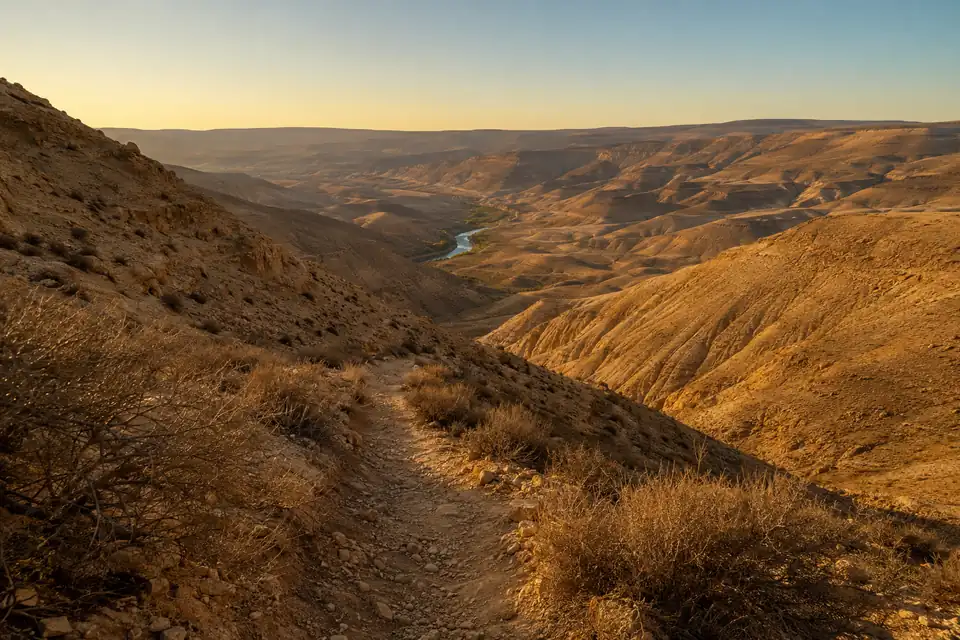
The Garden at the End of the Wilderness
Chapter Six
The Far Side of the Mountain
Miriam’s sixth letter sent them beyond the gate.
Moses encountered God while tending another man’s flock beyond the wilderness near Horeb, the mountain of God. The bush burned without being consumed. The place became holy ground because God revealed Himself there.
Walk today toward an uncultivated place. Carry water, adequate clothing, and humility. Wilderness deserves preparation. Ask where routine ended and attention began.
Kenji chose a trail rising from the eastern boundary into public forest. Snowmelt had swollen the creek, and sections of path were slick. Micah used trekking poles. Ruth wore three sweaters beneath her yellow coat and carried enough food for a small rescue operation.
Leah fell into step beside Daniel. Away from the garden, his silence felt different. In the group he used it to make room. On the trail it seemed to contain something heavy.
“Why did you leave your church?” she asked.
“I told them I had lost the ability to preach with integrity.”
“Lost faith?”
“Lost certainty. They had hired me for certainty.”
He stepped over a root. “My wife, Elise, died after eighteen months of illness. During those months I preached about trust. People quoted my sermons back to me in hospital hallways. Every sentence sounded true until it touched her pain.”
Leah knew the corridor he meant, though she had never met him there. Hospitals were full of sentences too small for what had happened.
“After she died,” Daniel continued, “the elders offered leave. I wanted them to admit that some theology is used to hurry grief out of the room. They wanted me restored to function.”
“So you resigned.”
“I became angry enough to call it courage.”
The trail steepened. Ahead, Tessa stopped beneath a Douglas fir and placed her hand against her side.
Leah’s body responded before thought. She reached Tessa in seconds.
“Pain?”
“A stitch.”
“Chest pressure? Dizziness? Shortness of breath beyond exertion?”
“I climbed a hill, Dr. Mercer.”
Leah checked her pulse anyway. It was fast and regular.
Tessa gently removed Leah’s fingers from her wrist. “My body is allowed to be tired without becoming an emergency.”
The words struck with more force than intended.
“I am aware,” Leah said.
“Your face disagrees.”
Kenji called a rest. They drank beside the creek while Ruth distributed rice balls wrapped in seaweed. Water thundered over boulders, loud enough to make private conversation impossible.
Leah watched Tessa eat. The young woman’s color improved. No distress. No danger.
Still, Leah remained alert.
She had built a career upon vigilance. She knew how quickly an ordinary moment could turn. A man joked with his daughter and arrested before finishing the sentence. A woman complained of indigestion and died with a clot spanning both pulmonary arteries. A child with a mild fever became unresponsive in the time required to change a shift.
Leah had learned to distrust peace because crisis often wore it as a disguise.
They climbed above the creek into a broad meadow where last year’s grass lay flattened beneath new green shoots. At the far edge, lightning had split a pine. One half remained standing, blackened from crown to root. The other lay open on the ground, its inner wood pale and fragrant.
Kenji stopped there.
“This is far enough,” he said.
“Where is the wilderness?” Ruth asked.
“You have been asking that since the parking lot.”
They spread out in the meadow. Wind moved unobstructed, carrying pine resin, wet grass, and distant snow. Leah sat against a boulder and looked back toward the valley. The cultivated garden was hidden by forest. Bellwether’s rooftops were faint beyond it.
Routine had ended at the gate, she thought. Attention had begun when Tessa stopped on the trail.
Then she recognized the harder truth: her attention had become captivity. She could identify danger while missing life occurring beside it.
Daniel sat a short distance away. “The wilderness in Scripture is rarely empty,” he said. “It is full of whatever can no longer hide behind abundance.”
“Is that from the letter?”
“No.”
“It sounds preachy.”
“Occupational scar.”
She smiled.
Below them, the creek continued toward the garden, carrying wilderness water into cultivated ground.
The trail narrowed after the first mile and began to climb through Douglas fir, alder, and sword fern. Snow remained in the shaded folds of the mountain, blue beneath fallen needles. Where sunlight reached the slope, water loosened from the soil and ran in silver threads across the path.
Kenji stopped at each crossing and tested the ground with his pole. He moved without haste, choosing stones that could bear weight and branches that would bend without breaking. Micah followed his line while altering it for the angle of his prosthetic ankle. Ruth accepted Daniel’s hand at the steepest places and released it immediately afterward, as though independence could be measured in seconds.
Leah watched the group arrange itself around weakness without announcement. No one called it leadership. No one created a policy. The person nearest a hazard slowed; the person with knowledge spoke; the others listened.
At the hospital, every emergency activated a visible hierarchy. Here competence moved like water, gathering wherever the terrain required it.
They reached a bridge made from two cedar planks spanning a ravine. The upstream plank had split near its center. Kenji crouched, pressed the wood, and shook his head.
“We turn back,” he said.
Tessa looked across. The trail continued through sunlight less than fifteen feet away. “Can we cross one at a time?”
“The split runs deeper than we can see.”
“The other plank looks solid.”
“Looking solid is one kind of information.”
Micah examined the anchoring stones. “The approach is unstable too.”
Leah felt disappointment rise with embarrassing force. They had climbed for an hour. The mountain’s shoulder lay close above them. A view Kenji had promised waited beyond the trees.
“There may be another crossing,” she said.
“There is, two miles downstream,” Kenji answered. “Snowmelt may have covered it.”
“We have equipment.”
“We have lunch.”
She heard the correction.
Preparation was not a charm against reality. Water, food, layers, maps, and first-aid supplies increased their capacity. They did not convert every route into permission.
Daniel sat on a rock and removed an orange from his pack. “The far side of the mountain appears committed to remaining far.”
Ruth accepted half the orange. “A mountain with boundaries. How refreshing.”
They ate beside the broken bridge. The ravine carried water hidden beneath boulders. Its sound rose through gaps in the stone, close and invisible.
Micah asked Kenji how long the bridge had been failing.
“Last autumn it was intact.”
“Then winter did this?”
“Winter, water, time, perhaps a falling limb. Structures receive many small forces before one crack becomes visible.”
Leah thought of her department. Nurses had resigned one at a time. Beds remained occupied longer. Documentation multiplied. Administrators changed scheduling rules by percentages small enough to defend. No single decision appeared catastrophic. Together they had become a split beneath weight.
Her phone showed no signal. The absence should have relieved her. Instead she imagined every message waiting below.
Tessa stood near the ravine taking photographs of water she could not see. “Sound proves something is there before sight catches up.”
“That is how many disasters begin,” Leah said.
“That is also how many songs begin,” Daniel replied.
They found a side path marked by elk tracks and followed it along the slope. It did not cross the ravine. It climbed to a shelf of exposed stone where the trees opened suddenly and the valley appeared beneath them.
The retreat garden was invisible among miles of forest. Bellwether’s roads lay like pale threads. The river flashed at three bends and vanished under trees. Mountains layered into the distance, each range a softer blue than the one before it.
No summit was required for the view.
Ruth sat with her back against a sun-warmed rock. Tessa removed her hat. Micah extended his leg. Kenji poured tea from a flask into small metal cups he had carried without telling anyone.
Leah stood at the edge of the shelf, careful of loose gravel. Scale rearranged her. The property dispute, the promotion, the forty-day condition, and every message waiting on her phone remained real. From this height they occupied less of the world than they had claimed.
Daniel came beside her.
“I used to preach that wilderness strips away illusion,” he said. “People nodded because it sounded clean.”
“And now?”
“Wilderness also strips away insulation. Illusion may remain. You simply feel the weather while carrying it.”
She looked at him. “What weather are you carrying?”
He turned the metal cup between his palms. “My wife died while I was asking a church to believe God could heal her.”
The valley wind moved between them.
“I am sorry,” Leah said.
“Her name was Elise. Ovarian cancer. Three years from diagnosis to death. She was a musician, a terrible gardener, and the only person who could tell when I was preaching to avoid saying something true.”
Leah waited. Grief often arrived through biography before emotion. Names, dates, occupations, the orderly facts people placed around an absence.
“Did your church expect healing?”
“Some expected it. Some promised it. I allowed language in prayer meetings that converted hope into prediction. When her disease progressed, people searched for hidden causes. Faith insufficient. Forgiveness incomplete. A lesson God had not finished teaching us.”
Anger tightened Leah’s jaw. “That was cruel.”
“Yes.”
“Did you challenge it?”
“Too late and too gently.”
His answer carried no defense.
“After she died, I preached the memorial. I spoke accurately about resurrection and dishonestly about myself. I told everyone that grief and faith could coexist. Then I went home and discovered I could not enter the sanctuary again.”
“Is that why you left ministry?”
“It is why I left the pulpit. Ministry is harder to leave. It follows you into grocery stores.”
Below them, a hawk crossed the valley without moving its wings.
Leah thought of every family she had guided through limits. She had learned to name uncertainty precisely, yet she sometimes used precision as distance. Data protected patients from false promises. It also protected her from entering the room where promises had failed.
“Did Elise want people to pray for healing?” she asked.
“Yes. She also wanted permission to prepare for death. People treated those desires as enemies.”
“They can share a room.”
“She knew that. I learned it after she was gone.”
Kenji called them back from the edge. Clouds had gathered over the western ridge. The temperature dropped quickly. They packed cups, wrappers, and orange peels. Ruth checked the shelf twice for anything left behind.
The descent began under sleet.
Water changed the trail within minutes. Dust became paste. Stones loosened. Leah placed each foot carefully, leaning uphill. At a switchback, Tessa slipped and struck her knee. She laughed from embarrassment, then tried to stand and sat down again.
Leah knelt beside her. “Where is the pain?”
“Below the kneecap. Sharp when I bend.”
There was no deformity, no rapid swelling, no instability on gentle examination. Tessa could bear weight, though pain altered her step.
“We slow down,” Leah said.
“I can manage.”
“That was not a question about character.”
Micah shortened one trekking pole for her and moved ahead to identify stable footing. Daniel took her pack. Kenji changed their route to a longer grade. Ruth walked beside Tessa and told a story so absurd that laughter kept her breathing evenly.
The group’s pace became the pace of the injured person.
Leah had said similar words in meetings about patient-centered care. On the mountain, their meaning acquired weight: cold fingers, wet socks, an extra hour before shelter, everyone’s body accepting the consequence of one person’s limitation.
They reached the broken bridge again from below. The ravine had risen. Brown water now showed between the rocks that had hidden it during lunch.
“Sound was early,” Tessa said through clenched teeth.
“Sight caught up,” Leah answered.
They descended another mile to a forestry road. Kenji radioed a ranger from a point where the signal returned. The ranger drove them to the trailhead in a mud-splashed truck that smelled of wet dog and pine cleaner.
Back at the retreat house, Leah cleaned Tessa’s abrasion, wrapped the knee, and reviewed symptoms that would require imaging. Tessa listened with the solemnity of someone relieved to receive instructions that did not treat pain as failure.
“I am sorry I slowed everyone,” she said.
“You revealed the group,” Leah replied.
Tessa frowned. “That sounds like Miriam.”
“I am having a difficult week.”
That evening, Kenji pinned a notice beside the trail map: EASTERN BRIDGE CLOSED. He recorded the damage with the county and listed materials for repair. The far side of the mountain would remain inaccessible from that route until the structure could bear weight again.
Leah opened her hospital messages. A committee chair had written that the board needed her answer because delay threatened the launch schedule. She read the sentence twice.
Some urgency described danger. Some urgency transferred pressure from the powerful to the conscientious.
She drafted a reply requesting staffing assumptions, projected volumes, vacancy rates, safety contingencies, and the names of the clinicians consulted. She did not apologize for the questions.
Before sending it, she went outside. Rain moved through the garden. Water gathered from uncultivated slopes, entered the stream, and traveled beneath the repaired lower bridge. The cultivated place depended upon wilderness it could neither command nor exclude.
Leah imagined faith in the same way. Garden paths gave prayer language, habit, and form. Wilderness delivered what the garden could not manufacture: scale, exposure, limits, and water from beyond the gate.
She sent the message.
The mountain had refused their planned crossing and still given them a view.
Leah understood then that the two places were not sealed from each other. The garden depended upon water gathered in mountains it could never contain.
The Garden at the End of the Wilderness
Chapter Seven
Forty Days
On day seven, Calvin delivered a notice from the county.
The eastern footbridge was unsafe. The guest wing lacked a functioning fire-suppression system. The pond overflow did not meet current standards. Public programming could resume only after repairs, inspection, and proof of insurance.
He placed the notice before Leah with the solemnity of a surgeon delivering pathology.
“Grant’s offer expires on day forty-one,” he said.
“He planned that.”
“He understands leverage.”
“So did my grandmother.”
Calvin adjusted his glasses. “Miriam understood people. She believed time reveals the actual object of our devotion.”
“You sound like her.”
“Occupational exposure.”
That morning’s letter addressed the number forty.
Israel’s wilderness journey lasted forty years. The spies explored the land for forty days; the judgment corresponded to those days, one year for each. Moses remained with the Lord on Sinai forty days and nights. Jesus fasted in the wilderness forty days and nights before beginning public ministry. Keep these periods distinct. Scripture deserves accurate remembrance.
Forty often signals a complete season of testing, preparation, judgment, or transition. It is long enough for performance to weaken and hidden loyalties to surface. You have not been given forty years. Receive forty days honestly.
Tessa counted on her fingers. “Seven days already gone.”
“Completed,” Ruth corrected.
“Same arithmetic.”
“Different posture.”
Leah wrote the county requirements on a board. The group divided the work according to skill. Micah would assess structures and obtain contractor estimates. Kenji would inventory plant health and irrigation. Ruth would evaluate food programming and local partnerships. Daniel would research nonprofit models and pastoral-care uses. Tessa volunteered for communications and visitor experience.
“I can do more than social media,” she said.
“Then define more,” Leah replied.
Tessa thought. “I will interview former guests and neighbors. I want to know whether this place changed anyone’s life or just gave them attractive photographs.”
Leah assigned herself financial analysis and regulatory coordination.
“You made yourself the center,” Micah observed.
“I took the tasks no one else can do.”
“Calvin can handle regulatory communication. I can build cost models. Daniel managed a church budget. Tessa worked for a marketing firm. Ruth ran a school library system.”
Ruth raised a hand. “Three branches and a bookmobile.”
“You made yourself the center,” Micah repeated.
Leah capped the marker. “Would you like to lead?”
“No. I would like the work distributed before you become indispensable and resent us for allowing it.”
The room went very still.
Leah felt heat move upward from her chest. “You have known me for seven days.”
“I know the pattern. I used it for years.”
His tone carried no accusation, which made resistance harder.
Daniel intervened with the gentleness of an experienced mediator. “Perhaps each responsibility needs a lead and a second. That protects continuity and prevents isolation.”
They revised the board. Leah remained financial lead; Ruth became her second. Micah led facilities with Tessa. Kenji led ecology with Micah. Daniel led program models with Tessa. Community research belonged to Tessa with Daniel supporting.
Leah disliked the arrangement and immediately recognized its wisdom.
That afternoon, Ruth sat beside her in the office while they opened seven years of financial records.
“You can say it,” Leah said.
“Say what?”
“That Micah was right.”
“He was.”
“You enjoyed that.”
“A little.” Ruth entered a figure into the spreadsheet. “My husband called me the sun of our family. It sounded romantic until I realized everyone expected me to rise daily and keep the entire system alive.”
“What happened when you stopped?”
“He had been dead six years by then, so he remained peacefully uninvolved. My daughter became furious. My son became confused. My grandchildren learned to make sandwiches.”
Leah laughed.
“Being needed can feel like love,” Ruth said. “It can also protect us from discovering who stays when we have nothing to provide.”
The spreadsheet blurred briefly. Leah blamed the screen.
On the board in the main room, Tessa had drawn thirty-three empty circles after the seven completed ones. Each evening she filled one with a different shade of blue.
Time was becoming visible.
Forty days had first seemed like an obstacle between Leah and a decision. Now each day felt like a vessel with its own capacity. She could waste it, fill it beyond usefulness, or receive its limits.
At dusk, she turned off her phone for one hour.
On the first of the explicitly numbered forty days, Ruth drew a line through the calendar.
“One,” she announced. “No one is transformed yet.”
Miriam’s letter warned against treating every biblical forty as interchangeable. Israel’s forty years in the wilderness were not forty days and nights. The spies explored Canaan for forty days; the resulting judgment corresponded in years. Moses remained on Sinai forty days and nights. Elijah traveled forty days and nights to Horeb. Jesus fasted forty days and was tempted in the wilderness. Numbers could echo across Scripture without making every event the same event.
Daniel placed the references on separate cards. “Pattern invites comparison. Accuracy preserves difference.”
They arranged the cards along the long table. Emi, visiting after school, drew a sun on every day card and four seasons around Israel’s years.
“Forty years is long enough to become old,” she said.
Kenji looked at his hands. “Yes.”
Leah thought of the legal condition attached to Miriam’s bequest. Forty days felt theatrically biblical, yet it was also a practical interval: long enough to disrupt routine, too short to resolve governance, finance, grief, or land use. Miriam had created a threshold, not a complete restoration.
“What happens if the number makes us rush?” Tessa asked.
“Then we refuse the rush,” Leah said. “The decision can establish a longer process.”
They wrote that principle into the transition notes.
The day’s task was to inventory what they carried into wilderness. Each person received a canvas bag and a weight limit. The walk would cross the exposed ridge and return before dark. Kenji checked weather, water, medications, and emergency contacts. Spiritual symbolism did not replace preparation.
Leah packed too much: medical supplies, extra food, two flashlights, a battery, rope, rain gear, and three notebooks. Micah lifted the bag.
“Are you treating a battalion?”
“Preparedness saves lives.”
“So does being able to walk.”
Together they divided communal supplies. Ruth carried almost nothing beyond water and her cane. Daniel forgot gloves. Tessa brought a camera and left it packed.
The ridge offered little shelter. Wind pressed their clothing against them. Below, the garden appeared ordered and small, its paths reduced to pale threads. Beyond it spread logged parcels, second-growth forest, roofs, roads, and the river.
“Wilderness is never merely empty,” Kenji said. “Someone calls land empty when they do not recognize what lives there or who belongs to it.”
They paused to acknowledge that biblical wilderness, North American land history, and modern recreation were different contexts. The retreat would not borrow wilderness language to erase Indigenous presence or romanticize displacement.
At the far marker, each person removed one unnecessary object. Leah set down nothing because leaving gear on the mountain would be littering. Instead they recorded what they would not pack next time.
“A symbolic exercise corrected by stewardship,” Daniel said.
“Miriam would approve,” Kenji replied.
“Would she?” Aaron asked quietly. He had joined them for the climb. “She loved a dramatic gesture.”
Kenji accepted the correction. “She might approve after arguing.”
On the descent, Ruth tired. The group slowed to her pace. Nobody described this as sacrifice. A body’s limit became part of the route.
By the time they reached the house, Leah’s shoulders ached. She unpacked the redundant equipment and wrote its weight beside each item. Anxiety had material mass.
Day one ended without revelation. They ate, dried wet clothes, checked tomorrow’s forecast, and slept.
Forty would be made of such days: each distinct, none sufficient alone.
The world continued.
The Garden at the End of the Wilderness
Chapter Eight
Bread Enough for Today
The storm took the power shortly before dawn.
By breakfast the retreat house had cooled, the well pump had stopped, and snow was falling heavily enough to erase the paths. The backup generator coughed twice and failed. Cell service weakened to one uncertain bar.
Leah entered command mode.
She inventoried medications, checked Tessa’s health needs, established water reserves, assigned firewood, located flashlights, and calculated how long the food would remain safe. Micah and Kenji went to the generator shed. Daniel cleared snow from the porch. Ruth lit the kitchen’s propane range and announced that adversity required pancakes.
“We need to conserve fuel,” Leah said.
“We need to conserve morale,” Ruth answered.
Miriam’s letter waited unopened.
By ten, the road was impassable. The generator required a part unavailable in Bellwether. The property had enough firewood for several days and enough stored water for one if used carefully.
Kenji led them to an old hand pump behind the bathhouse. After priming, it produced clear, icy water from a shallow backup well.
“When did anyone last test this?” Leah asked.
“October.”
“Results?”
He produced a folded report from inside the pump housing.
She stared at him. “You store laboratory reports outdoors?”
“Only the ones you will ask for during a snowstorm.”
The crisis diminished into work. They filled containers, cleared safe routes, moved food into sealed bins on the shaded porch, and closed unused rooms. By noon, wet gloves hung around the stove. Snow continued, but the house felt warm and inhabited.
Ruth opened the letter.
In the wilderness, Israel received manna one day at a time, with a different provision before the Sabbath. The lesson was dependence upon God’s word and provision rather than mastery of tomorrow. Jesus later answered temptation by quoting Deuteronomy: the human person lives by every word proceeding from God.
Today, ask what has been given for this day. Receive enough. Release the illusion that anxiety can manufacture tomorrow’s bread.
Daniel looked toward the windows. “Miriam had remarkable timing.”
“She scheduled the letters by number,” Leah said. “The weather supplied the timing.”
“Explanation and meaning can share a branch,” Tessa recited in Kenji’s voice.
They ate pancakes with preserved cherries. Without electric lights, the gray brilliance of snow filled the room. Conversation changed pace. Pauses grew longer because no one reached for a screen.
Tessa told them that during chemotherapy, friends had sent meal deliveries for the first month. Then attention faded while treatment continued. Her mother began labeling every container with the date and the name of the person who brought it.
“She said gratitude needed details,” Tessa recalled. “On the worst days, she would read the labels aloud. Lentil soup from Jo. Rice from Aunt Celia. Cornbread from the choir. She made a liturgy out of leftovers.”
Daniel turned his cup slowly. “Did it help?”
“It did not make me less sick. It made sickness less empty.”
Micah returned from the shed after a second attempt at the generator. Snow melted in his hair.
“No power today,” he said. “Maybe tomorrow.”
Leah felt the familiar surge: identify options, overcome limitation, restore normal operation.
Then she looked around the room. Water containers were full. Food was safe. Fire warmed the house. Everyone was present.
Enough for today.
The phrase did not erase tomorrow’s work. It placed a boundary around today’s fear.
In the afternoon they walked to the Witness Tree. Snow lay along every limb. The open blossoms had folded or fallen, and unopened buds appeared sealed in ice.
“Will they survive?” Tessa asked.
“Some,” Kenji said. “Some will not.”
“That answer applies to too much.”
He nodded.
Leah brushed snow from a lower branch. Kenji stopped her hand.
“Snow can insulate,” he said. “Help can injure when it does not understand what it touches.”
She let the snow remain.
That evening, they ate soup by lantern light. Daniel read Psalm 23 because Ruth requested something everyone knew. When he reached the table prepared in the presence of enemies, Micah closed his eyes. When he reached goodness and mercy following through all the days of life, Leah thought of provision as pursuit.
The storm closed the road before breakfast. Snow bent the bamboo and erased the upper path. Power failed at nine, taking the well pump and electric range with it.
Kenji brought out the emergency plan, which proved to be a handwritten page from six years earlier. The generator started on the fourth attempt. Fuel would last eighteen hours under restricted load.
“Daily bread,” Ruth said, examining the pantry. “Today it is also daily electricity.”
They inventoried water, food, heat, medication, and batteries. Leah wanted to calculate the entire storm. Forecast uncertainty made that impossible. They could prepare for twenty-four hours, conserve resources, and reassess.
Miriam’s letter described manna. Israel gathered what was needed by day; hoarded manna bred worms, while the Sabbath command included a different provision. Dependence was structured through instruction rather than vague optimism.
“Trust had quantities,” Micah said, measuring generator fuel.
“And exceptions stated in advance,” Leah added.
They moved perishables into coolers on the sheltered porch. Ruth designed meals around what would spoil first. Tessa checked on an elderly neighbor by phone before the cellular signal weakened. Daniel split wood. Micah cleared the accessible exit. Kenji monitored pipes.
Leah felt useful and therefore calm.
At noon a tree fell across the county road. Emergency services advised residents to remain in place. A family stranded nearby walked to the retreat: two parents, a toddler, and a teenager with type 1 diabetes. Their vehicle had adequate supplies, but the cold threatened the insulin pump controller and the toddler was shivering.
Leah assessed them with consent, confirmed stable glucose data, and helped protect the equipment from temperature extremes. She did not turn the pavilion into a clinic. The family needed warmth, food, communication, and a safe place to wait.
The teenager watched her mother hover over the pump. “I know how to manage it,” she said.
Her mother stepped back with visible effort.
Leah recognized care learning a different distance.
They served porridge and canned peaches heated on the propane burner. The toddler rejected everything until Ruth shaped rice into a small bear. Taste restored his interest in the world.
By evening, eight adults and two children occupied the safest rooms. The generator ran the refrigerator, a charging station, and essential heat circulation. No decorative lights. No private outlets. Scarcity required shared decisions visible to everyone.
Daniel suggested prayer before supper and explicitly allowed silence. The visiting father declined; his daughter joined. Nobody commented.
During the night, Leah woke every two hours to check the stove, pipes, and carbon-monoxide detectors. Kenji took the alternating hours. At four, he found her already awake.
“You do not trust my watch,” he said.
“I do not trust sleep.”
“Sleep has not signed a contract with you.”
He handed her tea and sent her back to bed.
The road reopened the next afternoon. The family left with their supplies intact and the teenager’s glucose within her usual range. They wrote a thank-you note on the back of an old retreat brochure.
When power returned, Leah felt an absurd urge to celebrate every glowing switch. Abundance had become visible through interruption.
She also saw the danger of converting hardship into a charming story. The storm had been manageable because they possessed shelter, fuel, food, communication, and expertise. Elsewhere, the same weather could expose people to eviction, injury, or death. Gratitude should deepen solidarity rather than congratulate the fortunate.
They updated the emergency plan, replenished every used supply, and created a fund for community resilience. Daily bread included systems that helped neighbors receive bread on difficult days.
Outside, the storm remade the garden into wilderness. Inside, bread was broken, soup was shared, and no one lacked what the day required.
The Garden at the End of the Wilderness
Chapter Nine
A Voice Beside the River
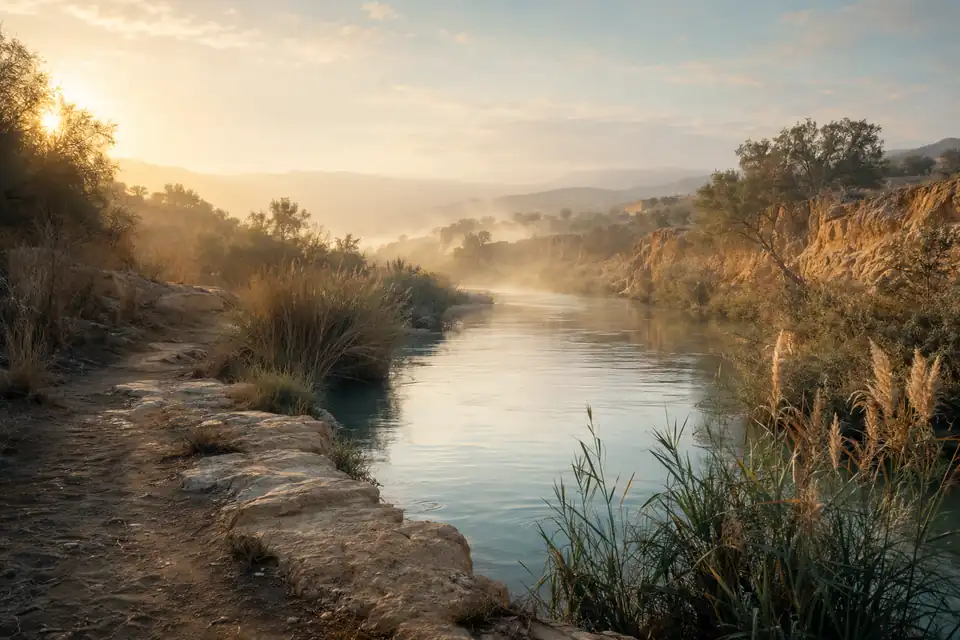
The power returned the next afternoon, accompanied by the hum of appliances awakening throughout the house. Everyone cheered except Ruth, who accused electricity of ending civilization’s brief recovery.
Snowmelt raised the stream. Kenji declared the lower bridge unsafe and roped it off. The river beyond the eastern boundary ran fast and brown, carrying branches from the mountains.
Miriam’s ninth letter sent them there.
The word of God came to John in the wilderness. He preached near the Jordan, calling people to repentance and preparing the way of the Lord. Crowds left familiar centers and went outward to hear a voice beside water.
Repentance is more than regret. It is a changed mind expressed in a changed direction. Walk beside the river. Name one direction that requires changing. Choose an action small enough to begin today.
They followed the bank until the retreat house disappeared behind alder. The river’s volume prevented easy speech, so each person walked alone.
Leah had many regrets. She regretted missing her grandmother’s final birthday because of a scheduling crisis. She regretted the junior physician she had corrected publicly and apologized to privately. She regretted every patient whose face she could remember after medicine had reached its limits.
Direction was harder.
Regret looked backward and preserved her as judge. Changed direction required movement and surrendered the comfort of self-punishment.
She stopped where a fallen tree extended over the water. Its exposed roots held stones, bottles, and a torn red ribbon. Snowmelt moved around the trunk, divided briefly, then reunited downstream.
Leah took out her phone. Eleven hospital messages waited. She opened the chief medical officer’s latest request.
We need your acceptance by Friday. The board considers you essential to the launch.
Essential.
The word entered precisely where Ruth had warned her.
Leah typed a response stating that she required the full bereavement period before deciding and that interim leadership should proceed without her. Her thumb hovered above send.
Anxiety offered a series of visions: opportunity withdrawn, colleagues disappointed, the new division given to someone less qualified, years of labor discounted.
She sent it.
The action was small enough to complete and large enough to change the direction of her day.
Farther along the bank, Daniel stood speaking into a small recorder. When he finished, Leah approached.
“Sermon?”
“Apology.”
He showed her the screen. The recording was addressed to the elders of his former church.
“I blamed them for wanting certainty,” he said. “I had trained them to expect it. When grief dismantled me, I wanted everyone else to confess the system while I remained the injured prophet.”
“Will you send it?”
“Before I revise it into their apology to me.”
He pressed send.
They found Tessa sitting on a boulder, her red cap beside her. Short dark hair covered most of her scalp now. She was deleting photographs from her phone.
“What direction?” Leah asked.
“I am removing the account where I document recovery.”
“You have thousands of followers,” Daniel said.
“That is the problem. I started it to tell the truth about cancer. Then people rewarded hope, so I performed hope. Every difficult day became raw material for an inspiring post. I want one feeling that belongs only to me and God.”
She deleted the account and began to cry immediately.
Leah sat beside her. No reassurance came. She placed her coat around Tessa’s shoulders and listened to the river.
Micah’s changed direction was physical. He led them to the maintenance shed and unlocked a cabinet containing several bottles of liquor.
“I do not drink every day,” he said. “I drink whenever pain and memory agree on the hour.”
He poured the bottles into a waste container for proper disposal, his jaw rigid.
“My action for today is telling you,” he said. “Tomorrow requires another action.”
Ruth called her daughter and asked for a conversation about housing rather than accepting the role of cheerful displaced mother. Kenji wrote a letter whose recipient he kept private.
By evening, nothing visible in the garden had changed. Yet six lives had shifted their direction by degrees.
The river kept speaking after each person had finished the action Miriam’s letter required. Its language was force without haste: brown water shouldering past alder roots, turning fragments of winter in its current, taking the mountain’s thaw toward places none of them could see.
They remained along the bank because returning immediately would have made their decisions feel like an exercise completed on schedule. Kenji found a gravel bar above the flood line. Micah tested the ground with his boot, then spread a wool blanket Ruth had brought. The six of them sat within the river’s cold breath.
Daniel asked whether anyone wanted prayer.
“I want lunch,” Ruth said. “Prayer can accompany it.”
She opened a basket of rice, boiled eggs, apples, and the last heel of yesterday’s bread. The food was plain and sufficient. Leah noticed that nobody reached first. Forty days together had created small courtesies they no longer announced.
Micah held an apple without eating it. “There is more.”
No one asked him to continue. They gave him the dignity of choosing the next sentence.
“The bottles were not the only ones. There is a flask in my truck and another bottle at my apartment.” He turned the apple until its stem pointed toward his palm. “I could tell you about pain. It would be true. I could tell you about sleep. Also true. The fuller truth is that I like the moment when the edges soften. I keep choosing that moment even when I know what follows.”
Leah heard the clinical questions gather in her mind: amount, frequency, withdrawal, falls, medications, suicidal thinking. They were necessary questions, yet this was neither an examination room nor a problem for her to seize. She asked, “What help do you want today?”
“Someone to drive my truck. Someone to sit with me while I call the veterans’ clinic. Then I want people to stop watching me as though honesty means I am about to shatter.”
“I can drive,” Kenji said.
“I can sit with you,” Daniel offered.
Micah looked at Leah. “And you can tell me whether stopping suddenly is dangerous.”
“It can be, depending on how much and how often. We will speak privately, and a clinician who is responsible for your care should assess you.”
“There she is.” His mouth moved toward a smile. “Doctor, with boundaries.”
“A recent model.”
The laughter that followed did not lighten the facts. It made room around them.
Tessa peeled an egg. “My action already feels ridiculous.”
“You deleted an account that had become a cage,” Ruth said. “That sounds expensive.”
“It also sounds dramatic. Everyone else is repairing family history or calling for treatment. I stopped posting pictures.”
“Comparison is a talented thief,” Daniel said.
Tessa gave him a warning glance. “Please do not turn me into a sermon while I am sitting here.”
“That was a sentence from a man eating bread.”
“Then the man may keep eating.”
Leah watched Tessa’s hands. Her fingernails showed pale horizontal ridges left by chemotherapy. New growth was advancing from each cuticle, an uncelebrated calendar of injury and repair. The deleted account had given strangers a coherent recovery story. Her body kept a more complicated record.
“What did you write when you started it?” Leah asked.
“That I would tell the truth.”
“Perhaps the changed direction is learning that truth does not entitle an audience to all of you.”
Tessa looked across the river. “I do not know who I am when nobody is responding.”
“You are the person who asked that question,” Ruth said. “That seems like a beginning.”
Kenji poured tea from a dented thermos. He had said nothing about the letter he wrote. Leah sensed that curiosity could become another form of taking. She accepted her cup and let his privacy stand.
The river rose another inch while they ate. A branch struck a half-submerged boulder and spun free. On the opposite bank, a strip of sand collapsed with a soft, granular sigh.
Daniel opened Miriam’s letter again. “Crowds went out to John,” he said. “They crossed social and geographic distance to hear him. Yet the message did not flatter them for making the trip.”
“Brood of vipers,” Ruth said. “Poor hospitality slogan.”
“John demanded fruit consistent with repentance. Luke gives practical examples: share clothing and food; collect no more than authorized; stop extortion and be content with wages. Changed direction entered economics and power.”
Leah thought of the hospital packet. She had interpreted her decision as personal restraint, a delay before accepting a prestigious role. The nurse’s concealed staffing data had not reached her yet, though quieter signs had. Colleagues described exhausted teams as resilient. Vacancy reports grouped permanent openings with temporary leave. Mandatory overtime appeared in presentations as flexible coverage. Language had been groomed until suffering became a metric with rounded edges.
Her phone rested in her pocket. Sending one boundary had altered her day. Repentance would ask what she did with the authority that made others’ days.
“I taught residents to survive conditions I should have challenged,” she said.
The statement arrived before she had decided to make it.
“You helped them survive,” Tessa said.
“Yes. I also made endurance a virtue because I knew how to endure. When someone struggled, I offered techniques. Better shoes. Better charting. Five-minute meals. I rarely asked whether the demand itself was wrong.”
Micah bit into the apple. “People who can carry too much tend to become evidence that the load is reasonable.”
“Who taught you that?”
“Carrying too much.”
Leah remembered a resident named Priya sitting in a supply closet after thirty hours awake. Priya had said, “I cannot keep doing this.” Leah had brought water, redistributed two patients, and helped her finish the shift. She had considered that compassion. The following week she had praised Priya’s recovery in a faculty meeting. She had never placed the unsafe schedule on the agenda.
Her shame wanted a grand punishment. The river offered direction.
She opened a blank message to the residency director and requested a review of overnight coverage, protected reporting, and the use of post-shift driving assistance. She named her own participation in normalizing the existing pattern. Then she stopped before sending it.
“I need evidence and the people affected at the table,” she said. “A dramatic email from leave could make me the center again.”
“So what is today’s action?” Daniel asked.
Leah wrote to Priya, now a physician in another state.
I have been remembering the night you told me you could not continue. I helped you complete the shift, but I did not challenge the conditions that put you there. I am sorry. You owe me no response. If you ever want to tell me what I failed to understand, I will listen.
She read it twice. The apology contained no explanation of her intentions. She sent it.
Ruth had moved away from the blanket and was speaking to her daughter. The river protected the conversation from easy listening, but her posture told its movement. At first she stood upright, one hand conducting the air. Then her shoulders lowered. She sat on a log. Finally she covered her face.
When the call ended, Ruth remained still.
Tessa went to her and waited nearby.
“She has been afraid to ask me,” Ruth said when they gathered. “Her marriage is in trouble. She wanted me to stay longer, but she also needed the guest room for her son. She kept offering solutions because she thought I required cheerfulness. I kept performing cheerfulness because I thought she required a mother without needs.”
“What did you decide?” Kenji asked.
“We will speak again tomorrow with calendars and numbers. Dreadful things. Love may survive them.”
By midafternoon the air sharpened. They packed the remains of lunch and walked upstream. A narrow animal trail climbed from the bank through sword ferns. The retreat house remained hidden, though Leah could see the upper limbs of the Witness Tree above the alders.
Kenji stopped at a cedar snag marked by woodpeckers. He removed the sealed letter from his jacket.
“It is for Aaron,” he said. “I wrote that when he warned us about the retreat, I treated his concern as disloyalty. I wrote that I chose my debt to Miriam over my duty to hear my son.”
No one moved.
“Have you sent it?” Leah asked.
“A letter can be another way to control a conversation. You arrange every word and leave the other person alone with it.” He placed the envelope back in his pocket. “I asked whether he would meet me. If he agrees, I will give it to him and remain while he reads.”
“And if he does not?”
“Then his refusal will be part of the truth I receive.”
At the maintenance shed, Micah handed Kenji his keys. Daniel sat with him on the low concrete step while he called the clinic. The first transfer disconnected. The second produced a recorded message. On the third attempt, he reached a nurse.
Leah went far enough away to preserve privacy and stayed close enough to help if invited. Repentance, she thought, changed even the distance at which love stood.
When the call ended, Micah had an appointment the following morning and instructions for the night. He looked exhausted.
“I expected something spiritual,” he said.
Daniel rose carefully, knees stiff from the concrete. “Making the call was spiritual.”
“And medical,” Leah added.
“And tedious.”
“Many holy things have hold music,” Ruth said.
They returned by the upper path as evening collected beneath the trees. The power had restored the retreat’s familiar hum, but nobody hurried toward it. At a bend above the river, Leah looked back. Their footprints crossed one another in the damp soil, indistinguishable after a few yards.
John had not invited people into the wilderness to admire his austerity. He had prepared a road for Someone greater. Every truthful apology, every surrendered disguise, every request for help cleared a little ground.
The path did not become straight all at once. It became walkable through the next faithful turn.
John’s wilderness voice had prepared a way through repentance. Leah began to understand preparation as removal of what made the path crooked within them.
The Garden at the End of the Wilderness
Chapter Ten
Stones That Could Speak
Tessa’s interviews brought visitors.
The first was a carpenter named Luis whose daughter had attended a grief camp after her mother died. Then came two teachers who remembered bringing fourth graders to test stream water. A retired oncology nurse described sitting beneath the cherry tree after difficult shifts. A Muslim neighbor recalled Miriam opening the garden for evening meals during Ramadan because the community hall was under repair. A Buddhist couple had married beside the pond with Kenji’s help. Three churches had used the retreat house. So had a veterans’ group, a caregivers’ circle, and families from the nearby tribal community, though Kenji cautioned that future partnership would require renewed relationship rather than assuming old permission continued.
“The garden served beyond one congregation,” Daniel said.
“Its Christian identity was clear,” Kenji replied. “Hospitality did not require confusion about that identity.”
Leah listened from the back of the room as former guests filled the long table. Their stories complicated the financial columns. The garden had produced outcomes difficult to price: reconciliations, vocational decisions, remembered prayers, children’s first experiences growing food, silence received without fear.
Grant’s offer remained mathematically persuasive.
Miriam’s tenth letter concerned stones.
John told religious leaders to bear fruit consistent with repentance and warned them against relying upon ancestry. God could raise children for Abraham from stones. Jesus later said that if His disciples were silent, the stones would cry out.
Stones in Scripture can witness, memorialize, support, obstruct, and proclaim. Today repair one section of path. Let your hands join your changed direction.
Micah selected the eastern approach, where roots had lifted paving stones into hazards. He demonstrated how to remove each stone, excavate carefully around roots, add compacted base, and reset the surface with enough flexibility for future growth.
“Why not cut the roots?” Tessa asked.
“Because the path serves the tree too.”
They worked in pairs. Leah partnered with Micah. He lifted heavy stones while she leveled the base and checked slope. Physical work made conversation unnecessary, then possible.
“What happens tomorrow?” she asked.
“I call the veterans’ clinic.”
“For pain management?”
“Pain, sleep, drinking, all the rooms I keep locking separately.”
He set a stone and tested it. “The blast happened nine years ago. People assume survival is the end of the story. Survival is the first page of a manual no one gives you.”
“What helped most?”
“A physical therapist who never called me inspiring. He was interested in function and honest about loss.”
“What hurt most?”
“People using God to explain why it happened.”
Leah looked at him.
“I believe God met me,” Micah said. “That is different from saying God planted a bomb to improve my character.”
She thought of the sentences offered in hospital rooms: everything happens for a reason, God needed another angel, faith will heal if it is strong enough. Words intended as bridges sometimes became stones placed on a grieving person’s chest.
“Daniel would agree,” she said.
“Now. He once preached at the memorial for two men from my unit.”
Leah sat back on her heels. “Did you know each other before this?”
“I knew his voice. He did not know my name.”
Across the path, Daniel worked beside Ruth, unaware of the conversation.
“Will you tell him?”
“When I can do it for truth rather than punishment.”
They reset the final stone near sunset. The path curved smoothly beneath the tree, stable enough for Ruth’s suitcase wheels and flexible enough for living roots.
Tessa walked it first, then returned with her camera lowered.
“The whole path looks unchanged,” she said.
“Successful repair often does,” Micah answered.
Leah saw every stone differently because she knew what lay beneath: gravel, roots, labor, judgment, room for growth.
Changed direction had become embodied. Repentance was no longer a feeling near the river. It was a path made safer for the next person.
PART THREE
The river left stones along the high-water mark: basalt, pale granite, red jasper, and pieces of concrete rounded until their human origin was almost hidden.
Miriam’s letter asked each person to choose one stone as a witness to changed direction. Kenji amended the instruction immediately.
“From the gravel bar, where collection is permitted. Nothing from the stabilized bank.”
They spread out. Tessa chose a flat black stone crossed by a white vein. Ruth selected one shaped like a small loaf. Daniel kept returning stones until he found an ordinary gray one that did not flatter his sense of symbolism.
Micah took none.
“I have enough objects carrying memories,” he said.
The group accepted that refusal as participation.
Leah selected a stone with one rough face and one surface worn smooth. She considered placing it on her desk as a reminder of the message to Priya. Then she saw how quickly another person’s pain could become an artifact in her growth story.
She returned it to the river.
“Changed your mind?” Tessa asked.
“Changed the use.”
They examined biblical memorial stones: Jacob’s pillar in Genesis, Israel’s stones from the Jordan in Joshua, Samuel’s Ebenezer. Different texts gave stones different functions. No universal biblical technique promised that carrying a stone would heal memory.
“Objects can help attention,” Daniel said. “They can also become substitutes for action.”
Back at the retreat, they discovered boxes of stones labeled with former guests’ confessions. Some bore names and dates. Privacy had been breached through a ritual nobody had reconsidered.
Tessa stopped filming. Leah contacted Calvin. They could not display, publish, or casually discard the material. After review, identifiable papers would be securely destroyed; ordinary stones would be cleaned and returned to landscaping only after documentation was removed.
Kenji held a stone marked FORGIVE MY FATHER. “Miriam believed the garden should remember people’s prayers.”
“Did the people agree to be remembered like this?” Aaron asked.
No one knew.
Consent absent from an old practice could not be manufactured afterward.
They spent the afternoon separating records under a written process. Ruth found her own handwriting on a card from twelve years earlier. She read it, tore it in half, and placed it in the secure bin.
“Do you want to say what it was?” Daniel asked.
“I want to enjoy being asked.”
She said nothing more.
At sunset, the permitted stones chosen that morning formed a small line at the pavilion edge. Each owner would take responsibility for the object or return it to its original place. There would be no permanent monument built from private struggle.
Leah’s place in the line remained open.
Absence could testify too.
THE GROUND THAT BURNED
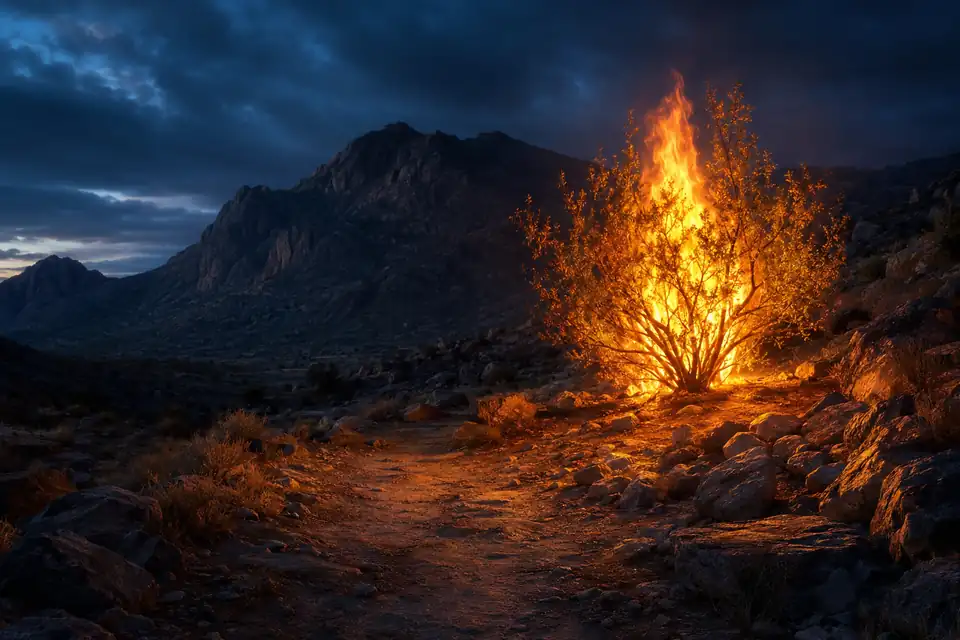
The Garden at the End of the Wilderness
Chapter Eleven
Turn Aside
The smoke appeared at 2:17 in the morning.
Leah woke before the alarm because emergency departments had trained her body to recognize interruption as a summons. She smelled heated plastic, opened her door, and saw a thin gray layer moving along the ceiling.
“Fire,” she shouted.
The house erupted into movement. Daniel pulled the alarm. Micah reached the extinguisher cabinet. Ruth and Tessa came from the guest hall wrapped in blankets. Kenji emerged already wearing boots.
Leah counted heads, directed everyone outside, called emergency services, and returned toward the east corridor until Micah blocked her.
“Everyone is out.”
“The records room.”
“Paper is replaceable.”
“The letters—”
“Kenji has the box.”
Outside, sleet struck their faces. Smoke pushed from an attic vent, but no flame showed. The volunteer fire crew arrived within twelve minutes. An electrical junction had overheated where old wiring fed the guest wing. The fire remained contained inside one wall, scorching studs and insulation before firefighters opened the structure and extinguished it.
At dawn, the retreat house stood wet, cold, and intact.
The fire chief’s report was blunt. A full electrical inspection was required. Occupancy in the guest wing remained prohibited. The incident could have been catastrophic.
Leah expected terror to subside once danger passed. Instead anger arrived.
“You knew the wiring was old,” she said to Kenji.
“We all knew.”
“Did you know it was unsafe?”
“The last inspection recommended replacement within two years. That was three years ago.”
“Why did you keep living here?”
“Because leaving would not repair it.”
“It might have kept you alive.”
Kenji’s expression changed. “There are several ways to stop living before death.”
Leah turned away before saying something cruel.
They gathered in the garden pavilion because the main house smelled of smoke. Miriam’s letter was titled TURN ASIDE.
Moses saw a bush burning without being consumed. He said, “I will turn aside to see.” When the Lord saw that he turned aside, God called his name. Attention preceded commission.
The biblical bush stood in the wilderness near Horeb, rather than in a cultivated garden. The ground became holy through God’s presence. Today examine what has been trying to gain your attention. Turning aside is more than looking. It is becoming available to be addressed.
No one commented on the timing.
Leah walked to the damaged wall. Firefighters had exposed blackened wood surrounding a junction box. The marks traveled upward like dark branches. The house had been warning them through flickers, tripped breakers, and a faint odor Ruth remembered two days earlier. Each sign had been explained separately.
Leah opened her hospital messages. A nurse manager had written privately: Before you accept the director role, ask for the staffing data they left out of the board packet.
The message was four days old.
Leah called her.
What she learned altered the promotion. The new division’s timeline assumed vacancy rates administrators had concealed, mandatory overtime they had softened as flexibility, and patient volumes unsupported by the proposed space. Leah’s reputation would be used to reassure staff and regulators while the system proceeded with an unsafe launch.
“Why did you tell me?” Leah asked.
“Because you still listen when someone says a patient is in danger,” the nurse replied. “I hoped you would listen when the patient was the department.”
After the call, Leah sat beside the exposed wall.
Smoke had turned aside her night. A quieter warning now turned aside her career.
The fire crew left after sunrise, trailing muddy water and the smell of diesel. Yellow tape crossed the east corridor. The opened wall revealed layers of the house that had never been intended for view: lath, hand-forged nails, cloth-covered wire, newer copper joined to older circuits, a bird’s abandoned nest near the eave. A building kept its history behind plaster until heat made disclosure unavoidable.
Leah photographed the damage for the insurer, careful to capture every junction and scorched stud. Her hands became efficient. Efficiency had always offered a bridge across fear.
The fire chief, a broad-shouldered woman named Elena Ruiz, returned with a clipboard. “Who is responsible for the property?”
Five faces turned toward Leah.
“The estate is,” Leah said. “I am the conditional beneficiary. Calvin Shaw is the attorney. Kenji Sato is the caretaker.”
“I need one contact for immediate safety decisions.”
Leah almost volunteered. The word essential still vibrated from the hospital message.
“Kenji knows the systems,” she said. “I can coordinate with the estate, and we will put decisions in writing.”
Ruiz nodded. “That is two contacts with defined roles. Better than one person who promises everything.”
The sentence followed Leah down the corridor.
They inspected every room. Smoke detectors in the main house were functional, though two were beyond their recommended service life. One guest-room window had been painted nearly shut. Extension cords supplied the records-room dehumidifier. The kitchen fire blanket hung behind a shelving unit. The evacuation map showed a door replaced six years earlier by a fixed window.
None of the failures looked dramatic in daylight. Together they described a culture of accommodation: each inconvenience managed locally, each warning accepted as part of an old building’s charm.
Ruth stood before the obsolete map. “We told guests the house had character.”
“It does,” Ruiz said. “Character still needs an exit.”
Micah began a list. He separated urgent hazards, occupancy requirements, accessibility improvements, and long-term repairs. When Kenji tried to explain which jobs he could complete alone, Micah capped the pen.
“We are inventorying the building. We are not inventorying your worth.”
Kenji’s jaw tightened.
“He is right,” Leah said. “Your knowledge belongs in the plan. Your body is not the plan.”
The guest wing would remain closed. The others moved into the cottage, office, pavilion, and two safe bedrooms in the main house. Calvin arranged emergency funds for an electrician and environmental testing. Grant offered a hotel through his company account. They declined for the first night, then accepted rooms for Ruth and Tessa once the cottage heater failed.
“Receiving help from a developer does not transfer ownership of our judgment,” Leah said when Daniel raised an eyebrow.
“I did not say anything.”
“Your eyebrow preached an entire series.”
At noon, the electrician arrived. She found heat damage beyond the visible junction and a panel with mismatched breakers. A restoration contractor measured moisture from the hoses. An insurance adjuster joined by video. The pavilion filled with estimates, exclusions, and terms nobody used during prayer.
Leah felt unexpectedly grateful for them. Love that remained only an intention could not size a wire, calculate a load, or establish safe occupancy.
During a break, she returned the nurse manager’s call. The account of concealed vacancies and unsupported patient volume left her silent.
“Do you have documents?” Leah asked.
“I have schedules, incident reports, and the original projections,” the nurse said. “I will share them through the protected reporting channel. I need assurance my name will not appear in your negotiation.”
“You have it. I will ask compliance counsel how to proceed without identifying you.”
“People have asked before.”
“What happened?”
“The data became a staffing challenge. The challenge became a leadership opportunity. Then we received resilience modules.”
Leah closed her eyes. “I am sorry.”
“Please do something more useful than being sorry.”
The words were firm, not cruel.
“I will.”
Afterward Leah wrote a chronology rather than an accusation. She listed the discrepancies she had personally observed, the questions she could ask without exposing the nurse, and the decisions that should pause pending independent review. She sent the document to her attorney and the hospital’s compliance office. She also informed the chief medical officer that she could not evaluate the role until workforce and safety assumptions were independently verified.
His response arrived within minutes.
This is an operational matter beyond the scope of your offer. I hope leave is giving you the rest you need.
The politeness carried a diagnosis: grief had impaired her judgment.
Her first draft was devastatingly precise. She deleted it. Her second draft asked three documented questions and requested answers in writing.
Daniel found her at the pavilion table.
“You look calm,” he said.
“I am furious.”
“Ah. Physician calm.”
“Fury is information. It is not yet instruction.”
He sat opposite her. “Elise used to say something similar about fear.”
Leah waited.
“She said fear could ring the alarm without being appointed fire chief.”
Across the clearing, Ruiz demonstrated extinguisher use to Micah and Kenji. Tessa filmed only the equipment. Ruth copied emergency contacts in lettering large enough to read without glasses.
“Was Elise in medicine?” Leah asked.
“Public-school counselor. She understood systems because children brought every system into her office.”
“You rarely speak about her work.”
“I made her illness the final chapter of every story about her.” Daniel looked toward the damaged house. “Loss can burn backward through a life if we let it. It makes everything before it look like fuel.”
They spent the afternoon building an incident process. Two people would verify the head count. Visitors would sign in. Emergency responsibilities would rotate. Spiritual-retreat language would never replace health and safety standards. Every near miss would be documented without punishing the person who reported it.
Kenji objected to the visitor log. “Hospitality should not feel like surveillance.”
“During an evacuation, welcome includes knowing whom we are seeking,” Leah said.
“Can we destroy the daily sheet after everyone leaves?” Tessa asked.
“Yes. Minimal information, limited purpose, limited retention.”
“Listen to us,” Ruth said. “Governance beside the camellias.”
The old garden programs had treated administration as an obstacle to ministry. Yet neglected administration had placed bodies at risk. Paperwork could become empty performance; it could also become memory that protected people when charismatic certainty failed.
Before dusk, Ruiz gathered them at the eastern door. “One more drill.”
The alarm sounded. Ruth exited first with her cane. Tessa checked the cottage. Daniel swept the pavilion. Micah stayed at the assembly point rather than entering the building to prove usefulness. Kenji brought the current roster. Leah counted.
Seven, including the electrician.
“All present,” she called.
The words released something in her chest that had remained clenched since 2:17.
That night the safe rooms smelled faintly of smoke despite the air scrubbers. Leah lay awake listening to the building settle. Every click suggested heat. Every shift of wind sounded like an alarm beginning.
She rose and walked outside. The scorched wall was hidden behind temporary sheeting. Above it, stars occupied the cold spaces between branches.
Kenji sat on the pavilion step.
“Could not sleep?” she asked.
“I was remembering the flickers.”
“So was I.”
“I knew enough to call an electrician. I kept postponing because each month brought another expense.”
“You were holding a failing institution together with inadequate resources.”
“That explains the decision. It does not make the house safer.”
Leah sat beside him. “Explanation and responsibility can share a bench.”
He looked at her. “That sounds like Daniel.”
“Do not tell him.”
Kenji’s hands rested open on his knees. “Miriam trusted me.”
“Perhaps too completely.”
“I liked being trusted.”
There it was: the warmer ember beneath duty. Being indispensable had given both of them identity. They had called it service, and much of it had been. It had also protected them from the vulnerability of shared authority.
“Tomorrow,” Leah said, “we form a facilities committee.”
“A committee would have taken three meetings to notice the smoke.”
“A healthy committee would have replaced the wiring three years ago.”
He considered this, then inclined his head.
In the morning, they read the burning-bush account in Exodus 3. Moses was keeping another man’s flock and had led it beyond the wilderness to Horeb. The bush burned without being consumed. He turned aside. God called from within the bush and named the ground holy. The story placed no cultivated garden around him, no human-made sanctuary, no evidence that Moses had prepared a sacred encounter.
“The wonder catches his attention,” Daniel said. “The voice gives the encounter meaning.”
“And the commission sends him toward suffering he already knows,” Leah added.
Ruth traced a line in the text. “God says He has seen, heard, and known the people’s affliction. Divine attention comes before Moses’s assignment.”
Leah thought about leadership reports. They often began with an initiative and searched afterward for evidence to justify it. Exodus began with cries God had heard.
She added a principle to the retreat plan: programs would begin with the needs of people and place, discerned through listening, rather than with a leader’s need to be needed.
By afternoon, the hospital had acknowledged the compliance review. The message offered no result. The electrical estimate exceeded the garden’s unrestricted cash. The insurer reserved judgment. The guest wing remained closed.
Turning aside had not solved either institution.
It had made their condition harder to ignore.
Leah stood before the exposed wall once more. Black marks climbed from the junction in branching lines. They were damage, neither sacrament nor secret message. Still, beside them she had become available to truth.
Attention had opened into accountability. The next step would be costly, measurable, and shared.
Attention was becoming costly enough to resemble obedience.
The Garden at the End of the Wilderness
Chapter Twelve
Holy Ground
The insurance adjuster required photographs, inventories, and statements. Leah managed the process until Calvin arrived and took the folder from her hands.
“Go outside,” he said.
“You are my attorney, not my supervisor.”
“Today I am the person your grandmother paid to prevent you from converting grief into paperwork.”
Leah went outside.
At the Witness Tree, blossoms had multiplied despite the snow. Pale clusters occupied the southern branches; the shaded side remained mostly budded. The asymmetry made the flowering feel alive rather than staged.
Kenji was sweeping fallen petals from the path.
“Why sweep them?” Leah asked. “You told us to receive them.”
“Receiving includes release. Wet petals become slippery.”
She took another broom.
For a while they worked from opposite sides of the clearing. The broom whispered over stone. Petals gathered in soft lines, pink edges already turning translucent.
“I am sorry,” Leah said.
“For which part?”
“Speaking as if you had chosen neglect. Assuming survival was the only value.”
Kenji rested both hands on the broom handle. “I also chose pride. Miriam asked me to move into town after her health failed. I said the garden needed me. Sometimes I meant I needed the garden to need me.”
He looked toward the damaged house. “Holy ground does not flatter the person standing on it.”
Miriam’s letter that day explored God’s command to Moses to remove his sandals because the place was holy.
Holiness belongs to God. Ground becomes holy through divine presence, rather than human sentiment. Reverence recognizes that we have entered a reality we do not own.
Shoes protected Moses and carried the dust of other places. Removing them expressed humility and response. Ask what protection has become a barrier to presence.
At sunset, the group entered the clearing barefoot.
The exercise had been Tessa’s idea and Kenji’s reluctant approval. He checked the path first for sharp stones. Cold rose immediately through Leah’s feet. The ground was damp, textured, undeniable. Fine gravel pressed her heels. Moss yielded beneath her toes. Every step required attention.
They stood in a circle without ceremony.
Micah removed his prosthesis and sat on a bench, his residual limb wrapped against the cold. “This is my holy-ground version,” he said.
No one praised his courage. They made room.
Daniel began. “My protection is explanation. If I can name what an experience means, I can stand outside it and teach.”
Ruth said, “Mine is usefulness.”
Tessa said, “Mine is brightness. People rarely ask a cheerful person whether she is afraid.”
Micah looked at the empty space below his knee. “Mine is competence.”
Kenji said, “Mine is staying.”
Leah felt cold entering bone.
“Mine is vigilance,” she said. “I watch for disaster so closely that I treat peace as negligence.”
The garden offered no answer. Water moved under the bridge. A bird settled somewhere overhead. Wood smoke from the town crossed the valley.
Then Daniel prayed without performance.
“God of Moses, make us available to You.”
They remained until the cold sent them indoors.
Leah washed soil from her feet in a basin. The water clouded, then cleared as Ruth poured more. She thought of every threshold she had crossed armored for danger.
The morning after the fire, holy ground included mud, caution tape, and an insurance adjuster’s shoe covers.
Miriam’s letter asked them to remove their shoes as Moses had at the bush. Leah gathered everyone before the exercise.
“We will do this in the clean pavilion,” she said. “The damaged corridor contains nails, moisture, and residue. Symbolism does not override protective equipment.”
They washed the pavilion floor and set chairs in a circle. Those able to remove footwear did so. Ruth kept one orthopedic shoe on because standing without it caused pain. Micah removed his boot and prosthesis liner only after returning to his room; in the circle he remained fully shod.
“Holiness is not measured by matching feet,” Daniel said.
Bare soles received temperature and texture immediately. The wood was warmer where sunlight crossed it, cool near the open edge, slightly ridged beneath the grain. Leah’s feet felt vulnerable in a way her hands rarely did.
They read Exodus 3 again. God called “Moses, Moses,” and Moses answered. The command to remove sandals marked the ground as holy because of divine presence. The place was wilderness near Horeb, not a garden cultivated for encounter.
“We keep trying to manufacture holy atmosphere,” Daniel said. “Light, music, scent, architecture—” He stopped, corrected himself, and continued. “The room can support attention. It cannot compel God.”
Kenji brought soil samples from three parts of the property. The stream bank held sandy loam. The kitchen garden contained compost-rich earth. Soil near the old workshop showed residues requiring professional testing before food cultivation expanded.
“Ground can be holy and contaminated,” Tessa said.
Leah wrote it down, then crossed it out so she would remember without claiming Tessa’s sentence.
Respect for ground required more than reverence. They commissioned testing, mapped drainage, and paused children’s programming near the workshop. Grant’s environmental consultant disclosed an old fuel tank on the adjoining parcel. The discovery entered easement negotiations.
In the afternoon, each person named ground from which they came. Ruth spoke of a row house stoop in Philadelphia. Micah named dry training fields and a hospital rehabilitation gym. Tessa described the linoleum beside an infusion chair. Daniel named the kitchen where Elise received hospice care. Kenji spoke of the small rented yard where his parents grew shiso after wartime incarceration had taken their earlier home and nursery business.
He gave only what he chose. The group did not turn family history into a lesson about resilience.
Leah named the emergency department floor where her grandmother died while Leah was treating someone else three rooms away.
“I have hated that floor,” she said. “It held both my duty and my absence.”
Daniel asked whether she wanted prayer. She did.
They prayed without declaring the floor good. They asked God to meet memory there and to hold what Leah could not repair.
When the exercise ended, everyone replaced shoes at a different pace. The pavilion did not look altered.
Leah stepped outside onto gravel. The protection of a sole returned, along with responsibility for where she walked.
Holy ground did not promise safety. It required presence.
The Garden at the End of the Wilderness
Chapter Thirteen
The Fire That Stayed
Micah’s appointment with the veterans’ clinic lasted three hours.
He returned with a treatment plan, a lockbox for medication, and fury bright enough to heat the room.
“They want me in a trauma group.”
“Do you want to go?” Tessa asked.
“I want the memories to stop using my body as a theater.”
“That sounds adjacent to yes.”
He looked at her, then laughed once.
The electrician’s estimate arrived the same day. Full rewiring would cost more than expected. Combined with structural repairs, the minimum reopening budget reached nine hundred thousand dollars.
Leah updated the model. Even with grants, donations, and earned revenue, the garden needed a major capital campaign. Grant’s purchase offer glowed on the spreadsheet like an exit sign.
Miriam’s letter returned to the burning bush.
The bush burned and was not consumed. Scripture describes divine manifestation, holy presence, and a call. It does not authorize us to romanticize human burnout. God’s fire revealed and commissioned Moses; Pharaoh’s system consumed people through forced labor.
Learn the difference between a flame that illumines vocation and a system that feeds upon your life. One deepens love, truth, courage, and obedience. The other steadily reduces persons to fuel.
Daniel read the paragraph twice.
“Churches need this,” he said.
“Hospitals,” Leah answered.
“Families,” Ruth added.
“Social media,” Tessa said.
Micah tapped the table. “War.”
Kenji looked out toward the garden. “Even good work can become consuming when identity and limits disappear.”
They drew two columns on the board: ILLUMINES and CONSUMES.
Under ILLUMINES they placed truth, courage, love, clarity, sustainable sacrifice, shared responsibility, freedom to rest, and deeper obedience.
Under CONSUMES came secrecy, chronic depletion, fear, isolation, coerced sacrifice, irreplaceability, loss of integrity, and contempt for limits.
Leah saw her career in both columns. Medicine had illuminated her gifts, trained her attention, and placed her beside people in sacred moments. The institution’s new plan would consume staff and call the smoke commitment.
She declined the director position that afternoon.
Her hands trembled as she wrote. She described the staffing risks and offered to participate in a redesigned launch with transparent safeguards. She avoided accusation unsupported by evidence. She named what she knew.
The chief medical officer called within minutes.
“You are walking away from the largest opportunity of your career,” he said.
“I am declining this version of it.”
“The board will move on.”
“Then it will move on with the data in writing.”
After the call, grief arrived before relief. She went to the orchard and stood beneath trees that held no blossoms yet.
Kenji found her there.
“I thought integrity would feel cleaner,” she said.
“Pruning leaves a wound before growth reorganizes.”
“You always have a plant.”
“You came to a garden.”
He handed her a pruning knife and showed her a dead branch on an apple tree. She cut it back to living wood. The interior changed from brown to pale green.
The investigators classified the incident as electrical failure rather than arson. Leah felt embarrassed by her relief; danger did not become benign because it lacked intent.
Miriam’s next letter concerned the bush that burned without being consumed. It warned against making all fire a symbol of divine presence. Scripture itself distinguished holy manifestation from destructive flame, ordinary heat, judgment imagery, and human violence.
“Our wall burned because insulation failed around an overloaded connection,” Leah said. “We should not call it a message from God.”
“Yet it exposed what required attention,” Ruth replied.
“We may describe what we learned without assigning God as the electrician.”
They laughed, then grew quiet.
Daniel told them about a prayer meeting after a church fire years earlier. He had said God burned away what no longer served the congregation. Later he learned a custodian had repeatedly reported the faulty heater.
“My metaphor baptized neglect,” he said. “It allowed leaders to speak of renewal before apologizing to the person they ignored.”
He wrote to the custodian that afternoon.
Micah accompanied the electrician through the house. They labeled circuits, removed improvised connections, and calculated future loads. The garden’s proposed commercial kitchen would require an upgraded service. Solar panels might reduce operating costs but would not eliminate storage, maintenance, or code requirements.
Tessa developed a display about the fire. Her first design centered a dramatic photograph of blackened timber. Marisol reviewed it and asked where the delayed inspection appeared.
Tessa changed the title from THE NIGHT FIRE TESTED US to WARNINGS, FAILURE, AND REPAIR.
“Less cinematic,” she said.
“More useful,” Leah replied.
At dusk, Kenji lit a small cooking flame in the designated outdoor area. They watched water warm for tea. Fire transformed, illuminated, and endangered according to conditions. Respect meant neither fear of every flame nor careless fascination.
Emi arrived with Aaron and asked whether Moses’s bush was a cherry tree.
“Scripture does not identify the species,” Daniel said.
“Could it have been?”
“We do not know. It was in the wilderness near Horeb, in the region associated with Sinai, far from this garden.”
“Then why do pictures make it the same kind of bush?”
“Artists choose a form so we can see a story. Their choice is an image, not additional Scripture.”
Emi drew several possible bushes and wrote QUESTION beneath each one.
When darkness fell, the cooking flame became the brightest point in the clearing. Kenji turned it off at the valve, waited for the metal to cool, and stored the equipment.
Wonder ended with a safety check.
Fire could remain without consuming. Calling could survive the loss of a title. The living part was deeper than the branch she had expected to bear it.
The Garden at the End of the Wilderness
Chapter Fourteen
Names Called Twice
“Moses, Moses.”
Daniel spoke the words softly.
“Abraham, Abraham. Jacob, Jacob. Samuel, Samuel. Martha, Martha. Simon, Simon. Saul, Saul.”
The morning letter invited them to consider the biblical tenderness and urgency of names repeated in moments of calling, warning, testing, or encounter.
God’s address is personal. Vocation begins with being known before being sent. Moses answered, “Here I am,” before he understood the assignment.
Write your name twice. Beneath it, write the roles by which others call you. Then ask which name remains when every role grows quiet.
Leah wrote:
Leah, Leah.
Physician. Director. Granddaughter. Decision-maker. Rescuer. Owner.
She crossed out director. The blank space felt physical.
Across the table, Ruth wrote mother, grandmother, librarian, widow, cook, helper. Tessa wrote survivor, patient, influencer, daughter. Micah wrote soldier, contractor, amputee, provider. Daniel stared at pastor for a long time before adding widower, teacher, husband.
Kenji wrote gardener.
“Only one?” Tessa asked.
He turned the page. The other side held son, brother, husband, father, grandfather, immigrant’s child, citizen, Christian, coward, faithful friend, proud man, forgiven man.
No one asked about coward.
He told them anyway.
Years earlier, his adult son Aaron had challenged the garden board’s finances and staff practices. Kenji believed Aaron was disrespecting Miriam and dividing the community. Their argument became public. Aaron left Bellwether and stopped speaking to him.
“The letter I wrote beside the river was to him,” Kenji said. “I apologized for using honor as a shield against truth.”
“Did he answer?” Ruth asked.
“He is coming tomorrow.”
Fear moved through Kenji’s face so quickly Leah nearly missed it.
“You kept the garden all these years,” Micah said. “Maybe he will see that.”
“That is what I am afraid I will try to make him see.”
The next afternoon, a truck stopped at the gate. Aaron Sato stepped out with a girl of about twelve. He resembled Kenji around the eyes and nowhere else. His daughter, Emi, wore headphones and carried a field guide to birds.
Kenji walked toward them, then stopped several feet away.
“Aaron.”
His son waited.
Kenji bowed his head. “I am sorry. I defended my importance and called it faithfulness. I made your truth into disloyalty. I want to hear what it cost you.”
Aaron’s face tightened. “It cost me my father.”
Kenji received the sentence without reply.
Emi looked between them. “Can I see the cherry tree?”
The question opened a path neither man could make.
They walked together toward the clearing, Emi ahead, identifying birds by sound. Beneath the blossoms, Aaron and Kenji sat on opposite ends of a bench and began the conversation that apology had made possible.
Leah watched from a distance. A name called twice was not flattery. It summoned the whole person from behind every role.
When she heard her own name inwardly, she no longer heard the hospital paging system.
Miriam’s letter listed names called twice in Scripture: Abraham, Jacob, Moses, Samuel, Martha, Simon, Saul. Repetition could convey urgency, intimacy, grief, or summons according to each passage. It was never a formula for forcing divine speech.
Daniel asked them to sit throughout the garden and listen for their own names as another person spoke them. The exercise sounded simple until Leah realized how many tones a name could carry.
Ruth called “Leah” as an invitation to tea. Micah called it across the stream as a safety warning. Tessa whispered it beside the pond. Kenji spoke it from the gate with the grave courtesy he had used when giving her Miriam’s key.
Each version addressed the same person and awakened a different readiness.
“Hospitals remove names quickly,” Leah said. “Patients become the gallbladder in four or the stroke in twelve. Clinicians become roles. A name slows the transaction.”
She remembered families saying a patient’s name after death, insisting that the body on the bed remained someone whose whole life exceeded the final event.
Micah declined to have his full legal name used. Military paperwork had trained his body to hear it as command. The group accepted “Micah” without requesting explanation.
Tessa disclosed that her online audience often called her brave. “They used the adjective so often it replaced my name. Brave people are difficult to comfort because everyone thinks they already possess what they need.”
Ruth wrote each person’s chosen name and pronunciation in the visitor-planning guide. She added space for titles, pronouns, and forms of address without making disclosure compulsory. Hospitality would include asking and remembering.
The hospital called Leah during the exercise. A senior colleague urged her to reconsider her compliance questions before they damaged relationships.
“Leah,” he began, stretching her name into concern, “you have been through a great deal.”
She heard the maneuver precisely because the garden had sharpened her hearing.
“Use my bereavement neither to dismiss the evidence nor to diagnose my motives,” she said. “Please answer the written questions through the review.”
The call ended coldly.
Her name had been used to reduce her. She could still answer from within it.
That evening, Kenji read his letter to Aaron aloud while Aaron sat opposite him. When he finished, he said his son’s name twice.
Aaron did not respond immediately. Finally he said, “I hear your apology. Trust will require a longer language.”
“I know.”
“Do you?”
Kenji let the question remain open.
Names could summon without controlling the answer. When God called Moses from the bush, Moses responded, yet the chapters that followed included fear, objection, promise, and repeated assurance. A call did not erase the called person’s humanity.
Before bed, Leah wrote her own name at the top of a clean page. Beneath it she listed no titles.
Beloved creature, she wrote, borrowing Miriam’s final language before she had read the final letter.
For once, the description felt sufficient.
She heard her grandmother: I loved you before you accomplished anything.
The Garden at the End of the Wilderness
Chapter Fifteen
Roots Bound in Iron
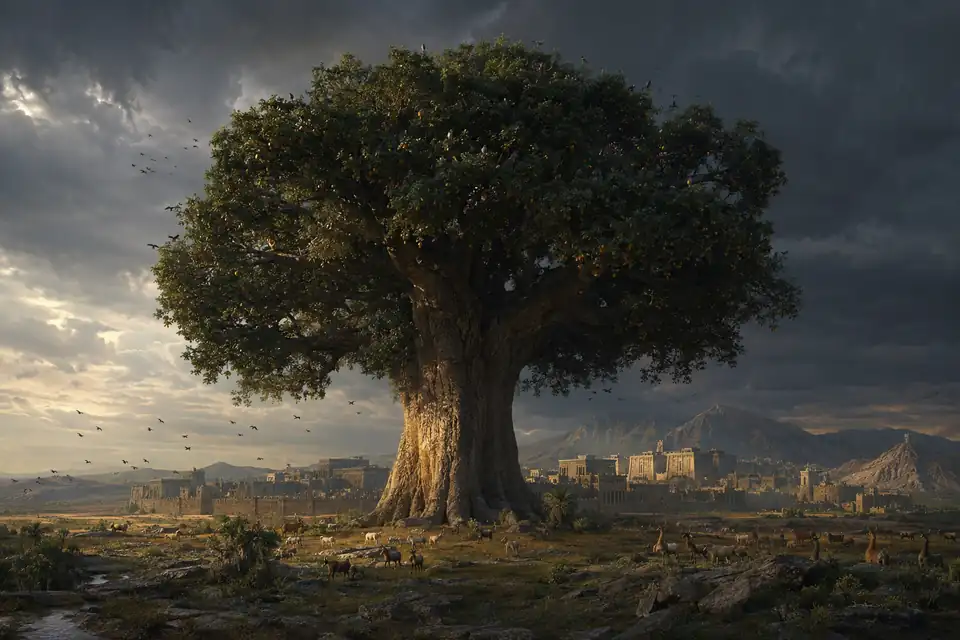
The county arborist arrived to evaluate the Witness Tree.
She examined the support cable, sounded the trunk, mapped roots, and collected samples from a darkened area near the crown. Her preliminary assessment was cautious: the tree was old, structurally compromised, and affected by fungal decay. It might live many years with careful management. A severe storm could cause major limb failure.
“Can you save it?” Tessa asked.
“Trees are living systems,” the arborist replied. “We manage risk and support vitality. Save is a word with a deadline hidden inside it.”
Leah liked her immediately.
Miriam’s letter concerned Nebuchadnezzar’s dream in Daniel 4: a vast tree visible across the earth, sheltering creatures and feeding many, then cut down under divine judgment while its stump and roots remained bound with iron and bronze.
Daniel 4 presents a tree as the image of royal greatness corrupted by pride. The cutting humbles the king. The preserved stump signifies that restoration remains possible when he acknowledges heaven’s rule.
Every flourishing institution can mistake reach for righteousness. Every gifted person can confuse being useful to many with being accountable to God. Consider what must be cut, what must be preserved, and what can grow only after humility.
Daniel asked Micah to walk with him.
They went to the repaired eastern path. Leah saw them from the office window, speaking beneath bare maples. Later Daniel returned alone, pale and shaken.
At supper he addressed the group.
“Micah heard me preach at a military memorial nine years ago. I said the men’s sacrifice fit within God’s purpose. I meant to honor them. My words placed a clean frame around violent loss. He carried anger from that day.”
Micah sat with his arms folded.
“Daniel listened,” he said. “That is all anyone needs to know tonight.”
Daniel continued. “The ministry grew. People quoted me. I believed reach confirmed faithfulness. When Elise became ill, the same framework I had given others became unbearable to me.”
He looked toward Micah. “I am sorry.”
Micah nodded once.
No reconciliation music played. No one applauded. Ruth passed the vegetables. The ordinary movement honored the seriousness of what had occurred.
The next day Daniel called the interim pastor of his former church and asked permission to return for a listening meeting. He offered no plan to reclaim the pulpit.
Leah reviewed the garden’s programs with the same question. What had grown too dependent upon Miriam’s personality? What practices protected reputation over truth? What could remain rooted after structures were cut?
They discovered missing personnel policies, vague spiritual-care boundaries, and a history of unpaid labor described as volunteer devotion. The garden had healed many people while depleting some who served it.
“We cannot restore the old model,” Leah said.
Kenji’s face showed pain, then assent.
They designed a different one: compensated staff, defined hours, clinical referral pathways, safeguarding standards, financial transparency, and governance independent of any single founder.
The plan cost more. It was also honest.
That afternoon, the arborist pruned one dangerous limb from the Witness Tree. The cut exposed a circle of pale wood nearly two feet across. The crown looked unbalanced without it.
Sunlight entered the clearing through the opening.
Leah stood in the new light and understood the mercy of a preserved stump. God’s restoration did not always recreate the former shape. Sometimes it guarded the root while pride’s canopy came down.
PART FOUR
The arborist’s name was Dr. Celia Mora. She refused to examine the Witness Tree while people stood beneath the crown, a precaution that embarrassed Kenji until she showed him a seam above the removed limb where bark had folded around decay.
“Old trees conceal both strength and weakness,” she said. “Our respect becomes useful when it changes how we behave.”
She established a work perimeter, then invited them to watch from beyond it. A mallet’s measured taps traveled through the trunk. A resistance drill produced a graph whose valleys indicated altered wood density. Celia explained each finding without turning uncertainty into drama. The root flare remained vigorous on the eastern side. Soil compaction threatened the western roots. Irrigation had encouraged surface growth at the expense of depth. The support cable was correctly placed for an earlier crown that no longer existed.
“Even support can become dangerous when the living structure changes,” Micah said.
Celia glanced at him. “That applies beyond trees, I assume.”
Daniel looked toward the retreat house. “We have been collecting metaphors.”
“Collect data as well.”
Her report recommended pruning, soil restoration, lightning protection, a revised support system, and a permanent exclusion zone during high winds. It could not promise the tree’s survival.
Kenji read the estimate twice. “Miriam would pay this without hesitation.”
“Miriam is not making the decision,” Aaron said.
Father and son stood on opposite sides of the table. The distance was only four feet, though years occupied it.
“The tree is central to the garden,” Kenji replied.
“So are safe buildings, fair wages, and the stream. Central cannot mean exempt from proportion.”
Kenji began to answer, then stopped. Leah saw the instant in which an old argument offered him its familiar words. He let them pass.
They created criteria. The work must meaningfully reduce risk. Funding could not come from restitution reserves. Public access would be restricted when weather required it. Propagation would begin so the garden’s future did not depend upon one organism. The tree would be honored as a living creature rather than preserved as a monument at any cost.
“That last sentence is for me,” Kenji said.
“It is for all of us,” Leah replied.
Daniel 4 waited on the pavilion table. After lunch, Daniel read the dream aloud. The great tree reached heaven and was visible to the ends of the earth. Its leaves were beautiful, its fruit abundant, and creatures found food and shelter in it. Then a holy watcher ordered it cut down while the stump, bound with iron and bronze, remained in the ground. Daniel interpreted the tree as Nebuchadnezzar, whose greatness had become pride. The warning included an ethical command: break with sin by practicing righteousness and show mercy to the oppressed.
“People remember the madness and the grass,” Ruth said. “They forget the poor in the interpretation.”
“Power’s repentance becomes visible in how power treats people,” Daniel said.
Leah opened the retreat’s old annual reports. Photographs showed Miriam at the center of nearly every page: Miriam serving soup, Miriam teaching, Miriam beside the tree, Miriam embracing a donor. The images reflected affection and fundraising strategy. They also taught viewers to imagine the institution through one face.
Aaron brought payroll records from a storage box. “There were months when staff checks were delayed and Miriam’s travel was reimbursed on time.”
Kenji flinched. “She traveled to raise the funds that paid them.”
“That was the explanation.”
“Was it false?”
“It was incomplete.”
Leah placed both sets of records side by side. “We can honor what the travel achieved and examine who carried its risk.”
They invited three former workers to a listening session. Calvin arranged separate conversations first so no one had to return to the property unexpectedly. Two accepted. One declined and sent documents through counsel. The refusals were treated as information, not hostility.
Marisol Vega had coordinated hospitality for four years. She arrived wearing a navy coat and held her handbag on her lap as if ready to leave. Her first question was whether the meeting would be recorded.
“Only notes you review and approve,” Leah said. “You may stop at any point.”
Marisol looked at Kenji. “You told me we were family.”
He lowered his gaze. “I did.”
“Family was the reason there was no overtime. Family was why I took calls at midnight. When my mother needed care, suddenly there was a policy.”
Kenji’s hands closed around each other. “I believed everyone was sacrificing together.”
“You lived here. Your sacrifice gave you a home and authority. Mine gave me debt.”
The sentence landed without ornament.
Leah wanted to move toward repair, because action was more comfortable than witness. She kept still.
Marisol described reimbursements delayed until receipts disappeared, retreat guests in psychiatric crisis assigned to staff without training, and testimony nights where workers were expected to disclose pain as evidence of the ministry’s authenticity. She also described guests who found safety, meals prepared with joy, and Miriam arriving at the hospital when Marisol’s child had surgery.
“I loved her,” Marisol said. “That is why it took me so long to call harm by its name.”
Kenji’s reply came slowly. “I loved her too. I used that love to defend what I should have examined. I am sorry.”
He did not ask for forgiveness. Marisol offered none. She corrected three items in the notes and left.
The second worker, Paul Imani, joined by video. His concern centered on spiritual-care boundaries. Guests disclosed suicidal thoughts to volunteers who were taught to pray and notify Miriam, though no formal escalation protocol existed. No known death had occurred during his service, but several crises had been managed through improvisation.
“We called it trusting the Spirit,” he said. “Often it meant trusting the most confident person in the room.”
Daniel covered his mouth. Leah knew he was remembering his church.
The sessions changed the restoration budget. Restitution became a named obligation. Training, referral agreements, insurance, and paid on-call coverage moved ahead of cosmetic work. The launch date became conditional. Every attractive plan acquired a less attractive column labeled recurrent cost.
“This may make the garden impossible,” Kenji said that evening.
“It may reveal which version was impossible all along,” Aaron answered.
The words carried no triumph. He looked tired enough to be his father’s son.
They walked to the Witness Tree after Celia’s crew finished. The missing limb had opened a broad wound protected according to current arboricultural practice. No decorative seal disguised the cut. Cable and brace hardware waited for the next visit.
Kenji touched the boundary rope. “When Miriam planted this, she said people would rest beneath it for a hundred years.”
“Perhaps they will,” Aaron said.
“She was thirty-two. A hundred years sounded like faith.”
“Now it sounds like maintenance.”
Kenji laughed softly. “Faith with invoices.”
They stood together without resolving the past. Leah saw how easily restoration could become another demand placed upon the injured: return, reconcile, make the institution whole. Aaron owed the garden no reunion. His presence was a gift he remained free to withdraw.
Daniel’s listening meeting at his former church was scheduled for the following week. He drafted an agenda with no sermon, no defense, and no promise of reinstatement. Micah agreed to attend only if invited by the elders and given authority over his own story.
“I do not want to become the wounded veteran who redeems the pastor,” he said.
“You will not,” Daniel replied.
“Good. I am still deciding whether I like you.”
“Take the time you need.”
At dusk, sunlight entered through the gap in the Witness Tree’s crown and reached a bed that had remained shaded for years. Small shoots were visible among last season’s leaves.
The light did not prove that cutting was good. Decay had required a loss. Care had made the loss safer. New conditions followed, carrying possibility alongside grief.
Leah wrote three phrases in her notebook: what must be cut; what must remain rooted; who bears the cost.
Any future garden would have to answer all three.
THE GARDEN OF SURRENDER
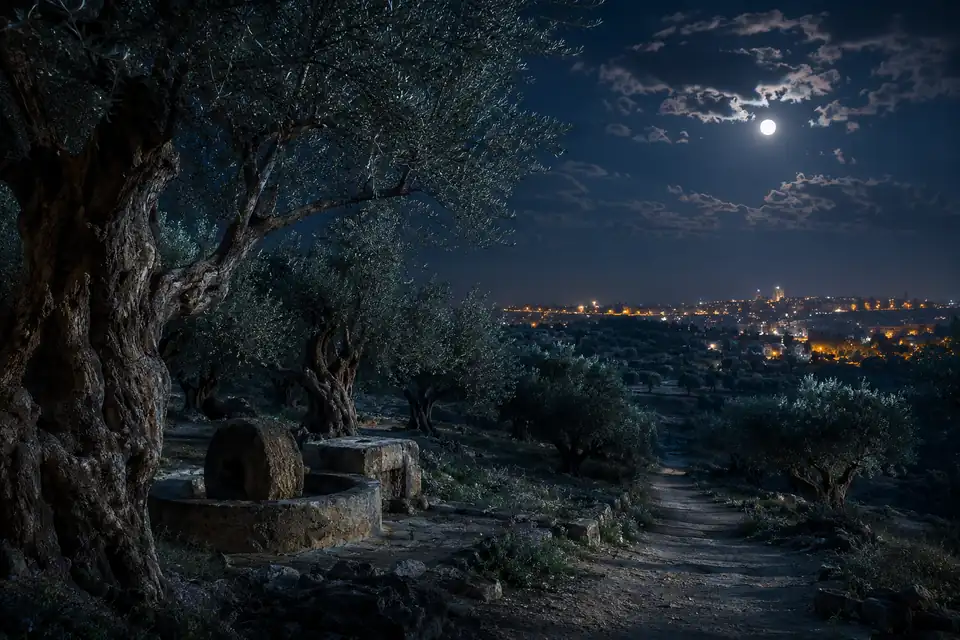
The Garden at the End of the Wilderness
Chapter Sixteen
Across the Kidron
On day twenty-six, Grant increased the offer.
The new figure would pay every debt, fund the clinic Leah had dreamed of, establish retirement security for Kenji, and leave enough for each participant’s work to receive generous support. It was, Calvin admitted, substantially above market value.
Grant presented it in the restored main room beneath temporary wiring and the faint smoke stain no amount of cleaning had removed.
“You can honor what happened here without preserving every board and stone,” he said. “Memory is portable.”
Kenji looked toward the garden but remained silent.
“The Witness Tree stays,” Grant continued. “We will create a public plaza around it. Interpretive panels can tell the history.”
“Until the tree fails,” Micah said.
“Then we replace it with a mature specimen.”
Tessa inhaled sharply. To Grant, one flowering tree could substitute for another if scale and color matched. To the group, the Witness Tree had become particular: wounded branch, resin seam, root flare, southern blossoms, the place where Miriam stored letters.
Leah understood both views. Institutions often confused attachment with mission. People sometimes sacrificed futures to preserve objects. Yet replacement could also become erasure wearing professional language.
“The offer remains open until noon on day forty-one,” Grant said. “After that, our capital moves elsewhere.”
That evening, Miriam’s letter took them across a different threshold.
After the Last Supper, Jesus crossed the Kidron with His disciples and entered a garden. The Synoptic Gospels name the place Gethsemane; John explicitly describes a garden across the brook. Jesus often met there with His disciples, so the betrayer knew the place.
Familiar places can become thresholds of surrender. Walk across water tonight. Carry the decision you wish someone else would make.
They crossed the repaired bridge after sunset. Lanterns marked the path to a grove where old olive trees grew in large containers inside a glasshouse. Miriam had named it the Oil Garden. The trees could not survive Bellwether winters outside, so generations of volunteers had moved them seasonally with wheeled platforms.
Inside, condensation silvered the glass. The leaves were gray-green above, pale beneath. An olive press stood at the center, decorative now but once used during harvest workshops.
Each person entered alone.
Leah carried Grant’s offer in a sealed envelope. She placed it beside the press.
The clinic imagined itself immediately: clean rooms, rapid access, competent staff, people receiving care before illness became catastrophe. Selling the garden could create undeniable good. Keeping it could consume years and fail.
She wanted Miriam’s letters to contain a final instruction. Sell. Keep. Choose the clinic. Choose the garden. Instead her grandmother had arranged forty days of attention and left Leah responsible.
“I do not know which good to release,” Leah prayed.
The silence held.
Her decision was larger than preference and smaller than divine revelation. She could gather wisdom, test motives, count cost, seek counsel, and still reach a threshold where obedience required choosing without total certainty.
Outside the glasshouse, water moved beneath the bridge they had crossed.
Gethsemane was not sacred because uncertainty disappeared there. It was sacred because Jesus entrusted His anguished will to the Father within it.
The path called Across the Kidron crossed the lowest stream channel. Kenji explained that this garden feature was contemplative, not geographical. The biblical Kidron Valley lay east of Jerusalem; Jesus crossed the Kidron with His disciples before entering the garden associated with Gethsemane.
“We must label the distinction,” Leah said. “Visitors should know when a landscape evokes a place rather than reproduces it.”
They walked at twilight. Water slid beneath the rebuilt bridge. The handrail felt new against older stone. Micah stopped midway to test the slight vibration under their combined weight.
“Safe,” he said. “Living structures move.”
On the far bank, Miriam’s letter asked what threshold each person faced. The Kidron crossing in John moved the story toward betrayal, arrest, and the Passion. Their wooden bridge carried no comparable weight, yet crossing could still help the body register decision.
Ruth’s threshold was housing. Her daughter had offered a six-month arrangement with written contributions, private space, and a review date. Accepting would require Ruth to admit that independence could change form without disappearing.
Micah’s was treatment. He had attended his clinic appointment and agreed to a plan addressing alcohol use, pain, sleep, and trauma through coordinated care. He refused to describe details for group approval.
Tessa’s was education. She had reenrolled in the course abandoned during treatment.
Daniel’s was the postponed church meeting. He would keep the door open without standing in its doorway forever.
Kenji’s was authority. He would sign the provisional policy placing horticultural decisions above a threshold under independent review.
Leah carried two thresholds: the hospital and the garden. She wanted them to resolve into one noble choice. Instead each required its own truthful process.
They crossed back after dark. Small path lights illuminated the rail and edge without erasing the night. The design balanced orientation with habitat needs; the lowest setting proved sufficient.
At the near side, Leah looked over her shoulder. The bridge did not make the far bank less real. It made passage possible.
Thresholds, she thought, deserved neither worship nor avoidance. They were places where one set of responsibilities met another.
Leah remained beside the press until the glass went dark.
The Garden at the End of the Wilderness
Chapter Seventeen
The Oil Press
The word Gethsemane is commonly associated with an oil press, Daniel explained the next morning, while acknowledging that the Gospels emphasize the place and Jesus’s prayer rather than offering a lesson in etymology.
“So we can receive the resonance without pretending the text says more than it does,” Tessa summarized.
“Exactly.”
Miriam’s letter described Jesus as deeply distressed and sorrowful, asking the Father whether the cup might pass, then yielding His will.
Christian surrender is neither emotional numbness nor passive resignation. Jesus named His desire, brought His anguish to the Father, and chose obedience. Honest desire entered the prayer. Surrender completed it.
Write the sentence you are afraid God will reject. Then write the sentence that entrusts the outcome to Him.
Leah wrote: I want a life that does not require me to rescue everyone.
Below it: Teach me to love faithfully within human limits.
Tessa wrote privately, folded her page, and slipped it into her pocket. Micah tore his first page in half and began again. Ruth filled both sides. Daniel sat for nearly an hour before writing one line.
Kenji asked Aaron to join them.
Father and son entered the Oil Garden carrying financial records from the retreat’s final active years. Together they described what had happened. Miriam’s vision had expanded faster than systems could support. Staff blurred pastoral care, hospitality, and crisis response. Aaron warned the board. Kenji defended Miriam because she had stood beside his family through years of prejudice, grief, and hardship. Loyalty made accountability feel like betrayal.
“I wanted you to protect the people doing the work,” Aaron said.
“I heard you attacking the woman who gave us the work.”
“Both could be true. She could be generous and wrong.”
Kenji closed his eyes. “Yes.”
The small word carried years through it.
Leah recognized a pattern familiar from hospitals and churches: gratitude weaponized against reform. A leader’s past goodness became a shield around present harm. People who raised concerns were told to remember the mission, the sacrifices, the lives changed.
Love without truth fermented into idolatry.
They created a restitution list. Several former employees had documented unpaid wages or expenses. The estate had limited funds, but Calvin identified a reserve that could address part of the harm. Aaron offered to help locate everyone and verify records.
“This reduces what remains for repairs,” Leah said.
“Then repairs wait,” Kenji answered.
The garden could not seek resurrection while leaving buried injustice beneath its paths.
That afternoon, Leah called Grant.
“If I keep the property, I will need an easement across the western parcel your firm owns. If I sell, I require protections for the stream and documented public access to the Witness Tree.”
“You are negotiating both futures.”
“I am refusing to use uncertainty as an excuse for poor stewardship.”
Grant was silent for a moment. “You sound like Miriam.”
“I am trying to sound like myself.”
When the call ended, Leah returned to the press. Oil emerged when fruit was crushed, but she resisted making suffering sound mechanically productive. Some crushing destroyed. Some pain yielded no lesson worth its cost. Gethsemane’s meaning came from Christ’s obedient love, rather than from a general rule that pressure improves everyone.
She added that insight to the program notes.
Rain entered the Oil Garden before dawn and collected in the channels beneath the press. Kenji covered the wooden screw with canvas. The replica had never produced commercial oil; Miriam had commissioned it as a teaching object, and years of weather had made its symbolism more durable than its mechanism.
Leah arrived carrying the restitution ledger. Numbers had followed her into prayer.
Daniel was already there. His single written line lay folded beside him.
“Did you write the sentence you fear God will reject?” Leah asked.
“I wrote the one I rejected on God’s behalf.”
He handed her the paper.
I am angry that Elise died, and I do not want her death made beautiful.
Leah returned it carefully.
“That seems admissible.”
“My theology agrees. Some other part of me still thinks good Christians should arrive at cleaner prayers.”
“Gethsemane is not clean.”
Daniel watched rain strike the canvas. “No.”
The Synoptic Gospels described Jesus as sorrowful, troubled, deeply distressed. He asked that the cup pass if possible and yielded to the Father’s will. His disciples slept. Luke described anguish and earnest prayer; textual traditions around one detail differed, but the central witness remained clear. Christ’s obedience included expressed desire and real suffering.
“People have used ‘not my will’ to silence the first half of the prayer,” Daniel said later to the group. “Jesus first names what He desires. Christian surrender speaks truth in God’s presence.”
Micah held his page. “What if the thing called surrender is merely giving up because you are tired?”
“Then it deserves an honest name,” Daniel said. “Surrender to God is not surrender to abuse, preventable danger, or another person’s control.”
Ruth adjusted the blanket over her knees. “The same sentence can be holy in one mouth and coercive in another.”
“Context and power matter,” Leah said.
Tessa unfolded her paper. “I wrote, ‘I want assurance that the cancer will never return.’ Then, ‘Help me live without forcing uncertainty to become a prophecy.’”
Her voice remained steady until the last word.
Leah felt the reflex to reassure her. Remission statistics, surveillance schedules, symptom thresholds—all waited within reach. None could give what Tessa had asked of God.
“Would you like us to pray with you?” she asked.
Tessa shook her head. “Sit with me first.”
So they sat while rain performed its patient work on leaf and stone.
Aaron arrived at ten carrying a document box. Kenji met him beneath the pavilion. The conversation about former staff continued for three hours. They verified claims, distinguished wages from voluntary gifts, and identified missing records. Calvin joined remotely. Restitution would require legal review and tax advice; moral urgency did not remove the need for accuracy.
At one point Kenji pushed back his chair. “Your mother and I worked without pay for years.”
Aaron’s face changed. “You owned a share in the house then. The staff did not.”
“We did not think of it as ownership.”
“That did not prevent it from becoming an asset.”
Kenji walked into the rain.
Leah found him near the pond, bareheaded, water darkening his shirt.
“He speaks as if everything we gave was a scheme,” he said.
“He speaks as someone whose warnings cost him a family place.”
“Do you believe Miriam exploited people?”
Leah considered the temptation of a decisive label. It promised clarity by compressing a person into a verdict.
“I believe the garden’s structure benefited from labor it did not fairly compensate. I believe Miriam did profound good and exercised power carelessly. I believe loyalty helped the pattern continue. We can state those things without pretending we possess every motive.”
Kenji wiped rain from his face. “Where is grace in that account?”
“Grace is why truth can be faced without annihilating a person. It is not a solvent poured over the records.”
They returned to the table.
Kenji sat across from Aaron. “I am listening again.”
By late afternoon, the reserve could cover verified wage claims only if exterior restoration was delayed. The Witness Tree work remained protected by a restricted gift whose donor consent would be required for any change. They drafted letters that named uncertainty rather than promising immediate payment.
“This feels inadequate,” Aaron said.
“It is incomplete,” Calvin replied through the speaker. “Incomplete repair can still be honest if it states its limits and continues.”
The word surrender appeared nowhere in the ledger, though Leah saw it everywhere. The garden surrendered an early opening date, a polished facade, the comfort of an uncomplicated founder story. Kenji surrendered control over Miriam’s memory. Aaron surrendered the hope that one meeting could return the years. Former workers were asked to surrender nothing further.
That distinction mattered.
After the meeting, Daniel received a call from his former church. The listening session had been postponed. One elder feared it would divide the congregation. Another wanted Daniel to submit questions in advance.
His face emptied as he listened.
“I understand,” he said. “Please tell them the offer remains open.”
When the call ended, he placed the phone on the press.
“You did everything correctly,” Tessa said.
“Correctly is not a lever.”
“No.”
He picked up his written prayer. “I wanted obedience to produce an outcome I could recognize.”
Leah understood. She had treated sacrifice as a contract: work hard enough and the patient might live; prepare thoroughly and the institution might act; surrender sincerely and clarity might come. Gethsemane promised none of those exchanges. Christ’s prayer moved toward the cross through love, not technique.
They shared bread and soup in the pavilion. The meal had no ceremonial plan, yet Daniel lifted his bowl and thanked God for daily provision, for truth that arrived through unwelcome voices, and for the freedom to entrust what they could not command.
Later, Leah called Grant about the easement. His firm’s western parcel offered the only accessible route wide enough for emergency vehicles without removing mature cedars. He proposed a permanent easement in exchange for support of a denser housing plan near the road.
“Those decisions require separate review,” Leah said. “Emergency access cannot purchase my endorsement of density.”
“Everything affects everything.”
“Yes. That is why each effect needs daylight.”
He sighed. “You are difficult to negotiate with.”
“I am becoming easier to understand.”
They agreed to commission independent appraisals and environmental review. Grant would provide interim emergency access during the conditional period without securing the garden’s support for his development. The agreement remained narrow enough to be honest.
Night fell early under the storm. Leah returned alone to the Oil Garden. Water dripped from the press into the empty stone basin. She placed both hands against the weathered beam.
She thought of every sermon that had described pressure as God’s method for extracting usefulness. The image could console some sufferers, yet it could also make cruelty seem purposeful and endurance obligatory. Jesus did not bless suffering in the abstract. In Gethsemane He entered the path of saving love, fully aware of its cost.
“I want a life that does not require me to rescue everyone,” Leah said aloud.
Rain answered without interpretation.
“Teach me to love faithfully within human limits.”
The second sentence did not erase the first. Together they became her prayer.
Accuracy, she was learning, could itself become an act of care.
The Garden at the End of the Wilderness
Chapter Eighteen
Keep Watch
At 11:40 that night, Tessa knocked on Leah’s door.
“I found another lump.”
The words changed the air.
Leah examined the area with Tessa’s consent. It was small and mobile near the scar line, possibly normal postoperative change, scar tissue, a cyst, or recurrence. Her mind generated probabilities and next steps.
“You need imaging,” she said. “Morning is appropriate unless symptoms change. I will call your oncology team’s after-hours service now.”
Tessa’s face remained composed. “Tell me the truth.”
“The truth is that touch alone cannot identify it. Several benign explanations are plausible. Your history makes prompt evaluation important.”
“Can you stay until I fall asleep?”
Leah’s instinct was to promise that everything would be fine. Instead she sat in the chair beside the bed.
The others gathered quietly. Ruth brought tea. Micah placed a lamp in the hall. Daniel asked Tessa whether she wanted prayer. She nodded.
He prayed for healing, skilled clinicians, peace, courage, and truth. He made no prediction.
They kept watch in shifts.
Miriam’s letter, opened after midnight, described Jesus asking Peter, James, and John to remain and watch while He prayed. They slept. Jesus returned and found them unable to keep watch even one hour.
Watching is love that remains present while another person undergoes what cannot be transferred. It resists distraction, premature explanation, and the urge to make another’s suffering prove our faith.
Leah sat beside Tessa through the second hour. Rain began on the roof. The young woman slept briefly, woke, and asked what time it was.
“Two fourteen.”
“My worst thoughts happen after two.”
“Mine too.”
“What do you do?”
“Usually work.”
“That explains a lot.”
They smiled in the dark.
“I wrote yesterday that I want to live long enough to become ordinary again,” Tessa said. “Everyone tells survivors life is precious. Precious becomes pressure. Every day has to justify that I survived.”
“What would ordinary look like?”
“Missing a train. Complaining about rent. Being bored at someone’s birthday dinner. Planting something I may or may not see mature.”
Leah took her hand. “That sounds holy.”
At dawn, Calvin drove them to the cancer center because the roads were clear and Leah was too tired to drive safely. Imaging suggested a benign postoperative change. The clinician arranged follow-up according to Tessa’s history.
Relief moved through the group, but Tessa remained quiet.
“Everyone wants the scene to end now,” she said on the return trip. “Good news, tears, music.”
“Fear takes longer to leave than information takes to arrive,” Leah said.
Back at the garden, they slept through most of the day.
“Keep watch” had once meant overnight prayer vigils in the Oil Garden. Archived schedules showed volunteers assigned in two-hour blocks, some driving home exhausted afterward.
Leah placed the schedules beside Miriam’s letter. “We will not reproduce this.”
Daniel read the Gospel accounts of the disciples sleeping while Jesus prayed. Their failure mattered. Yet using the passage to demand unsafe wakefulness from modern volunteers mistook reenactment for obedience.
“Watching with someone can mean helping them rest,” Ruth said.
They redesigned the exercise around attentive presence. Pairs would keep twenty-minute watches during daylight and early evening. No one would disclose more than desired. The listener would avoid advice unless requested.
Leah paired with Micah. They sat near the accessible path.
“What should I watch?” she asked.
“The moment I start making pain funny.”
For twenty minutes he described phantom sensations, the bureaucracy of prosthetic repair, and the shame of needing help with tasks he had mastered the week before. Twice he made a joke and glanced at Leah to see whether she would accept the exit. She let the humor exist and remained.
When roles reversed, Leah spoke about the patient who died the night Miriam called for the last time. She had chosen the resuscitation bay. The choice was professionally sound. Grief kept trying to turn simultaneous emergencies into a moral test she had failed.
Micah did not say she had done the right thing. “You wanted to be in two places,” he said.
“Yes.”
“That sounds painful.”
The plain sentence reached where reassurance had not.
Elsewhere, Tessa watched with Ruth, Daniel with Kenji. Aaron chose not to participate and maintained his work on the records. Presence could not be demanded as evidence of reconciliation.
That evening, Tessa received a frightened message from a former follower who said her cancer had returned. Tessa asked whether the woman had immediate support, offered crisis and clinical resources appropriate to her location, and declined to become her sole contact.
“I feel cruel,” she said.
“A boundary can feel cruel when unlimited access has been mistaken for love,” Leah replied.
They made tea and remained together while the woman connected with family.
Keeping watch did not mean preventing every sorrow. It meant refusing abandonment within truthful limits.
Keeping watch had changed nothing about the tissue in Tessa’s body. It had changed the loneliness of the night.
The Garden at the End of the Wilderness
Chapter Nineteen
The Cup
Day thirty-three brought decisions.
Ruth’s daughter arrived first. Their conversation took place on the porch, visible through the windows and inaudible from the garden. At times Ruth’s hands moved sharply. At times her daughter covered her face. Two hours later they walked the eastern path together.
Ruth announced at supper that she would move into a small apartment in Bellwether if the garden continued. She would pay rent from her pension and serve limited, compensated hours in the kitchen.
“Grandmothers require employment contracts now?” Micah asked.
“This one does.”
Micah accepted the trauma group and asked his foreman to assume more daily authority in the company. Tessa enrolled in a design course she had postponed during treatment. Daniel scheduled a listening meeting with his former church and began training in grief-informed spiritual care.
Kenji agreed to move into town with Aaron for three months while the electrical work proceeded.
“You are leaving?” Leah asked.
“I am practicing a different form of staying.”
Leah’s decision remained.
Miriam’s letter traced the cup through Gethsemane with restraint.
Jesus’s cup belongs uniquely to His redemptive obedience and suffering. Christian discipleship may involve costly obedience, yet no human sacrifice adds to Christ’s completed work. Refuse spiritual language that coerces people to endure preventable harm for another person’s power.
Ask whether the cup before you belongs to obedience, consequence, fear, ambition, or someone else’s refusal to carry responsibility. Receive only what faithfulness requires.
Leah reviewed both futures.
Selling was not automatically cowardice. Keeping was not automatically faith. The clinic was not selfish. The garden was not sacred because Miriam loved it. Neither path guaranteed purity of motive or success.
She called three people who had no financial interest: a hospital ethicist, a nonprofit executive, and a pastor Miriam had trusted. Each asked different questions.
What decision preserved Leah’s actual calling rather than a fantasy of limitless capacity?
Could the garden operate without depending upon her personal wealth or constant presence?
Was there a qualified governing body prepared to carry it?
Could the clinic vision take another form?
The questions produced a third possibility. Leah could retain the land temporarily, transfer operations to a new nonprofit after benchmarks were met, and create a health-access program within the garden through partnerships rather than building a separate clinic alone.
Calvin confirmed the structure was possible. Difficult, but possible.
The group spent two days testing it. Micah identified phased repairs. Tessa drafted a case for support. Daniel contacted potential program partners. Ruth calculated food-service revenue. Aaron agreed to advise the board only if governance safeguards were binding. Kenji offered plant knowledge without demanding authority.
Leah wrote her decision and placed it unopened in Miriam’s box.
She had chosen to carry responsibility without becoming the garden’s savior.
The cup in Miriam’s nineteenth letter had no decorative equivalent in the garden. Daniel resisted making one.
“In Gethsemane, the cup belongs to Christ’s approaching suffering and obedient mission. We should not hand visitors a prop and imply their difficulties are the same.”
Instead they set an empty table beneath the olives and read the texts.
Leah considered the language Christians used around unavoidable burdens. Some cups were accepted in faith. Others had been filled by abusers, unjust systems, or preventable neglect and then presented as God’s will. Discernment required Scripture, community, wisdom, and attention to power.
Marisol joined the discussion by invitation. “When I asked for wages, I was told ministry required sacrifice,” she said. “The person saying it received a salary.”
Daniel bowed his head. “Spiritual language can conceal who chooses the cup and who is forced to drink.”
The restitution process had verified part of Marisol’s claim. Payment would begin after legal review. She welcomed the progress and kept her anger.
“Repair does not purchase my peace,” she said.
“Agreed,” Leah answered.
That afternoon the insurer denied coverage for a portion of the electrical work classified as deferred maintenance. The estate could appeal, but the documents supported much of the finding. The cost threatened the reopening plan.
Kenji called it their cup.
Leah shook her head. “It is an invoice produced partly by neglect. We will pay, appeal what is inaccurate, and avoid making it sacred.”
He accepted the correction with a weary smile.
They revised the budget again. A decorative water feature disappeared. The guest wing lost four planned rooms. Staff compensation remained. Emergency access remained. Restitution remained.
Surrender became visible through priorities.
At dusk, Daniel unfolded the line about Elise. He read it aloud to the group and added, “I entrust her to the God who raised Jesus. I still refuse to make her death beautiful.”
No one asked him to improve the prayer.
The empty table held rainwater, leaves, and nothing that pretended to be the cup Christ alone received.
The cup before her contained limits, risk, accountability, and hope. It also contained the freedom to let other people carry it with her.
The Garden at the End of the Wilderness
Chapter Twenty
The Gardener at Dawn
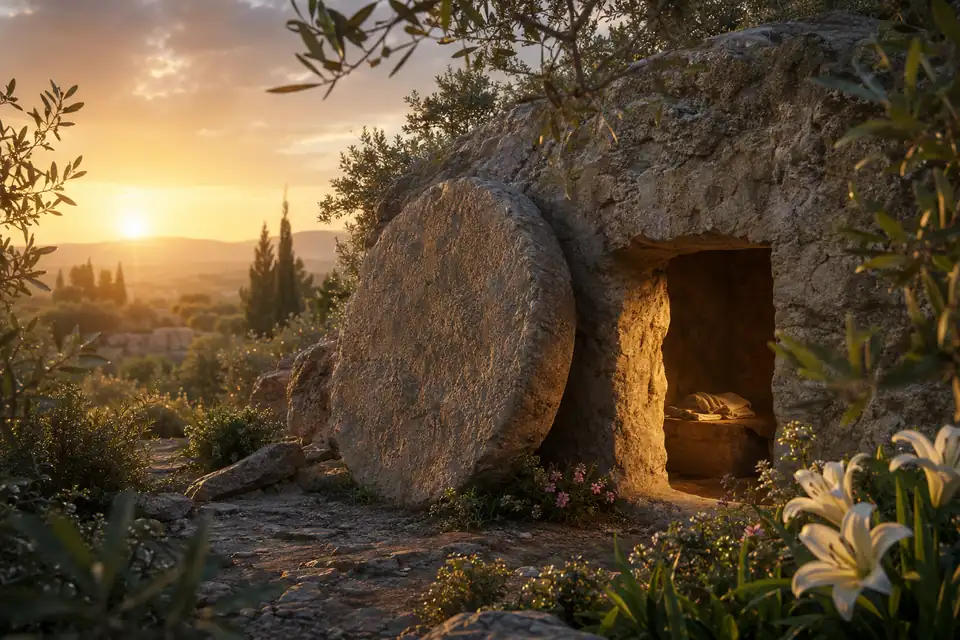
On day thirty-five, Leah woke before light and went to the garden tomb.
That was Miriam’s name for a small stone chamber built into the northern slope. It had once stored tools. Later, retreat leaders used it during Holy Week as a place of prayer. The entrance faced east. Vines covered the outer wall, and a round millstone leaned beside the doorway as a visual symbol rather than a functioning door.
Miriam’s letter directed them to John 19 and 20.
John records a garden near the place of crucifixion and a new tomb within it. Jesus’s body was laid there. On the first day of the week, Mary Magdalene came while it was still dark. When the risen Jesus spoke to her, she initially supposed Him to be the gardener.
The text records her perception. Christian readers may receive the garden setting as rich new-creation resonance while honoring what John explicitly says. Come while it is dark. Wait for dawn. Listen for your name.
Leah sat on the cold bench inside the chamber. No one else had arrived. Darkness simplified the room into stone, breath, and the open doorway.
She imagined Mary carrying grief toward a sealed conclusion. She imagined the shock of an open tomb, the confusion of absence, the question from a figure she did not recognize. Then one word: Mary.
Recognition came through her name.
Leah had spent her life responding to titles, emergencies, and need. Her name itself had become rare. At work she was Doctor. In meetings, Mercer. In crises, the person everyone called because she would answer.
“Leah.”
The voice came from outside.
She stood abruptly.
Tessa appeared in the doorway holding two cups of coffee.
“I did not mean to frighten you.”
Leah laughed, then began crying with such force she had to sit again.
Tessa placed the cups down and waited.
“You said my name,” Leah managed.
“That is generally how I find people.”
The ordinary answer made the moment more tender.
They watched dawn enter. The first light touched the garden’s upper branches, then moved downward. Birds began one species at a time. A wren. A robin. A chorus of smaller calls Leah could not name. The air smelled of wet stone and the coffee cooling beside them.
“Do you think Mary being wrong about the gardener was also somehow right?” Tessa asked.
“The text says she supposed it. It does not explain a symbol.”
“That was not my question.”
Leah considered. “I think Jesus is the risen Lord through whom creation is renewed. So the image carries truth even if Mary was simply mistaken in that moment.”
Tessa nodded. “Explanation and meaning.”
“Sharing a branch.”
When the sun reached the Witness Tree, the blossoms became luminous. Petals loosened in the warming air and moved across the clearing like pale rain.
Leah stepped outside. Resurrection did not return Jesus to the former arrangement. It inaugurated something new. The wounds remained visible; death’s authority did not.
The garden would also carry wounds: the removed limb, the fire stain, the repaired path, the employees who had been harmed, the years of closure. Restoration would require memory rather than cosmetic innocence.
Behind her, Tessa lifted one of the coffees.
“This is terrible now.”
“Some things do have a deadline.”
They drank it anyway as morning opened around them.
PART FIVE
Others came to the stone chamber after sunrise, one at a time. Nobody had organized the procession. The narrow entrance itself imposed patience.
Micah entered with a thermos and left without speaking. Ruth carried a sprig of rosemary, then returned it to the plant when she remembered the garden’s rule against taking living material. Daniel remained inside long enough for the sun to move across the threshold. Kenji stood outside, unwilling or unable to cross.
Leah joined him.
“Miriam brought me here after Aiko died,” he said. “She told me the tomb was empty.”
“Did it help?”
“It was true. Help came later.”
Aiko was his wife, Aaron’s mother. Leah knew only the outline: a stroke, three days in intensive care, a death before Aaron reached the hospital from overseas. Kenji had spoken her name rarely, as though grief had placed it behind glass.
“What do you remember this morning?” Leah asked.
“Her hands smelled of yuzu when she cooked. She planted peas too early every year. She could hear when I was pretending to agree.” His mouth softened. “I remember life. That is different from remembering death less.”
They entered together.
Inside, Daniel read John’s account. Mary stood outside the tomb weeping. Angels asked why. Jesus asked why and whom she sought. She supposed Him to be the gardener until He spoke her name. Then she became a witness, carrying news to the disciples.
“Resurrection gives Mary a commission while she is still weeping,” Tessa said.
“Tears and testimony occupy the same morning,” Daniel replied.
The insight stayed with Leah as she checked her messages. Priya had answered the apology.
I remember that shift. I also remember you buying me breakfast and waiting until my ride came. You helped me survive, and the system stayed the same. Both are true. If you want to help now, ask current residents what they need without using my story as your credential.
Leah read the message twice. It offered neither absolution nor condemnation. It returned responsibility to the present.
She wrote back: Thank you. I will honor that.
The hospital compliance office had opened a formal review and appointed external counsel. Her promotion remained available, the chief medical officer wrote, though the timeline could not be delayed indefinitely.
An older version of Leah would have interpreted the deadline as proof of value. Now she saw how urgency narrowed consent. She requested the role be offered to other candidates while the safety review proceeded. If it remained open afterward, she would evaluate it under transparent conditions.
The reply took four hours.
We accept your withdrawal from immediate consideration.
Loss moved through her with surprising force. The title had carried years of labor, her grandmother’s pride, colleagues’ expectations, and a future in which influence might redeem every cost of gaining it. Releasing the process felt less like freedom than amputation.
She went to the greenhouse and repotted seedlings until her breathing steadied.
Tessa found her there. “Do you regret it?”
“Yes.”
“Will you change your mind?”
“Regret does not automatically mean the decision was wrong.”
“That is inconvenient.”
“Most useful truths are.”
They worked in silence. Roots loosened beneath Leah’s fingers. Each seedling required a container large enough for growth and small enough to hold moisture. Too much space could be as harmful as too little.
Tessa’s surveillance scan was scheduled for the week after the forty days ended. She had not told the group.
“Everyone looks at me differently when a scan is coming,” she said. “They start waiting for the verdict.”
“How would you like us to look at you?”
“As if today has content.”
They carried the seedlings to a bench where morning reached them. Tessa described a ceramics class she wanted to take, an argument with her sister, and the sourdough starter she had accidentally killed during treatment. None of it became inspirational. All of it belonged to a living person whose future was uncertain in the ordinary human way, intensified by a medical history.
At noon, Aaron and Emi arrived. Emi ran toward the tomb, then stopped at the threshold.
“Is there a body?” she asked.
“No,” Kenji said. “It is a tool room made to help us remember another tomb.”
“Was there a body in the other one?”
“Jesus was buried there.”
“Then He became alive?”
“Yes.”
“Where did He go?”
Kenji looked at Daniel, who wisely remained quiet.
“He appeared to His followers,” Kenji said. “Later He ascended. Christians believe He lives and reigns.”
Emi entered, inspected the bench, and came out disappointed by its emptiness. “It looks like a closet.”
“Empty places often look ordinary,” Ruth said.
They ate lunch beneath the Witness Tree. Scattered petals fell into bowls and were removed rather than eaten. Kenji explained that ornamental cherry blossoms might be exposed to treatments or unsuitable preparation; edible preserved sakura came through food-safe sources. Emi accepted the distinction and drew a skull beside the fallen petals until Tessa persuaded her that uncertainty did not require poison symbols.
“Accuracy without panic,” Leah said.
“Your family motto,” Aaron replied.
After lunch, Daniel spoke about resurrection and wounds. The risen Jesus in John showed His hands and side. Resurrection did not depend upon erasing the history of crucifixion. Christian hope treated the body’s story as redeemable, not disposable.
Micah rested a hand on his prosthesis. “People call me restored when they mean I can climb stairs.”
“What word would you choose?” Tessa asked.
“Alive. Adapted. Sometimes hurting. Usually handsome.”
“We can verify one of those.”
“The pain?”
“Your modesty.”
Their laughter rose into the branches.
Leah thought of the garden’s visible wounds: char beneath fresh plaster, a crown opened by pruning, railings added along old stone, paths widened for chairs and slower feet. A restoration plan built around appearance would hide these alterations. A truthful one would let repair become part of the place’s form.
She revised the design brief. The fire-damaged beam, once structurally cleared, would remain visible behind glass with the date and safety changes documented. The accessible bridge would carry the names of donors and advisers, including people who had identified failures. The founder display would include the restitution process. Beauty would carry memory.
“Visitors may find that uncomfortable,” Grant said when he reviewed it.
“Comfort is one purpose of the garden,” Leah answered. “Credibility is another.”
At sunset, Kenji placed Aiko’s photograph in the stone chamber for one hour. She stood beside a young cherry tree, laughing at someone beyond the frame. Aaron sat next to the photograph. Emi leaned against him.
“Why only one hour?” Leah asked.
“Because this is not her grave,” Kenji said. “And because I am ready to bring her picture back into the house.”
When the hour ended, he did.
The chamber emptied again. Darkness gathered inside it while the garden remained luminous for several minutes more.
The empty tomb at the center of Christian faith was not a blank into which every desired ending could be written. It announced a particular victory: Jesus Christ raised from death, the beginning of new creation. That hope did not promise Leah control over scans, institutions, trees, or grief. It promised that death and ruin would not have the final authority over God’s beloved world.
Morning had spoken her name. Evening returned her to faithful limits.
Between them, life contained work enough for one day.
THE GARDEN RESTORED

The Garden at the End of the Wilderness
Chapter Twenty-One
The River Through the City
The irrigation survey revealed a buried channel.
Micah’s crew found it beneath the lower path while tracing a leak. Flat stones formed a narrow conduit running from the spring-fed cistern toward the pond. Silt had filled most of it. Old maps showed that Miriam’s original design allowed water to move visibly through several garden rooms before entering the stream.
“Why bury it?” Tessa asked.
Kenji remembered a child slipping near the channel and a later board decision to pipe the water underground. Safety concerns were valid, but the repair had been rushed. Over time the pipe cracked, roots entered, and water disappeared into soil before reaching the pond.
“We can rebuild it as an accessible rill,” Micah said. “Shallow, textured edges, crossings at grade, recirculation during low flow.”
The cost was significant. So was the symbolic power. Tessa’s campaign concept emerged immediately: LET THE RIVER RUN AGAIN.
Leah rejected it immediately.
“We need a capital plan, not a slogan.”
“People give to a future they can see.”
“They also deserve accurate budgets.”
“Those can share a branch.”
Kenji concealed a smile.
Miriam’s letter moved from Eden’s river to Revelation’s river of life.
Genesis describes a river flowing from Eden to water the garden before dividing. Revelation describes the river of the water of life, bright as crystal, flowing from the throne of God and of the Lamb through the holy city. The final vision joins city, river, tree, worship, healing, and reign.
God’s ending is neither escape from creation nor a private garden sealed from the nations. It is renewed creation filled with divine presence. Let water teach you movement: received from a source, carried through a place, shared beyond it.
The group approved the rill as a later phase, contingent upon full funding. They refused to borrow against imagined donations. For now, Micah’s crew repaired the broken pipe and exposed a ten-foot section of the original stone channel near the main path.
When water entered, everyone leaned close.
It hesitated at the first stone, gathered, then moved forward in a clear sheet. Sunlight broke across the surface. The sound was modest, almost conversational.
News of the garden spread through Tessa’s interviews. Former guests offered money, labor, and expertise. A regional foundation requested a proposal. The hospital where Leah worked expressed interest in caregiver retreats and clinician recovery programs, provided the garden established appropriate boundaries and outcome evaluation. A seminary offered interns for supervised spiritual-care training. The county discussed conservation incentives.
Grant sent a brief message: Momentum does not equal solvency.
Leah answered: Agreed.
She built the model with conservative assumptions. The first-year plan remained fragile, but no longer imaginary. It depended upon diversified revenue, grants, individual giving, and phased programming. It also required a reserve fund before opening.
“The river moves because its source exceeds the channel,” Daniel said during one planning session.
“And because gravity exists,” Leah replied.
“Must you always improve my metaphors?”
“Someone should.”
They designed a governance structure in which no founder, donor, pastor, clinician, or family member held unilateral authority. The garden would remain explicitly Christian, rooted in Scripture and the way of Jesus, while welcoming guests with dignity and clarity. Clinical programs would involve licensed professionals. Spiritual programs would avoid promises of medical cure. Consent, safeguarding, privacy, and referral pathways would be written before marketing.
The river would move through the city, not become a moat around a spiritual enclave.
At the exposed channel, Ruth floated a cherry petal on the current. It turned twice, passed beneath the small crossing, and traveled toward the pond.
Leah watched until it disappeared.
They opened the channel gates on the River Garden after the pump passed inspection. Water moved from the upper basin through a narrow rill, widened beside the pavilion, and entered the pond. Children could touch it at one accessible edge, though a sign clarified that it was recirculated landscape water and unsafe to drink.
Revelation’s river was not this water. John described the river of the water of life, bright as crystal, flowing from the throne of God and of the Lamb. The garden feature offered an image for contemplation, not a replica or sacrament.
“Every sign seems to say what a thing is not,” Tessa observed.
“Then our speaking should also say what it offers,” Daniel replied.
They added: Follow the water with your eyes or ears. Consider life received from God and shared beyond every private boundary.
Ruth, whose hearing was uneven, could not detect the upper trickle above surrounding conversation. Micah adjusted a resonant stone so the falling water produced a lower tone. A seating ledge allowed visitors to feel vibration through a hand placed on its surface.
“Sound accessibility,” he said. “An experiment, not a universal solution.”
They invited review from people with varied sensory experience before calling the design inclusive.
Leah followed the rill. Water reflected sky, carried petals, cooled stone, and sustained algae nobody had planned. It also required a pump, filters, electricity, cleaning, and protection against stagnant pools. Even an image of freely given life created maintenance in a human garden.
The biblical river needed no such qualification within the vision. It flowed from God’s throne. Their rill flowed from municipal water and recirculation equipment. The difference did not destroy symbolism; it kept worship aimed beyond the symbol.
At the pond, Grant showed Leah the conservation map. A wider stream buffer reduced buildable area but connected habitat across both parcels. His firm would seek density nearer the road to preserve it.
Neighbors might object. Investors might reject the revised return. The garden could endorse environmental principles without guaranteeing Grant’s project.
Water ignored their property line. Stewardship required cooperation across boundaries while maintaining independent judgment.
As evening came, floating petals reached the pond and gathered near the intake screen. Kenji removed them so circulation could continue.
The river image opened toward abundance. The small rill taught them that receiving a gift also meant clearing the channel through which it moved.
Received from a source. Carried through a place. Shared beyond it.
The Garden at the End of the Wilderness
Chapter Twenty-Two
Leaves for the Nations
The public meeting filled the retreat house beyond its temporary occupancy limit, so they moved outside.
Folding chairs covered the clearing. People stood along the paths. Children sat on blankets beneath the Witness Tree, now fully in bloom. The tree’s damaged crown opened toward the sky where the dangerous limb had been removed. From a distance the gap looked like a doorway.
Leah presented the plan without drama. She named the garden’s history, its failures, the restitution process, the required repairs, the governance commitments, the phased budget, and the conditions that had to be met before programs resumed.
Then she invited questions.
They came quickly.
Would the garden welcome people outside Christianity?
Yes, with transparent Christian identity and respect for every guest.
Would prayer replace professional mental-health treatment?
No. Spiritual care and clinical care would remain appropriately distinguished and coordinated when consented to.
Would the property become another event venue pricing out local residents?
Community-access commitments and scholarship funding would be written into the operating model.
Would the garden acknowledge the labor and cultural contributions that created it?
Yes, through researched interpretation developed with participants and families, with correction welcomed when the record proved incomplete.
Would the Witness Tree survive?
No one could promise a lifespan. The arborist’s plan would manage risk, support health, propagate cuttings where appropriate, and prepare for succession without pretending replacement erased loss.
An elderly man near the back stood. “Why should leaves heal nations?” he asked. “That sounds like religious poetry, not a plan.”
Daniel rose, but Leah answered.
“Revelation 22 gives that image within John’s vision of renewed creation: the tree of life bears fruit, and its leaves are for the healing of the nations. We are not claiming these leaves have medicinal power. We receive the passage as a picture of God’s final restoration. Our responsibility here is smaller and concrete: create a place where truth, rest, beauty, skilled care, reconciliation, food, and worship can serve people without exploiting them.”
The man nodded. “Smaller and concrete I can support.”
Miriam’s letter that morning had warned them about grandeur.
The leaves in Revelation belong to the tree of life in the holy city. Every earthly ministry remains partial. A garden may offer rest and beauty; it cannot complete the healing only God will accomplish. Let the final vision enlarge hope while keeping present claims truthful.
After the meeting, people wrote offers on cards: electrical labor, grant writing, native plants, translation, accounting, carpentry, meals, transportation, music, legal services, child care. A cardiology nurse offered to help design walking programs. A local oncologist proposed survivorship retreats with clear medical oversight. Veterans asked for accessible workdays. Teachers requested the return of water-science visits.
Aaron stood beside the contribution table verifying that enthusiasm became documented commitments.
Grant approached Leah beneath the tree.
“You made a persuasive case,” he said.
“You sound disappointed.”
“I sound expensive. If this falls short, my offer still solves the problem.”
“Until noon on day forty-one.”
“You remember.”
“I attend.”
A petal landed on his sleeve. He brushed it away, then watched where it fell.
“Miriam once asked me to join the board,” he said. “I told her gardens were poor uses of land.”
“What did she say?”
“She said land always forms the people who use it. The question is what kind of people.”
He left before Leah could answer.
By sunset, the pledge total had crossed one-third of the first-phase goal. It was extraordinary and insufficient.
Leaves arrived after bloom with little ceremony. The Witness Tree’s bronze new growth deepened toward green. Visitors who had crowded the gate for blossoms became fewer each day.
Miriam’s letter turned to the leaves for the healing of the nations. Daniel warned that Revelation’s language must not be recruited to advertise plant remedies or the garden’s programs.
“These leaves are not medicine,” Leah said, holding a fallen cherry leaf by its stem. “And the verse does not authorize us to sell tea from them.”
They reviewed the gift shop proposal. One product claimed “biblical healing botanicals.” Another described cherry blossom as detoxifying. Leah removed every unsupported health claim. Culinary products would list ingredients, allergens, and sources. Spiritual reflections would remain distinct from medical promises.
Tessa looked disappointed by the revised labels. “Truth has poor packaging.”
“Truth can be beautifully packaged,” Ruth said. “It simply cannot promise what is not inside.”
They commissioned a local artist to design leaf motifs around accurate language. Sales would support access and restitution rather than a vague healing fund.
The phrase “healing of the nations” led to harder questions. Nations carried histories of war, empire, forced migration, racism, and exclusion. Kenji spoke of his parents’ wartime incarceration in the United States and the loss of their nursery. He rejected any account that used cherry blossoms to dissolve those facts into a universal story of beauty.
“Healing requires memory with justice,” he said. “Forgetting can make a wound look closed while harm continues underneath.”
Micah thought of military memorial language. Marisol thought of labor. Ruth thought of a church that welcomed immigrants in worship while refusing to translate tenant-rights information. Daniel thought of sermons about unity that had arrived before truth.
The future garden would host conversations with qualified community partners rather than appointing itself healer of nations. Its role could be smaller: offer space, food, funding, truthful history, prayer where welcomed, and durable relationships.
Leah added another policy: no testimony of healing would be used in promotion without specific, revocable consent and contextual review. Individual experience would never establish a clinical claim.
In the afternoon, Emi sorted fallen leaves by color. Green, copper, yellow, spotted, torn. She arranged them in a circle and left an opening.
“Why the gap?” Tessa asked.
“For the next leaf.”
Healing, Leah thought, could make room before it knew who would enter.
Hope remained accountable to arithmetic.
The Garden at the End of the Wilderness
Chapter Twenty-Three
The Tree on Either Side
The question came from Emi.
She sat beneath the Witness Tree with her bird guide open, listening to Daniel explain Revelation 22.
“Is it the same tree as Genesis?” she asked.
Everyone turned toward Daniel.
He looked at Leah. “You answer.”
“Why me?”
“You enjoy improving metaphors.”
Leah sat beside Emi.
“The careful answer has layers,” she said. “Genesis and Revelation both call it the Tree of Life. Revelation deliberately brings the Eden story to completion, so it carries the same biblical identity and theological thread. In Genesis, access is guarded after human rebellion. In Revelation, the redeemed receive access, the curse is gone, and the leaves serve the healing of the nations.”
“So yes?”
“Yes in the unified story. Scripture does not tell us whether it is the same physical specimen moved from one place to another. We can leave that part unexplained.”
Emi considered this. “Why is it on both sides of the river?”
“The vision may show one magnificent tree spanning the river, or the tree collectively growing along both banks. The language is visionary. It also echoes Ezekiel’s vision of fruit trees beside life-giving water.”
“Could God make one tree be on two sides?”
“God could. The passage’s central purpose is to show abundant life flowing from God and the Lamb.”
Emi looked upward into the cherry branches. “Is this a tree of life?”
Kenji answered from behind them. “It is alive, and it is a tree. It is not the biblical Tree of Life.”
“Can it remind us?”
“Yes.”
“Then why did you take so long?”
Kenji laughed, a full sound Leah had never heard from him.
Miriam’s twenty-third letter addressed the same question.
Scripture often gives enough light for faithfulness while leaving room for wonder. Accuracy protects wonder from invention. Humility allows mystery to remain mystery.
The Tree of Life forms a living thread from Eden to the paradise of God. The final vision expands from a guarded garden to a holy city whose gates open to the redeemed and whose leaves concern nations. God’s restoration is personal, communal, creational, and cosmic.
That afternoon, arborists took scion wood from the Witness Tree for propagation. They explained that grafted descendants would carry the cultivar’s living tissue, yet each new tree would have its own form, root system, wounds, and place.
Tessa filmed the process but kept the camera away from private faces. She had created a new communications policy requiring consent before stories became content.
“We used to say the camera preserves a moment,” she told Leah. “It also changes the moment. People perform when they know they are being preserved.”
“What will you do with the footage?”
“Make a short film about succession. The tree can be loved without pretending it will remain forever.”
Micah had designed a circular support beneath the damaged crown, subtle enough to disappear among branches. The structure carried weight without forcing the tree into symmetry.
Leah thought of the community forming around the garden. Support should do the same: carry weight, preserve living movement, and release the demand for perfect shape.
At dusk, Emi drew the river of life in blue pencil. She placed one enormous tree across it, roots on both banks and branches filling the page. Along the margins she drew leaves shaped like open hands.
Her picture made no claim about botany.
Emi’s question traveled through the group long after she returned to her drawing. Was it the same tree?
Ruth fetched three Bibles and a worn concordance from the library. Daniel placed Genesis 2–3, Ezekiel 47, and Revelation 22 beside one another. They read slowly enough to notice both echoes and differences.
In Eden, the Tree of Life stood among the trees God caused to grow, alongside the tree of the knowledge of good and evil. After human disobedience, the way to the Tree of Life was guarded. In Ezekiel’s temple vision, water flowed outward and fruit trees grew on both banks, bearing fresh fruit and leaves for healing. In Revelation, the river of the water of life flowed from the throne of God and of the Lamb; the Tree of Life appeared with abundant fruit, and its leaves were for the healing of the nations.
“Revelation gathers the Bible’s images without merely copying them,” Daniel said. “Garden becomes city without ceasing to be garden. Divine presence fills communal life.”
“So heaven is a city?” Emi asked.
“John receives a vision of the holy city coming down from God,” he answered. “Christians speak about being with God after death, but Revelation’s final horizon is renewed creation and God dwelling with humanity.”
“Will there be hospitals?”
Leah felt every adult look toward her.
“The vision says death, mourning, crying, and pain will be gone,” she said. “It does not give us a list of buildings. Hospitals exist because bodies need healing here.”
“Then doctors need a different job.”
“I would be glad to learn one.”
Emi colored another leaf.
Daniel explained that the phrase “on either side of the river” had produced more than one visual interpretation. A single collective noun could present the Tree of Life as a species lining both banks, while visionary imagery could also suggest one tree spanning the water. The passage did not invite certainty about horticultural mechanics.
“Could we put both possibilities in the visitor notes?” Tessa asked.
“Yes,” Leah said. “People can see where interpretation begins.”
They drafted a three-part label for the River Garden. The first section quoted brief Scripture references. The second identified clear connections: Revelation intentionally returned to Eden’s Tree of Life and echoed Ezekiel’s healing river. The third named open questions, including physical continuity and visual arrangement.
Ruth read the draft. “It needs one sentence about why any of this matters.”
Kenji supplied it. “The guarded way becomes welcome because God has overcome the curse.”
Daniel added, “Through the Lamb.”
They wrote: The Bible’s final garden-city announces life with God through the Lamb: the curse removed, servants seeing God’s face, and the nations gathered into healing.
“Gathered into healing,” Leah repeated. “That avoids implying nations are erased.”
“The leaves serve them,” Daniel said. “Human difference enters the city as gift and glory, purified from domination.”
The conversation turned toward Japan and the cherry tree. Sakura carried centuries of cultural meanings that could not be reduced to one Christian lesson. Beauty, seasonality, renewal, mortality, celebration, imperial appropriation, local custom, and contemporary commerce had all touched the blossoms. Kenji refused the familiar claim that cherry blossoms simply represented the brevity of life for every Japanese person.
“Symbols have histories,” he said. “People use them differently. A blossom does not become Christian because we place a verse beneath it.”
“Then how do we use it here?” Tessa asked.
“With gratitude and restraint. We can say what it prompts us to consider. We should not claim it preaches.”
Leah revised another sign: The Witness Tree is a flowering cherry planted by Miriam Mercer and Kenji Sato. Its brief bloom invites many visitors to attend to beauty, transience, and renewal. These reflections are offered as human responses to the tree, not as a fixed meaning belonging to all Japanese culture or as a teaching of Scripture.
Kenji approved.
The propagation work began that afternoon. Celia cut selected scions with sterilized tools and labeled each by location and date. A specialist nursery would graft them onto compatible rootstock. Success was probable, never guaranteed.
Emi watched every cut. “Will the babies remember this tree?”
“They will carry living tissue from it,” Celia said. “Memory is your word.”
“What is your word?”
“Propagation.”
“Memory is better.”
Celia smiled. “For a picture, perhaps.”
Micah’s new support structure arrived in curved steel sections. He had designed it with an engineer, submitting load calculations rather than trusting intuition. The ring rested beyond the trunk and carried two branches through flexible supports. It could be adjusted as the tree changed.
“The old cable expected the crown to remain as it was,” he told Aaron. “This system expects movement.”
“Can institutions be fitted with one?” Aaron asked.
“They call it governance.”
“Ours has more bolts.”
The transitional board held its first provisional meeting beneath the pavilion. Leah was not automatically chair. A community health director named Simone Baptiste facilitated. Marisol attended as a paid adviser. Aaron observed. Kenji had voice without veto. The arrangement felt awkward because no single person could force momentum.
They reviewed conflicts of interest, safeguarding, compensation, public access, environmental care, and the Christian purpose of the retreat. Simone asked who could halt a program if safety concerns arose.
Five answers emerged.
“Then no one knows,” she said.
They assigned authority by domain and created a rapid escalation path. They established that a guest’s refusal of prayer or religious conversation would never affect access to food, rest, or emergency help. Programs presenting clinical content would involve qualified professionals and clear scope. Spiritual caregivers would receive training in referral and abuse reporting.
“Will rules extinguish hospitality?” Daniel asked, voicing the concern rather than endorsing it.
Marisol answered. “Rules can tell the person with less power what they are entitled to receive.”
The meeting ran long. No visionary speech rescued it. By the end, they had five provisional policies, twelve unresolved questions, and a date for public review.
Leah felt more hope than she had during the original presentation with its perfect renderings.
At dusk, Emi’s drawing rested against the tree. Her blue river divided the page. Roots crossed beneath it; branches crossed above. Open-handed leaves filled the margins, each a different shade of green.
“The nations need many colors,” she explained.
Leah knelt beside her. “Why are there twelve kinds of fruit?”
“Because the Bible says twelve.”
“Every month,” Daniel added from a safe distance.
Emi had drawn apples, oranges, pears, cherries, lemons, plums, figs, peaches, grapes, pomegranates, mangoes, and one fruit that resembled a blue lantern.
“What is that?” Leah asked.
“The one we have not discovered.”
Accuracy left room for wonder. Wonder kept accuracy from becoming a locked gate.
The Witness Tree rustled above them, mortal and particular. It was not Eden’s Tree, Ezekiel’s trees, or Revelation’s Tree of Life. It required pruning, fungal assessment, and a support ring. Its blossoms would fall. One day the whole tree would fall.
Yet beneath it, Scripture’s living thread had drawn a family, a physician, a gardener, a pastor, a veteran, a survivor, a librarian, and a wounded institution toward a vision larger than preservation. The goal was not endless survival for one beloved specimen. It was faithful participation in the life God gives and the healing God intends for nations.
They carried Emi’s picture inside before the dew could damage it.
The tree remained under the open sky.
It told the truth about welcome.
The Garden at the End of the Wilderness
Chapter Twenty-Four
The Desert Shall Blossom
Three days before the deadline, the principal foundation declined the proposal.
Its committee admired the project but considered the operating history too fragile. The decision removed nearly half the anticipated first-phase funding.
Leah read the email twice, then gathered the group.
“We have pledged labor and funds for urgent electrical work, restitution, and limited site stabilization,” she said. “We do not have enough for safe public reopening or the required reserve.”
“Can we ask donors to increase?” Tessa said.
“We can. We cannot manufacture capacity through urgency.”
Grant’s deadline stood four days away.
The weather shifted overnight. A dry east wind moved through the valley, unusual for the season. Petals fell in sheets. By morning the Witness Tree’s peak bloom had passed.
The clearing looked emptied.
Tessa stood beneath the branches crying. “It was full yesterday.”
Kenji picked up one fallen petal. “Fullness is a season, not a permanent pose.”
“I know what blossoms do.”
“Knowing does not remove grief.”
Miriam’s letter turned to Isaiah.
The prophets speak of wilderness rejoicing and blossoming, deserts becoming like Eden, and desolate land being restored. Isaiah 35 announces the wilderness in bloom. Isaiah 51 speaks of waste places comforted and wilderness made like Eden. Ezekiel 36 describes desolate land becoming like the Garden of Eden.
These promises belong first within their scriptural contexts of God’s restoration. Receive their pattern with humility: God rebuilds what human beings call ruined. The desert’s blossom is God’s work before it becomes anyone’s slogan.
Do not confuse bloom with absence of process. Roots labor invisibly. Rain gathers elsewhere. Seeds wait. Communities rebuild one faithful act at a time.
Leah closed the letter.
“We may need to sell,” she said.
No one argued.
That afternoon, they completed the restitution payments the reserve could support. They sent each former worker an accounting, an apology from the interim board, and a process for correcting records. The action reduced cash again.
“If we sell now, was any of this wasted?” Ruth asked.
“No,” Aaron said. “Truth was owed regardless of the property’s future.”
Leah walked through every garden room before sunset.
The herb bed held miner’s lettuce she would once have removed. The repaired path flexed above living roots. The stone channel carried water. The fire wall remained open for inspection. The olive trees waited in the glasshouse. The garden tomb faced the coming dawn. Each place held a lesson and a cost.
At the northern boundary she discovered Grant alone, looking across the property.
“Calvin told me about the foundation,” he said.
“Confidentiality seems lively in this family.”
“The foundation chair called my office about easement implications.”
He handed her a revised plan. The townhouses had been moved from the orchard. Development occupied the western parcel instead, with a conservation easement protecting most of the garden. A smaller portion near the road would hold mixed-income apartments. The developer would fund core infrastructure in exchange for access and density adjustments, subject to county approval. The garden nonprofit would retain ownership of seven acres and receive a long-term lease on two more.
“Why?” Leah asked.
“Because your meeting changed the political landscape. Because the stream corridor increases the value of my parcel when preserved. Because I can build fewer units at higher density and still meet return targets. Because Miriam was partly right about land forming people.”
“Which reason is true?”
“All of them. Motives are rarely single-species gardens.”
She almost smiled.
The proposal required negotiation, legal review, community input, and regulatory approval. It was no miracle check. It was a viable structure emerging from intersecting interests, public pressure, moral memory, and practical design.
“The offer deadline?” she asked.
“Replaced by a sixty-day exclusivity period for this plan, if you choose it.”
Leah looked over the dry field on Grant’s parcel. Survey flags moved in the wind like small flames.
The desert had not bloomed overnight.
The desert bed lay beyond the greenhouse, built with gravel, drought-tolerant plants, and a dry channel that carried stormwater during heavy rain. Miriam had called it Isaiah’s Garden after passages in which wilderness rejoiced and blossoms.
Daniel read Isaiah 35. The prophetic vision held transformed land, strengthened hands, steadied knees, opened senses, safe passage, and the return of the redeemed with joy. It was poetry of divine restoration, larger than a horticultural demonstration.
Leah noticed the language about disability and asked that future teaching include disabled interpreters. Biblical healing hope should never become a judgment upon people whose bodies remained disabled or a reason to postpone access in the present.
Micah examined the path. “If your sign promises the lame will leap while your gravel stops my chair, your theology has become satire.”
The surface was already scheduled for replacement.
They planted no new species that day. First they reviewed water use, invasiveness, soil, pollinator value, and climate projections. A plant associated with arid beauty elsewhere could become harmful here. Restoration required attention to place rather than importing an image.
Tessa asked whether wilderness was the opposite of garden.
“Sometimes the Bible contrasts fruitful land with desolation,” Daniel said. “Yet wilderness also becomes a place of encounter, formation, testing, provision, and promised transformation. The relationship is richer than a simple opposite.”
Israel’s wilderness journey lasted forty years, not forty days and nights. The spies had explored for forty days. Moses and Jesus had distinct forty-day fasts in distinct settings. John the Baptist lived and preached in the wilderness and near the Jordan. Jesus was led into wilderness for temptation. Moses encountered the burning bush while keeping flocks near Horeb. None of those places should be casually turned into a pleasant retreat landscape.
“Real wilderness can kill,” Leah said. “And some human desolations are produced by injustice. We should not romanticize what people need delivered from.”
They reviewed the garden’s older brochure, which promised that every wilderness concealed a blessing. Daniel crossed out the sentence.
“Some wilderness contains loss,” he said. “God may meet us there. Calling the loss a blessing can wound the person still crossing it.”
Rain began unexpectedly. Water entered the dry channel, first as scattered dark marks, then a continuous thread. Everyone moved beneath the greenhouse roof except Kenji, who watched how the channel carried runoff.
One low point overflowed toward the path. He marked it for correction.
The desert bed blossomed sparsely: penstemon, yarrow, a late iris. Its beauty came through adaptation rather than abundance alone.
Leah watched rain bead on the leaves. The promised flowering of wilderness belonged ultimately to God’s renewal. Their responsibility was humbler and immediate: reduce preventable desolation, conserve water, make passage safe, and cultivate signs of hope without confusing them for completion.
Someone had finally agreed to protect the ground where blooming could occur.
The Garden at the End of the Wilderness
Chapter Twenty-Five
The Garden at the End of the Wilderness
Day forty arrived under a clean sky.
The group gathered before sunrise at the locked gate. Leah held the iron key. Kenji placed the heart-shaped stone in her other hand.
“Why are we outside?” Micah asked.
“Because we began here,” Leah said.
She unlocked the gate again.
This time, six people entered together. Aaron and Emi followed. Calvin came behind them carrying final documents. Grant waited at the retreat house with his planning team. Former staff, neighbors, and community representatives would join later for the announcement.
They walked slowly.
Sound came first: gravel underfoot, bamboo clicking, streamwater crossing stone. Then fragrance: cedar, damp earth, rosemary, and the faint green sweetness remaining after cherry bloom. Morning light moved across moss. Cold iron touched Leah’s palm. Ruth had packed small rice cakes filled with sweet bean paste, and they ate them beside the pond, receiving taste as part of remembrance.
All five senses had become forms of attention.
At the Witness Tree, only scattered blossoms remained. New bronze leaves had begun to unfold. Tessa touched one carefully.
“I thought the petals were the whole event,” she said.
“Flowers prepare fruit and leaves,” Kenji answered. “A tree has more than one glory.”
Leah opened Miriam’s final letter.
Beloved ones,
If you have reached this day, you know the garden more truthfully than when you entered. Perhaps you will keep it. Perhaps faithfulness will require release. I have withheld my preferred outcome because stewardship cannot be inherited as obedience to a dead woman’s desire.
The human story begins in a garden entrusted to our care. Moses meets God in wilderness and discovers holy ground. Israel is formed through forty years of dependence. John’s voice prepares a way beside the river. Jesus resists temptation in the wilderness, surrenders in Gethsemane, is buried in a garden, and is revealed risen there. Revelation ends with the river and Tree of Life, the curse removed, God’s face seen, and leaves for the healing of the nations.
The wilderness is more than the garden’s opposite. It is often the place where counterfeit abundance falls away, dependence becomes visible, and a future garden begins beneath the soil. Yet suffering should never be romanticized. Some wildernesses result from injustice, violence, neglect, or human sin. Faithfulness includes ending preventable desolation.
Attend. Work and keep. Receive daily bread. Turn aside. Remove your sandals. Watch with those who suffer. Surrender without surrendering truth. Welcome resurrection. Let the river move beyond you.
And Leah: you were never the sun. You are a beloved creature beneath it.
Miriam.
Leah lowered the page.
Ruth’s hand found her shoulder. No one hurried her tears.
When she could speak, Leah described the decision.
The estate would retain the garden during the sixty-day planning period. A new nonprofit would receive operations only after independent governance, funding thresholds, safety requirements, restitution, and community agreements were complete. Grant’s firm would pursue the revised development and conservation plan. If benchmarks failed, the board would reconsider options without disguising insolvency as faith.
Leah would chair the transitional committee for six months with defined hours and a co-chair selected independently. She would return to clinical work part time and develop a collaborative health-access and caregiver-rest program rather than building a clinic alone.
Kenji would become horticultural adviser emeritus, a title he accepted after confirming that emeritus included permission to disagree and no authority to overrule staff. Micah would oversee accessibility and phased construction through a contracted scope. Tessa would lead ethical storytelling and visitor experience as paid work while completing her course. Ruth would develop the community table program under written hours. Daniel would design grief-informed spiritual care with clinical referral boundaries and outside review. Aaron would serve on the governance committee until policies were established, then rotate off to prevent family control.
“You planned all our lives,” Tessa said.
“Draft roles,” Leah replied. “Each requires consent.”
“Growth,” Micah murmured.
Calvin distributed documents.
Before anyone signed, Kenji asked them to walk to the heart-shaped stone’s place by the gate. Leah returned it to the shallow hollow but kept the key.
“Why put it back?” Emi asked.
“Someone else may need to remember where opening began,” Leah said.
The public gathering started at noon. There were speeches, though Daniel kept his under four minutes. Former employees read the accountability commitments. Children released no balloons because Tessa had researched the environmental harm and replaced them with handfuls of native seeds for approved planting areas. Ruth served soup, bread, pickled vegetables, and cherry-blossom tea prepared from culinary-grade preserved blossoms purchased from a reputable supplier. Kenji posted a clear notice that ornamental blossoms from the garden were not food.
Music moved through the clearing. People prayed. Others listened. The garden’s Christian identity rested in hospitality, truth, worship, repentance, and care rather than pressure.
Near sunset, Leah found Grant beside the rill.
“You kept it,” he said.
“We entered a process for keeping it faithfully.”
“You really have changed.”
“I am learning to use accurate verbs.”
He extended his hand. She took it.
The final petals traveled along the water toward the pond. Above them, the Witness Tree stood mostly green.
Leah had imagined that the end of wilderness would look like permanent bloom. Instead it looked like people carrying tools, agreements, food, questions, and one another. It looked like repaired wiring and unfinished walls. It looked like grief given room, money counted honestly, work distributed, and beauty received without possession.
The garden at the end of the wilderness was not an escape from difficult ground.
The public gathering tested every promise before the speeches began.
A wheelchair user discovered that loose gravel near the pavilion exceeded the stable-path boundary. Micah closed the route and directed guests around the pond. A child became separated from his father; the sign-in and assembly process reunited them within minutes. One former employee asked that her name be removed from a printed acknowledgment. Tessa stopped distribution until the page was replaced. Hospitality acquired a hundred practical forms.
Leah moved among them without carrying every task. When the sound system failed, she allowed the technician to repair it. When soup ran low, Ruth changed portions. When a reporter requested a private interview about Miriam, Leah referred her to the public materials and scheduled a later conversation. Defined roles did not diminish care. They allowed it to travel through many hands.
At noon, a bell sounded once.
Simone welcomed the assembly and named the land’s layered history without claiming a completeness the garden’s records could not support. She acknowledged the Indigenous peoples whose ancestral territories included the region and committed the future board to consultation grounded in specific research and relationships, rather than ceremonial language alone. Kenji spoke about the Witness Tree. Marisol presented the accountability commitments. Daniel offered a prayer that lasted ninety seconds.
Then Leah came forward with Miriam’s letter.
She could feel the crowd waiting for a simple verdict: saved or sold, miracle or loss. The actual decision contained conditions, budgets, easements, deadlines, and the possibility of failure. She read it without apology.
“For sixty days,” she concluded, “the estate will support a transparent transition. Continuation will depend upon safety, solvency, restitution, independent governance, environmental protection, and community trust. The garden’s mission will be measured partly by its willingness to change.”
A hand rose before she finished. “Does this mean the developer is gone?”
Grant stood near the rear, visible to everyone.
“No,” Leah said. “His firm owns adjoining land and remains part of access and conservation negotiations. The garden will evaluate each agreement publicly and independently.”
“So luxury houses could still be built beside a healing retreat?”
“A revised housing proposal is under review. I will not describe an undecided process as a victory.”
Murmurs traveled through the chairs.
Another person asked whether the retreat would reopen before summer. Leah said the date would follow inspection and staffing, not the calendar preferred by donors. A former volunteer asked why Miriam’s failures were being discussed after her death. Marisol answered from her seat.
“Because some of us had to live with them while she was alive.”
Silence widened.
Kenji walked to the microphone. “I helped create the conditions Marisol has described. Miriam’s generosity does not cancel them. My loyalty does not excuse them. Any future garden must tell the fuller truth.”
He stepped away before the crowd could turn confession into performance.
The questions continued. Some were suspicious. Some protected cherished memories. One donor withdrew a pledge because the garden would permit guests to decline explicitly religious activities. Another increased hers after reading the financial controls. A neighbor objected to traffic. An oncology nurse offered to advise the caregiver program. The future entered through disagreement rather than unanimous applause.
Emi and three children distributed packets of native seed appropriate to approved restoration zones. Each packet carried instructions: where planting was permitted, which conditions the species required, why seeds should never be scattered in protected habitat without guidance. Hope had directions printed on recycled paper.
Near the food tables, Ruth supervised cherry-blossom tea. The preserved petals opened in hot water, releasing a delicate floral aroma and a mild saltiness from their preparation. Beside the urn, Kenji displayed a notice explaining the culinary source and warning visitors not to harvest ornamental flowers.
Leah accepted a cup. Steam touched her face. The tea’s taste was subtler than its beauty, a meeting of fragrance and salt.
All five senses had accompanied the forty days. Sight received pale blossom, scorched timber, green leaf, and faces altered by truth. Hearing received river, alarm, silence, prayer, and names spoken without demand. Smell carried cedar, smoke, earth, rosemary, and rain. Touch learned iron keys, rough bark, cold stone, another person’s steady hand. Taste made theology ordinary through bread, broth, rice, apples, bitter coffee, and a preserved flower floating in clear water.
The senses had not proved God. They had trained attention within creation.
Christian faith claimed more than a generalized spirituality of beauty. The God who made the world acted in history, called a people, met Moses in wilderness, spoke through prophets, and was revealed in Jesus Christ. Christ prayed in Gethsemane, was crucified, buried in a garden, and raised. Revelation’s garden-city placed hope in God’s renewing presence. The retreat would hold that confession openly while practicing welcome without coercion.
Late in the afternoon, the wind strengthened. Celia checked the forecast and closed the Witness Tree’s inner circle. Several guests complained that they had traveled to stand beneath the blossoms.
“The blossoms are mostly gone,” Emi told one of them.
“I know. I wanted a photograph with the tree.”
Tessa offered a marked viewpoint beyond the risk zone. The guest accepted reluctantly. Safety limited the desired experience; it also preserved the person who desired it.
Grant found Leah by the rill after the crowd thinned. He carried the revised easement draft.
“Permanent emergency and accessible access,” he said. “Independent valuation. No endorsement clause. Environmental maintenance shared by formula. The housing application proceeds separately.”
Leah read the first page. “And the public path?”
“Protected during garden operating hours, with closure authority for safety and restoration.”
“The board reviews closures.”
“Within forty-eight hours, except emergencies.”
She marked the margin. “Write it.”
He watched her. “Miriam would have settled this with a handshake.”
“Miriam left us several reasons to use paper.”
“She also left you the land.”
“Conditionally.”
“You insist on the least romantic adverb.”
“It has protected us.”
Grant looked toward the pavilion, where volunteers stacked chairs. “My mother loved this place. I resented how completely it belonged to Miriam’s story. Development was partly business and partly an argument with a dead woman.”
Leah lowered the draft.
“Does recognizing that change your proposal?”
“It changes what I ask the proposal to accomplish.”
“That is a beginning.”
He took back the marked pages. Their handshake carried no reconciliation beyond the agreement under review.
At sunset, the core group returned to the gate. The heart-shaped stone rested in its hollow. The key remained in Leah’s hand.
“You have not signed the inheritance acceptance,” Calvin said.
“I know.”
The conditional period ended at midnight. Accepting meant assuming obligations that the transition might still fail to meet. Declining would activate sale provisions, including protections Miriam had negotiated imperfectly. Neither choice guaranteed faithfulness.
Leah asked each person to speak from role rather than affection.
Micah said the accessibility plan was feasible in phases if funding remained protected. Tessa said the public story could survive complexity. Ruth said hospitality needed paid coordination before reopening. Daniel said spiritual care required outside accountability. Kenji said the horticultural plan was sound and the tree’s future uncertain. Aaron said governance had begun credibly and family influence should diminish. Simone, joining by phone, confirmed that the provisional board would proceed even if Leah’s chair term ended.
The last answer mattered most. The garden no longer depended upon her staying indispensable.
She signed acceptance of the property subject to the published transition covenants. Calvin witnessed it. The paper made no sound beyond the movement of the pen.
Leah expected a rush of certainty. She felt weight, grief, and a calm narrow enough for the next step.
They walked the garden after dark with low lanterns. Petals had gathered in the rill’s bends. Frogs sounded near the pond. The repaired bridge held beneath their feet. Smoke no longer scented the house, though the opened wall awaited reconstruction.
At the garden tomb, Tessa spoke about her coming scan. She asked them to receive the result with her, whatever it was, without turning fear or relief into a lesson before she had lived it. They agreed.
At the Oil Garden, Aaron placed a copy of the restitution plan on the table and took it back inside when rain threatened. Symbolic gestures would not replace protected records.
At the Witness Tree, the support ring disappeared among shadows. Kenji did not cross the safety boundary.
Finally they reached the gate again. Leah returned the stone to its hollow and locked the gate for the night.
“Why lock it after all that?” Ruth asked.
“Because welcome has hours,” Leah said.
Ruth smiled. “Boundaries. Our newest perennial.”
They entered the house through the safe door. Tasks waited on the pavilion board for morning: insurer follow-up, soil testing, payroll registration, donor notices, a clinic appointment, a daughter’s housing call, and electrical bids. No task had become less ordinary because the garden was kept.
Leah paused beside the exposed beam. The fire stain remained visible beneath work lights. Beyond the window, the dark garden breathed through leaf and water.
Eden had been gift and vocation. Wilderness had revealed dependence, temptation, injustice, and provision. Gethsemane had held honest desire within surrendered love. The garden tomb had announced resurrection. Revelation opened the guarded story toward a city where God dwelt with humanity and the river nourished healing.
Their small acreage fulfilled none of those Scriptures. It received them as a pattern of faithful attention.
The end of wilderness was not permanent blossom. It was ground where truth could be planted, limits honored, grief accompanied, labor paid, danger addressed, beauty received, and hope entrusted to God.
Leah switched off the work light.
In darkness, the garden remained alive.
It was difficult ground tended in the presence of God.
The Garden at the End of the Wilderness
Epilogue
The First Petal
One year later, the first blossom opened while Leah was away.
She had returned to the hospital three days each week, working clinically and advising the redesigned emergency division after the board delayed its launch. The nurse manager who had warned her became operations co-lead. Staffing ratios and escalation criteria were published internally. Progress remained uneven, but concealment had become harder.
At the garden, the electrical system passed inspection. The retreat house reopened for day programs, with overnight use scheduled for a later phase. The new rill carried recirculated water through the central rooms. Accessible paths reached the pond, orchard, and Oil Garden. The nonprofit met its reserve threshold two weeks before opening.
The development plan gained county approval after intense negotiation. Mixed-income housing rose on the western parcel while the conservation easement protected the stream corridor. Grant complained often and kept every signed environmental commitment.
Tessa sent Leah a photograph of the blossom, then called to apologize because the new consent policy did not apply to trees but friendship required more than policy.
“Do you want me to wait before posting?” she asked.
“Post the tree. Leave my grandmother’s letter out of the caption.”
“Agreed.”
Leah arrived after dark. She slept in her small room and woke before dawn.
At the clearing, she found everyone already there.
Ruth wore the yellow coat. Micah stood without trekking poles on the stable path, though he carried them in his truck without shame. Daniel had returned from his former church, where he now taught one monthly seminar and held no formal authority. Tessa’s hair reached her jaw. Kenji sat beside Aaron and Emi, who could identify twenty-seven birds by call and had become intolerant of imprecise theological answers.
The Witness Tree held a single open flower.
No one called it a miracle. No one reduced it to weather. They received it.
Leah placed her hand against the trunk. The old wound remained. The support held. New growth had formed around the previous year’s cut.
“What happens now?” Emi asked.
“Breakfast,” Ruth said.
“After breakfast.”
Kenji looked toward the paths where volunteers would soon arrive.
“We tend what has been entrusted,” he said. “Then we release the outcome to God.”
Wind moved gently through the branches. The blossom trembled and remained.
One year later, the first petal opened on a Tuesday before the garden was ready.
The forecast had placed peak bloom ten days away. The communications calendar expected photographs the following week. Kenji found the flower during his morning inspection and sent a message to the staff channel: EAST LIMB. ONE BLOSSOM. NO EMERGENCY.
Leah arrived at eight after a hospital shift. She now worked three clinical days each week and served the garden in a defined strategic role. The arrangement remained imperfect. On hospital days she missed garden decisions. On garden days she worried that clinical skill was leaving her by degrees. Her supervisors, colleagues, and the board reviewed the arrangement quarterly, which prevented anxiety from becoming the sole evaluator.
The hospital safety investigation had confirmed material problems. Timelines changed. Two senior administrators left. Staffing targets increased, though negotiations continued. Leah never received the original director title. She led a smaller patient-safety program with protected reporting authority and shared leadership. The work carried less prestige and more proximity to the questions that had called her attention.
Priya joined one resident forum by video and set her own terms. Leah introduced her without recounting the old shift. Current trainees spoke for themselves. Several improvements followed; other requests remained unfunded. Changed direction proved slower than apology and more vulnerable to budget cycles.
At the retreat, the guest wing had reopened with six rooms rather than ten. One room remained unfinished because restitution payments took precedence. A clear panel displayed the fire-stained beam and a brief account of delayed maintenance, warning signs, and corrective action. Visitors often stopped there longer than expected.
Marisol served on the board’s workforce committee as a compensated adviser. She had accepted restitution and had not resumed friendship with Kenji. They greeted each other with courtesy. The garden learned to receive repair without demanding intimacy.
Ruth’s community table filled every Thursday. She lived with her daughter under an agreement both women revised after three months. Her grandson set up chairs and was paid for the work. Ruth continued to insist that soup was a governance instrument.
Tessa’s scan after the forty days had shown no evidence of disease. The following scan had done the same. She received each result as good news without allowing anyone to declare the story finished. Her ceramics course produced bowls with uneven rims and glazes the color of river stone. The retreat purchased them at her stated price rather than requesting a donation.
She directed the garden’s storytelling. Consent forms used plain language. People could withdraw future use of an interview. Medical and spiritual claims underwent review. The most watched film on the garden’s channel was not about a miraculous recovery. It showed Celia grafting scion wood while Emi asked whether trees remembered.
Micah completed the accessible route in phases. The bridge held through winter flooding. He continued treatment through the veterans’ clinic, with stretches of progress and days he described only as difficult. The group learned to ask what support he wanted instead of reading every silence as crisis. He taught a design workshop whose first rule was: invite the people who will use the path before drawing it.
Daniel returned to his former church for one listening meeting. Some people welcomed him. Others challenged his account. The church established an independent review of pastoral care, and Daniel held no official role in it. He occasionally preached elsewhere, always under structures he once considered restrictive. At the garden he facilitated grief groups with a licensed clinical consultant and referral agreements.
Elise entered his speech through stories of life: her students, terrible puns, strong coffee, and the time she repaired a sink with a library book open beside her. Her death remained part of the story and ceased consuming every page before it.
Aaron rotated off the governance committee as promised. His relationship with Kenji grew through short, reliable contacts: Sunday lunch twice a month, written horticultural decisions, no surprise requests. Trust developed without a public ceremony.
Emi’s drawing of the Tree of Life hung in the library beside the interpretation label. She had added more undiscovered fruit.
Kenji became horticultural adviser emeritus. He tested the title’s limits with dedication. Staff overruled him twice about pruning and once about irrigation. He documented his disagreement, then helped implement the decision. The Witness Tree remained alive, supported by the adjustable ring and protected during high winds.
Three grafts had taken at the nursery.
Grant’s revised development received conditional county approval after months of debate. It included a wider habitat corridor, fewer total structures than the original plan, and greater density near transit. Some neighbors appealed. The garden neither celebrated nor condemned the project as a whole; it published its environmental and access agreements and continued independent review.
The emergency easement had already been used once when a visitor experienced chest pain. Staff activated the response plan, emergency vehicles reached the pavilion, and the visitor received timely care. Afterward the team held a debrief, corrected two communication gaps, and sent no promotional story.
On the Tuesday of the first blossom, the garden was closed to the public for staff training. This disappointed three photographers who saw the social-media post from outside the gate. Tessa explained that the notice documented season rather than offering an opening invitation. They returned later.
Leah stood beneath the eastern limb outside the risk boundary. The flower was small enough to disappear whenever wind turned it sideways. White at first glance, it held pink near the center.
“Do you feel transformed?” Ruth asked beside her.
“Today?”
“After a year. Writers like anniversaries.”
Leah considered the word. Transformation suggested a before and after clean enough to narrate. Her life felt more like the Witness Tree: pruned, supported, still vulnerable to weather, producing growth from an altered crown.
“I feel accountable,” she said.
“Very marketable.”
“And grateful.”
“Better.”
They went inside for training. The morning session covered mandatory reporting, emergency roles, privacy, and the right of guests to decline participation. After lunch, Daniel led a biblical orientation.
He began in Genesis with the garden planted by God. He moved to wilderness carefully: Moses near Horeb, Israel’s forty years, the spies’ forty days, John by the Jordan, Jesus’s temptation. He crossed the Kidron into Gethsemane, entered John’s garden tomb at dawn, read Daniel’s great-tree warning, and ended at Revelation’s river and Tree of Life.
“Are the trees in Genesis and Revelation the same?” a new volunteer asked.
Emi, attending because school was closed, raised her hand before Daniel could answer.
“Same Bible tree,” she said. “We do not know the plant-moving part.”
Daniel looked at Leah. “Our most concise interpreter.”
After the session, staff practiced offering five-sense experiences. They described blossom colors without promising fragrance. They identified permitted tactile materials. They used food-grade preserved sakura for tea and explained its source. They provided a quiet route, seating, captions, large print, and permission to engage through fewer than five senses.
One volunteer asked how the garden could be spiritually powerful if every statement carried a qualification.
Kenji answered. “Truth is not less powerful because we stop adding to it.”
Leah watched the sentence settle.
At four, staff opened the gate for a small caregiver group. No camera recorded them. Some went directly to the Witness Tree. Others chose the greenhouse, table, or river path. One woman sat beside the fire display and wept. A facilitator asked whether she wanted company. She said no. The facilitator remained available at a respectful distance.
Near dusk, Leah met a physician named Owen at the garden tomb. He had cared for patients through three years of shortages and had begun forgetting ordinary words during shifts.
“I thought coming here would make me want to return,” he said.
“To work?”
“To myself.”
Leah sat on the bench, leaving space between them. “Which self?”
He did not answer for a long time.
“The one who believed effort could keep everyone safe.”
She recognized him immediately, though they had never met.
“That belief can save a life during an emergency,” she said. “It can consume a life when it becomes a permanent assignment.”
“What replaced it for you?”
“People. Limits. Systems that can be challenged. God, with less of my assistance.”
Owen laughed once. “Does the grief leave?”
“Mine changes. It has not asked my permission.”
They watched evening enter the stone room. Leah did not tell him what to do about work. She gave him information about confidential support and offered to connect him with the physician-health program. He accepted the number and declined the call for now.
When he left, the doorway framed the upper branches of the Witness Tree. More buds would open overnight. Rain might shorten the bloom. The staff had contingency plans for crowds, wind, parking, allergies, food, emergencies, and disappointment. None could control the season.
Leah returned to the gate after closing. Beneath the heart-shaped stone, the old hollow held a duplicate key for authorized staff. The original iron key hung in the secure office cabinet, labeled and logged. Opening no longer depended upon one person remembering where Miriam had hidden it.
She walked the perimeter with Tessa, checking latches. At the pavilion, Ruth’s bowls dried on racks. Along the accessible path, low lights marked edges. Water moved through the rill. The fire display reflected the garden without hiding the blackened wood behind it.
The five senses received the evening in layers: blossom pale against blue shadow; frogs and recirculating water; cedar and wet soil; cool rail beneath her palm; the last salt-floral trace of tea.
Leah offered no interpretation for several steps.
At the Witness Tree, the first petal released. It moved downward, lifted once on a current, and landed outside the boundary rope.
Tessa bent to photograph it, then changed her mind.
“Let this one belong to the ground,” she said.
They continued toward the house.
Behind them, unseen buds prepared to open.
For the moment, remaining was its form of praise.
The Garden at the End of the Wilderness
A Reader’s Companion
Reading the Biblical Gardens with Care
The Garden at the End of the Wilderness draws its central images from Scripture while distinguishing what the biblical texts state from what later readers may infer. That distinction protects both faith and imagination. A novel can place fictional people beneath a cherry tree, beside a stream, or within a stone chamber. It can allow those places to awaken echoes of Eden, Gethsemane, and the garden tomb. It should also tell readers when the echo belongs to artistic reflection rather than to the text itself.
The Bible begins its human story in a garden. Genesis 2 describes the Lord God planting a garden in Eden and placing the human there. Trees grow that are pleasant to sight and good for food. A river waters the garden. The human receives work and responsibility: to work the garden and keep it. The setting joins abundance with vocation, delight with boundary, and human life with the material creation God has made.
Genesis does not present “garden” as a synonym for effortless perfection. Work is present before rebellion, though toil and frustrated ground appear afterward. The garden includes a command whose limit must be honored. Human creatures receive a place they did not create and a life they cannot rightly possess apart from trust in God. These elements inform Leah’s discovery that stewardship involves beauty, safety, labor, governance, appetite, and restraint.
Two named trees receive special attention in Eden: the Tree of Life and the tree of the knowledge of good and evil. They are distinct. After disobedience, the way to the Tree of Life is guarded so humanity does not take from it and live forever in the fallen condition. The narrative therefore leaves the reader east of Eden with both judgment and an unresolved longing for restored access.
Revelation returns deliberately to this imagery. In Revelation 2, Christ promises access to the Tree of Life in the paradise of God. Revelation 22 places the Tree of Life beside the river of the water of life in the holy city. The curse is gone, God’s servants see His face, and the tree bears abundant fruit while its leaves serve the healing of the nations.
Is it the same tree? The most careful answer is the one Leah gives Emi. It is the same biblical identity and theological thread: Revelation brings Eden’s Tree of Life into the Bible’s final vision of restoration. Scripture does not explain whether the physical organism from Genesis has been preserved, relocated, recreated, or presented through visionary symbolism. Readers may hold the narrative continuity firmly and the botanical mechanics humbly.
The wording that places the Tree of Life “on either side” of the river has been understood in more than one way. The vision may show a single magnificent tree spanning the river or may use a collective term for the tree growing along both banks. Ezekiel 47 provides an important background: life-giving water flows from the temple, and fruit trees grow on both banks with fruit for food and leaves for healing. Revelation intensifies and completes that prophetic image around the throne of God and of the Lamb.
Daniel also contains a significant tree, though it is not a garden scene. In Daniel 4, Nebuchadnezzar dreams of an immense tree whose fruit feeds many and whose branches shelter creatures. A heavenly watcher orders it cut down while the stump and roots remain bound. Daniel identifies the tree with the king’s greatness and warns him to practice righteousness and show mercy to the oppressed. The king’s pride leads to humiliation; restoration follows his acknowledgment of heaven’s rule. The novel draws on this passage to examine institutions whose reach and usefulness can conceal unaccountable power.
The preserved stump of Daniel 4 should not be merged with Revelation’s Tree of Life. The images serve different prophetic purposes. One concerns royal pride, judgment, humility, and restored rule. The other belongs to the final vision of divine life and healing. Their shared use of tree imagery permits fruitful conversation while their contexts preserve the differences.
Gethsemane gives the novel its garden of surrender. The Gospels locate Jesus with His disciples in a place or garden across the Kidron. The name Gethsemane is commonly associated with an oil press, an association that can deepen literary resonance. The Gospel narratives themselves emphasize Jesus’s distress, prayer, the disciples’ failure to remain awake, betrayal, and arrest. Jesus names His desire that the cup pass if possible and yields to the Father’s will.
This prayer reveals surrender as honest obedience. Jesus does not perform emotional numbness. His anguish is real, His request is spoken, and His obedience is freely offered within His saving mission. Christian teaching becomes harmful when “not my will” is detached from Christ and used to silence people facing abuse, exploitation, unsafe labor, or preventable harm. Surrender to God never grants another person unlimited authority.
The garden tomb belongs especially to John’s Gospel. John 19 states that a garden lay near the place where Jesus was crucified and that a new tomb stood in the garden. John 20 describes Mary Magdalene coming while it was still dark. She encounters the risen Jesus and initially supposes Him to be the gardener. Recognition comes when He speaks her name.
John explicitly reports Mary’s mistaken perception; he does not pause to explain a “new gardener” symbol. Christian readers have nevertheless found profound new-creation resonance in the setting. Such reflection is responsible when presented as theological reading rather than as a sentence John wrote. The risen Christ is indeed the One through whom creation is reconciled and renewed. The image can carry truth without being made into a hidden code.
The wounds of the risen Jesus also shape the novel’s account of restoration. Resurrection does not pretend crucifixion never occurred. John depicts Jesus showing His hands and side. Christian hope therefore exceeds cosmetic return. It is compatible with truth, memory, justice, transformed embodiment, and a future that does not simply recreate the old arrangement.
Wilderness, Forty, and Holy Ground
The wilderness is not a single biblical symbol with one fixed meaning. It may be a place of danger, scarcity, judgment, refuge, testing, encounter, dependence, or promised transformation. Its significance comes from the particular story in which it appears.
Moses encounters the burning bush while keeping the flock of Jethro. Exodus 3 says he leads the flock beyond or to the far side of the wilderness and comes to Horeb, the mountain of God. The bush is therefore not described as standing in a cultivated garden. God’s presence makes the ground holy. Moses turns aside to see, removes his sandals at God’s command, and receives a commission grounded in God’s seeing, hearing, and knowing Israel’s affliction.
The burning bush should be distinguished from the fire in the fictional retreat house. An electrical failure is an electrical failure. The characters may learn because danger exposes neglected systems, while responsible theology avoids declaring every dramatic event a coded divine message. Moses’s wonder receives its meaning from God’s self-revelation and speech in the biblical narrative.
Israel’s wilderness period lasts forty years. The phrase “forty days and forty nights” properly belongs to other biblical events. The spies explore the land for forty days in Numbers 13, and Israel’s judgment corresponds in years to those days in Numbers 14. Moses remains on Sinai forty days and nights. Elijah travels forty days and nights to Horeb. Jesus fasts forty days and is tempted in the wilderness. These events echo one another without becoming interchangeable.
The forty-day condition in the novel is fictional. It draws literary energy from the biblical pattern of testing, dependence, judgment, preparation, and transition. It does not claim that forty days automatically produce spiritual change. Durable transformation often requires care extending far beyond a meaningful interval.
John the Baptist appears in the wilderness and in the region of the Jordan. The Gospels connect him with Isaiah’s voice crying in the wilderness and with a baptism of repentance. Crowds go out to hear him. His preaching demands fruit consistent with repentance, and Luke preserves practical answers involving food, clothing, economic honesty, power, and contentment.
Repentance therefore includes more than private regret. The New Testament term carries the sense of a changed mind and orientation that becomes visible in conduct. Within the novel, Leah, Daniel, Tessa, Micah, Ruth, and Kenji each take a concrete action. None completes repentance in one afternoon. The action establishes direction.
Jesus also enters the wilderness. After His baptism, the Synoptic Gospels describe Him led or driven by the Spirit into the wilderness, where He is tempted. The forty days connect His story with Israel and other scriptural patterns, while His identity and obedience remain unique. He does not enter wilderness because gardens are inherently false or because deprivation is inherently holy. The temptation narrative concerns the faithful Son’s obedience.
The wilderness can appear as the opposite of a flourishing garden when Scripture contrasts desolation with fruitful land. Isaiah’s visions of wilderness blossoming use that transformation to announce divine restoration. Yet wilderness also shelters Hagar, forms Israel, receives Moses, carries Elijah, and becomes the setting of John’s ministry and Jesus’s testing. A simple opposition loses too much.
The novel therefore treats wilderness as difficult ground where counterfeit abundance may be exposed and dependence may become visible. It also refuses to romanticize suffering. Some wildernesses arise through injustice, violence, poverty, exclusion, illness, or neglect. Faithfulness may include leaving danger, changing policy, paying restitution, treating illness, and repairing what human beings have allowed to fail.
Holy ground does not mean harmless ground. Moses removes his sandals because God commands it in a particular encounter. Modern readers should not reproduce the gesture where broken glass, contaminated soil, extreme heat, disability, or other conditions make it unsafe or excluding. A practice intended to deepen reverence should remain subordinate to love of neighbor.
Cherry Blossom and the Five Senses
Japanese cherry blossom, widely called sakura, can fill sight with extraordinary variation. Petals may appear white, blush, rose, or deeper pink according to cultivar, age, weather, and light. Dark branches give the bloom structure. New bronze or green leaves change the canopy as flowering ends. Fallen petals gather along paths and water, turning the ground into another field of color.
The most vivid experience often comes from movement rather than saturation alone. Wind releases petals in small flights. Sun passes through thin tissue. Reflection doubles branches in a pond and breaks them again. A single damaged petal can hold more truth about living beauty than an image perfected beyond season and decay.
Hearing receives the blossom indirectly. Flowers open without a humanly audible sound, but their setting is rich with acoustics: bees, wind in branches, birds, footsteps, water, distant conversation, cloth moving as visitors turn. Petals may brush dry leaves or a paper umbrella. Silence itself changes when many people pause together beneath a tree.
Touch requires restraint. Living flowers can be bruised or removed by handling, and trees should be protected from climbing, bark damage, and compacted soil. Safer tactile experiences include feeling a fallen petal where collection is permitted, resting a hand on a designated piece of pruned wood, receiving cool air beneath the canopy, or noticing the contrast between smooth petal, rough bark, damp stone, and woven picnic cloth.
Smell varies widely. Some flowering cherries offer a delicate fragrance; others have little scent detectable to a casual visitor. The air around them may carry wet earth, grass, cedar, nearby food, rain, or urban surroundings more strongly than blossom perfume. Accuracy allows a subtle fragrance to remain subtle.
Taste requires the greatest care. Ornamental blossoms growing in a public garden should not be assumed edible. They may have been treated with chemicals, exposed to contamination, or belong to a plant part unsuitable for casual consumption. Culinary sakura products use food-grade blossoms or leaves prepared through controlled methods, often preserved with salt and sometimes vinegar. Sakura tea can carry floral aroma and a gentle saltiness. Sweets may use blossom, leaf, flavoring, or color in different ways. Labels and reputable sourcing matter.
The senses do not operate independently. Much of flavor depends upon smell. Sight shapes expectation before tasting. Sound affects whether a place feels spacious, intimate, crowded, or safe. Temperature alters touch and aroma. Memory can make a simple food vivid with the presence of people and places no longer available.
For Christian reflection, sensory attention can become gratitude for creation and a discipline of presence. It does not function as proof of God, nor does beauty guarantee that every observer feels peace. Trauma, grief, migraine, allergy, sensory processing, disability, and cultural experience all affect reception. Hospitality offers multiple paths into attention and permits a guest to step away.
Sakura is not a biblical symbol. Scripture does not assign Christian doctrine to Japanese cherry trees. Cherry blossom also carries varied meanings within Japanese history and contemporary life; no single explanation can speak for every person or period. The novel uses a particular fictional tree as a created thing that invites its characters to consider beauty, brevity, renewal, grief, and stewardship. It presents those meanings as their responses, not as ownership of Japanese culture.
This restraint strengthens rather than weakens the image. A flower need not be converted into a doctrinal code to be received with gratitude. It can remain a flower: biologically particular, culturally storied, seasonally brief, and radiant within the world God made.
Spiritual Care, Medicine, and Human Limits
Leah’s medical vocation shapes how she approaches every spiritual practice. She knows that attention to a body can save life and that expertise has a proper scope. Her growth does not require abandoning medicine for intuition. It requires practicing medicine without allowing competence to become an identity built upon being indispensable.
The distinction matters wherever faith communities address illness. Prayer may accompany clinical care. It should not be presented as a guaranteed cure, a diagnostic tool, or a reason to avoid qualified treatment. Testimonies of recovery describe individual experience; they do not establish general medical effectiveness. Claims about food, herbs, fasting, detoxification, trauma, addiction, cancer, or mental health require appropriate evidence and professional boundaries.
Fasting carries particular risks. Although Scripture contains meaningful fasts, a fictional retreat should not prescribe fasting to every guest. Pregnancy, diabetes, eating-disorder history, cancer treatment, medication schedules, frailty, and many other circumstances may make fasting inappropriate or require clinical guidance. Alternative practices can include simplicity, reduced media, generosity, silence, or a carefully chosen form of abstention unrelated to food.
Addiction also requires more than a symbolic disposal of alcohol. Micah’s disclosure begins a changed direction; it does not complete treatment. Abrupt cessation can be medically dangerous for a person with physiological dependence. Assessment, safety planning, evidence-based care, peer support, pain treatment, sleep care, and ongoing consent all belong in a responsible response.
Trauma-informed spiritual care avoids forcing disclosure, surprise touch, public testimony, or religious participation. It explains what will happen, offers meaningful choice, protects privacy, and recognizes the right to stop. It knows when to refer to clinical or emergency support. It also respects that a person may want prayer, Scripture, sacraments, and explicitly Christian counsel as part of care.
Grief resists fixed schedules. Daniel’s wife Elise, Leah’s grandmother Miriam, Kenji’s wife Aiko, and the losses carried by other characters remain particular. Christian resurrection hope does not require calling death beautiful. Lament, anger, longing, and trust may inhabit the same prayer. A grieving person owes nobody an uplifting conclusion.
The novel also examines the moral injury that can arise when leaders place clean explanations around violent or premature loss. Statements about divine purpose may intend comfort and still cause harm. Listening, apology, restitution, and changed teaching can be more faithful than defending the intention behind a sentence.
Human limits appear throughout the garden as gifts of truth. Defined work hours, safe staffing, consultation, sleep, accessibility, and shared authority are not failures of devotion. They acknowledge that creatures are finite. The claim that one person is essential may express appreciation, but it can also reveal a system unwilling to distribute knowledge and responsibility.
In Christian understanding, no worker is the sun around which the ministry must turn. Vocation matters deeply. So do Sabbath, succession, community, and the freedom to receive care. Love becomes more durable when it can survive one person’s rest, disagreement, departure, or death.
Leadership, Repair, and the Great Tree
The great tree of Daniel 4 gives the novel a vocabulary for leadership that has grown impressive and dangerous. The dream tree offers food and shelter across an enormous reach. Its benefits are real. Its greatness is also identified with a king whose pride requires judgment.
This prevents an easy moral division between fruitful institutions and harmful ones. A ministry can help many people and still exploit workers. A hospital can save lives and still conceal unsafe staffing. A founder can be generous and still resist accountability. A leader’s good intentions and past sacrifices should be included in the record; they should never become immunity from examination.
Repair begins with naming what happened in language specific enough to be tested. Delayed wages, unpaid overtime, unsafe wiring, absent referral pathways, misleading publicity, inaccessible paths, and concealed vacancies call for different remedies. A general confession of imperfection can create an appearance of humility while leaving every structure unchanged.
Listening is part of repair, especially listening that does not require the harmed person to comfort the institution. People may choose written statements, private meetings, representatives, legal counsel, or no renewed contact. Their refusal to participate does not erase a claim. Their forgiveness, if offered, does not eliminate the need for restitution and policy change.
Restitution is not a purchase of reconciliation. It addresses material obligation. Payment may remain incomplete because records are missing or resources limited, but honest incompleteness names the remaining debt and preserves a process for continuing. Organizations should seek qualified legal, financial, and employment advice rather than improvising remedies that create new harm.
Governance distributes authority, defines roles, manages conflicts of interest, and creates ways to halt unsafe activity. Healthy governance can feel slower than charismatic leadership. Its friction often protects information that a central figure could ignore. Independent review becomes especially important when family, property, money, spiritual authority, and personal legacy overlap.
Safety systems express moral values through ordinary means. Inspections, alarms, accessible exits, staff training, privacy controls, clinical referral, incident reporting, and accurate signs may appear less spiritual than prayer beneath blossoms. They become forms of neighbor love when they protect bodies and dignity.
Accessibility should begin during design rather than arrive as a later accommodation. A route, program, sign, meal, soundscape, or spiritual exercise rarely serves every person in the same way. Consultation with disabled people, compensation for expertise, clear information, and multiple forms of participation are more faithful than claiming universal inclusion after one modification.
Environmental stewardship also requires specificity. Protecting a beloved tree may include pruning, soil care, risk zones, propagation, and eventual loss. Preserving habitat may require fewer buildings, changed lighting, careful drainage, and coordination across property boundaries. Native planting still requires attention to precise place and conditions. Symbolic seed scattering can harm ecosystems when performed without guidance.
The novel’s garden survives through conditions rather than a triumphant rescue. This is deliberate. Christian faithfulness is not measured by keeping every institution open. Some organizations should close. Others may continue only after their model changes. Discernment asks what serves God and neighbor, who bears the cost, whether truth can be spoken, and whether the work remains viable without exploiting devotion.
Questions for Personal and Group Reflection
1. Leah first understands the garden as a legal and practical burden. Which encounter begins to change her attention, and why does attention precede affection for her?
2. The Witness Tree is beautiful, old, damaged, culturally resonant, and biologically finite. How does the story resist making the tree either a mere asset or an idol?
3. Miriam leaves a forty-day condition. When does a symbolic deadline create focus, and when can urgency narrow honest consent?
4. Kenji’s loyalty grows from gratitude and shared history. How can gratitude support faithfulness? How can it become a shield against accountability?
5. Aaron insists that generosity and harm can both be true. What becomes possible when a community refuses to simplify a person into hero or villain?
6. Daniel recognizes that his teaching about suffering harmed Micah and later became unbearable during Elise’s illness. What distinguishes explanation from accompaniment?
7. Tessa deletes an audience built around her recovery. What belongs to a community, and what may a person rightly keep private even after sharing publicly before?
8. Micah asks for specific forms of help while retaining control over his story. What does consent change about the way the group responds?
9. Ruth’s conversation with her daughter moves from cheerful vagueness to calendars and numbers. Why can practical clarity become a form of love?
10. Leah apologizes to Priya without demanding a response. What makes an apology accountable? Which explanations would have weakened it?
11. The fire reveals separate warnings that had been normalized. Where have you seen repeated small signals treated as unrelated inconveniences?
12. Fire Chief Ruiz says that an old building’s character still needs an exit. How might this sentence apply to traditions, churches, families, or workplaces?
13. The group distinguishes a burning electrical junction from Moses’s burning bush. Why is restraint important when interpreting dramatic events spiritually?
14. Moses turns aside after seeing the bush. What competes for your attention? What might becoming available to be addressed require in practice?
15. Holy ground in the novel includes environmental testing and safe footwear. How can reverence become more concrete through responsibility?
16. The garden’s former fasting guidance confused distress with spiritual progress. Which spiritual practices need clearer health, consent, or power boundaries?
17. Daily bread appears through porridge, emergency supplies, labor, and shared infrastructure. How does this widen the meaning of provision?
18. The characters refuse to romanticize the storm because they possess resources others may lack. How can gratitude deepen solidarity?
19. In the river scene, regret preserves Leah as judge while repentance requires movement. What is the difference between self-punishment and changed direction?
20. The group removes old confession records because the original consent is unclear. How should communities treat personal stories entrusted under outdated practices?
21. Daniel 4 connects pride with the treatment of the oppressed. How does this challenge leadership assessment based mainly on reach, growth, or popularity?
22. Marisol says that “family” language concealed unequal sacrifice. When does family language strengthen a workplace or ministry, and when does it blur obligations?
23. The arborist says that “save” is a word with a deadline hidden inside it. How does finitude change responsible care for a person, tree, or institution?
24. Gethsemane holds both Christ’s expressed desire and surrendered obedience. Which half of that prayer has your community emphasized more strongly?
25. The characters distinguish surrender to God from submission to abuse or preventable danger. What practices help communities keep that distinction clear?
26. Leah refuses to make all suffering productive. How can Christians speak of redemption without claiming that every injury was necessary?
27. The disciples fail to keep watch. In the novel, watching becomes bounded, attentive presence. What kind of presence helps a suffering person feel accompanied?
28. Daniel refuses to make Elise’s death beautiful. How can resurrection hope coexist with protest, anger, and grief?
29. Mary Magdalene recognizes Jesus when He speaks her name. What names, roles, or labels have shaped the way you understand yourself?
30. The garden tomb is a former tool room and explicitly a teaching symbol. Why does the distinction between a historical site and an evocative space matter?
31. Resurrection restoration preserves visible wounds and difficult history. What would truthful restoration look like in a place you know?
32. The hospital offers Leah urgency, prestige, and influence. How does she learn to distinguish vocation from indispensability?
33. Revelation moves from Eden’s garden to a garden-city. What does the city add to the image of restored life with God?
34. The river flows beyond private property in the novel. Which forms of stewardship require cooperation with people whose goals differ from yours?
35. The leaves are for the healing of the nations. Why does the group reject unsupported health claims while retaining the biblical vision of healing?
36. Kenji says healing requires memory with justice. Which kinds of forgetting imitate peace without producing it?
37. Emi asks whether the Tree of Life is physically the same tree in Genesis and Revelation. How does the answer hold confidence and mystery together?
38. The propagated cherry trees carry living tissue but develop different forms. What does succession preserve, and what should it allow to change?
39. The transitional board’s slowness gives more people authority to speak. When is efficiency a virtue, and when can it conceal domination?
40. A visitor can decline prayer without losing access to food or rest. What does noncoercive Christian hospitality communicate about grace?
41. The desert bed turns prophetic poetry into a limited garden image. How can art evoke Scripture without claiming to fulfill it?
42. Micah challenges any theology that celebrates future healing while ignoring present access. Where should hope produce immediate practical change?
43. Leah’s final decision remains conditional and measurable. Why might a faithful ending contain benchmarks, review dates, and the possibility of closure?
44. The opening gathering includes objections and withdrawn support. What does the absence of unanimous approval reveal about truthful community?
45. All five senses become forms of attention. Which sense do you rely upon most? Which one might widen your awareness if approached safely and patiently?
46. The blossom is only one season of the tree’s life. What forms of quieter growth have you overlooked because they lacked visible splendor?
47. The garden maintains an explicitly Christian identity while rejecting pressure. What is the difference between clear witness and coercion?
48. “You were never the sun” frees Leah from a central role. Which systems in your life depend too heavily on one person, and how could responsibility be shared?
49. The locked gate at night shows that welcome has hours. How can healthy limits make hospitality more durable?
50. The novel ends with difficult ground tended in God’s presence. What piece of ground—literal, relational, institutional, or spiritual—is presently yours to tend?
A Five-Sense Garden Practice
Choose a place you have permission to enter and enough physical safety to remain for twenty to thirty minutes. It may be a garden, park, courtyard, porch, indoor conservatory, or a room with a living plant. Check weather, access, allergies, hydration, medication needs, traffic, and personal security. Bring another person if solitude would be unsafe or unhelpful.
Begin by arriving rather than performing. Notice the support beneath your body. Allow breathing to find its ordinary rhythm. Christian prayer may begin with a brief acknowledgment: Creator and Lord, help me receive this place truthfully and love what You have made without possessing it.
For sight, name color, light, movement, distance, boundary, and change. Delay metaphor. Notice what appears healthy and what appears damaged. Include human work: paths, labels, drains, fences, pruning, litter, repair. Ask whose access the design supports and whose body it may have forgotten.
For hearing, receive foreground and background. Notice water, wind, insects, birds, traffic, machinery, voices, and intervals of quiet. Avoid identifying every sound unless knowledge serves attention. If hearing is limited, notice vibration, visual movement associated with sound, or the social conditions that make the place calm or overwhelming.
For smell, breathe normally. Do not touch or crush plants without permission. Notice floral, green, earthy, woody, wet, culinary, urban, and artificial scents. Step away from anything that provokes respiratory symptoms, nausea, migraine, or distress. A faint smell needs no exaggeration.
For touch, favor surfaces designated for contact or material already fallen where collection is allowed. Feel air temperature, humidity, clothing, seating, rail, stone, or water at an approved feature. Protect plants, soil, habitat, and your own skin. Touch can remain imagined or omitted when contact is unsafe or unwelcome.
For taste, consume only food or drink obtained from a reliable culinary source. Never taste an unidentified plant or assume an ornamental flower is edible. A simple piece of bread, fruit, or safe tea can locate gratitude in the body. Notice labor, land, water, transport, preparation, and shared systems behind it.
After attending, read one short passage suited to the place: Genesis 2:8–15, Exodus 3:1–6, Psalm 104, Isaiah 35:1–10, John 20:1–18, or Revelation 22:1–5. Observe what the passage actually says before drawing connections. Let the created place remain itself while Scripture addresses you on its own terms.
Ask three closing questions. What gift did I receive? What limit did I encounter? What act of care becomes mine? The action may be small: remove permitted litter, report a hazard, compensate someone’s labor, learn a name, conserve water, respect a boundary, share food, seek treatment, apologize, or return at another season.
Leave without taking what does not belong to you. Gratitude can carry the encounter without carrying the flower.
Closing Reflection
The Bible’s gardens do not offer an escape from the world’s wounds. Eden reveals gift, vocation, boundary, and loss. Gethsemane receives the anguish and obedience of Christ. The garden tomb holds death and then opens upon resurrection. Revelation’s garden-city gathers river, tree, fruit, leaves, nations, worship, and the face of God into the final horizon of Christian hope.
Between Genesis and Revelation, wilderness remains part of the story. Moses turns aside there. Israel learns dependence there. John prepares a way there. Jesus resists temptation there. Wilderness can expose, endanger, shelter, form, and wait for promised bloom.
The Christian life therefore moves through more than one landscape. Faithfulness may look like cultivating or leaving, speaking or listening, accepting a limit or challenging an injustice, keeping watch or receiving sleep, preserving a root or allowing a canopy to be cut. The unifying center is not the landscape itself. It is the God who creates, calls, accompanies, redeems, and renews through Jesus Christ.
A cherry tree blooms within this larger world as one created life among many. Its splendor is real. Its season is brief. Its cultural histories deserve respect. Its roots need air and water. Its branches require wise care. Its petals can awaken grief and delight without bearing the weight of doctrine.
When the petals fall, the tree continues. Leaves open. Wood thickens. Roots exchange life beneath unseen soil. People who came for color may depart, while gardeners remain to tend irrigation, disease, paths, records, wages, and welcome.
This quieter season offers its own spiritual truth. Love is often sustained through work too ordinary for a photograph. Hope becomes credible through practices that protect the vulnerable. Repentance becomes visible in changed direction. Surrender speaks honest desire and releases control to God. Resurrection hope remembers wounds while expecting a future beyond them.
The garden at the end of the wilderness is finally neither a private refuge nor a perfect institution. It is a place where received beauty becomes responsibility, where truth and mercy remain together, and where human hands tend difficult ground beneath a grace they did not create.
A Forty-Day Reading Journey
Readers who wish to inhabit the book slowly may use the following forty-day path. The schedule is devotional rather than prescriptive. It does not promise transformation on a deadline, and anyone may pause, combine days, or choose a different pace. Each day joins a short portion of the novel with one attentive action. The actions are intentionally modest so reflection can enter ordinary life.
Day 1: Read the opening at the locked gate. Notice one threshold you cross routinely. Ask what responsibilities begin on the other side.
Day 2: Read the first blossom scene. Spend five minutes looking at one living thing without photographing it. Record only observable detail.
Day 3: Read the chapter on sight. Identify one beauty and one hazard in the same environment. Consider how responsible attention receives both.
Day 4: Read the community meal chapter. Eat one safe, simple food slowly. Give thanks for named forms of labor behind it.
Day 5: Read “Work It and Keep It.” Complete one maintenance task whose value will remain mostly invisible.
Day 6: Read the mountain chapter. Distinguish a burden that belongs to you from one that should be shared or released.
Day 7: Review the biblical forties. Write the events separately so their differences remain clear. Resist turning a pattern into a formula.
Day 8: Read the storm and daily-bread scenes. Check one practical provision: medication supply, emergency contact, drinking water, flashlight, or transportation plan.
Day 9: Read beside the river. Name one direction that requires change and one action possible within twenty-four hours.
Day 10: Read the stones chapter. Consider whether an object helps you remember responsibility or has begun to substitute for action.
Day 11: Read the fire scene. Attend to one warning that has been explained away in isolation. Seek qualified help where needed.
Day 12: Read “Holy Ground.” Learn something specific about the land beneath a place you value: watershed, soil, prior use, or people connected to it.
Day 13: Read “The Fire That Stayed.” Separate physical cause, moral responsibility, spiritual response, and metaphor. Let each remain distinct.
Day 14: Read the chapter about names. Ask someone how to pronounce or use their chosen name and remember the answer.
Day 15: Read Daniel 4 and “Roots Bound in Iron.” Examine one form of success. Ask who carries its cost and who can question its leadership.
Day 16: Read the Kidron threshold. Take one safe, deliberate walk across a bridge, doorway, or boundary. Name the decision it helps you face.
Day 17: Read “The Oil Press.” Write an honest desire before writing any sentence of surrender. Bring both to God.
Day 18: Read “Keep Watch.” Offer someone bounded attention. Ask whether they want listening, prayer, practical help, advice, or space.
Day 19: Read “The Cup.” Identify one burden that should be accepted and one imposed burden that should be challenged. Seek wise counsel if the distinction is unclear.
Day 20: Read the garden-tomb chapter. Sit with John 20:1–18. Notice darkness, tears, questions, a spoken name, and commission.
Day 21: Read “The River Through the City.” Trace the water that serves your home from source to drain as far as reliable information allows.
Day 22: Read “Leaves for the Nations.” Review one health or spiritual claim before sharing it. Ask whether evidence and context support the language.
Day 23: Read the Tree of Life discussion. Write what Scripture clearly says, what you reasonably infer, and what remains mysterious.
Day 24: Read “The Desert Shall Blossom.” Identify one form of suffering that should never be romanticized. Consider a practical response to preventable harm.
Day 25: Read the final decision chapter. Choose one value and give it a measurable practice, responsible person, resource, and review date.
Day 26: Return to Genesis 2:8–15. Notice gift, beauty, food, river, work, and keeping. Which theme has been absent from your idea of garden?
Day 27: Read Genesis 3:22–24. Sit with guarded access to the Tree of Life. Avoid hurrying past loss toward the final vision.
Day 28: Read Exodus 3:1–12. Observe where Moses is, what he sees, why he turns aside, what God says about Israel, and what commission follows.
Day 29: Read selected passages about Israel’s wilderness years. Consider the difference between a difficult season and a history spanning a generation.
Day 30: Read Luke 3:1–14. List the concrete economic and social fruits John connects with repentance.
Day 31: Read a Gospel temptation account. Notice how Jesus answers and how His wilderness testing differs from a chosen modern retreat.
Day 32: Read Daniel 4:19–37. Attend to greatness, warning, mercy toward the oppressed, humiliation, and restored acknowledgment of God.
Day 33: Read a Gethsemane account. Allow Christ’s expressed anguish and obedient surrender to remain together.
Day 34: Read John 19:38–42. Notice the garden, the new tomb, the constraints of time, and the embodied care given to Jesus’s body.
Day 35: Read John 20:1–18 again. Ask how resurrection hope honors wounds and creates a new future rather than merely restoring the old arrangement.
Day 36: Read Ezekiel 47:1–12. Follow the deepening water, transformed environment, abundant fruit, and healing leaves.
Day 37: Read Revelation 21:1–5. Notice the holy city coming down, God dwelling with humanity, tears wiped away, and all things made new.
Day 38: Read Revelation 22:1–5. Receive river, throne, Lamb, Tree of Life, fruit, leaves, face, name, light, service, and reign.
Day 39: Revisit one scene that troubled you. Ask whether the discomfort points toward disagreement, grief, conviction, cultural history, or a boundary needing care.
Day 40: Read the epilogue. Name one gift received, one truth faced, one repair begun, and one outcome that must remain entrusted to God.
At the end of the journey, avoid measuring success by emotional intensity. A quiet change in direction may matter more than a memorable feeling. Review any commitment made during the forty days. Decide who should know, what support it requires, when it will be revisited, and what would indicate that the action is causing unintended harm.
If the journey awakens medical, psychological, legal, financial, employment, or safeguarding concerns, seek qualified assistance appropriate to the issue. A devotional practice can help a person notice reality. It should never be used to replace expertise that care and justice require.
The final day is not a finish line for faith. In Scripture, forty often leads into another responsibility: Moses descends from the mountain; Israel continues through history; Elijah receives a renewed commission; Jesus begins public ministry after temptation. Attention becomes fruitful when it enters the next faithful act.
The final page
Carry beauty, truth, stewardship, and resurrection hope into the ground entrusted to you.
The page becomes a practice
Return, Memory, and Renewal
Travel through wilderness, grief, identity, and the gradual reception of new life.
This title also carries a prepared Convergence Q45 formation handoff for Renewal, Return, and Restoration.