
Complete illustrated edition
Illustrations and worksheets include accessible text descriptions.
This reading edition contains all 184 pages from the supplied print interior, including illustrated diagrams, forms, references, and the entire text available in the PDF. Open the accessible text below each page for copyable reading text.
Listen throughout the book. Select Play to prepare the af_heart voice on your device. The first preparation downloads the voice model from Hugging Face. Your reading text stays on your device. Narration follows every page with text, and your listening place is saved. Keep this page open while listening.
© 2026 Dr. Sherry-Ann Brown. All rights reserved. Published by Dr. Brown Cares LLC. This book provides general education. Consult your clinical team for individualized medical advice. Seek emergency services for possible heart attack or stroke symptoms.

Accessible text for page 1

Accessible text for page 2
Accessible text for page 3
Pa t i e n t E d u c a t i o n · B o o k O n e
My Mammogram Found Something About My Heart Understanding Breast Arterial Calcification and What to Do Next
Dr. Sherry-Ann Brown, MD, PhD, FACC, FAHA
Accessible text for page 4
Copyright and Educational Use Copyright © 2026 Dr. Sherry-Ann Brown. All rights reserved.
Published by Dr. Brown Cares LLC Miami, Florida, USA
For permissions: Dr. Brown Cares LLC, 1200 Brickell Ave, Ste 1950 #1005, Miami, FL 33131. www.drbrowncares.com/llc
Educational purpose This book provides general health education, not personal medical advice, diagnosis or treatment. Your clinical team determines which tests, targets and treatments fit your situation. Do not start, stop or change a medicine, supplement or care plan based on this book. Reading does not create a clinical relationship.
Urgent symptoms Call 911 in the United States for possible heart attack or stroke symptoms or another serious medical emergency. Outside the United States, use your local emergency number. Do not delay emergency help to read or complete an activity.
Creative process and illustrations Generative artificial intelligence tools supported drafting, revision, research organization and illustration. Dr. Sherry-Ann Brown directs the work. Narrative scenes depict fictional people. Anatomy and imaging composites are artistic concepts, not patient scans or diagnostic references. Tables and forms support education and discussion.
Except as permitted by law, reproduction or redistribution requires written permission. Keep personal medical information private and use your care team's approved communication systems.
Accessible text for page 5
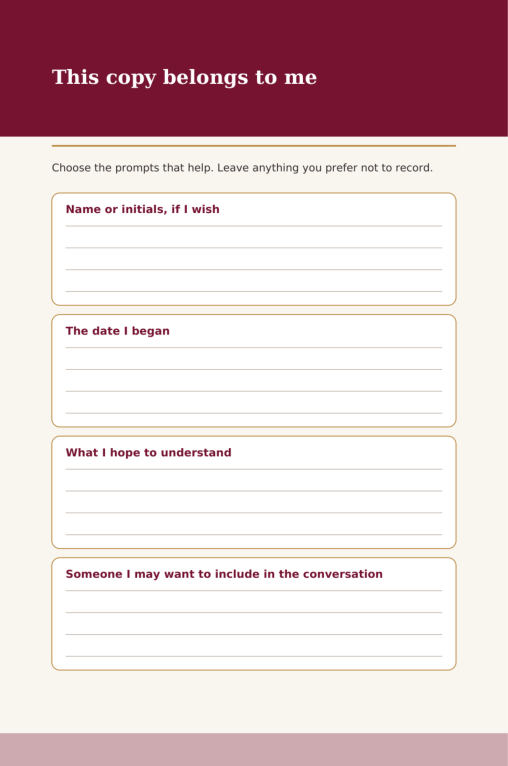
Visual text and description: This copy belongs to me Choose the prompts that help. Leave anything you prefer not to record. Name or initials, if I wish The date I began What I hope to understand Someone I may want to include in the conversation

Accessible text for page 6
Accessible text for page 7
A Note to the Reader You may have opened this book because of one sentence in your mammogram report. It mentioned calcium in the arteries of your breasts, and now you have questions. Does this mean something is wrong with my heart? Do I need another test? Where do I begin?
The finding is called breast arterial calcification, or BAC. Researchers have found a connection between BAC and cardiovascular problems in groups of women. The finding deserves a conversation, but it cannot tell you exactly what will happen to you or which treatment you need.
This book explains the words, introduces the conversations you may have, and makes room for your own concerns. You will find stories, visual explanations, optional reflections and a small workbook. Use the parts that help. You do not need to complete every page or become an expert before asking for care.
Your history, symptoms, priorities and daily circumstances matter. Your clinical team interprets the report and determines which tests and treatments fit your situation. This book provides education, not a diagnosis or personal medical advice.
Start with the question you have today. You can bring an unfinished question to an appointment. Understanding can grow through the conversation.
i
Accessible text for page 8
ii
Visual text and description: What makes this worth my attention Choose the prompts that help. Leave anything you prefer not to record. An activity or relationship I want my health to support What would make this reading useful to me A concern I want to approach with patience
Accessible text for page 9
How to Use This Book Start with Chapters 1 and 2 if the wording in your mammogram report is new to you. Chapter 3 explains a heart risk conversation. Chapter 4 helps you begin that conversation. Chapters 5 through 7 cover familiar measurements, tests, medicines, and your health history.
Chapter 8 offers a flexible way to organize the next few weeks; it is not a medical timetable. Chapter 9 answers common questions. Chapter 10 looks beyond the first report. The report guide and four optional workbook pages are there when you need them.
Read selectively. You do not need to complete every reflection, understand every test, or gather every old record. Keep the questions that help. If you have possible emergency symptoms, seek help immediately rather than continuing to read.
iii
Accessible text for page 10
iv
Visual text and description: My starting point Choose the prompts that help. Leave anything you prefer not to record. What brought me to this book today What I already understand One question I want to keep in view
Accessible text for page 11
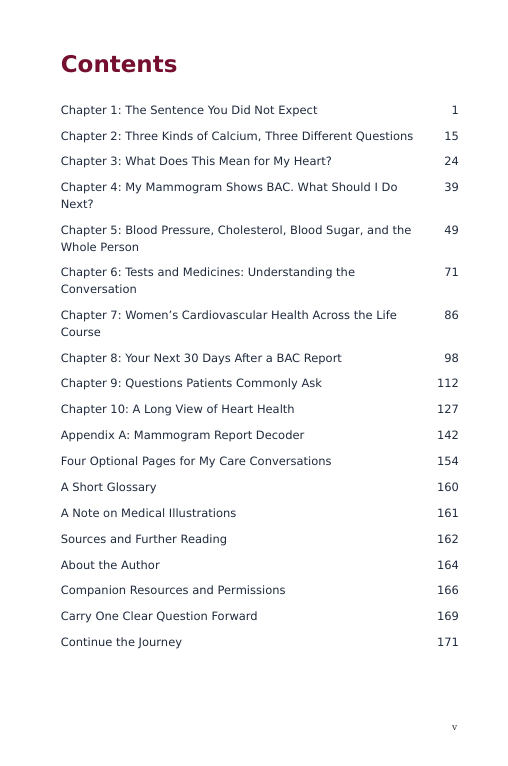
Contents Chapter 1: The Sentence You Did Not Expect 1
Chapter 2: Three Kinds of Calcium, Three Different Questions 15
Chapter 3: What Does This Mean for My Heart? 24
Chapter 4: My Mammogram Shows BAC. What Should I Do 39 Next?
Chapter 5: Blood Pressure, Cholesterol, Blood Sugar, and the 49 Whole Person
Chapter 6: Tests and Medicines: Understanding the 71 Conversation
Chapter 7: Women’s Cardiovascular Health Across the Life 86 Course
Chapter 8: Your Next 30 Days After a BAC Report 98
Chapter 9: Questions Patients Commonly Ask 112
Chapter 10: A Long View of Heart Health 127
Appendix A: Mammogram Report Decoder 142
Four Optional Pages for My Care Conversations 154
A Short Glossary 160
A Note on Medical Illustrations 161
Sources and Further Reading 162
About the Author 164
Companion Resources and Permissions 166
Carry One Clear Question Forward 169
Continue the Journey 171
v

Accessible text for page 12
vi
Visual text and description: A woman reads her mammogram report.
Accessible text for page 13
Chapter 1: The Sentence You Did Not Expect A familiar examination, an unfamiliar finding You went for a mammogram. Perhaps it was part of your routine breast cancer screening. Perhaps you were returning for additional images after an earlier examination. Perhaps you were following up on a symptom or a finding that required attention. Whatever brought you to the imaging center, you probably expected the results to focus on your breasts. You may have anticipated words about breast density, masses, cysts, or calcifications. You may have been watching for reassurance that your examination showed no evidence of breast cancer.
Then you encountered a different phrase:
Breast arterial calcification.
The words may have sounded technical, unfamiliar, or concerning. You might have wondered why your mammogram was describing your arteries. You might have thought of calcium in the arteries surrounding the heart. Or perhaps you wondered whether the finding meant that something was wrong with your circulation. These are reasonable questions. And the answers begin with understanding what the mammogram actually detected.
The blood vessels within your breasts Your breasts contain a network of blood vessels. Like the blood vessels throughout your body, these arteries carry oxygen rich blood to the tissues they supply. Arteries have walls composed of several layers. These layers help the vessels maintain their structure, respond to changes in blood flow, and accommodate the pressure created as the heart pumps blood through the circulation.
1
Accessible text for page 14
Over time, calcium may accumulate within portions of an arterial wall. When this happens in arteries within the breast, the calcium may become visible on a mammogram. Radiologists call this finding breast arterial calcification. On a mammogram, BAC may appear as fine, bright lines that trace the course of an artery. Sometimes the lines appear parallel, outlining portions of the vessel.
The appearance can help radiologists distinguish arterial calcium from other forms of breast calcification. This distinction matters because calcium deposits may occur in different tissues and have different clinical implications.
Three important facts about breast arterial calcification First: BAC is a finding involving blood vessels.
The calcium is present in the walls of arteries within breast tissue.
Second: BAC is generally a benign breast imaging finding.
Its presence, by itself, is not considered evidence of breast cancer. The breast cancer assessment and any recommended breast imaging follow up still deserve separate attention.
Third: BAC may provide information about cardiovascular risk.
Studies have demonstrated associations between BAC and future cardiovascular events, including coronary heart disease and stroke. These facts provide the foundation for understanding the finding. A mammogram can supply information about breast health while also revealing an observation relevant to heart disease prevention.
2
Accessible text for page 15
Why would arteries contain calcium? Calcium is an essential mineral. Your body uses calcium to maintain strong bones, support muscle contraction, transmit nerve signals, and participate in numerous biological processes. Most of the calcium within your body is stored in your bones and teeth. Under certain conditions, calcium can accumulate in soft tissues, including blood vessel walls. In breast arteries, calcification commonly involves the media, a middle layer of the arterial wall that contains smooth muscle.
This process is called medial arterial calcification. Imagine a flexible garden hose. Its walls must bend and accommodate changes in pressure as water moves through it. Now imagine that parts of the wall gradually become less flexible. The hose may remain open, but the characteristics of its wall have changed. This illustration helps explain one aspect of medial arterial calcification: the process can affect the structure and stiffness of an artery.
It also introduces an important distinction. The calcium seen in breast arteries often differs from the calcified plaque that physicians assess in the arteries supplying the heart. These processes may coexist, while their anatomical locations and implications remain distinct.
What the research means for an ordinary reader Researchers have found that women with BAC, as a group, experience more cardiovascular problems than women without it. That makes the finding worth discussing. It does not tell you your personal chance of a heart attack, prove that an artery is blocked, or establish that you need a particular test or medicine. Your clinician puts the finding in the context of your own health. [10, 12]
3
Accessible text for page 16
You do not need to read research papers before asking what your report means. The useful question is: “Does this finding change anything we should discuss about my heart health?”
The difference between a clue and a diagnosis Medical examinations provide different kinds of information. Some establish diagnoses. Some help rule out particular conditions. Others identify characteristics associated with an increased likelihood of disease. BAC belongs primarily in this third category when considering cardiovascular health. It is an imaging finding that can contribute to a conversation about risk. A physician evaluating BAC may consider your age, medical history, family history, blood pressure, cholesterol levels, diabetes status, kidney health, smoking exposure, medications, pregnancy history, and other relevant information.
The goal is to understand what the finding contributes to an already developing picture of cardiovascular health. Some women will benefit from additional evaluation or treatment. Others will benefit most from confirming that their established prevention plan remains appropriate. The next steps should reflect the evidence and individual health circumstances.
When a new word becomes an opportunity For many years, BAC received relatively little attention outside breast imaging. Radiologists recognized its characteristic appearance. Researchers investigated its associations with aging, metabolic disorders, and cardiovascular disease. Over time, the evidence linking BAC with cardiovascular risk grew. A particularly important development occurred in Maryland, where legislation effective October 1, 2026, requires specified mammography centers to include a notice in the screening results letter when arterial calcification is observed on a mammogram.
4
Accessible text for page 17
This change reflects growing recognition that information already present on a medical image may have value beyond the original purpose of the examination. For a woman receiving a new BAC finding, the opportunity is personal. She can ask questions. She can examine her cardiovascular risk factors. She can seek an assessment of her own health. And she can use that information to make thoughtful decisions about her health.
If your mammogram report mentions breast arterial calcification, preserve a copy of the report and identify the clinician responsible for coordinating your heart prevention care. A good opening question is:
“My mammogram reported breast arterial calcification. How does this finding fit into my overall cardiovascular risk, and would any changes to my current care be appropriate?”
The question invites a comprehensive assessment. It gives your clinician an opportunity to consider your history, available test results, and the potential significance of the mammogram finding. That conversation is a meaningful beginning.
5
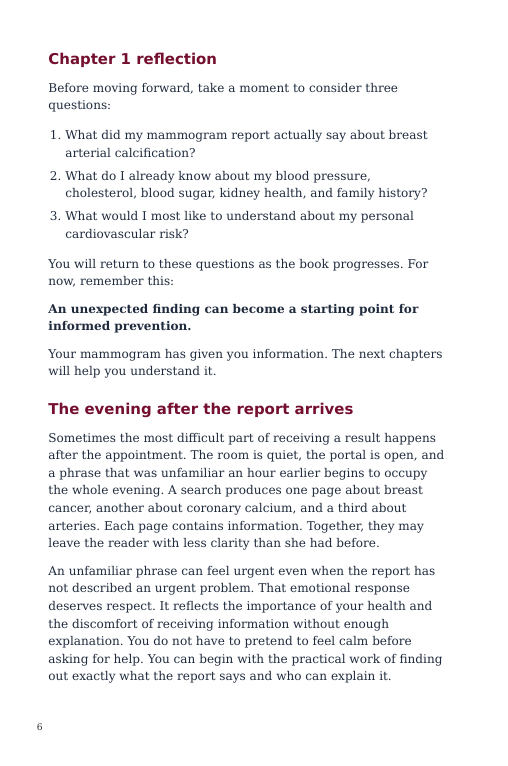
Visual text and description: What I need from this conversation. What I am feeling — What I can ask for; The report sounds frightening — Please explain what the finding does and does not mean.; I have too many questions — Help me identify the question that matters today.; I am unsure what happens next — Please explain the next step in everyday language.; I need time or support — Can we discuss what would help me understand the choice?
Accessible text for page 18
Chapter 1 reflection Before moving forward, take a moment to consider three questions:
1. What did my mammogram report actually say about breast arterial calcification? 2. What do I already know about my blood pressure, cholesterol, blood sugar, kidney health, and family history? 3. What would I most like to understand about my personal cardiovascular risk?
You will return to these questions as the book progresses. For now, remember this:
An unexpected finding can become a starting point for informed prevention.
Your mammogram has given you information. The next chapters will help you understand it.
The evening after the report arrives Sometimes the most difficult part of receiving a result happens after the appointment. The room is quiet, the portal is open, and a phrase that was unfamiliar an hour earlier begins to occupy the whole evening. A search produces one page about breast cancer, another about coronary calcium, and a third about arteries. Each page contains information. Together, they may leave the reader with less clarity than she had before.
An unfamiliar phrase can feel urgent even when the report has not described an urgent problem. That emotional response deserves respect. It reflects the importance of your health and the discomfort of receiving information without enough explanation. You do not have to pretend to feel calm before asking for help. You can begin with the practical work of finding out exactly what the report says and who can explain it.
6
Accessible text for page 19
Read the finding in its own paragraph. Then read the assessment and recommendations. These parts of a report have different jobs. The findings describe observations. The assessment places breast observations in a reporting framework. The recommendations describe the breast imaging action the interpreting team wants next. A cardiovascular observation may need a separate conversation even when the breast recommendation is clear. Keeping those functions distinct makes the document easier to use.
If the report is difficult to access, you can request a copy from the imaging center. A short portal notification may leave out details found in the complete document. A message saying that a result is available also differs from a clinical explanation of that result. The useful question is which document and interpretation you have actually received.
Consider this fictional example. Denise opens a notification saying that her mammogram has a new finding. She remembers the word calcification and assumes that every use of that word concerns the same process. Later, she notices separate sentences about breast tissue and breast arteries. Her task becomes more manageable once she brings the complete report to the imaging team and asks them to identify each observation. The important turning point is the clarification of the record. The example does not predict what another person’s report will show.
Give uncertainty a place to sit Uncertainty can spread when it has no boundaries. A question about one sentence can become a question about every possible future outcome. It may help to separate what is documented from what remains unanswered.
On a sheet of paper, draw two headings: What the report states and What I still want explained. Under the first, copy the relevant wording without improving, simplifying, or interpreting it. Under the second, write the question in your own language.
7
Accessible text for page 20
You may know the examination date, the imaging center, and the name of the clinician who receives the report. You may still want to know whether the finding changes your preventive care. Both kinds of information belong on the page.
The unanswered column can remain incomplete until you speak with the appropriate professional. A blank space is useful when it prevents you from filling a gap with a frightening assumption. You do not need to calculate a risk estimate from an unfamiliar image or decide on a test before the conversation has occurred.
There is also a difference between uncertainty that can be resolved now and uncertainty that may remain even after a careful review. The team may be able to explain the wording, locate an earlier study, or confirm the recommended follow up. It may be unable to predict an individual future event with certainty. A good medical discussion can be useful without eliminating every unknown.
Try asking, “Which part can we clarify from the records we have, and which part remains uncertain?” This invites a specific answer. It can also keep a long conversation from drifting into questions that no available examination can settle.
When people around you offer different advice Friends and relatives may respond to a finding with a story about someone they know. One person may recommend the test that helped her. Another may advise you to ignore a result because she had a similar phrase in a report. Personal experiences can offer companionship, but they rarely contain all the information needed to compare two health situations. You can accept the care behind the advice while keeping the decision with the team reviewing your own history. A useful response is, “I am gathering my records and will ask how this applies to me.” This allows you to appreciate someone’s support while keeping the discussion focused on your own circumstances.
8
Accessible text for page 21
If you would like someone to join your appointment, decide what role would help. A support person can listen, take notes, remind you of an important question, or help you remember the next step. Ask that person to allow you to speak first. Your priorities should remain audible even when others are understandably concerned. A productive clinical discussion can begin with the actual report, your lived experience, and a question that can be explored together. You are building a reliable account of what happened. A clear question gives the conversation a place to begin.
Celia closes the laptop Celia had planned to read the report quickly before bed. She was still wearing the cardigan she had pulled on after dinner, and the kitchen was quiet except for the dishwasher. The first lines sounded familiar. Then she reached the words about arterial calcification. She read them again. By the third reading, the report had become a different document in her mind: something that might explain every tired afternoon and every relative who had died too young.
The stories in this book are fictional. They illustrate experiences and conversations, not recommended tests, treatment plans, or promised outcomes.
Celia opened a search window. One page led to another. A sentence about heart risk became, in her imagination, a prediction about tomorrow. She kept looking for the page that would make the fear disappear. Instead, each unfamiliar term supplied another question. When her partner came into the kitchen, she said, “I think they found something terrible,” although the report had not said that.
He asked what the report actually recommended. Celia realized that she had stopped reading before reaching the end. They returned to it together. They did not try to interpret the images or decide which heart test she should have. They looked for the breast imaging instructions and the words she wanted
9
Accessible text for page 22
explained. She still felt unsettled, but the task had become smaller: find out what the observation meant for her, rather than solve her entire future that evening.
An unexpected health word can gather older worries around it. You may think of a parent, an illness you have already survived, or a time when an important concern was missed. Those memories deserve respect. They also deserve to be distinguished from the information in front of you. A report can raise a real question without confirming the frightening story your mind has begun to tell.
Celia did one practical thing before closing the laptop. She sent a routine message through her care team’s recommended system asking how to discuss the finding. Then she put the report away. This did not mean she had decided that everything was harmless. It meant that she had reached the limit of what another hour of searching could reasonably tell her.
You may find it useful to decide in advance what would make a search session complete. Perhaps you want a definition of one term or the contact details for the imaging center. A search without a purpose can become an attempt to obtain certainty that no website can give. Stopping can be a thoughtful choice when you have a clear route to a professional explanation.
The next morning, Celia noticed that she was still anxious. She had expected the message itself to make her feel better. Instead, it had simply opened the conversation she needed. She told her partner, “I have asked for help. I don’t have the answer yet.” That was a more accurate sentence than the one she had used the night before.
There is room between dismissing a finding and treating it as a disaster. In that space, you can continue ordinary activities, ask for an explanation, and notice what support you need. If your worry is interfering with sleep, work, or daily life, you can mention that too. The emotional effect of receiving a report belongs in a conversation about your care.
10

Accessible text for page 23
Celia’s evening did not end with a diagnosis or a triumphant discovery. It ended with the laptop closed and a question ready for the right person. Sometimes that is what a useful beginning looks like.
11

Accessible text for page 24
12
Visual text and description: A mammogram and heart model in a quiet sunlit study.
Accessible text for page 25
13
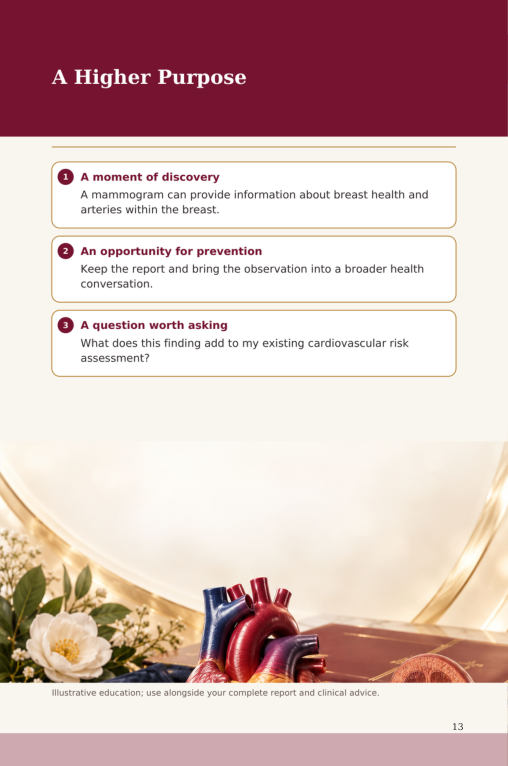
Visual text and description: A Higher Purpose A moment of discovery — A mammogram can provide information about breast health and arteries within the breast. An opportunity for prevention — Keep the report and bring the observation into a broader health conversation. A question worth asking — What does this finding add to my existing cardiovascular risk assessment?
Accessible text for page 26
14
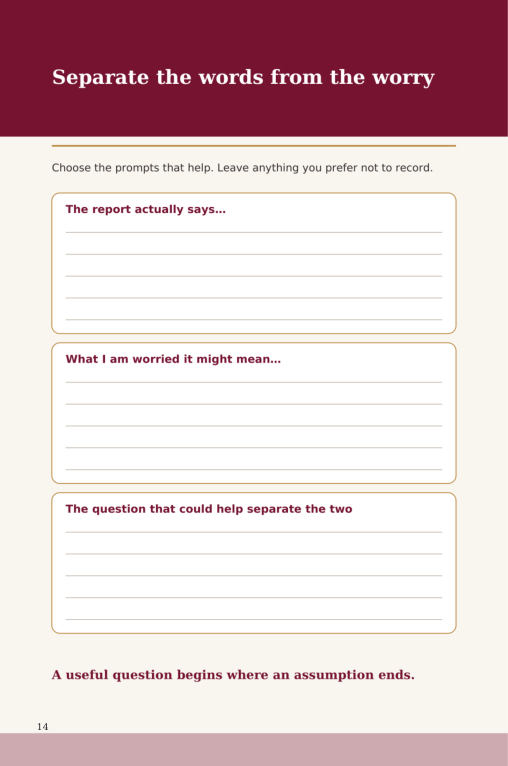
Visual text and description: Separate the words from the worry Choose the prompts that help. Leave anything you prefer not to record. The report actually says… What I am worried it might mean… The question that could help separate the two
Accessible text for page 27
Chapter 2: Three Kinds of Calcium, Three Different Questions The same word, calcium, can describe findings in different tissues. Their locations guide three distinct questions about your care and the conversations that follow.
The word calcium can mean different things When women hear that calcium has appeared on a medical image, the natural response is often to wonder what the finding means for their health. Calcium is involved in many normal biological functions. It is also visible on certain medical imaging examinations when it accumulates in particular tissues. On a mammogram, a radiologist may see calcium deposits in breast tissue or in the walls of arteries.
On a cardiac CT scan, physicians may identify calcium associated with plaque in the coronary arteries. These findings share a word, but each has its own interpretation. Understanding the differences will help you read your medical reports more confidently.
1. Breast tissue calcifications Breast tissue calcifications are small deposits of calcium within the breast. They are common, particularly as women grow older. Many are associated with benign changes. Some appear after inflammation, injury, surgery, or other changes within breast tissue. Others occur in patterns that require additional imaging or occasionally a biopsy. Radiologists evaluate calcifications according to their size, shape, distribution, and appearance.
15
Accessible text for page 28
Certain patterns suggest a benign process. Other patterns may raise concern about a possible breast abnormality, including ductal carcinoma in situ. Your radiologist communicates the breast imaging assessment using a standardized reporting system known as BI-RADS, or the Breast Imaging Reporting and Data System. The BI-RADS assessment helps guide whether routine screening, additional imaging, short interval follow up, or tissue sampling is appropriate.
The most important point for the reader is that any recommended breast evaluation deserves attention based on the complete report.
2. Breast arterial calcification Breast arterial calcification occurs within the walls of blood vessels located in the breast. Its characteristic appearance often allows radiologists to identify it as vascular calcium. BAC is typically considered benign from a breast cancer imaging perspective. Its potential significance lies in the information it may contribute to cardiovascular risk assessment.
BAC often has an imaging pattern associated with calcification in the middle layer of the arterial wall. Coronary calcium, in contrast, is generally measured as calcium within coronary plaque. Medical imaging provides a pattern rather than a microscopic tissue specimen, and vascular biology can be complex. The practical conclusion is that BAC and CAC are related cardiovascular observations, not the same deposit in the same artery and not interchangeable measurements.
This leads to an unusual but valuable opportunity: a finding discovered during breast imaging may prompt a discussion about the heart and blood vessels throughout the body. The presence of BAC alone cannot establish whether someone has coronary artery disease, how extensive coronary plaque may be, or whether a heart attack will occur. It can, however, provide another reason to review cardiovascular health.
16
Accessible text for page 29
3. Coronary artery calcium Coronary artery calcium, or CAC, is calcium within plaque in the arteries supplying the heart. A specialized CT scan can measure it. This is a different location and a different test from BAC on a mammogram.
A coronary calcium scan can help with some heart prevention decisions, but it is not needed for every person with BAC. Your clinician considers the reason for the scan and your symptoms and history. A score of zero does not settle every possible question about heart health. [4]
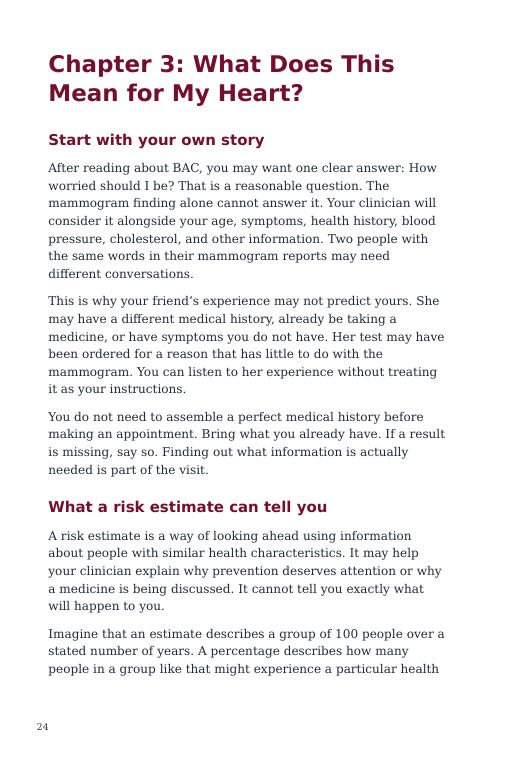
A practical comparison • Breast tissue calcifications are seen within breast tissue on mammography. The principal question is whether the breast finding requires further evaluation. • Breast arterial calcification, or BAC, is seen in the walls of arteries within the breast. The cardiovascular question is whether the finding should contribute to risk assessment. • Coronary artery calcium, or CAC, is seen in the coronary arteries on CT. The principal question is what the burden of calcified coronary plaque suggests about cardiovascular risk.
Why this distinction changes the conversation Suppose a mammogram identifies BAC and the breast assessment is otherwise benign. A woman may appropriately continue her routine breast screening plan while discussing heart disease prevention with her clinician. Another woman may have suspicious breast tissue calcifications requiring further diagnostic imaging. Her breast evaluation should proceed according to the radiologist recommendations. A third woman may have an elevated coronary calcium score on a cardiac CT scan. Her physician may use that result to guide lipid management and other preventive decisions.
17
Accessible text for page 30
Each finding deserves interpretation according to its location, significance, and the health question under consideration.
What if your mammogram mentions both BAC and other calcifications? Ask your breast imaging clinician to explain which findings involve breast tissue and which involve arteries. You can request clarification of the exact wording of the report, including the BI- RADS assessment and recommended breast follow up. Your primary care or cardiovascular clinician can then address any possible relevance to heart health of the arterial finding. A useful question is:
“Can you help me separate the breast imaging recommendations from the cardiovascular questions raised by this report?”
The answer should help you identify the next action for each finding.
Chapter 2 reflection A medical report can contain several observations, each with a different purpose. Understanding the language allows you to participate more confidently in decisions about your care. Before proceeding, identify the precise language used in your mammogram report. Preserve the BI-RADS assessment and any imaging recommendations. Record any mention of breast arterial calcification separately.
One medical examination can reveal several kinds of information. Each deserves its proper place in the larger picture of your health.
18
Accessible text for page 31
Why a finding may be described differently over time Two reports may use different language even when the reader thinks they are discussing the same thing. Institutions may have different reporting practices, and the purpose or technical details of the examinations may differ. An earlier report may not mention an observation described in a later one. The absence of a sentence alone does not establish when a biological process began.
Ask whether the imaging team can compare the actual prior studies and explain the difference. This is more reliable than comparing isolated phrases yourself. Keep the dates and facility names with the reports so that the correct examinations can be retrieved. If images have not yet been transferred, record that limitation in your question.
The same discipline helps when a report uses an adjective such as mild or extensive. Ask what the term describes, how it was determined, and whether the reporting method is comparable with the earlier examination. A word that sounds quantitative may not be equivalent to a standardized score. The clinician can explain what the wording can reasonably contribute to the decision at hand.
A family conversation without a frightening headline June’s daughter called during her lunch break. June had sent a message that said, “Calcium showed up on my mammogram. They say it can have something to do with the heart.” Her daughter immediately began asking about blocked arteries. June could hear the concern in her voice and felt herself becoming more alarmed as she tried to explain a finding she did not yet understand.
19
Accessible text for page 32
They were using the same word, calcium, for several different ideas. June had read a mammogram report. Her daughter was imagining a coronary scan. Neither was being careless. They were trying to make unfamiliar information fit a familiar story about heart disease.
June said, “Let me start again. The report mentions calcium in the arteries in my breasts. I need someone to explain what it means alongside the rest of my health.” This did not settle the clinical question. It did make their conversation more accurate. Her daughter stopped searching for a heart procedure and asked whether June wanted company at an appointment.
Sharing health information can be harder when the listener loves you. A worried relative may ask for more detail than you have, recommend the test a friend received, or begin telling other family members before you have decided what to share. Concern can arrive in the form of instructions. You are allowed to slow the exchange down.
You might say, “I want you to know what is happening, but I am still waiting for an explanation.” You can also name the kind of support you would appreciate. Perhaps you want someone to listen, help with transport, or stay with a child during a visit. Support does not have to mean that another person takes charge of the medical decisions.
June asked her daughter to help her remember questions rather than research every possible heart condition. Her daughter wrote down one question about the mammogram wording and one about what information to bring. They agreed that June would decide what she wanted to share after the visit. The conversation became a collaboration instead of a family emergency meeting.
You do not owe everyone the same level of detail. A colleague may only need to know that you have an appointment. A close friend may be someone with whom you can discuss the worry. A
20
Accessible text for page 33
support person attending a visit may need more information, with your permission. Choosing these boundaries can protect your energy while you are still learning.
If you use a group message, consider how much personal information it contains. A photograph of a report can include your birth date, account number, address, or other details beyond the sentence you intended to share. You can discuss a general question without distributing the whole document. Your care team can explain its process when you want someone formally included in clinical communication.
Later, June told her daughter that the most helpful part of the call had been the offer of company. She had not needed a second person trying to become an imaging specialist. She had needed to feel that she could ask a question without carrying everyone else’s fear as well as her own.
A clear family explanation can remain modest: this is what the report says, this is what I still need explained, and this is the help I would welcome. You can revise that explanation when you learn more. You do not have to make the first conversation sound like a final conclusion.
21
Accessible text for page 34
22
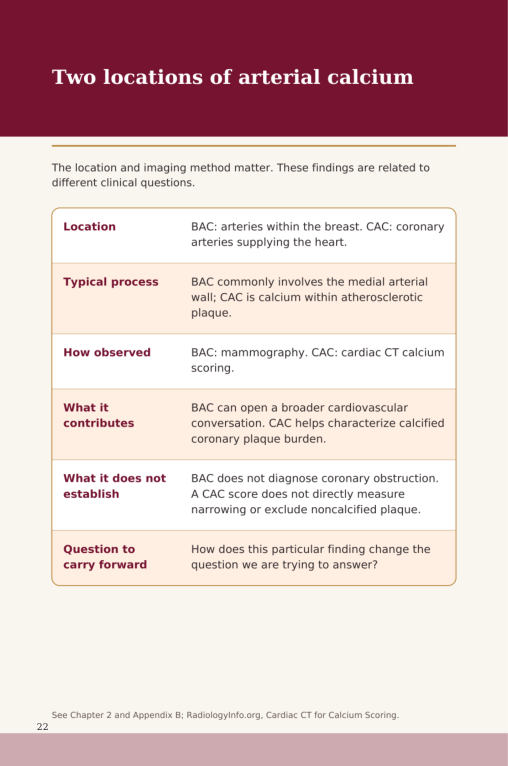
Visual text and description: Two locations of arterial calcium The location and imaging method matter. These findings are related to different clinical questions. Location — BAC: arteries within the breast. CAC: coronary arteries supplying the heart. Typical process — BAC commonly involves the medial arterial wall; CAC is calcium within atherosclerotic plaque. How observed — BAC: mammography. CAC: cardiac CT calcium scoring. What it contributes — BAC can open a broader cardiovascular conversation. CAC helps characterize calcified coronary plaque burden. What it does not establish — BAC does not diagnose coronary obstruction. A CAC score does not directly measure narrowing or exclude noncalcified plaque. Question to carry forward — How does this particular finding change the question we are trying to answer?
Accessible text for page 35
23
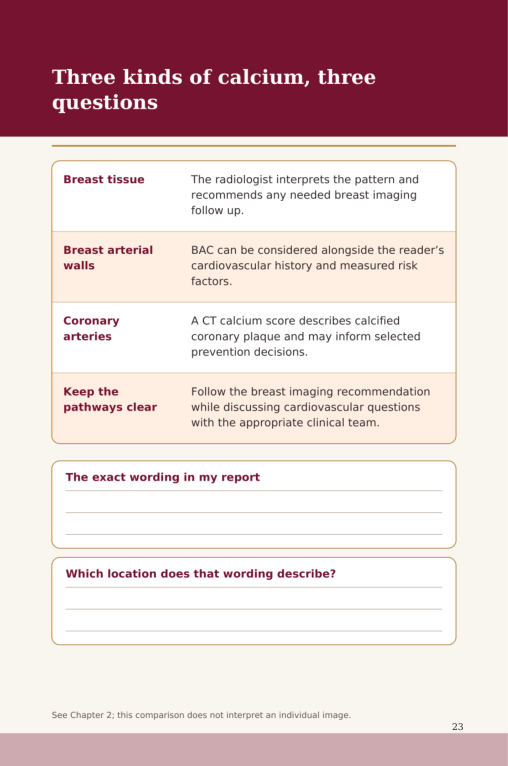
Visual text and description: Three kinds of calcium, three questions Breast tissue — The radiologist interprets the pattern and recommends any needed breast imaging follow up. Breast arterial walls — BAC can be considered alongside the reader’s cardiovascular history and measured risk factors. Coronary arteries — A CT calcium score describes calcified coronary plaque and may inform selected prevention decisions. Keep the pathways clear — Follow the breast imaging recommendation while discussing cardiovascular questions with the appropriate clinical team. The exact wording in my report Which location does that wording describe?
Accessible text for page 36
Chapter 3: What Does This Mean for My Heart? Start with your own story After reading about BAC, you may want one clear answer: How worried should I be? That is a reasonable question. The mammogram finding alone cannot answer it. Your clinician will consider it alongside your age, symptoms, health history, blood pressure, cholesterol, and other information. Two people with the same words in their mammogram reports may need different conversations.
This is why your friend’s experience may not predict yours. She may have a different medical history, already be taking a medicine, or have symptoms you do not have. Her test may have been ordered for a reason that has little to do with the mammogram. You can listen to her experience without treating it as your instructions.
You do not need to assemble a perfect medical history before making an appointment. Bring what you already have. If a result is missing, say so. Finding out what information is actually needed is part of the visit.
What a risk estimate can tell you A risk estimate is a way of looking ahead using information about people with similar health characteristics. It may help your clinician explain why prevention deserves attention or why a medicine is being discussed. It cannot tell you exactly what will happen to you.
Imagine that an estimate describes a group of 100 people over a stated number of years. A percentage describes how many people in a group like that might experience a particular health
24

Accessible text for page 37
problem. The time period matters. So does the problem being counted. A number about the next ten years is different from a number about the rest of your life.
You are allowed to ask for a slower explanation. Try: “Could you describe that as a number out of 100, and tell me over how many years?” Then ask what the number helps you decide. You do not need to remember every percentage to understand the purpose of the discussion.
25

Accessible text for page 38
26
Visual text and description: A quiet setting for considering evidence and questions.
Accessible text for page 39
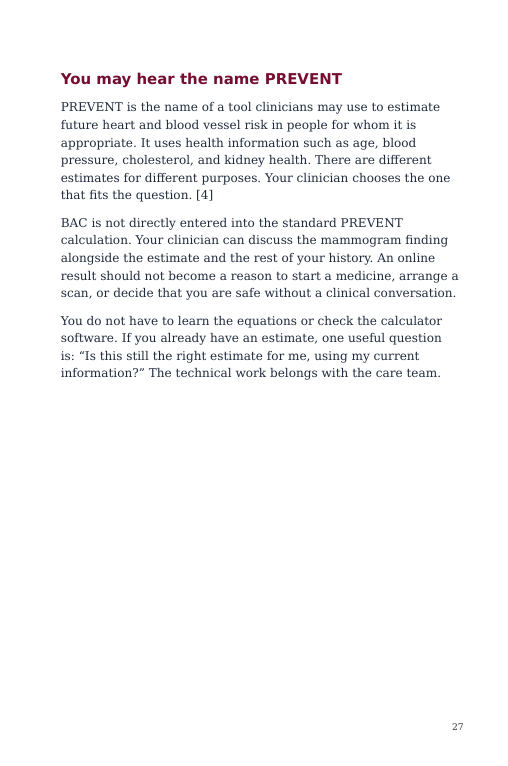
You may hear the name PREVENT PREVENT is the name of a tool clinicians may use to estimate future heart and blood vessel risk in people for whom it is appropriate. It uses health information such as age, blood pressure, cholesterol, and kidney health. There are different estimates for different purposes. Your clinician chooses the one that fits the question. [4]
BAC is not directly entered into the standard PREVENT calculation. Your clinician can discuss the mammogram finding alongside the estimate and the rest of your history. An online result should not become a reason to start a medicine, arrange a scan, or decide that you are safe without a clinical conversation.
You do not have to learn the equations or check the calculator software. If you already have an estimate, one useful question is: “Is this still the right estimate for me, using my current information?” The technical work belongs with the care team.
27

Accessible text for page 40
28
Visual text and description: A woman considers her questions in a sunlit room.
Accessible text for page 41
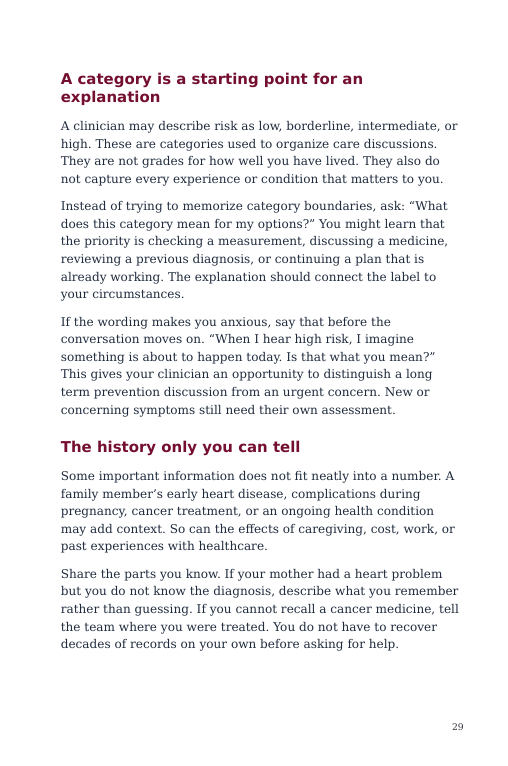
A category is a starting point for an explanation A clinician may describe risk as low, borderline, intermediate, or high. These are categories used to organize care discussions. They are not grades for how well you have lived. They also do not capture every experience or condition that matters to you.
Instead of trying to memorize category boundaries, ask: “What does this category mean for my options?” You might learn that the priority is checking a measurement, discussing a medicine, reviewing a previous diagnosis, or continuing a plan that is already working. The explanation should connect the label to your circumstances.
If the wording makes you anxious, say that before the conversation moves on. “When I hear high risk, I imagine something is about to happen today. Is that what you mean?” This gives your clinician an opportunity to distinguish a long term prevention discussion from an urgent concern. New or concerning symptoms still need their own assessment.
The history only you can tell Some important information does not fit neatly into a number. A family member’s early heart disease, complications during pregnancy, cancer treatment, or an ongoing health condition may add context. So can the effects of caregiving, cost, work, or past experiences with healthcare.
Share the parts you know. If your mother had a heart problem but you do not know the diagnosis, describe what you remember rather than guessing. If you cannot recall a cancer medicine, tell the team where you were treated. You do not have to recover decades of records on your own before asking for help.
29
Accessible text for page 42
Your daily life also belongs in the conversation. A plan that looks straightforward on paper may be hard to carry out if you work nights, care for a relative, have limited transportation, or cannot afford the proposed treatment. Explaining that difficulty helps the team understand what support or alternatives to discuss.
Two people, two conversations The following examples are fictional. They illustrate communication, not recommended testing or treatment.
Elena sees BAC mentioned in her report. She feels well and has recent blood pressure and cholesterol results. Her main question is whether the finding changes anything she is already doing. At her visit, she and her clinician review the information together. Elena leaves understanding the reason for the plan, rather than leaving with a list of tests she assumed everyone needed.
Margaret sees the same wording but has been struggling to take a prescribed medicine because of its cost. She has avoided mentioning the problem because she feels embarrassed. The mammogram conversation becomes an opportunity to explain what has been happening. The useful next step is shaped by her actual circumstances, including the treatment she has not been able to obtain.
Neither woman needs to copy the other’s plan. A useful conversation begins with the person in the room.
When you already have heart disease If you already have a heart or blood vessel condition, the team will consider that established history. The mammogram finding does not replace it. You can ask whether the new information changes your current plan or simply belongs in your record.
30

Accessible text for page 43
You do not need to decide which guideline applies to you. Tell the clinician about the diagnosis, procedures, medicines, and symptoms you know about. If several teams are involved, ask which office you should contact about this particular question.
31
Accessible text for page 44
32
Visual text and description: The context I want to bring Choose the prompts that help. Leave anything you prefer not to record. A past experience I have not mentioned A measurement or result that is missing The concern that matters most to me
Accessible text for page 45
33
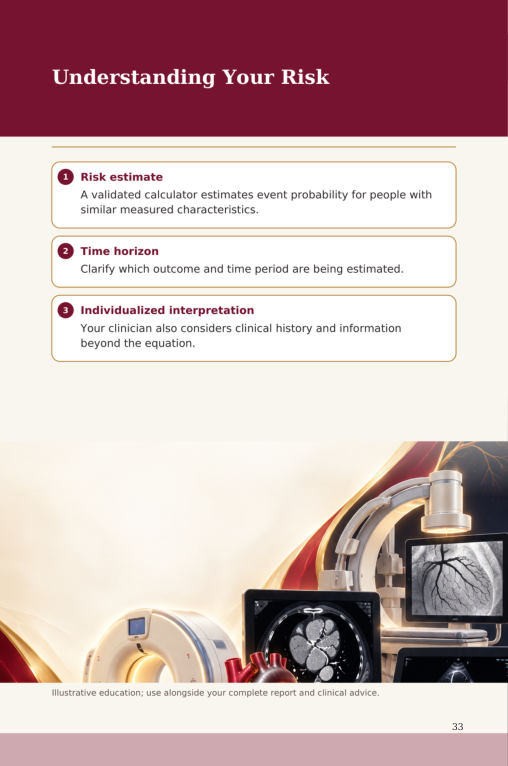
Visual text and description: Understanding Your Risk Risk estimate — A validated calculator estimates event probability for people with similar measured characteristics. Time horizon — Clarify which outcome and time period are being estimated. Individualized interpretation — Your clinician also considers clinical history and information beyond the equation.
Accessible text for page 46
Make room for what matters to you A good explanation includes more than a proposed benefit. It also makes room for your concerns. You may be worried about side effects, taking another medicine, the cost of a scan, or missing work for an appointment. You may want to know whether there is time to think before deciding.
You can say: “I understand why you are suggesting this. The part I am struggling with is…” That sentence keeps the conversation open while making the practical problem visible. Understanding an option does not require pretending it is easy.
You can also ask what happens if you choose to wait or decline an option. Your clinician can explain what that would mean in your situation. The book cannot make that decision for you.
34

Accessible text for page 47
35
Visual text and description: Two fictional women discuss care with their hands above the desk.
Accessible text for page 48
Leave with one clear understanding You may not remember every term from a risk discussion. Aim to understand the reason for the next step. Can you explain, in your own words, what your clinician thinks deserves attention and why?
If not, try: “Before we finish, could you tell me the most important thing to understand about my heart health today?” There is space in the workbook for that answer. Use it if it helps; a short note in your phone or a printed visit summary may work just as well.
Reflection: the concern behind the question When I ask about my risk, what am I most hoping to understand? Am I looking for reassurance, an explanation, practical help, or time to discuss a choice? There is no required answer. Naming the concern may help me express it at the visit.
When a number feels like a verdict Tanya liked numbers when they belonged to her household budget. They helped her see what was available and what needed attention. Health percentages felt different. When a clinician mentioned an estimate of future risk, she heard a warning about the kind of person she had become. She wondered whether she was being judged for the years when she had worked two jobs and eaten whatever was available between shifts.
The clinician was discussing a prediction tool. Tanya was hearing a moral assessment. Until she explained that difference, they were having two conversations at once.
A risk estimate can carry emotional meanings that the person giving it does not intend. A high number may sound like blame or inevitability. A low number may sound like permission to
36
Accessible text for page 49
ignore every concern. Neither reaction tells the whole story. The purpose of an estimate is to help discuss care in context, not to summarize a person’s character.
Tanya eventually said, “When you say that number, I feel as though I have already failed.” The clinician paused and explained what information the estimate used, what time period it concerned, and why they were discussing it. Tanya did not need a lesson in the equations. She needed to understand how the number related to an actual choice.
You can ask which part of an explanation matters for the decision in front of you. Is the team considering a medicine, reviewing a previous plan, or deciding whether more information would be useful? A percentage without that connection may leave you with more worry than understanding.
It can also help to say what you think you heard. “I am hearing that this could happen soon. Is that what the estimate means?” gives the clinician a chance to correct a misunderstanding. “Does this mean the same thing for someone who already has heart disease?” makes another important uncertainty visible. You are not expected to choose the correct framework before asking.
Tanya had a practical concern too. She was already paying for prescriptions and did not know whether she could afford another one. She had planned to keep that concern to herself until she understood the numbers better. During the visit, she realized that cost was part of the decision now, not something she had to solve afterward in private.
Some people prefer to see numbers written down. Others understand an explanation better through a comparison or a short description. You can ask for the form that helps you. If an estimate is uncertain or a particular benefit cannot be calculated reliably for you, it is reasonable to hear that limitation plainly rather than receive a number that sounds more precise than the evidence allows.
37
Accessible text for page 50
The goal is not to leave with every statistic memorized. It is to understand enough to participate: what concern is being addressed, what options are available, what the team recommends, and what matters to you about those options. A printed visit summary or a short note may be enough to preserve that understanding.
Afterward, Tanya described the conversation differently to her sister. “We talked about what might help me over time,” she said. She had not received a guarantee, and the practical issues were not all settled. But she no longer felt that one percentage had erased the circumstances of her life.
Your health story contains choices, opportunities, constraints, treatments, relationships, and experiences. A calculation can contribute information. It should leave room for that story, including the parts that no calculator asks you to enter.
38
Accessible text for page 51
Chapter 4: My Mammogram Shows BAC. What Should I Do Next? The question that matters most You have received your mammogram results. You understand that the radiologist observed calcium within arteries in your breast. You have learned that this observation may be associated with cardiovascular risk, and you may already be thinking about blood tests, heart scans, cholesterol medications, or visits with a specialist. Where should you begin? Begin by understanding your report, gathering the information that is already available, and identifying the questions about your care that deserve attention.
Your next steps should be individualized, practical, and proportionate to your circumstances.
Begin with the complete report Begin with the actual wording. Perhaps your report contains a sentence such as:
“Benign vascular calcifications are present.”
Or perhaps it specifically mentions breast arterial calcification. Read the entire report to understand the breast imaging assessment as well. Your radiologist may have assigned a BI- RADS category, and the report may include recommendations for additional imaging, routine screening, or other follow up. Keep a copy of the full report, including the date and the name of the imaging facility.
If a previous mammogram is available, it may provide useful context for your radiologist. Remember that BAC reporting practices can differ among institutions. A report that does not
39
Accessible text for page 52
mention BAC may simply reflect a facility reporting approach or the way the images were assessed. If clarification is important, your imaging facility can explain whether BAC was evaluated or reported.
Mention symptoms and how you feel Before focusing exclusively on long term risk, pay attention to any symptoms that may require clinical evaluation. You may feel entirely well. Many women discover BAC during routine screening and have no cardiovascular symptoms. Other women may already be experiencing chest discomfort, unusual breathlessness, reduced exercise tolerance, palpitations, or other symptoms. These symptoms deserve assessment according to their characteristics and severity.
New or persistent chest pressure, severe shortness of breath, sudden weakness, facial drooping, difficulty speaking, or other symptoms of a possible heart attack or stroke warrant emergency medical attention. For a woman who feels well, the BAC finding may provide an opportunity to arrange a preventive cardiovascular review. The urgency of evaluation should always reflect the full health situation.
Bring what you already have Your medical records may contain much of the information needed for an initial cardiovascular assessment. You may already have recent cholesterol tests, blood pressure readings, diabetes screening results, and kidney function measurements. Reviewing these results together can help your clinician identify the next useful clinical decision. Bring your medication list, including prescribed medications and any over the counter products that may affect health or treatment decisions.
Include information about allergies, previous medication reactions, and treatments that have been difficult to tolerate. Also consider whether you have ever received cancer treatment,
40
Accessible text for page 53
experienced a pregnancy complication, or developed symptoms suggesting cardiovascular disease. A complete record can make a prevention conversation far more useful.
Chapter 4 reflection An unexpected medical finding can bring a sudden sense of urgency. Knowledge can turn that urgency into purposeful action. You now have a framework for approaching BAC thoughtfully: understand the report, recognize any symptoms, review your existing measurements, discuss your individualized risk, and develop a practical prevention plan.
The value of your mammogram finding lies partly in the opportunity it creates to give your cardiovascular health the attention it deserves.
When the first appointment is with someone new An unfamiliar clinician may not have access to the imaging center’s records. Bring the complete report if you can and ask whether the images themselves are needed. Explain where earlier cardiovascular testing was performed. A result mentioned in a summary may require its original report for interpretation.
You may also need to explain why you made the appointment. A scheduling label such as follow up can hide the actual purpose of the visit. A clear opening sentence helps: “I am here because my mammogram mentioned BAC, and I would like a review of how that observation fits my preventive care.” If symptoms or another active problem also need attention, say so at the beginning so that the team can determine priorities.
If the visit cannot cover every question, ask which issue will be addressed today and how the others will be handled. A separate appointment, record review, or message may be appropriate.
41
Accessible text for page 54
Leaving with an explicit route for the remaining questions is more useful than assuming that silence means they have been resolved.
When the plan is difficult to carry out A plan can be medically reasonable and still encounter a practical obstacle. Insurance authorization may be incomplete. An appointment may be distant. A prescription may cost more than expected. A request for records may reach the wrong office. These difficulties should be reported specifically rather than summarized as an inability to follow the plan. Describe the obstacle and the action already attempted. For example: “The pharmacy quoted a cost I cannot manage. I have not started the prescription. What option should we discuss?” Or: “The imaging center needs an order that explains why the test is being requested. Which team can provide it?” The actual team can then determine the appropriate response.
Do not change a prescribed treatment solely because an administrative process is frustrating. Ask for clinical guidance and keep a record of the reply. If a potentially urgent symptom develops, use the appropriate urgent or emergency route rather than waiting for a routine authorization or portal response.
Ask for an explanation that fits your situation Once you have the report and a way to contact your care team, you have enough to begin. You do not have to check every risk factor, arrange a scan, or complete a workbook first. Tell the office what the report says and ask how to discuss it. If cost, language, transport, disability, or caring responsibilities make that difficult, say what support would help.
The next chapters explain familiar measurements and common conversations about tests and medicines. Read the parts that answer your questions. You can return to the rest later.
42
Accessible text for page 55
An appointment in which you can be heard Monique had learned to prepare carefully for medical visits. Years earlier, she had left an appointment feeling that her concern had been brushed aside. This time, she rehearsed a long explanation in the car. She worried that if she forgot a detail, the question about her mammogram would not be taken seriously.
By the time she reached the examination room, she was tired from trying to say everything correctly. The first question she asked was not the one she most wanted answered. She began apologizing for being confused.
You do not have to deliver a polished presentation to deserve an explanation. A useful opening can be as simple as, “My mammogram report mentions BAC, and I would like to understand what it means for me.” If there is another concern you want the clinician to hear, you can add it in ordinary language. The professional’s task includes asking the questions needed to understand it.
Monique’s turning point came when she said, “I am worried I won’t explain this well.” The clinician asked what she was most afraid would be missed. That allowed her to name both the current question and the earlier experience that made the visit difficult. The conversation became more direct once she stopped trying to prove that she had prepared enough.
A support person may help, if you want one and the setting permits it. You can decide in advance whether that person will listen, take notes, or remind you of a question. You can also ask them to let you speak first. Support should make your voice easier to hear rather than replace it with someone else’s account.
If you need an interpreter, an accessible format, hearing support, or another accommodation, tell the service what would help. A relative’s willingness to interpret does not always meet your need for an accurate, private clinical conversation. Ask the
43
Accessible text for page 56
office about the assistance it provides. You may also want time alone with the clinician for a concern you prefer not to discuss in front of a companion.
It is possible to understand individual words and still lose the thread of an explanation. You can interrupt respectfully: “Could we pause there?” or “I understand the first part. I need the next part explained more simply.” These requests do not indicate that you are a difficult patient. They tell the clinician where the explanation needs to change.
If the appointment is running out of time, ask which question can be answered now and how to continue the others. You do not have to rush every concern into the final minute. A planned follow up conversation can be more useful than leaving with several hurried instructions that do not make sense together.
There may also be times when an explanation remains unsatisfactory. You can ask for clarification, contact the appropriate office afterward, or discuss another opinion through suitable care channels. The important thing is to identify the unresolved concern rather than conclude that you must either accept confusion or manage everything yourself.
Monique left with fewer notes than she had brought. The clinician’s summary was clearer than her pages of preparation, so she kept that summary and one question to revisit. For her, being heard did not mean completing an impressive amount of paperwork. It meant that the team understood the issue she had come to discuss.
You can bring knowledge to an appointment. You can also bring uncertainty, a difficult past experience, or a request for help. All of those belong in a conversation about your care.
44
Accessible text for page 57
45
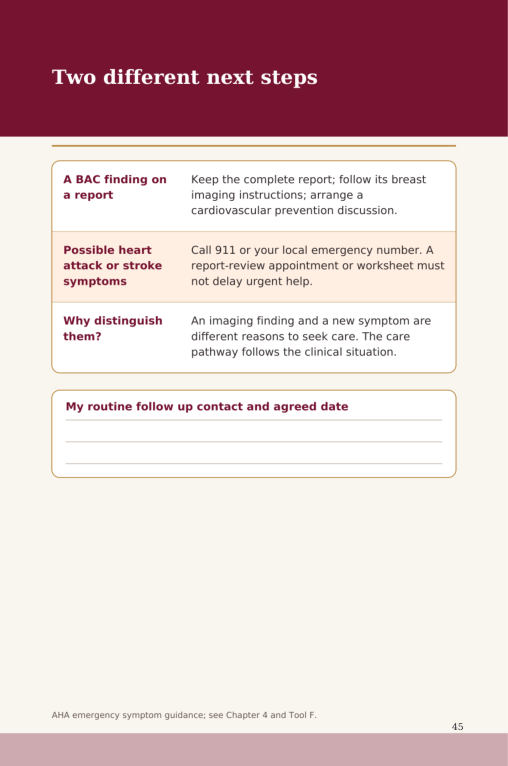
Visual text and description: Two different next steps A BAC finding on a report — Keep the complete report; follow its breast imaging instructions; arrange a cardiovascular prevention discussion. Possible heart attack or stroke symptoms — Call 911 or your local emergency number. A report-review appointment or worksheet must not delay urgent help. Why distinguish them? — An imaging finding and a new symptom are different reasons to seek care. The care pathway follows the clinical situation. My routine follow up contact and agreed date
Accessible text for page 58
46
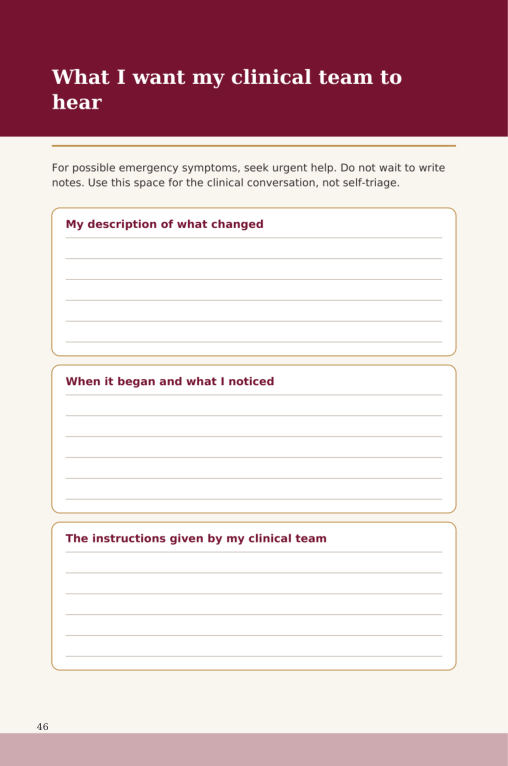
Visual text and description: What I want my clinical team to hear For possible emergency symptoms, seek urgent help. Do not wait to write notes. Use this space for the clinical conversation, not self-triage. My description of what changed When it began and what I noticed The instructions given by my clinical team
Accessible text for page 59
47
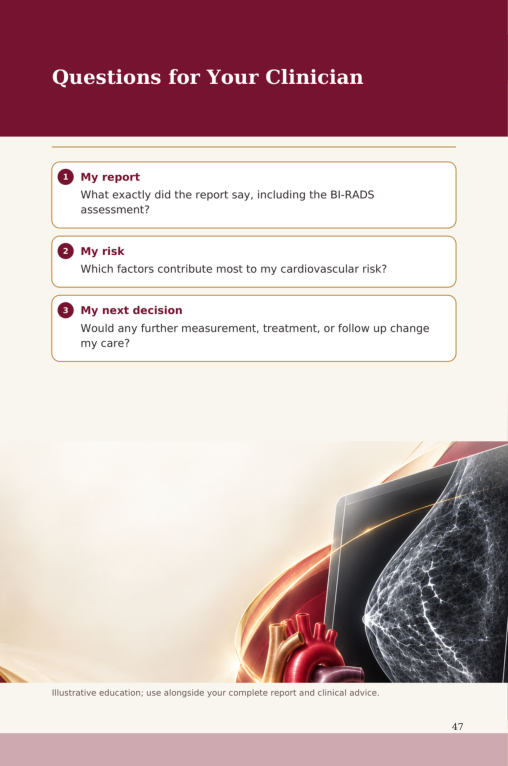
Visual text and description: Questions for Your Clinician My report — What exactly did the report say, including the BI-RADS assessment? My risk — Which factors contribute most to my cardiovascular risk? My next decision — Would any further measurement, treatment, or follow up change my care?

Accessible text for page 60
48
Visual text and description: A fictional woman reads a report in daylight.
Accessible text for page 61
Chapter 5: Blood Pressure, Cholesterol, Blood Sugar, and the Whole Person The prevention questions that matter today A mammogram may draw your attention to cardiovascular health for the first time. The next useful step is to learn what your existing medical information already tells you. Some of the most powerful prevention opportunities involve familiar measurements: blood pressure, cholesterol, blood sugar, kidney function, and smoking exposure. These measurements gain meaning when they are considered with your age, symptoms, family history, medical conditions, medications, and priorities.
You may already be taking steps that protect your heart. You may also have areas where a focused plan could make a meaningful difference. The goal is to learn which changes are relevant to your circumstances and which ones can be sustained.
Blood pressure: A measurement that deserves context Blood pressure has two numbers. The systolic pressure reflects the pressure during a heartbeat; the diastolic pressure reflects pressure between beats. A single elevated measurement can be influenced by pain, anxiety, recent activity, caffeine, or technique. When your clinician is evaluating possible hypertension, repeated measurements and sometimes home readings provide a more useful picture.
Ask whether your measurement method is reliable. A properly sized arm cuff, supported feet, back support, a rested seated position, and an arm at heart level all matter. If you already monitor at home, write down the date, time, measurements, and
49
Accessible text for page 62
any symptoms. Bring your device to a visit if you would like it checked against the clinic device. Your clinician can interpret your pattern and recommend a treatment goal matched to your health situation.
Some people respond well to lifestyle measures, including improved diet, movement, sleep, and limiting sodium when appropriate. Others benefit from medication. The important question is whether your current blood pressure pattern is being assessed and treated appropriately for your health risks.
Your own blood pressure goal should be explained by your clinician. Ask what your readings mean, whether more measurements are needed, and when to contact the team about a concern. You do not have to apply treatment thresholds or calculate risk to ask these questions.
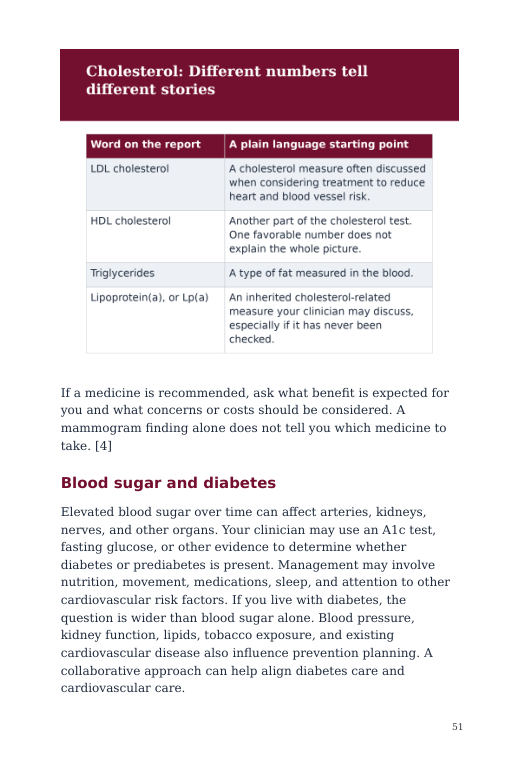
Cholesterol: Different numbers tell different stories A cholesterol blood test usually contains several results. You do not have to decide which one determines treatment. Ask your clinician which results deserve attention and why.
50
Accessible text for page 63
If a medicine is recommended, ask what benefit is expected for you and what concerns or costs should be considered. A mammogram finding alone does not tell you which medicine to take. [4]
Blood sugar and diabetes Elevated blood sugar over time can affect arteries, kidneys, nerves, and other organs. Your clinician may use an A1c test, fasting glucose, or other evidence to determine whether diabetes or prediabetes is present. Management may involve nutrition, movement, medications, sleep, and attention to other cardiovascular risk factors. If you live with diabetes, the question is wider than blood sugar alone. Blood pressure, kidney function, lipids, tobacco exposure, and existing cardiovascular disease also influence prevention planning. A collaborative approach can help align diabetes care and cardiovascular care.
51
Visual text and description: Cholesterol: Different numbers tell different stories. Word on the report — A plain language starting point; LDL cholesterol — A cholesterol measure often discussed when considering treatment to reduce heart and blood vessel risk.; HDL cholesterol — Another part of the cholesterol test. One favorable number does not explain the whole picture.; Triglycerides — A type of fat measured in the blood.; Lipoprotein(a), or Lp(a) — An inherited cholesterol-related measure your clinician may discuss, especially if it has never been checked.
Accessible text for page 64
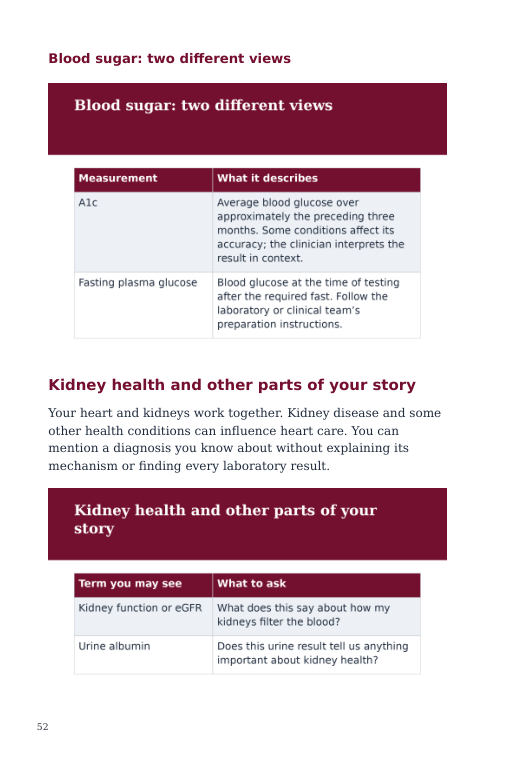
Blood sugar: two different views
Kidney health and other parts of your story Your heart and kidneys work together. Kidney disease and some other health conditions can influence heart care. You can mention a diagnosis you know about without explaining its mechanism or finding every laboratory result.
52
Visual text and description: Blood sugar: two different views. Measurement — What it describes; A1c — Average blood glucose over approximately the preceding three months. Some conditions affect its accuracy; the clinician interprets the result in context.; Fasting plasma glucose — Blood glucose at the time of testing after the required fast. Follow the laboratory or clinical team’s preparation instructions.
Visual text and description: Kidney health and other parts of your story. Term you may see — What to ask; Kidney function or eGFR — What does this say about how my kidneys filter the blood?; Urine albumin — Does this urine result tell us anything important about kidney health?
Accessible text for page 65
These are explanations of report terms, not a list of new tests to request. Ask which information your team needs for your particular situation.
What about the calcium in my breasts? Breast arterial calcification is an observation about calcium in vessels seen during mammography. Researchers have documented associations between BAC and cardiovascular outcomes in populations of women. [2, 3] It has not been established that a particular BAC finding should automatically trigger the same tests or medications in every woman. Your risk profile and symptoms guide the discussion. If your blood pressure, blood sugar, or cholesterol has been monitored for years, BAC may be an opportunity to confirm whether your current prevention plan remains appropriate. If you have received limited preventive care, it may prompt a more comprehensive conversation.
An achievable first step Choose one piece of information that will make your next visit more productive. Retrieve your most recent blood pressure readings, lipid results, or A1c. If you do not know where to find them, ask the practice that ordered the test. Write down the question you want answered. A small, concrete action can turn a confusing report into a useful discussion.
Eight areas, one workable life The American Heart Association organizes cardiovascular health through Life’s Essential 8: eating patterns, physical activity, tobacco or nicotine exposure, sleep, weight, blood lipids, blood glucose, and blood pressure. These domains offer a useful overview of the established prevention topics discussed in this chapter. They should not be turned into a new BAC score. Your clinical team can help identify which areas need attention and which actions fit your circumstances.
53
Accessible text for page 66
The challenge is rarely understanding that health matters. The challenge is arranging health related actions inside a life that already contains work, family, appointments, responsibilities, financial limits, pleasure, fatigue, and uncertainty. A sustainable plan respects that whole setting. It also leaves room for treatment when lifestyle changes alone do not meet the clinical need. Begin by looking for the action that would make the next week more manageable. It may be learning how to use a prescribed treatment, obtaining an appropriate home measurement device, preparing food that fits your clinician’s advice, or arranging support for a tobacco cessation discussion. The best first action has a clear purpose and a realistic place in your day.
Start with observation rather than a complete redesign For several ordinary days, notice the circumstances around the behavior you want to change. What happens just before it? What resources are available? When does the plan become difficult? Observation can reveal practical causes that a broad instruction such as be healthier leaves untouched.
Consider a fictional reader, Marisol, who wants to change her eating routine. She discovers that the difficult decision happens during the journey home, when she is hungry and has no prepared option waiting. Her next experiment concerns that moment: arranging an acceptable meal or snack earlier, rather than relying on a new decision when she is tired. The example illustrates planning; the appropriate eating pattern remains personal and can be discussed with a qualified professional.
Another reader may discover that a proposed walking time conflicts with a caregiving task. Moving the activity to a different part of the day, asking for practical help, or discussing an adapted form of movement may be more useful than repeatedly recommitting to the same unworkable schedule. The observation identifies the obstacle without defining the person
54
Accessible text for page 67
as unmotivated. Keep the experiment small enough to evaluate. Name the action, the situation in which you will attempt it, and the sign that will tell you whether the arrangement worked. You can change the arrangement when it fails. A failed plan provides information about the plan; it does not erase the value of trying.
Make food decisions easier before mealtime A useful food plan begins with what is available, affordable, enjoyable, and practical to prepare. Cultural preferences, household routines, allergies, appetite, treatment related symptoms, and medical conditions can all shape the conversation. The plan should be discussed in that context rather than built around a single ideal menu.
Look at one routine meal. Which parts already fit the pattern you are working toward? Which part creates the greatest difficulty? You may need a convenient ingredient, a preparation method, a lower cost option, a change in portioning, or help interpreting a package label. A registered dietitian can help translate general guidance into a workable pattern when individualized nutrition support is needed.
Shopping is also a planning task. A short list tied to meals you actually intend to prepare can reduce the number of decisions made in the store. If shopping opportunities are limited, discuss options that store well and remain compatible with your care. The goal is a pattern you can repeat, not a photograph of a perfect plate. For a shared household, identify one change that can occur without requiring everyone to eat identically. You might prepare a flexible base meal with different additions, agree on a few preferred ingredients, or keep a useful option available for busy evenings. Negotiating the routine may matter as much as knowing the recommendation.
Eating away from home deserves the same realistic approach. Decide which question you need answered about the available food and what choice is feasible. A meal that differs from your usual plan does not require abandoning the rest of the week.
55
Accessible text for page 68
Return to the pattern at the next opportunity and discuss persistent difficulties rather than compensating through extreme restrictions.
Build movement around function and safety Physical activity should fit the person doing it. Existing symptoms, medical conditions, mobility, balance, pain, treatment effects, and prior activity experience can influence the appropriate plan. Ask your clinician what level or type of activity is suitable when you are unsure. A general exercise target does not replace an individualized discussion when a health concern affects safety. Once the appropriate activity is clear, make the starting point concrete. Decide where it will happen, what equipment or clothing is needed, and which part of the day is realistic. Preparing these details can reduce the distance between an intention and an action.
Some readers prefer companionship. Others value quiet time. Some can use an outdoor route; others need an indoor or seated option. The plan can reflect those preferences. Choose an arrangement that supports participation without making another person’s availability the only way the activity can occur. Describe the experience when you review the plan. Were you comfortable? Did pain, fatigue, breathlessness, dizziness, or another problem affect participation? Tell the clinical team about concerning or unexpected symptoms and use the appropriate urgency route. A record of how the activity felt is more useful than treating a device’s number as the complete account.
Progress can involve a routine becoming easier to begin, better understanding of an adapted activity, or a more reliable arrangement for participation. Discuss which measurements or functional changes your clinician wants followed. Avoid using comparison with another person’s exercise capacity as the standard for your own care.
56
Accessible text for page 69
Treat sleep as a practical care issue Advice about sleep can sound simple to someone whose schedule, health, or home environment makes it complicated. Shift work, caregiving, discomfort, worry, treatment effects, and disrupted breathing during sleep may require different kinds of attention. Describe the actual pattern rather than apologizing for it. You can note when you usually try to sleep, when interruptions occur, and how rested or sleepy you feel during the day. If someone has observed a concerning sleep pattern, bring that information to your clinician. Ask which details would help determine whether further assessment is appropriate.
A practical change may involve an evening routine, a discussion about a medication effect, an environmental adjustment, or evaluation of a possible sleep disorder. These possibilities have different purposes. The team can help identify which question needs attention rather than assuming that every sleep problem can be solved by the same habit. When a routine is being adjusted, evaluate it over ordinary days rather than one exceptional night. Record the change you attempted and the difficulty that remained. This allows the next discussion to focus on an observable pattern.
Discuss tobacco and nicotine without hiding the difficult part If tobacco or nicotine is part of your life, give the clinician an accurate account of what you use, how often, and in which circumstances. An honest description helps the team discuss support. It should not depend on whether you already feel ready to stop. Different moments may carry different functions. A product may be connected with stress, a work break, a social setting, or a longstanding routine. Describing those situations can make a cessation conversation more specific. Ask about the kinds of support and treatment that may be appropriate for you, including how they would fit other medical conditions and medications.
57
Accessible text for page 70
If an earlier attempt was difficult, explain what happened. Perhaps an adverse effect, cost, access problem, or an especially stressful period interrupted the effort. That history can guide a new discussion. It is useful information rather than evidence that assistance is no longer worthwhile. The people around you may also affect exposure. You can discuss ways to address smoke in a shared environment while recognizing that household relationships can be complicated. Ask for practical help when the change involves other people, housing, or workplace circumstances beyond your direct control.
Use weight information respectfully A measurement of weight can be one part of a clinical assessment. It does not describe a person’s worth, effort, fitness, eating experience, or complete metabolic health. A useful conversation should connect the measurement with a health question and an appropriate plan. Tell the team if weighing or weight related discussion is difficult because of earlier experiences, an eating disorder, treatment history, stigma, or another concern. You can ask why the information is needed and how it will be used. Respectful care makes room for that explanation.
Discuss the health outcomes you and the clinician intend to follow. These may include relevant measurements, symptoms, function, or treatment response. The appropriate focus depends on the individual. A plan centered only on a changing number can miss other important information. When a treatment is proposed, ask how its benefits, risks, cost, duration, and follow up will be evaluated. A medication or other intervention should be understood within the clinical plan, rather than treated as an isolated solution. Keep your medication and supplement list current so that recommendations can be reviewed together.
58
Accessible text for page 71
Plan for the week that goes badly Most long term routines encounter interruptions. Travel, illness, caregiving, work changes, bereavement, and financial strain can alter what is feasible. A prevention plan is more resilient when it includes a modest fallback arrangement before disruption occurs. Choose the part of the routine that you can reasonably preserve during a difficult week. Identify which changes require medical guidance and which practical arrangements you can make in advance. Keep important contact information and current medication details accessible through a secure method appropriate to your circumstances.
After an interruption, review the cause before setting a new goal. Was the plan too complicated? Did it depend on a resource that became unavailable? Did a new symptom or treatment problem require clinical attention? The answer determines whether the next step is a practical adjustment, professional advice, or both. An ordinary recovery from disruption may look unremarkable: arranging a refill, returning to a feasible meal pattern, clarifying an instruction, or rescheduling a necessary review. These actions matter because prevention is carried by repeated workable decisions over time.
Define progress before you measure it When the team recommends a change, ask what improvement would be meaningful and when it should be assessed. Some questions concern a clinical measurement. Others concern tolerability, function, understanding, or access. Knowing the purpose of follow up can prevent unnecessary disappointment with a measure that was never meant to answer the question. Use a review conversation with four parts: the action attempted, the information observed, the obstacle encountered, and the next adjustment. This structure can be used without turning your life into a daily performance score. It keeps attention on the relationship between the plan and the outcome being considered.
59
Accessible text for page 72
You may find that a successful first month produces better records and clearer decisions before it produces a dramatic change in a measurement. Discuss that progress accurately. Better organization is useful because it supports care; it is not proof that a health outcome has already improved. This chapter’s practical work is to make a prevention plan livable. The next chapter returns to the clinical decisions that may accompany that work: when another examination would help, what a treatment is intended to achieve, and how to understand the choices in front of you.
Chapter 5 reflection. Which measurements do I understand well? Which one do I want explained? What action would help me arrive at my next clinical conversation with better information?
Chapter 5 takeaway Chapter 6 introduces common test and medicine conversations. The report guide explains the parts of a mammogram report, and the four optional workbook pages offer a place for your own questions and the plan your team explains. You can use whichever part helps with the question you have today.
Rosa makes room for one ordinary week Rosa had become good at putting everyone else’s needs into the calendar. Her mother’s appointments, her grandson’s school events, and her work shifts all had a place. Her own health plans tended to appear in the spaces left over. After the mammogram report arrived, she imagined that caring for her heart would require an entirely different life.
She made an ambitious list on a Sunday evening. By Tuesday, it felt impossible. The problem was not a lack of concern. She had designed the list for a person with more time, money, and energy than she had that week.
60
Accessible text for page 73
A health conversation can acknowledge that difference without giving up on prevention. The point is to find changes that are appropriate for your health and possible in your circumstances. You can ask for help choosing priorities instead of trying to improve every part of daily life at once.
For Rosa, the first useful change was in the conversation itself. She explained that she usually ate her evening meal after caring for her mother and often had little energy left to cook. She did not need another instruction to make better choices. She needed suggestions that began with the situation she had described. Depending on the question, her team could discuss support from a dietitian, social worker, pharmacist, or another suitable professional.
Food carries history, pleasure, family customs, budget decisions, and the effort of preparing it. You do not need to abandon the foods that connect you to people you love before asking how to support your health. A respectful discussion can consider familiar meals, available ingredients, portion patterns, preparation methods, and the changes you would actually welcome. Ask for advice suited to your medical circumstances, including any dietary instructions you already follow.
Movement has a similar practical side. Your abilities, symptoms, responsibilities, environment, and access to safe space matter. A person caring for a relative may have a different set of possibilities from someone with a predictable workday. An exercise plan discussed with your clinician should make room for your health and limitations. There is no need to copy the routine of a person whose circumstances are different from yours.
Rosa also noticed how often she described rest as something she would earn once everything else was done. Talking about sleep brought up a more difficult issue: there was no one else to answer her mother’s calls at night. The conversation moved
61
Accessible text for page 74
beyond reminders about bedtime. It became a discussion of what help might be available and what she could reasonably change.
Sometimes the barrier is less visible. A medicine bottle may be hard to open. A monitor’s display may be difficult to read. A prescription may be affordable this month but not next month. A schedule may make sense when explained in an office and become confusing among several daily routines. These details are worth mentioning because they can change what kind of assistance is useful.
At the end of the week, Rosa had not completed her original list. She had identified one manageable priority with her team and one practical problem that required help from another person. That was a more honest measure of progress than the number of boxes she had checked.
There is dignity in an ordinary, workable plan. It can support health without turning each day into a performance. When a suggestion does not fit your life, describe the mismatch. A useful plan should be able to meet the person who will have to live with it.
62
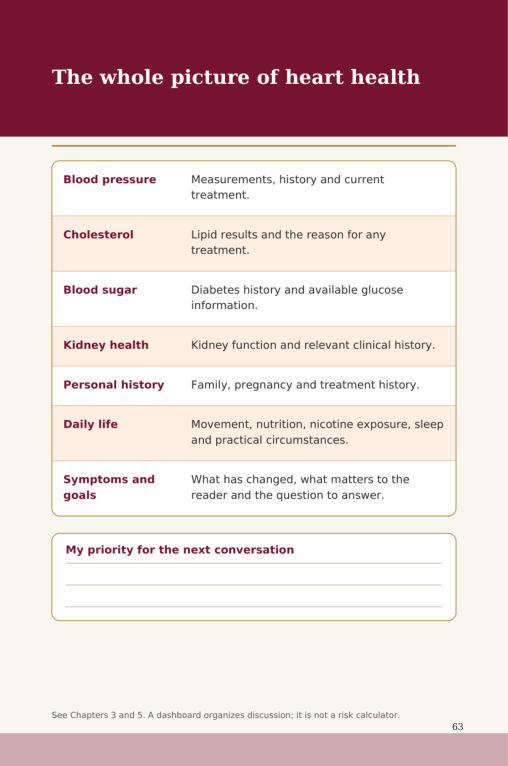
Accessible text for page 75
63
Visual text and description: The whole picture of heart health Blood pressure — Measurements, history and current treatment. Cholesterol — Lipid results and the reason for any treatment. Blood sugar — Diabetes history and available glucose information. Kidney health — Kidney function and relevant clinical history. Personal history — Family, pregnancy and treatment history. Daily life — Movement, nutrition, nicotine exposure, sleep and practical circumstances. Symptoms and goals — What has changed, what matters to the reader and the question to answer. My priority for the next conversation
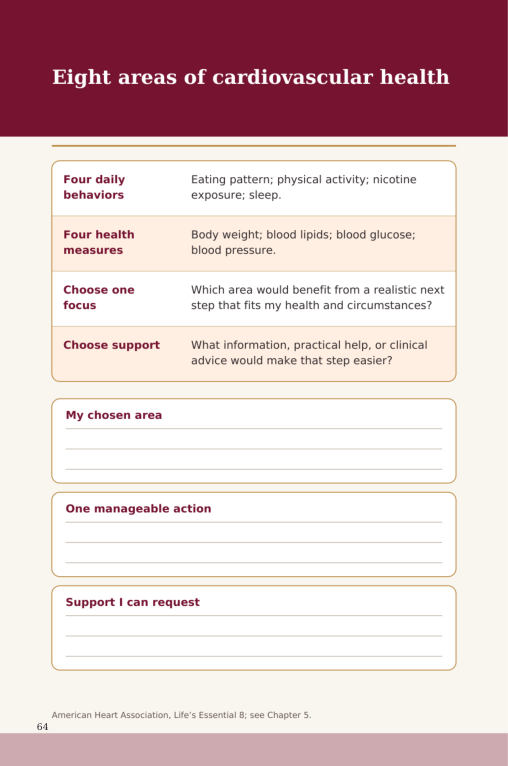
Accessible text for page 76
64
Visual text and description: Eight areas of cardiovascular health Four daily behaviors — Eating pattern; physical activity; nicotine exposure; sleep. Four health measures — Body weight; blood lipids; blood glucose; blood pressure. Choose one focus — Which area would benefit from a realistic next step that fits my health and circumstances? Choose support — What information, practical help, or clinical advice would make that step easier? My chosen area One manageable action Support I can request
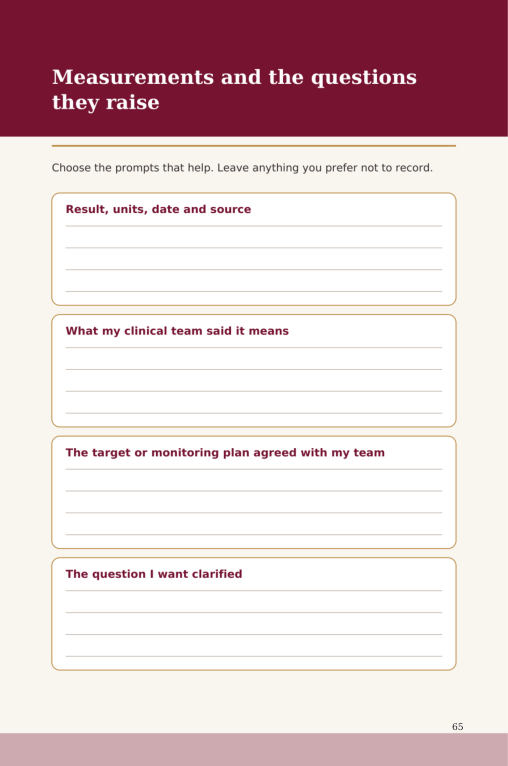
Accessible text for page 77
65
Visual text and description: Measurements and the questions they raise Choose the prompts that help. Leave anything you prefer not to record. Result, units, date and source What my clinical team said it means The target or monitoring plan agreed with my team The question I want clarified

Accessible text for page 78
66
Visual text and description: A laboratory still life representing blood testing, without diagnostic results.
Accessible text for page 79
67
Visual text and description: Illustrative home blood pressure equipment with no displayed reading.
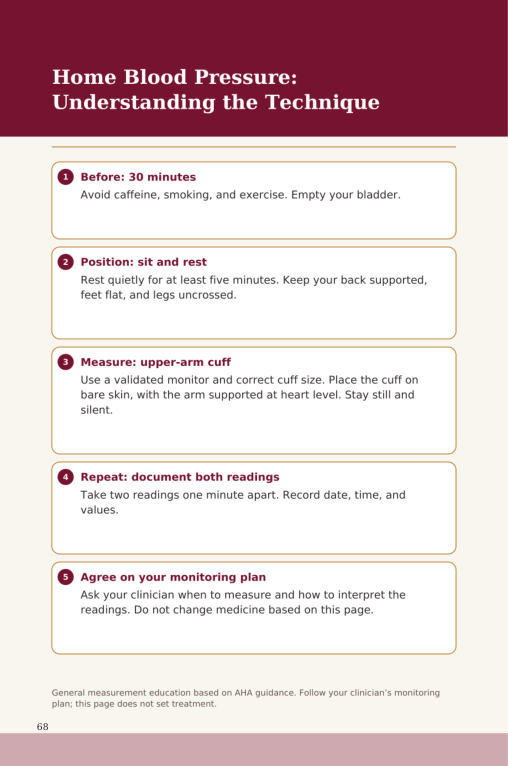
Accessible text for page 80
68
Visual text and description: Home Blood Pressure: Understanding the Technique Before: 30 minutes — Avoid caffeine, smoking, and exercise. Empty your bladder. Position: sit and rest — Rest quietly for at least five minutes. Keep your back supported, feet flat, and legs uncrossed. Measure: upper-arm cuff — Use a validated monitor and correct cuff size. Place the cuff on bare skin, with the arm supported at heart level. Stay still and silent. Repeat: document both readings — Take two readings one minute apart. Record date, time, and values. Agree on your monitoring plan — Ask your clinician when to measure and how to interpret the readings. Do not change medicine based on this page.
Accessible text for page 81
69
Visual text and description: Lifestyle and Next Steps Move with purpose — Plan appropriate movement based on your abilities and clinical situation. Eat for vascular health — Review nutrition patterns, LDL cholesterol, and metabolic goals. Support recovery — Address sleep quality, tobacco exposure, and stress. Track what matters — Monitor agreed measures and revisit your prevention plan.

Accessible text for page 82
70
Visual text and description: A woman walks through a sunlit garden.
Accessible text for page 83
Chapter 6: Tests and Medicines: Understanding the Conversation A finding does not automatically require another test BAC can open a discussion about heart health. It does not mean that everyone needs a heart scan or a new prescription. Your symptoms, previous results, medical history, and the decision being considered all matter. [4, 6]
Before learning a list of test names, begin with one question: “What would this test help us understand?” The answer should connect the test to your care. You do not need to work out the testing pathway yourself.
Sometimes a clinician will recommend reviewing information already available. Sometimes another test may help answer an unresolved question. Sometimes a clear explanation of why more testing is unnecessary is the useful outcome. More information is valuable when it serves a purpose.
A few names you may hear A coronary calcium scan is a CT scan that looks for calcium in the arteries supplying the heart. It is a different examination from a mammogram. A clinician may use it in selected situations to help with prevention decisions. The result does not directly state the percentage that an artery is narrowed. [13]
A coronary CT angiogram uses CT images and contrast material to examine the heart’s arteries in more detail. A catheter angiogram uses a thin tube passed through an artery, usually from the wrist or groin, to obtain images. These are different
71

Accessible text for page 84
procedures with different preparation, risks, and recovery arrangements. If one is proposed, ask which one it is and what to expect. [8, 9]
A stress test looks at aspects of how the heart responds to exercise or medication used for the examination. The information depends on the kind of stress test. An echocardiogram uses ultrasound to look at the heart’s structure and how it works. An ECG, also called an EKG, records the heart’s electrical activity. These tests are not interchangeable. Their names are here to help you recognize the conversation, not to give you a shopping list. [6, 13]
72
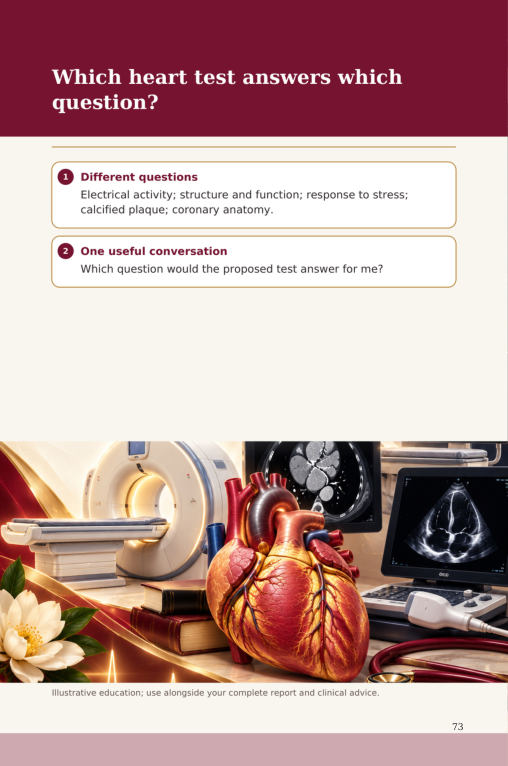
Accessible text for page 85
73
Visual text and description: Which heart test answers which question? Different questions — Electrical activity; structure and function; response to stress; calcified plaque; coronary anatomy. One useful conversation — Which question would the proposed test answer for me?
Accessible text for page 86
If two results sound different One test may look at calcium, another at the shape of the arteries, and another at how the heart responds when it works harder. Different findings do not automatically mean someone made a mistake. Ask your clinician to explain what each test was designed to show and how the results fit together.
You do not need to resolve an apparent disagreement by searching through images or comparing report codes. A practical question is: “After looking at both results and my symptoms, what do you think this means for me?” If symptoms continue or change, describe them. Do not let a reassuring phrase in an old report become a reason to ignore a new concern.
When you are told no further test is needed You may feel relieved, or you may wonder whether something is being missed. Either reaction can be discussed. Ask what information supports the recommendation and whether anything should lead you to contact the team again.
“No further test now” can be a considered plan. Understanding the reasoning may be more helpful than repeatedly asking for a different examination. If the explanation remains unclear, you can ask for clarification or discuss obtaining another opinion through appropriate care channels.
Before an examination Once a test is recommended, the imaging or procedural team should give you instructions for that examination. Ask about eating and drinking, medicines, transportation, clothing, and when you can return to usual activities. Requirements vary. Follow the team’s instructions rather than borrowing preparation advice from a friend or another test.
74
Accessible text for page 87
Tell the service about concerns that might affect the appointment, such as a previous reaction to contrast, difficulty lying flat, claustrophobia, pregnancy or a possibility of pregnancy, or a need for mobility or communication support. The team can explain what information it needs and how to plan for your circumstances.
If an instruction seems to conflict with another clinician’s directions, contact the appropriate team before changing what you do. You should not have to settle that conflict yourself.
Cost is a reasonable question Ask the facility and your insurer about coverage, authorization, and likely out of pocket cost before a nonurgent examination when possible. A quoted price may not include every charge. You can ask whether interpretation or other services are billed separately.
If the proposed expense is unaffordable, explain that to the ordering team. Ask whether the timing, location, or an alternative approach can be discussed. Do not quietly assume that a financial barrier means there is no way to continue the conversation.
75
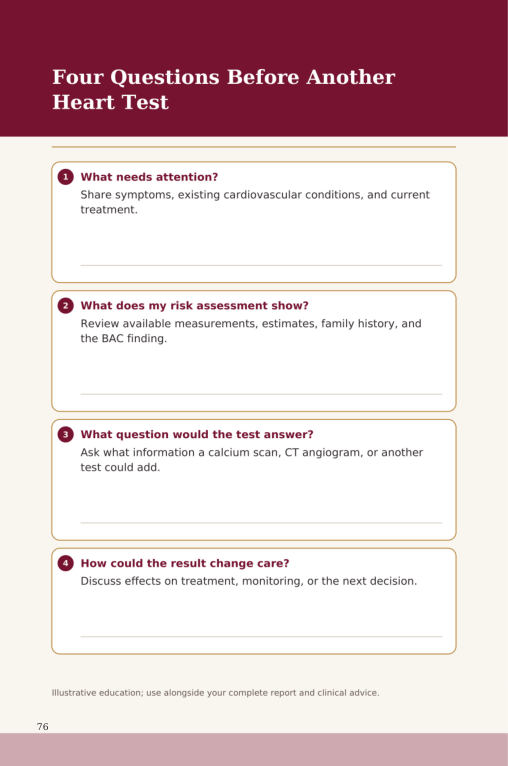
Accessible text for page 88
76
Visual text and description: Four Questions Before Another Heart Test What needs attention? — Share symptoms, existing cardiovascular conditions, and current treatment. What does my risk assessment show? — Review available measurements, estimates, family history, and the BAC finding. What question would the test answer? — Ask what information a calcium scan, CT angiogram, or another test could add. How could the result change care? — Discuss effects on treatment, monitoring, or the next decision.
Accessible text for page 89
During a stressful appointment Being familiar with healthcare does not prevent anxiety when you are the patient. You can ask a staff member to explain what happens next before it happens. If you need a pause, tell the team. Ask whether a support person may accompany you, recognizing that some parts of an examination have safety or privacy restrictions.
A useful request is: “I do better when I know what I am going to feel and how long it will last.” Another is: “Please tell me how I can let you know if I need help.” These are ordinary requests for communication.
Understanding a medicine recommendation A medicine may be discussed because of your cholesterol, blood pressure, diabetes, established heart disease, or other circumstances. The reason should be explained in terms of your overall health. BAC alone is not an instruction to begin treatment.
Ask what the medicine is intended to help prevent or manage, what benefit is expected, and what possible harms or burdens matter for you. You can also discuss cost, interactions, how to take it, and whom to contact about a problem. Your prescriber or pharmacist can explain the instructions for your actual prescription.
The word statin refers to a group of medicines commonly used to lower cholesterol and reduce cardiovascular risk in appropriate patients. Whether a statin or another treatment fits your circumstances belongs in a clinical discussion. You do not need to choose a treatment intensity from a chart in this book. [4]
77
Accessible text for page 90
Aspirin also needs an individual discussion. It can cause bleeding and is not routinely appropriate for everyone trying to prevent a first heart attack or stroke. Do not start or stop prescribed aspirin because BAC appears in a mammogram report or because of a general statement in a book. [11]
If you already take several medicines Bring a current list or the containers if your team asks. Include supplements and medicines bought without a prescription. You do not need to explain every interaction. Showing what you actually take helps the clinician or pharmacist review it.
If you have been taking something differently from the label, say so. The reason may be cost, a suspected side effect, a confusing schedule, or uncertainty about whether the prescription is still current. An accurate conversation is more useful than a list that looks complete but does not describe daily life.
78

Accessible text for page 91
79
Visual text and description: An illustrative CT scanner room; a test is considered only for a clinical question.
Accessible text for page 92
When an option feels difficult A recommendation can make medical sense and still feel hard to accept. Perhaps a relative had a bad experience, or you worry that taking a medicine means you have failed. Perhaps you simply do not understand the benefit well enough yet.
Try to name the specific concern. “I am worried about adding another daily task” opens a different conversation from “I am afraid of this side effect.” The team needs to know which problem you are trying to solve.
Ask what support is available. That might include clearer instructions, a pharmacist discussion, an interpreter, a review of cost, or time to revisit a nonurgent decision. The appropriate response depends on your situation.
A fictional conversation about a choice Ruth is offered a preventive medicine and immediately thinks of her sister, who stopped a different medicine after feeling unwell. Ruth says, “I am worried that I will feel the way she did.” Her clinician asks what happened and explains the purpose of the proposed treatment, the concerns relevant to Ruth, and how problems would be handled.
The important part of this example is not whether Ruth accepts the prescription. It is that an unspoken fear becomes a question the team can address. A clear discussion makes room for evidence and experience without assuming that another person’s outcome will be hers.
80
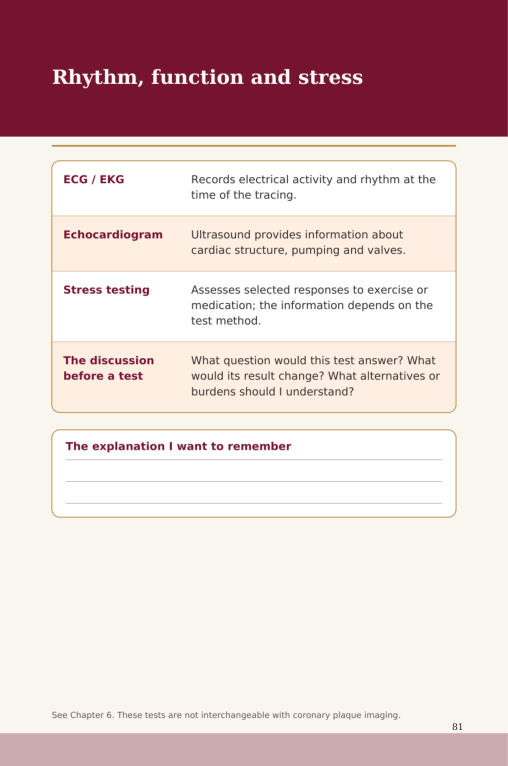
Accessible text for page 93
81
Visual text and description: Rhythm, function and stress ECG / EKG — Records electrical activity and rhythm at the time of the tracing. Echocardiogram — Ultrasound provides information about cardiac structure, pumping and valves. Stress testing — Assesses selected responses to exercise or medication; the information depends on the test method. The discussion before a test — What question would this test answer? What would its result change? What alternatives or burdens should I understand? The explanation I want to remember
Accessible text for page 94
82
Visual text and description: What matters in this decision? Choose the prompts that help. Leave anything you prefer not to record. The outcome I value The burden I want considered The uncertainty I want to discuss
Accessible text for page 95
Before you leave You should know what was agreed, how you will receive any result, and whom to contact if the expected communication does not arrive. The workbook offers one place for that information. You can use the office’s own summary instead if it is clearer or easier to keep.
If you cannot explain the plan, ask for it again in everyday language. “Could you write the next step for me?” is enough. You are not expected to leave the appointment sounding like a clinician.
Reflection: what would help me feel ready? Is there a question I have avoided because I think I should already know the answer? What would help me discuss it: a written note, a support person, an interpreter, or a little more time? I can bring the question without first solving it.
Alma asks for time to understand a choice Alma’s first reaction to a proposed test was to agree. She assumed that asking questions might sound as though she did not trust the clinician. On the way home, she realized that she could not explain why the test had been suggested. She remembered its name and the date, but not the decision it was meant to help make.
She called the office through the recommended route and asked for clarification. The question was straightforward: “Before I go ahead, can someone explain what we hope to learn and what the result might change?” She was not refusing care. She was trying to understand the choice she had been offered.
Trust and questions can exist together. You can respect a professional’s expertise while asking about the purpose of an examination, its possible benefits and burdens, and the
83
Accessible text for page 96
alternatives that matter in your situation. An explanation should connect the recommendation to your symptoms, history, or prevention discussion rather than leave the test sounding inevitable because BAC appeared on a report.
Alma was concerned about cost, but she had treated that concern as separate from the medical discussion. It was not separate in her daily life. She could not arrange the appointment without knowing how she would pay for it and whether she would need someone to drive her. Explaining those concerns allowed the team to discuss the practical arrangements rather than assume she had simply failed to schedule.
There are also choices about timing. For a nonurgent decision, you can ask whether there is time to think, talk with a support person, or receive another explanation. The clinician can tell you what timing means in your circumstances. This is different from delaying care for a possible emergency, when seeking help takes priority.
A useful explanation may include uncertainty. A test might answer one question while leaving another unresolved. It could reveal something that needs clarification or lead to a conversation about further evaluation. You can ask about those possibilities without assuming that every uncertain result will be dangerous or every additional test will be useful.
The same approach can help with a proposed medicine. You may want to understand its purpose, what benefit is expected for you, and how concerns would be addressed. If another person’s experience is shaping your worry, describe the experience rather than quietly assuming it predicts your own. Your prescriber or pharmacist can help distinguish a general concern from the instructions for your actual treatment.
Alma found it easier to ask one question at a time. When she tried to cover the test, the cost, the preparation, and every possible outcome in one sentence, she lost track of the answer.
84
Accessible text for page 97
Pausing after each explanation gave her a chance to say what was still unclear. She did not need to choose between listening politely and asking everything at once.
After the discussion, the decision was documented by the team. Alma kept the summary because it explained the purpose of the plan more clearly than the appointment reminder did. What changed most was her understanding of why she was participating, not the appearance of her calendar.
Your role in a decision is not to provide the technical expertise the clinician already brings. It is to contribute your experience, ask what you need to understand, and express the preferences and practical concerns that affect the choice. A decision can become more informed without becoming more complicated.
85
Accessible text for page 98
Chapter 7: Women’s Cardiovascular Health Across the Life Course Your health story contains important details Many cardiovascular conversations begin with blood pressure and cholesterol. Those measurements matter, but a woman’s life course may reveal additional relevant information. Pregnancy history, menopause, cancer treatment, certain autoimmune disorders, sleep patterns, and caregiving responsibilities can shape cardiovascular health and access to care. Bring these details to the discussion when they apply to you. Your clinician can assess how they change your risk profile or influence treatment choices.
Pregnancy related conditions and later cardiovascular care A history of hypertensive disorders of pregnancy, gestational diabetes, or some other pregnancy related complications can be relevant to long term cardiovascular risk. Even if the pregnancy occurred many years ago, it may be worth including in your medical history. You may ask whether this history changes the frequency of blood pressure, glucose, or other preventive assessments. Reproductive history can also affect what medications and tests are appropriate if pregnancy is possible or planned. Do not assume that a medication used by someone else with similar cholesterol levels will be appropriate in your situation. Bring pregnancy plans and contraception questions into treatment conversations when relevant.
86
Accessible text for page 99
Menopause, aging, and changing priorities Cardiovascular risk often changes with age and the transition through menopause. The presence of BAC becomes more common at older ages, which is one reason the meaning of the finding must be assessed in context. A finding in an older woman with several known risk factors may warrant a different conversation from the same finding in a younger woman without other risk factors.
Discuss new symptoms, lifestyle changes, medical conditions, and treatments as your health evolves. A prevention plan is a living plan: it can be updated as evidence, measurements, and priorities change.
Cancer treatment and long term heart care Some cancer therapies can affect cardiac function or the blood vessels, and others may be associated with changes in blood pressure, cholesterol, blood sugar, or other risk factors. The appropriate surveillance depends on the treatment exposures and the person’s overall health. A history of cancer alone does not establish a single uniform cardiovascular testing schedule.
If you have undergone cancer treatment, ask whether your oncology records include therapies that should inform your future cardiovascular care. Bring names and approximate dates of treatments when available. If you have a care plan from your oncology team, share it with the clinician overseeing heart disease prevention. Patients in active treatment should coordinate new symptoms and treatment decisions with the treating teams.
Your everyday circumstances matter Access to transportation, insurance coverage, medication costs, work hours, language services, reliable nutrition, safe opportunities for movement, and time to care for yourself can influence whether a medical plan is practical. These
87
Accessible text for page 100
circumstances are relevant to the clinical conversation. Your care team may be able to select an affordable medication, simplify monitoring, coordinate referrals, or direct you to available support.
An inclusive, respectful conversation Some people experience dismissal when presenting cardiovascular symptoms. Others have concerns about the cost, cultural relevance, or feasibility of recommendations. It is appropriate to ask your clinician to explain the reasoning behind a recommendation, clarify alternative approaches, and document a shared plan. Your questions are part of care. They help align medical evidence with your circumstances and preferences.
Menopause without a single explanation for everything The transition through menopause can bring several changes at once. Sleep may become disrupted. Daily responsibilities may expand. A woman may be caring for a parent while supporting an adult child and adjusting to changes in her own body. If a mammogram report arrives during this period, it is easy for every new concern to become part of one overwhelming story.
Separate the questions so that each can receive a useful answer. What symptoms are new? Which measurements have changed? What treatments are you using? What is interfering with sleep, activity, work, or enjoyment? A clinician can then consider the relevant possibilities without assuming that one life stage explains every concern.
Prepare a short account of the symptom that matters most to you. Describe when it began, how often it happens, what seems to bring it on, and how it affects your usual activities. If you are using a hormonal treatment or considering one, give the exact product and reason for use. Ask the treating clinician how its
88
Accessible text for page 101
benefits and risks apply to your history. A general conversation about BAC cannot settle an individualized hormone treatment decision.
You also deserve room to discuss quality of life. A plan that pays attention only to laboratory values may miss the problem that makes daily care difficult. Poor sleep, pain, and exhausting symptoms can interfere with a routine that previously worked well. Bringing them into the visit gives your team an opportunity to address the conditions under which prevention must actually occur.
When care has felt dismissive A previous encounter can shape the next one. If a symptom was minimized, a question went unanswered, or you were treated disrespectfully, it may be difficult to approach another visit with confidence. Preparing a clear account can help the discussion, but responsibility for respectful care does not rest solely on how well you prepare.
Describe the current concern in concrete terms. Instead of saying only that you feel unwell, explain the change in function: you now stop during a walk you previously completed, you have had to leave work, or a symptom interrupts sleep. These observations help the clinician understand what needs evaluation. State what explanation you have already received and what remains unclear.
If the proposed plan does not answer your concern, ask the clinician to explain the reasoning and the conditions that should trigger reassessment. Request that the symptom, relevant findings, and follow up plan be documented. A support person may help take notes if you want one present. Professional interpretation may make the conversation more accurate when language is a barrier. A second opinion can be reasonable when an important question remains unresolved. Seek it with the available records and a clear question, rather than feeling that
89
Accessible text for page 102
you must begin the story from nothing. Emergency symptoms still require immediate evaluation. A future second opinion is not a reason to postpone urgent care.
Caregiving belongs in the history of the plan Many women organize the appointments, meals, medicines, and transportation of other people while postponing their own care. Caregiving may be meaningful and necessary, yet it can leave little room for an additional appointment or a complicated monitoring routine. A plan that assumes unlimited time will be difficult to carry out.
Make the constraint specific. Explain whether you cannot leave a person alone, cannot travel on particular days, or need advance notice to arrange coverage. Ask whether an appropriate appointment can be coordinated with another visit or whether some communication can occur remotely. Availability will depend on the service and the medical question, but naming the obstacle gives the team something concrete to work with.
Support does not have to mean asking one person to take over everything. A relative might provide a ride, a neighbor might sit with someone briefly, or a friend might help collect records. Decide what information each person needs and what you wish to keep private. A small, clearly defined request is often easier to arrange than a general plea for help.
Your own care deserves a place in the household calendar. That may require negotiation rather than inspiration. Write down the next appointment, the time needed to travel, and the help required. Treating these details as part of the plan makes it more realistic and reduces the chance that the appointment disappears beneath other responsibilities.
90
Accessible text for page 103
Before the Next Step: Looking Across Your Health History Before moving into your 30 day action plan, consider which parts of your health history are already well documented and which questions may benefit from a more complete record.
Which event, treatment, or transition from my earlier life should I mention at my next cardiovascular discussion?
Which finding or symptom would I like my clinician to explain more fully?
What record can I locate before the next decision about testing or prevention?
Miriam is more than a treatment history Miriam had heard the phrase “after cancer” many times. It appeared in appointments, conversations, and the way people asked how she was doing. She was grateful to be alive and tired of feeling that every new health question would return her to the hardest chapter of her life.
When the mammogram report mentioned BAC, she wondered whether she was about to begin another long series of examinations. She also worried that explaining her cancer history would take up the entire appointment. She wanted someone to remember that she had a job she enjoyed, a partner who made her laugh, and plans unrelated to medical care.
A treatment history can matter without becoming the whole description of a person. If you have had cancer, tell the team where and when you were treated and which details you know. You do not have to reconstruct every medicine or radiation record from memory. The clinician can explain what information is relevant and help identify a reasonable way to obtain it.
91
Accessible text for page 104
Miriam began her visit by saying what she wanted from it: to understand the mammogram finding without assuming that she needed to relive every earlier decision. The clinician asked about her present concerns and explained why certain treatment details might help. Knowing the purpose of the questions made them easier to answer.
Other experiences can carry a similar emotional weight. Pregnancy complications, a difficult menopause transition, a family member’s early illness, or years of feeling dismissed may influence how a new report is received. You can decide which experience you want to name and how much detail you are ready to discuss. A factual history and the emotional meaning of that history are related, but they are not the same conversation.
You may also have information you are uncertain about. A parent may have used the phrase heart trouble without knowing a diagnosis. A pregnancy problem may have been described in terms that were never explained. You can report that uncertainty honestly. Guessing at a technical label is less useful than describing what you remember and allowing the clinician to decide whether further detail is needed.
For some people, bringing a supporter into the conversation makes this easier. For others, a private visit offers room to speak about an experience that family members do not fully know. There is no single correct way to share your history. The important thing is that the information needed for your care can be discussed with respect for your choices and privacy.
Miriam was surprised by the question that helped her most: “What would make this process feel manageable?” Her answer included advance notice of what records were needed and an explanation before an appointment was added. Those requests did not alter the evidence. They changed how care could be organized around a person who had already been through a great deal.
92

Accessible text for page 105
You are allowed to want both careful medical attention and a life that is not organized entirely around surveillance. Tell your team when the effort of keeping up is becoming heavy. There may be ways to clarify, coordinate, or simplify the plan without abandoning necessary care.
Miriam left the visit with a health question still under discussion and an ordinary evening ahead of her. That combination mattered. Her history deserved to be taken seriously, and her present life deserved room to continue.
93
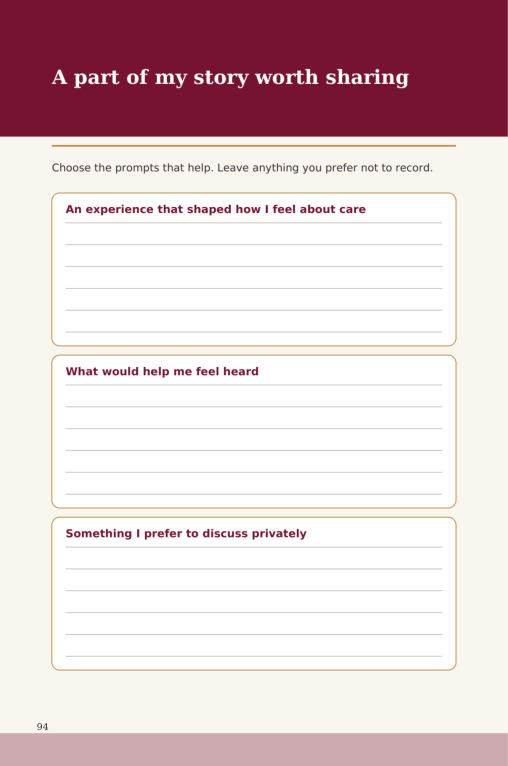
Accessible text for page 106
94
Visual text and description: A part of my story worth sharing Choose the prompts that help. Leave anything you prefer not to record. An experience that shaped how I feel about care What would help me feel heard Something I prefer to discuss privately
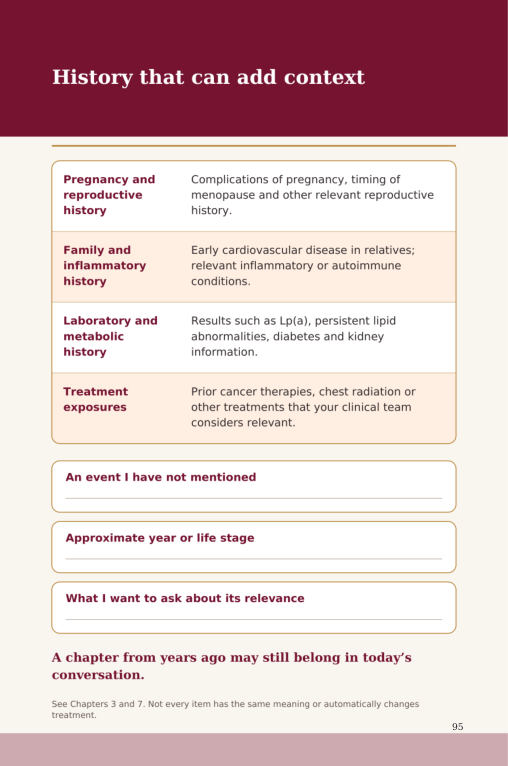
Accessible text for page 107
95
Visual text and description: History that can add context Pregnancy and reproductive history — Complications of pregnancy, timing of menopause and other relevant reproductive history. Family and inflammatory history — Early cardiovascular disease in relatives; relevant inflammatory or autoimmune conditions. Laboratory and metabolic history — Results such as Lp(a), persistent lipid abnormalities, diabetes and kidney information. Treatment exposures — Prior cancer therapies, chest radiation or other treatments that your clinical team considers relevant. An event I have not mentioned Approximate year or life stage What I want to ask about its relevance

Accessible text for page 108
96
Visual text and description: Three generations share a quiet conversation outdoors.
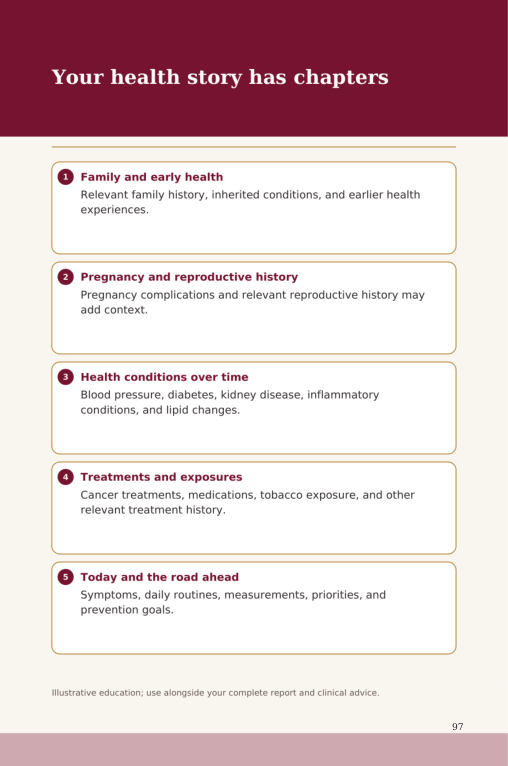
Accessible text for page 109
97
Visual text and description: Your health story has chapters Family and early health — Relevant family history, inherited conditions, and earlier health experiences. Pregnancy and reproductive history — Pregnancy complications and relevant reproductive history may add context. Health conditions over time — Blood pressure, diabetes, kidney disease, inflammatory conditions, and lipid changes. Treatments and exposures — Cancer treatments, medications, tobacco exposure, and other relevant treatment history. Today and the road ahead — Symptoms, daily routines, measurements, priorities, and prevention goals.
Accessible text for page 110
Chapter 8: Your Next 30 Days After a BAC Report A plan you can actually use The purpose of a 30 day plan is to organize your questions and next steps. It does not imply that all people with BAC need urgent testing or that a particular treatment should begin within 30 days. The plan is a way to coordinate information, clarify priorities, and leave the next medical discussion with an actionable summary.
Days 1–7: Understand the report Read the complete mammography result, including the breast assessment category and the radiologist’s recommendations. If the report includes follow up breast imaging or other evaluation, follow the pathway recommended by the imaging team. Separately, highlight the words describing BAC. Save the report somewhere you can access during a future clinical discussion. If you have sudden chest pain, severe breathlessness, focal weakness, trouble speaking, or another emergency symptom, seek emergency assistance immediately. A future preventive appointment is appropriate for routine risk discussion; emergencies require immediate action.
Days 8–14: Gather the information you already have Find your recent blood pressure readings, cholesterol panel, A1c or blood sugar results, a current medication list, and relevant history. You may include smoking history, family cardiovascular history, kidney disease, prior cardiovascular events, pregnancy complications, and treatment exposures such
98
Accessible text for page 111
as certain cancer therapies. It is acceptable to arrive without every number. Your clinician can help identify which information is necessary and which tests, if any, should be ordered.
Days 15–21: Prepare for a cardiovascular risk conversation Write three questions that would make the visit useful. An example is: “Does this mammogram finding change my overall cardiovascular risk assessment?” Another is: “Which existing risk factors deserve attention?” A third is: “What is one action I can take now, and when should we reassess?” You can communicate these questions through your patient portal or bring them to an appointment. If you have a concern about cost, distance, caregiving responsibilities, or another practical barrier, include that information. A plan is more useful when it can be carried out.
Days 22–30: Record the agreed plan Following the clinical discussion, summarize any decisions about lifestyle measures, medication, laboratory testing, imaging, referrals, symptom monitoring, and follow up. Include who is responsible for each action. If you are awaiting a result, note how you will receive it and when to inquire if it has not arrived. Use the workbook pages in this book to keep the plan organized. Where possible, keep the original clinician instructions in your patient portal so the record stays connected with your care.
What progress might look like Progress may mean understanding that your current prevention plan already addresses your risk appropriately. It may mean confirming a blood pressure pattern, discussing a new lipid value, or making an affordable treatment plan. It may mean that
99
Accessible text for page 112
a clinician identifies symptoms requiring a separate diagnostic assessment. Each of these is a meaningful result. The benefit comes from aligning the information with an appropriate action.
Begin with the week you actually have A calendar can make a vague intention visible. It can also become another source of pressure if it assumes that every reader has the same schedule, energy, transportation, or access to care. Use the coming month as a flexible container. The dates help you remember tasks; they do not determine the medical urgency of a finding. Before writing appointments into a calendar, identify any instructions already given by your imaging center or treating clinician. Those instructions take priority over the sample sequence in this chapter. If a breast imaging follow up has been recommended, preserve its timing. If symptoms need prompt assessment, contact the appropriate service rather than waiting for a later week in the plan.
For routine preventive questions, choose a short period when you can look at the report without rushing. You might work at a kitchen table, in a quiet room at a community center, or during a break with a trusted person nearby. The setting does not have to be ideal. What matters is having the actual report and a place to record the next action.
Decide how you will keep your notes. One paper folder or one secure digital location is often enough. A complicated collection of apps can scatter the information you are trying to bring together. Select a method you can open easily during an appointment and maintain when your week becomes busy.
100
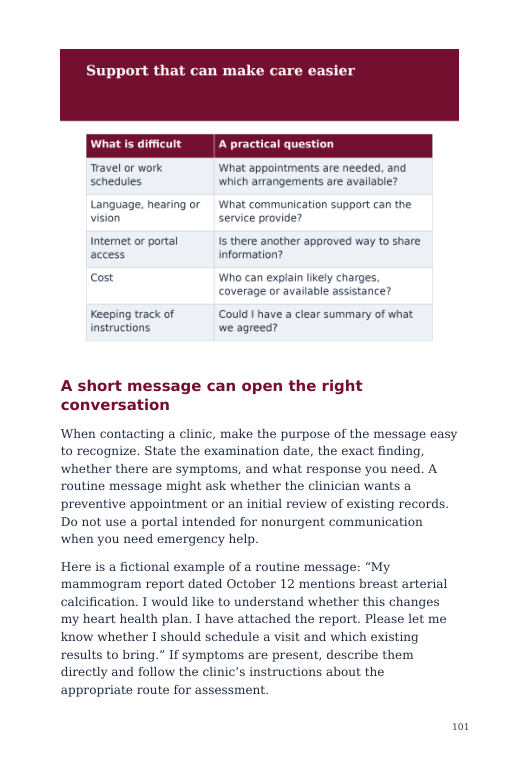
Accessible text for page 113
A short message can open the right conversation When contacting a clinic, make the purpose of the message easy to recognize. State the examination date, the exact finding, whether there are symptoms, and what response you need. A routine message might ask whether the clinician wants a preventive appointment or an initial review of existing records. Do not use a portal intended for nonurgent communication when you need emergency help.
Here is a fictional example of a routine message: “My mammogram report dated October 12 mentions breast arterial calcification. I would like to understand whether this changes my heart health plan. I have attached the report. Please let me know whether I should schedule a visit and which existing results to bring.” If symptoms are present, describe them directly and follow the clinic’s instructions about the appropriate route for assessment.
101
Visual text and description: Support that can make care easier. What is difficult — A practical question; Travel or work schedules — What appointments are needed, and which arrangements are available?; Language, hearing or vision — What communication support can the service provide?; Internet or portal access — Is there another approved way to share information?; Cost — Who can explain likely charges, coverage or available assistance?; Keeping track of instructions — Could I have a clear summary of what we agreed?
Accessible text for page 114
Avoid sending a long list of copied internet statements as the first message. The original report and your specific question give the team a clearer starting point. You can bring a selected source or concern into the later discussion if it would help explain what is worrying you. Write down when you sent the message and the response time the service tells you to expect. If that period passes without a reply, use the clinic’s usual follow up process. A missing response may reflect a routing problem rather than a clinical judgment. Keeping a simple record makes it easier to ask what happened.
When insurance or cost interrupts the sequence A proposed test or medicine may introduce a financial question before the medical decision feels settled. It is reasonable to ask what the intervention is expected to change and what alternatives exist. The clinical rationale and the financial process are related parts of carrying out care, but they are different questions that may require different people to answer. Ask the clinic who can clarify authorization, network requirements, or financial assistance. Coverage information can change, and a general statement from someone outside your plan may not settle your individual responsibility. Keep the name of the service you contacted, the date, and any reference number provided. Written estimates and explanations can be useful when available.
If the cost means you cannot proceed, tell the treating team before the task is silently dropped. They may be able to consider a different option, clarify the urgency, or help identify a more feasible route. Do not change a medication or substitute a test without discussing the decision. Any alternative should still address the medical question the team is trying to answer. Financial difficulty is not a failure of motivation. A plan becomes more useful when it acknowledges the resources required to
102
Accessible text for page 115
carry it out. Your role is to make the obstacle visible; the team’s role includes helping you understand the medically appropriate choices that remain available.
Two fictional months with different outcomes Elaine receives a report mentioning BAC while she is already seeing a clinician regularly for blood pressure and cholesterol care. She has no new symptoms. During the first week, she obtains the full report and sends it through the clinic’s usual channel. The team asks her to bring it to an already scheduled prevention visit.
At that visit, Elaine and her clinician review her existing measurements, discuss the report, and confirm the current plan. They agree that another scan would not change the decision they are making at present. Elaine records the reason and the timing of her next review. Her month ends without a dramatic new intervention, but with a clearer understanding of the care she is already receiving.
Nadine’s month is different. She has moved recently, has no established primary care clinician, and cannot find her prior laboratory results. Her first task is to arrange appropriate ongoing care and obtain the mammogram report. A records request takes longer than expected. She brings the available information to the initial appointment and identifies the missing items honestly. The clinician determines what needs assessment now and what can wait for the records. Nadine leaves with a short list of actions and a plan for reviewing results. Some work extends into the following month. The plan remains useful because the next steps are clear and the medical timing comes from the treating team.
Neither fictional reader has succeeded by completing the largest number of tasks. Elaine has clarified an existing plan. Nadine has established a workable route into care. Your own
103
Accessible text for page 116
month may resemble either story or neither. Judge the calendar by whether it helps you obtain appropriate answers and carry out agreed actions.
Build a recovery route for missed steps Illness, work, weather, caregiving, and transportation can interrupt the best calendar. A useful plan includes a way to restart. If you miss a test or visit, find out whether it needs to be rescheduled promptly and whether an order or authorization must be renewed. Record the new arrangement rather than leaving the original date as an unresolved reminder. If you did not complete home measurements, bring the readings you actually obtained. Do not fill gaps with remembered or invented numbers. Explain what prevented the routine. The clinician may be able to simplify the schedule, clarify the technique, or determine whether another method is appropriate.
If a medicine was not started or was stopped, tell the prescriber what happened and why. Cost, side effects, uncertainty, and an unclear instruction lead to different solutions. Accurate information is more useful than an appearance of perfect adherence. Seek individualized advice about restarting or changing treatment. A missed task should trigger a practical question: what is the smallest next action that restores the agreed route into care? Sometimes that is a phone call. Sometimes it is asking a trusted person for a ride. Sometimes it is an earlier clinical conversation because the situation has changed. The calendar should help you recover direction.
Patrice’s calendar has no empty squares Patrice lived far enough from the imaging center that an appointment usually meant arranging a ride and changing a work shift. The report arrived during a week when she was also helping her brother move. A sample thirty day plan sounded
104
Accessible text for page 117
encouraging until she looked at her calendar. She wondered whether taking longer would mean that she had failed to act responsibly.
The calendar in this book is an organizing example, not a deadline for your care. The timing of a recommended examination, the urgency of a symptom, and the instructions from your clinical team take priority. Routine questions may unfold differently depending on access, existing relationships with clinicians, and the information needed.
Patrice’s first useful step was not an elaborate record. It was telling the office that travel was difficult and asking how to begin the conversation. She wanted to know whether an appropriate telephone or video discussion was possible, or whether an in-person examination was needed. The service could explain what it could offer for her question and circumstances.
Remote care can be helpful in some situations, but it is not interchangeable with every examination or local service. Ask what can be addressed, what information the clinician needs, and what arrangements are necessary if care must continue in person. A difficult journey does not make it your responsibility to decide which parts of an evaluation can safely be omitted.
A missed call can create more work when your day has little flexibility. You can ask whether there is a useful time window for a reply, which number the office will use, and whether a message can be sent through an approved system. Tell the service if leaving a detailed voicemail would create a privacy problem. These are practical communication needs, not signs of poor engagement.
Patrice had limited internet access at home. A long online form that saved no progress was a barrier rather than a convenience. She asked whether there was another way to provide the
105
Accessible text for page 118
information. The office helped her identify an available route. The question was how to make the conversation possible, not how to prove that she could use every digital tool.
Sometimes a delay is caused by something you cannot resolve alone: a referral that has not arrived, an authorization question, an unavailable appointment, or uncertainty about which service should review a result. Tell the office what is missing and ask who can help. You can follow up through the agreed route without becoming the manager of all the services involved.
A useful plan also makes room for interruptions. Work changes, illness in the family, transportation problems, and financial surprises can disrupt an arrangement that was realistic when it was made. If that happens, explain the obstacle and ask how to proceed. Leaving the problem unspoken may allow an office to mistake a barrier for a decision you never made.
Patrice’s routine discussion took longer to arrange than the example calendar suggested. Once she reached the team, she received an explanation of which timing mattered clinically and which parts could be organized around her circumstances. That distinction was more useful than feeling behind a schedule designed for an imaginary month.
You deserve a plan that recognizes the work involved in obtaining care. The goal is a feasible next step with appropriate timing, not a perfect calendar. When the path is difficult, that difficulty belongs in the conversation.
106
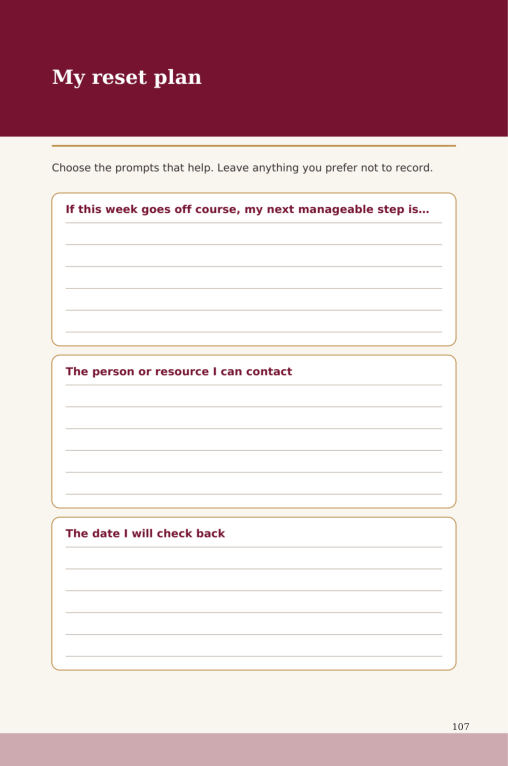
Accessible text for page 119
107
Visual text and description: My reset plan Choose the prompts that help. Leave anything you prefer not to record. If this week goes off course, my next manageable step is… The person or resource I can contact The date I will check back
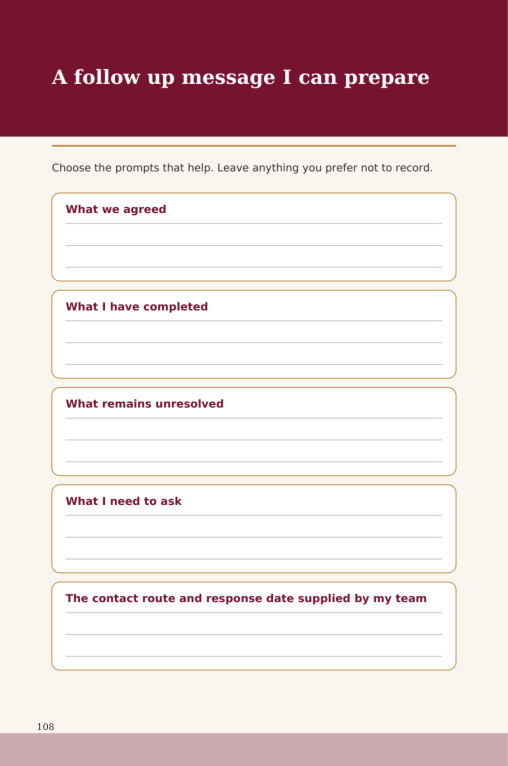
Accessible text for page 120
108
Visual text and description: A follow up message I can prepare Choose the prompts that help. Leave anything you prefer not to record. What we agreed What I have completed What remains unresolved What I need to ask The contact route and response date supplied by my team

Accessible text for page 121
109
Visual text and description: A blank notebook and water glass in a sunlit room.
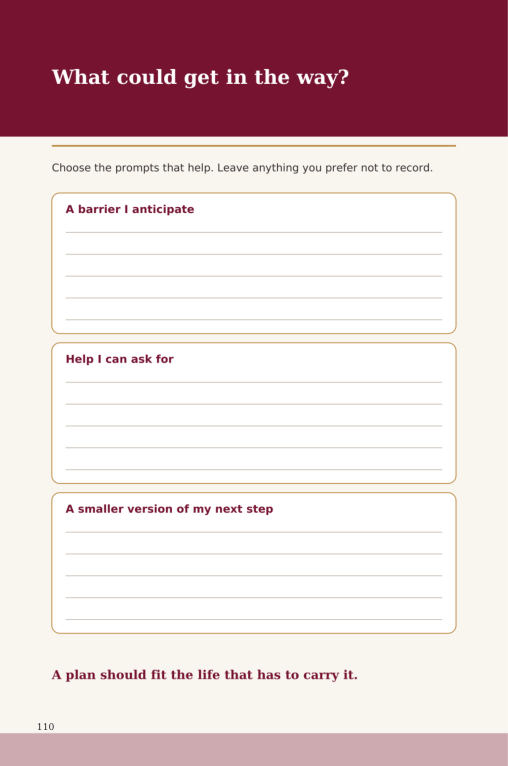
Accessible text for page 122
110
Visual text and description: What could get in the way? Choose the prompts that help. Leave anything you prefer not to record. A barrier I anticipate Help I can ask for A smaller version of my next step

Accessible text for page 123
111
Visual text and description: A woman writes questions beside her report.
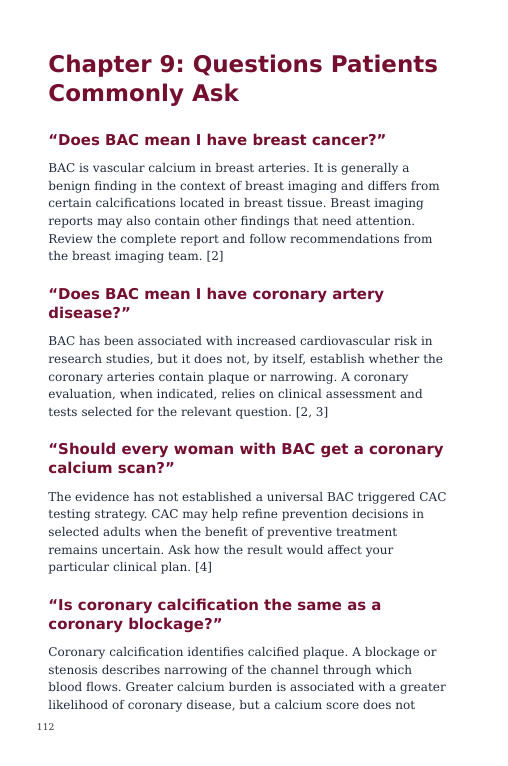
Accessible text for page 124
Chapter 9: Questions Patients Commonly Ask “Does BAC mean I have breast cancer?” BAC is vascular calcium in breast arteries. It is generally a benign finding in the context of breast imaging and differs from certain calcifications located in breast tissue. Breast imaging reports may also contain other findings that need attention. Review the complete report and follow recommendations from the breast imaging team. [2]
“Does BAC mean I have coronary artery disease?” BAC has been associated with increased cardiovascular risk in research studies, but it does not, by itself, establish whether the coronary arteries contain plaque or narrowing. A coronary evaluation, when indicated, relies on clinical assessment and tests selected for the relevant question. [2, 3]
“Should every woman with BAC get a coronary calcium scan?” The evidence has not established a universal BAC triggered CAC testing strategy. CAC may help refine prevention decisions in selected adults when the benefit of preventive treatment remains uncertain. Ask how the result would affect your particular clinical plan. [4]
“Is coronary calcification the same as a coronary blockage?” Coronary calcification identifies calcified plaque. A blockage or stenosis describes narrowing of the channel through which blood flows. Greater calcium burden is associated with a greater likelihood of coronary disease, but a calcium score does not 112
Accessible text for page 125
translate directly into a percentage of narrowing. CCTA or invasive coronary angiography may define anatomy when clinically appropriate, while functional or physiological testing may assess whether a narrowing limits blood flow. [6, 7]
“What is the difference between a CT angiogram and a catheter angiogram?” CCTA is a noninvasive CT examination performed after contrast is injected through a vein. It can show coronary plaque and estimate narrowing. Invasive coronary angiography guides a catheter through an artery, injects contrast directly into the coronary arteries, and can support pressure measurements or treatment during the same procedure. Ask for the complete name of a proposed test because the word angiogram may be used informally for either examination. [8, 9]
“What if I already take a statin?” Ask your prescribing clinician, “How are we monitoring my response and tolerance? Does this finding change anything you recommend? What should I do if cost or side effects make the current plan difficult?” Your clinician can explain how your risk factors, lipid levels, other conditions, and treatment history inform that recommendation.
“Can a person have BAC and still feel perfectly well?” Yes. BAC is often an incidental imaging observation discovered during mammography. It may be present without cardiovascular symptoms. Its significance for prevention is evaluated using the whole clinical picture.
113
Accessible text for page 126
“Does having no BAC mean I am protected from heart disease?” No. The absence of BAC does not rule out coronary disease or guarantee low future risk. Cardiovascular prevention remains relevant whether or not BAC is reported.
“What if the report says nothing about BAC?” Reporting practices differ, and a report that does not mention BAC does not necessarily establish that it was specifically assessed or absent. Discuss the report with the imaging team if clarification would be useful. Decisions about heart health should still use established risk assessment and symptom evaluation.
“Will insurance pay for another test?” Coverage depends on the insurance plan, indication, setting, and required authorization. Before scheduling a nonurgent service, ask the ordering clinician and insurer about medical necessity, estimated patient responsibility, and any in network alternatives. A clinically important evaluation should not be delayed solely because coverage details are confusing; ask the care team about available financial assistance and appropriate options.
“Is my diet the reason calcium appeared?” BAC involves processes within arterial walls and is associated with factors including age, metabolic conditions, and vascular changes. The observation cannot identify a single dietary cause. Cardiovascular nutrition advice should be tailored to your health history, nutritional needs, and other medical conditions.
114
Accessible text for page 127
“Do calcium supplements cause BAC?” A mammogram cannot determine that a particular supplement caused vascular calcification. If you take calcium or vitamin D for bone health, review the amount and indication with your clinician, especially if you have kidney disease or other relevant conditions. Treatment decisions should weigh the original reason the supplement was recommended and your complete health history.
“Can BAC disappear?” The available evidence does not support promising reversal of visible BAC through a particular supplement, diet, exercise program, or prescription. The clinically meaningful goal is appropriate prevention and management of cardiovascular risk factors, including those with strong evidence for reducing future events.
“Where should I start if I have many questions?” Start with the most actionable question: “What should I do next based on my own history?” Then ask which information will support that decision. Keep the conversation focused on specific next steps, how results will be communicated, and when to revisit the plan.
“Why did nobody mention this on an earlier mammogram?” Reporting practices can differ among imaging centers and can change over time. An earlier report may have used different language or may not have addressed the observation. The absence of a sentence in a report does not, by itself, establish what was or was not visible on the images.
115
Accessible text for page 128
If the timing matters to your discussion, ask the imaging service whether a comparison with prior examinations would be useful. Bring the actual reports and identify where the earlier images were obtained. The radiologist can explain what can reasonably be concluded from a comparison. Avoid assigning an exact start date to the finding from the first report in which you happen to notice it.
You may also want to know why communication is changing. That is a reasonable question for the imaging center. Keep it separate from the question of what your current team recommends for you. Understanding a reporting practice and choosing a prevention plan require related but distinct explanations.
“Can I tell whether it is getting better?” A desire to see improvement is understandable. Before treating a future image as a progress measure, ask whether the finding is being measured in a consistent way and whether a change would alter care. A description in one report may not be directly comparable with a different description in another. Your clinician can identify which measurements are appropriate for following the conditions being treated. Those measurements may concern blood pressure, lipids, glucose, symptoms, medication tolerance, or another aspect of care. The appropriate monitoring plan should follow the clinical purpose rather than the wish to make the original image disappear.
Do not assume that a helpful preventive treatment must visibly remove BAC to be worthwhile. Ask what benefit the treatment is intended to provide and how its safety and effectiveness will be assessed in your situation. This helps you judge the plan using the outcome it was actually designed to influence.
116
Accessible text for page 129
“My friend had the same finding and got a different plan. Should I be concerned?” Two reports can contain the same phrase while the people receiving them have different symptoms, ages, diagnoses, measurements, treatment histories, and preferences. Those differences may lead to different recommendations. A friend’s experience can suggest a useful question, but it cannot supply the missing details of your own assessment. Ask your clinician what features of your history determine the recommendation. If you are curious about a test your friend received, explain the question you hope it would answer for you. The team can then discuss whether that question is already resolved, requires a different approach, or would benefit from the proposed examination.
The useful comparison is between the recommendation and your health circumstances. Seek a clear rationale. If it remains unclear after discussion, you can ask for another explanation or an additional opinion with the relevant records available.
“What if I cannot remember the explanation after the visit?” Medical discussions can contain unfamiliar terms, especially when you are worried. Ask for a written summary of the main conclusion, the next action, and the follow up timing. Use your own words to repeat what you understood before the visit ends. That gives the clinician an opportunity to correct a misunderstanding while you are together. You may bring a support person if you want one and the service permits it. Agree in advance whether the person will take notes, help remember your questions, or assist with practical arrangements. Make clear that the decisions and privacy preferences remain yours.
117
Accessible text for page 130
If the uncertainty appears after you leave, send a focused clarification through the appropriate channel. Quote the instruction or term that is unclear and ask the specific question. A brief request is often easier to resolve than trying to reconstruct the entire visit from memory.
“How do I know whether a website is offering education or selling me a solution?” Look at who provides the material, what evidence it cites, and whether the page leads directly to a product or paid service. Commercial involvement does not automatically make a statement false, but it gives you a reason to examine the claim and its supporting evidence carefully. Be cautious when a page treats a single finding as proof that everyone needs the same scan, supplement, or treatment. Individual care requires more information than a general website can gather from a report phrase. Claims of certainty deserve particular scrutiny when the page does not explain limitations, alternatives, or the people actually studied.
Bring the claim and its source to your clinician if it might affect a decision. You can ask, “What evidence supports this recommendation, and does it apply to me?” Do not stop prescribed treatment or purchase an expensive intervention solely because an advertisement connects it with the words in your mammogram report.
“Should I use an online risk calculator before my appointment?” An online calculator may help you become familiar with the kinds of information used in a risk discussion. Its result still depends on eligibility, correct inputs, the chosen outcome, and clinical interpretation. Entering an uncertain value can produce a precise looking number with an unreliable foundation.
118
Accessible text for page 131
If you explore a tool, record its name, the date, and the information entered. Do not treat the output as a diagnosis or as permission to begin or stop treatment. Bring the result as a question and ask whether that tool is appropriate for you. A clinician may need to correct an input or use a different decision pathway entirely.
Avoid entering personal identifying information into an unfamiliar service. Use authoritative resources where possible and review what information the tool requests. You can prepare for a risk conversation simply by collecting your existing results and questions; completing an online calculation is not a requirement.
“Does this mean I should become responsible for everyone else’s heart health too?” Learning something important can create an urge to protect the people you love. You may want to check relatives’ reports, arrange appointments, or make sure everyone understands what you have learned. That impulse can become exhausting, particularly if you already carry caregiving responsibilities. Choose a modest, respectful way to share the information. Tell people what you found useful, encourage questions about their own care, and let them decide how much they want to discuss. A person with new or severe symptoms needs appropriate medical attention, but routine prevention remains an individual conversation with a qualified team.
You can offer support without becoming the interpreter of every result. Helping someone locate a report or prepare a question may be enough. Keep room for your own appointments and recovery from the uncertainty that brought you to this book.
119
Accessible text for page 132
“What if my main worry is the word heart?” Sometimes the emotional weight of a word is larger than the sentence containing it. You may have lost someone suddenly or watched a relative experience a serious illness. A report can bring those memories into the present before you know what the finding means for you.
Tell your clinician what the word brings to mind. That context can help the team explain the distinction between your fear, the observed finding, and the information still needed for a decision. It also gives room for support with the distress itself. You do not have to present only the technical question while hiding the reason it feels urgent to you.
Return to the actual source when worry begins to generate conclusions the report does not make. Write the observation on one line and the unresolved question on another. Then use the appropriate route to obtain an explanation. If anxiety continues to disrupt sleep or daily functioning, ask for help with that experience alongside the medical discussion.
“What should I do with advice that sounds more certain than my clinician’s explanation?” Certainty can be attractive when you are frightened. A confident statement from a friend, a video, or a promotional page may feel easier to follow than a careful explanation containing qualifications. The confidence of the delivery does not establish the quality of the evidence. Ask what information the advice uses and what it leaves out. Does the person know your symptoms, diagnoses, medicines, kidney function, and actual report? Does the recommendation distinguish research associations from tested treatment benefits? Does it acknowledge circumstances in which the advice would be inappropriate?
120
Accessible text for page 133
A qualified clinician should be able to explain the reasoning behind a recommendation and the limits of what is known. If you need a clearer explanation, ask for it. The goal is an understandable decision that fits your situation, supported by evidence rather than by the forcefulness of someone’s tone.
“What would count as a useful outcome from reading this book?” You might leave with one corrected misunderstanding, such as recognizing that BAC and a coronary calcium score are different observations. You might have a better question about a proposed test, a more accurate medication list, or a plan to retrieve an important treatment summary. These are useful changes because they improve the next conversation. The book cannot determine your diagnosis, predict your individual future, or complete a medical decision without your history. Its role is to make the information easier to approach and the practical work easier to organize. Your clinician supplies the individualized interpretation and treatment advice.
Choose the tool that addresses your current question rather than trying to complete every exercise. Keep the explanation that clarified something for you. Then carry that understanding into the next appropriate conversation, with enough room for your own circumstances to shape what happens afterward.
Leila meets an answer that sounds too certain Leila’s social feed seemed to know what she had been reading. Within days of searching for BAC, she saw posts about artery cleansing, supplements, special scans, and programs that promised to reveal hidden danger. Several messages sounded reassuring because they offered a simple explanation and a single action. They were easier to understand than the uncertainty in the research.
121
Accessible text for page 134
A confident message can feel helpful when you are worried. Confidence alone does not show that a claim is accurate or that it applies to you. A useful educational source should let you distinguish a general explanation from a recommendation to buy, test, or treat.
Leila noticed that one article began with a reasonable description of a mammogram finding and ended by suggesting a product. The transition was subtle. She had been reading as though the entire page served one purpose. She decided to separate the explanation she wanted checked from the purchase she was being encouraged to make.
You do not have to become a research reviewer to ask a few ordinary questions. Who is speaking? What are they offering? Do they make clear what is uncertain? Are they using a story or a percentage to suggest an outcome that has not been established for you? If the message directs you toward a product or service, that financial interest belongs in your understanding of the source.
A personal story can be sincere and still be a poor guide to someone else’s treatment. A woman may have had a useful test after a mammogram, but her symptoms, history, or other findings may have supplied the reason for it. A testimonial usually cannot provide the information needed to apply that decision to you.
Leila also tried asking an artificial intelligence tool to explain her report. It produced a fluent response, including a confident suggestion about what she should do next. She realized that she did not know whether the answer reflected her complete history, a current source, or an unsupported guess. She kept one general question from the exchange and brought that question to her clinician instead of treating the answer as a care plan.
Digital tools can help organize language, but an explanation that sounds personal is not necessarily an individualized clinical assessment. Be thoughtful about entering identifiable medical
122
Accessible text for page 135
information into a service that is not part of your approved care system. A general question about the meaning of BAC does not require sharing your full report, birth date, medication labels, or other private details.
You can bring a claim to your clinician without presenting it as a challenge. Try, “I saw this and it worried me. What part is accurate, and does any of it matter for my situation?” That makes room for correction while explaining the concern the message created.
If an answer online leaves you repeatedly checking or searching for reassurance, consider whether the activity is helping you understand a specific question. You can return to the source of care rather than continue through an endless stream of competing explanations. A professional may also be able to suggest educational material suited to the question you are asking.
Leila did not leave the internet with a final answer. She left with a better sense of which claims needed explanation and which offers she did not have to accept. A thoughtful reader can remain curious without treating every confident message as an instruction.
123
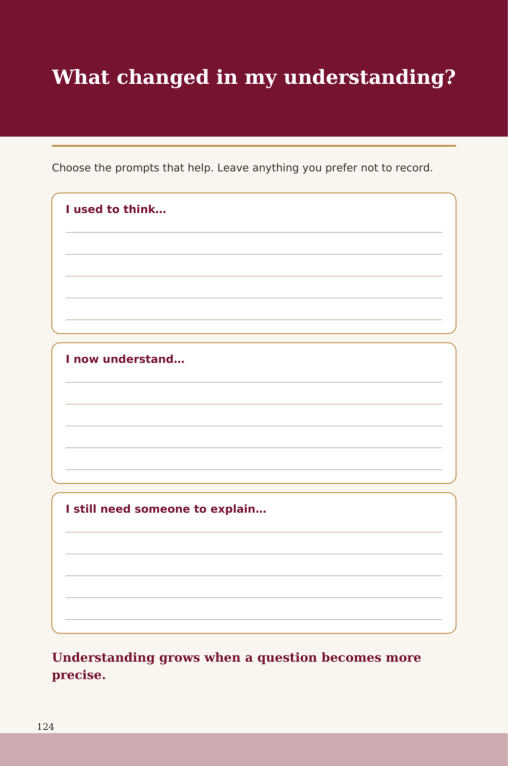
Accessible text for page 136
124
Visual text and description: What changed in my understanding? Choose the prompts that help. Leave anything you prefer not to record. I used to think… I now understand… I still need someone to explain…
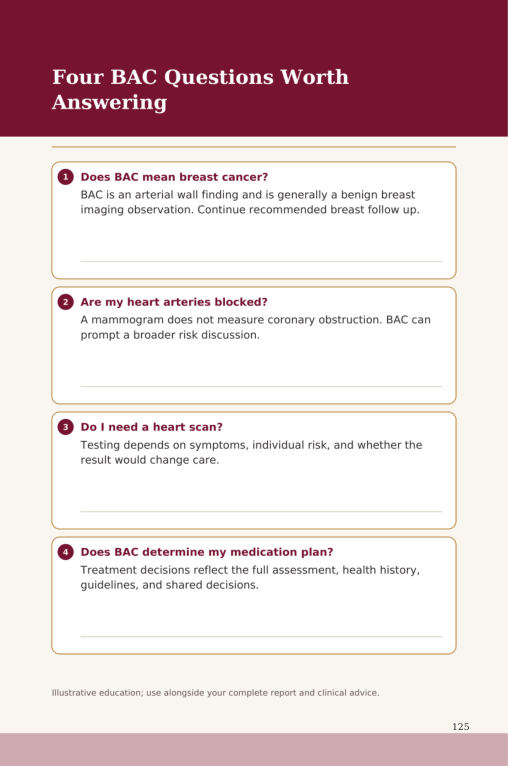
Accessible text for page 137
125
Visual text and description: Four BAC Questions Worth Answering Does BAC mean breast cancer? — BAC is an arterial wall finding and is generally a benign breast imaging observation. Continue recommended breast follow up. Are my heart arteries blocked? — A mammogram does not measure coronary obstruction. BAC can prompt a broader risk discussion. Do I need a heart scan? — Testing depends on symptoms, individual risk, and whether the result would change care. Does BAC determine my medication plan? — Treatment decisions reflect the full assessment, health history, guidelines, and shared decisions.

Accessible text for page 138
126
Visual text and description: A report and notebook prepared for the next conversation.
Accessible text for page 139
Chapter 10: A Long View of Heart Health Health is shaped over time An incidental finding can become a moment of attention. Sustained cardiovascular health is built through decisions made over months and years, in partnership with clinicians who understand your medical history. Some prevention measures protect health quietly, without producing a dramatic sensation or immediate visible change. The American Heart Association describes eight broad domains that contribute to cardiovascular health: eating patterns, physical activity, tobacco avoidance, sleep, body weight, cholesterol, blood glucose, and blood pressure. [5] These domains offer a useful framework for conversation, but priorities and goals should be individualized.
Make the plan sustainable A plan that fits your life has a greater chance of lasting. If the recommended approach requires frequent visits, expensive medications, significant travel, or an unrealistic change in daily routines, tell your care team. Ask which portions are essential, which can be adjusted, and what support might be available. A prevention plan can include small, gradual actions. Some people may begin by organizing home blood pressure results. Others may review cholesterol medications, seek help with tobacco cessation, pursue supervised activity after an illness, or improve sleep quality. The right starting point is the one grounded in your medical needs and circumstances.
Know when to return to the question New symptoms, changes in clinical measurements, a new cardiovascular diagnosis, or an important change in treatment may warrant reassessment. As recommendations evolve, an
127
Accessible text for page 140
earlier decision may need to be revisited. Maintaining a copy of your report and a short record of decisions can make that conversation more efficient.
Share information respectfully If you have a family history of cardiovascular disease, relatives may benefit from knowing about relevant inherited risk factors. A finding of BAC alone is not a diagnosis of an inherited disease. Your clinician may recommend family discussions or specific testing when another established hereditary risk factor, such as elevated lipoprotein(a), is present.
The meaning of a finding The most important value of a mammogram report is that it can help inform an appropriate next action. Understanding the observation, appreciating what research can and cannot tell us, and participating in prevention suited to you are useful steps. Your health is broader than a single image. The information belongs in the context of your full story: where you have been, how you are doing today, and what choices may help you live well in the years ahead.
A quieter relationship with the report At first, an unfamiliar phrase can seem to occupy the whole page. You may remember where you were when you read it, whom you called, and the questions that arrived before an explanation did. Over time, the phrase can take a more proportionate place in your health story. It remains useful information, connected with a plan and a source of advice.
That change does not require pretending that uncertainty has disappeared. Medical decisions often involve estimates, incomplete information, and choices among reasonable options.
128
Accessible text for page 141
A good plan makes the next step understandable and identifies what would cause the team to reconsider it. You can live with some uncertainty while still knowing what to do.
Consider what you want to remember when you next encounter the report. Perhaps it is the difference between breast and coronary arteries. Perhaps it is the reason your clinician recommended a particular preventive treatment. Perhaps it is the knowledge that a new symptom should be evaluated on its own merits. Write that understanding in a few clear sentences, grounded in the explanation you received.
Those sentences can become the beginning of a future handoff. They also help distinguish a question that has been answered from one that remains open. Without that distinction, an old worry can return with the force of a new finding every time the same report appears in a portal.
Review the plan when there is a reason Long term care benefits from continuity. Keep the review schedule agreed with your clinician and ask what changes should prompt earlier contact. An appointment may be linked to medication monitoring, a measurement, a symptom, or a broader preventive review. The appropriate interval depends on the individual plan. Before a scheduled review, update the information that has changed. This may include new medicines, new diagnoses, a different pattern of symptoms, treatment side effects, or a practical difficulty carrying out the plan. Bring actual measurements with their dates when requested. You do not need to recreate the full initial history if a concise update will communicate the change.
Avoid turning every new article into a reason to abandon an established decision. If a source raises a relevant question, keep the link and ask how the evidence applies to your circumstances. Check whether the study describes people like
129
Accessible text for page 142
you, which outcome it measured, and whether it changes a current recommendation. A headline rarely supplies enough information to settle those questions.
Equally, an earlier plan is not beyond revision. New evidence, symptoms, treatment options, or preferences may change the balance of a decision. A dated record of the original reasoning makes revision easier because the clinician can see what has changed. Continuity includes the ability to update a plan thoughtfully.
When the plan becomes tiring Prevention can involve repeated tasks whose benefits are not immediately visible. Taking a medicine, recording a measurement, arranging a laboratory visit, or planning a meal may feel manageable one week and exhausting the next. A difficult period does not erase the value of previous care. Tell the team which task is becoming hard and why. The solution depends on the obstacle. A confusing schedule may call for clearer instructions. Cost may require a different discussion. A suspected side effect needs clinical assessment. Emotional exhaustion may mean that the number of simultaneous changes has exceeded what you can sustain.
Ask which action is most important now and whether the routine can be simplified safely. Do not silently stop a treatment because the entire plan feels too large. An honest account gives the clinician a chance to help you maintain the essential parts while addressing the burden. It can also help to stop measuring your effort against an imagined perfect patient. You are managing health within a life that includes work, relationships, losses, responsibilities, and ordinary unpredictability. A useful plan takes those conditions seriously and allows a return after disruption.
130
Accessible text for page 143
Decide how much monitoring helps Some readers feel calmer with a written record. Others find that repeatedly checking numbers makes them more anxious. Discuss what to measure, how often to measure it, and what action should follow a particular result. Monitoring is most useful when it serves an agreed clinical purpose. If you have begun checking far more often than instructed, explain what you are hoping each new reading will answer. The clinician can help clarify the schedule and the limits of interpretation. Repeated readings taken under changing conditions may create a confusing record rather than a clearer one.
Use the instructions given for your device and condition. Ask whether the device needs to be checked against a clinical measurement and how the team wants results recorded. Do not let a consumer score or automated app message replace advice about symptoms or treatment. When worry begins to occupy much of the day, interferes with sleep, or makes ordinary activities difficult, bring that experience into care as well. Emotional distress deserves attention in its own right. You do not have to wait until every cardiovascular question is resolved before asking for help with the burden of uncertainty.
Share the lesson without diagnosing someone else After learning about BAC, you may want to tell friends and relatives. Sharing accurate information can be generous. Keep the message focused on understanding reports and seeking individualized advice. Another person’s medical history may differ substantially from yours. A useful conversation might begin, “My report mentioned calcium in breast arteries, and I learned that it is worth asking how the finding fits my overall cardiovascular health.” That statement describes your experience without telling someone else what scan or medicine to request. Encourage the person to read her own report and discuss its actual wording with her team.
131
Accessible text for page 144
If a friend brings you a result, resist the pressure to interpret a photograph of the report as though you were the treating clinician. You can help identify questions, find the appropriate contact, or accompany her if she wishes. Support can make a conversation easier without taking over the medical decision. Respect differences in how much people want to discuss. Some may welcome a detailed explanation; others may prefer privacy or need time. Your own experience can be a point of connection while leaving room for another person’s circumstances and choices.
A different measure of confidence Confidence after an unexpected finding does not have to mean feeling certain about the future. It can mean knowing the name of the finding, understanding its limits, and having a clear route for the next question. It can mean recognizing when routine follow up is appropriate and when symptoms require a different response. You may also become more comfortable asking why. Why this test? Why this treatment? Why this interval? A respectful explanation can reveal the connection between evidence and action. When the reasoning is unclear, asking again is part of participating in care.
There may be days when the report feels important and days when it barely enters your mind. A well organized plan allows you to return attention to the rest of your life without losing the thread of care. Keep the essential information available, carry out the agreed next step, and let the record support you when it is needed. The woman who first read that unexpected sentence may have had only a question. By the end of this book, she can have a vocabulary, a set of records, and a more deliberate conversation. The next page of her story belongs to a whole person, with interests and relationships and hopes that extend far beyond an image.
132
Accessible text for page 145
Esther makes plans that are not appointments Months after her mammogram conversation, Esther found the report while sorting a drawer. She remembered how much space one sentence had occupied in her thoughts. The paper still mattered, but it no longer felt like a summary of her future. She had a clearer explanation, a plan from her team, and several questions that could wait for the next appropriate conversation.
On the same afternoon, she was choosing photographs for a family gathering. The two activities belonged to the same life. Caring for her health did not require that health become the subject of every plan she made.
An imaging finding can create a period of close attention. Over time, it may be useful to notice whether that attention is supporting care or crowding out ordinary life. You can follow agreed instructions without turning every sensation, meal, or missed routine into a verdict about your future.
Esther had once measured progress by the amount of information she collected. Later, she found a different measure: could she explain the purpose of her plan, obtain help when needed, and spend most of the week thinking about other things? The question was not whether she had stopped caring. It was whether the plan had become understandable enough to live with.
There will still be changes. A new diagnosis, a treatment concern, a move, or a change in symptoms may bring another discussion. Returning to care does not mean that earlier efforts were wasted. A plan can be revised because life and health have changed, not because the person following it has failed.
You may also outgrow a way of organizing information. A detailed notebook might help during a busy month and become unnecessary later. An office summary may be more useful than a form you made yourself. You can keep what serves a purpose
133
Accessible text for page 146
and let go of a system that has become another obligation. Preserve important instructions and records in a way that remains accessible and private.
For Esther, a good conversation with her team included permission to ask fewer, better questions. She no longer arrived feeling that every item in a workbook had to be discussed. She began with the concern that mattered at that visit and trusted the clinician to ask what else was needed.
Some readers will want to share what they have learned with family or friends. You can offer encouragement without becoming responsible for their medical decisions. Tell them what helped you ask questions or understand a report. Let their own symptoms, history, preferences, and clinicians shape their care.
There is also room for pleasure without attaching a health claim to it. A meal with people you enjoy, a favorite song, an afternoon outside, or a project that absorbs your attention does not have to be justified as prevention before it belongs in your life. Your worth is not measured by your ability to turn every activity into a health intervention.
Esther put the report in a place where she could find it and returned to the photographs. She had not received certainty about the years ahead. She had learned how to hold an important piece of information without asking it to carry the meaning of her whole life.
That is a reasonable hope for this book: a reader who understands more, feels able to ask for help, and has room to continue living. The next conversation matters. So does everything you hope to do between conversations.
134
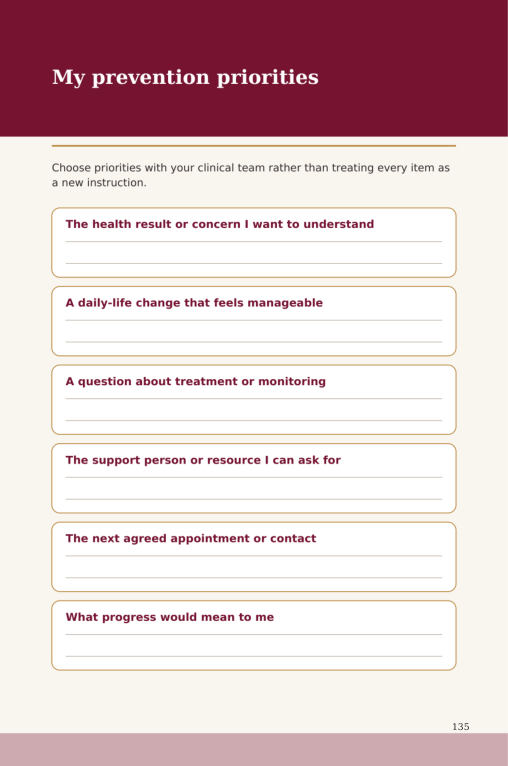
Accessible text for page 147
135
Visual text and description: My prevention priorities Choose priorities with your clinical team rather than treating every item as a new instruction. The health result or concern I want to understand A daily-life change that feels manageable A question about treatment or monitoring The support person or resource I can ask for The next agreed appointment or contact What progress would mean to me
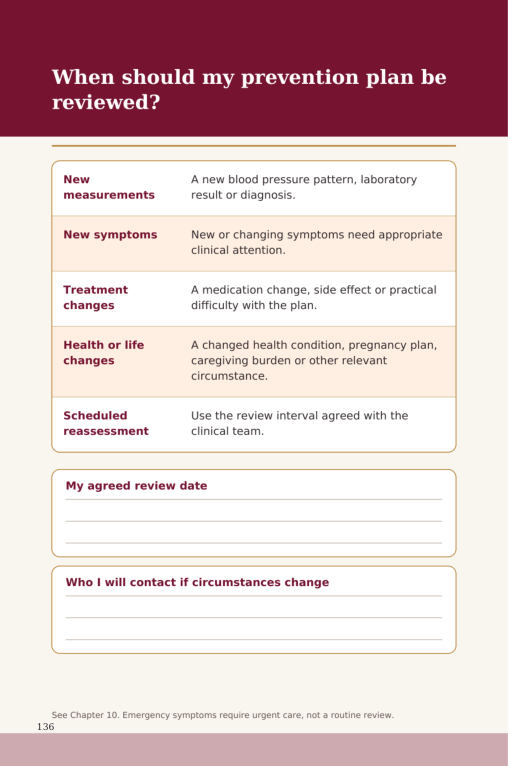
Accessible text for page 148
136
Visual text and description: When should my prevention plan be reviewed? New measurements — A new blood pressure pattern, laboratory result or diagnosis. New symptoms — New or changing symptoms need appropriate clinical attention. Treatment changes — A medication change, side effect or practical difficulty with the plan. Health or life changes — A changed health condition, pregnancy plan, caregiving burden or other relevant circumstance. Scheduled reassessment — Use the review interval agreed with the clinical team. My agreed review date Who I will contact if circumstances change

Accessible text for page 149
137
Visual text and description: Pause, notice, prepare
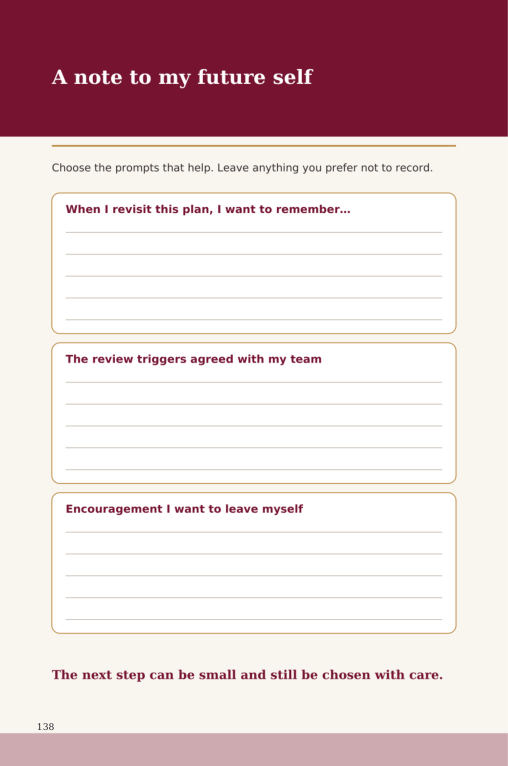
Accessible text for page 150
138
Visual text and description: A note to my future self Choose the prompts that help. Leave anything you prefer not to record. When I revisit this plan, I want to remember… The review triggers agreed with my team Encouragement I want to leave myself
Accessible text for page 151
139
Visual text and description: What made the plan easier or harder? Choose the prompts that help. Leave anything you prefer not to record. A pattern I noticed A practical difficulty A question about the agreed monitoring plan

Accessible text for page 152
140
Visual text and description: A fictional woman walks outdoors.

Accessible text for page 153
141
Visual text and description: A woman looks toward a symbolic horizon of heart health.
Accessible text for page 154
Appendix A: Mammogram Report Decoder The report that started the conversation A mammogram may be familiar to you, yet its written report can feel like an unfamiliar language. The report contains observations about breast tissue, a radiologist’s assessment, and recommendations for appropriate follow up. It may also mention calcification within arteries in the breast. When those observations appear together, it is important to understand which finding each recommendation addresses. Learning to navigate the report gives you a practical advantage: you can identify the words that matter, preserve the recommended breast care, and bring a focused cardiovascular question to the clinician who coordinates your preventive care.
Imagine placing your report on a table and reading it with a pen nearby. You are looking for three things: what was seen, what the radiologist concluded, and what action was recommended.
The main parts of a mammogram report The exact format varies by imaging center, but most reports communicate several kinds of information.
The examination. This identifies the date, whether the study was performed for screening or diagnostic evaluation, and the type of images obtained. Screening mammography is used to look for early signs of breast cancer in people without symptoms. Diagnostic mammography evaluates a specific clinical concern or a finding that needs more detailed assessment.
142
Accessible text for page 155
Breast composition. The radiologist describes breast density. Dense tissue can reduce the ability of mammography to reveal certain abnormalities and is also associated with breast cancer risk. Breast density addresses a separate question from breast arterial calcification.
Findings. This section describes what appears on the images. It may address masses, distortion, asymmetries, calcifications within breast tissue, postsurgical changes, or benign findings such as vascular calcifications.
Assessment and recommendation. This summarizes the radiologist’s interpretation and communicates whether routine screening, additional imaging, short interval follow up, or biopsy is recommended.
The American College of Radiology uses the Breast Imaging Reporting and Data System, known as BI-RADS, to standardize breast imaging assessments and recommendations. The current BI-RADS manual was released in 2025. [14]
What the BI-RADS category tells you BI-RADS is designed primarily to communicate the breast imaging assessment and appropriate breast follow up.
143
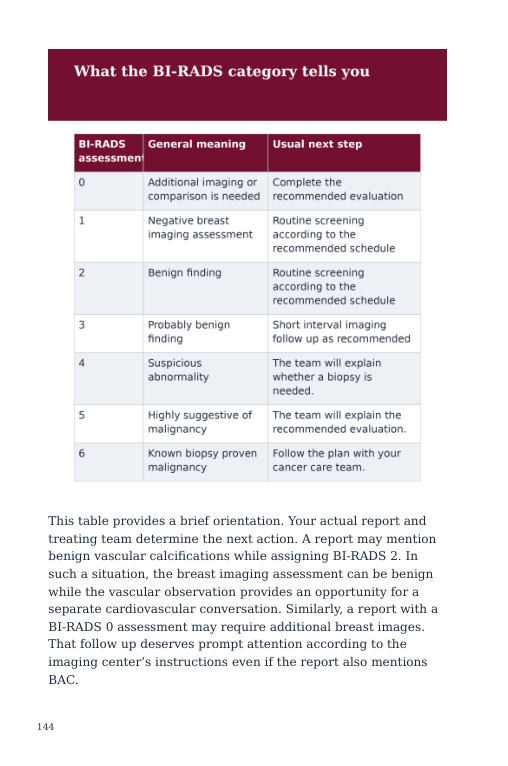
Accessible text for page 156
This table provides a brief orientation. Your actual report and treating team determine the next action. A report may mention benign vascular calcifications while assigning BI-RADS 2. In such a situation, the breast imaging assessment can be benign while the vascular observation provides an opportunity for a separate cardiovascular conversation. Similarly, a report with a BI-RADS 0 assessment may require additional breast images. That follow up deserves prompt attention according to the imaging center’s instructions even if the report also mentions BAC.
144
Visual text and description: What the BI-RADS category tells you. BI-RADS assessment — General meaning — Usual next step; 0 — Additional imaging or comparison is needed — Complete the recommended evaluation; 1 — Negative breast imaging assessment — Routine screening according to the recommended schedule; 2 — Benign finding — Routine screening according to the recommended schedule; 3 — Probably benign finding — Short interval imaging follow up as recommended; 4 — Suspicious abnormality — The team will explain whether a biopsy is needed.; 5 — Highly suggestive of malignancy — The team will explain the recommended evaluation.; 6 — Known biopsy proven malignancy — Follow the plan with your cancer care team.
Accessible text for page 157
One mammogram may generate two different conversations: a breast health conversation guided by the BI-RADS assessment and a cardiovascular risk conversation prompted by BAC.
What does breast arterial calcification look like in a report? The wording varies among radiologists and imaging centers. Examples of short descriptive language include:
“Benign vascular calcifications are noted.”
“Breast arterial calcifications are present.”
“Vascular calcification is identified bilaterally.”
These are illustrative examples of possible report language, rather than excerpts from a particular patient’s report. The word bilaterally means on both sides. Unilateral means on one side. A radiologist may describe the location or extent of calcifications when that information is relevant to the report. The wording may be brief because the purpose of the mammogram is ordinarily breast imaging. Some imaging centers now give additional attention to BAC as an incidental cardiovascular risk marker.
When reading your report, record its exact wording. A small difference in terminology can matter when determining whether a finding involves breast tissue or the walls of blood vessels.
What about breast density? Breast density describes the relative amounts of fibroglandular tissue and fatty tissue visible on a mammogram. Radiologists use standardized categories to describe breast composition. Density influences breast cancer screening discussions because dense tissue can make certain abnormalities harder to detect on mammography. Depending on personal risk and medical
145
Accessible text for page 158
circumstances, additional breast imaging may be considered. BAC provides different information. It is an observation involving blood vessel walls.
A woman can have dense breasts and BAC. Another woman can have predominantly fatty breast tissue and BAC. The two observations answer separate questions. If your patient letter contains both a breast density notification and an arterial calcification notice, read each in its own context. Keep the breast screening recommendations and the cardiovascular assessment plan together in your records.
Does the amount of BAC matter? Researchers are investigating whether BAC burden, distribution, and quantified measurements improve cardiovascular risk prediction. Some research studies assign categories such as mild, moderate, or severe. Others use computerized methods to estimate the amount of calcium in breast arteries. A 2026 review described considerable variation in reporting practices and a continuing need for standardized, validated BAC grading methods and clinical follow up pathways. [15]
For a patient, this means the most useful initial step is usually to document the reported finding and have the overall cardiovascular risk evaluated using established clinical tools. If a report describes an extensive amount of BAC, you can bring that description to your clinician. Ask how the observation should be considered alongside your risk factors and any previous cardiovascular investigations.
A radiology phrase alone does not automatically establish a coronary calcium score, the severity of coronary artery narrowing, or the need for a particular medication.
146
Accessible text for page 159
Why some mammogram reports mention BAC and others do not Many radiologists recognize characteristic vascular calcification. Reporting practices, however, have historically varied. A 2026 review noted that radiologists differ in whether they report BAC routinely, describe its burden, or recommend follow up. [15] The absence of a statement in a report therefore may leave uncertainty about whether the radiologist evaluated BAC specifically. A woman whose mammogram letter contains no BAC statement may wish to ask the imaging center whether vascular calcification was assessed and whether any such finding was present.
The question is especially useful if earlier reports mentioned BAC and a more recent report uses different wording. Comparing reports requires attention to the actual images, technique, prior examinations, and reporting practices. Your imaging center can advise whether an addendum or clarification is appropriate.
A changing approach to patient notification On October 1, 2026, a Maryland law took effect requiring specified mammography centers to include a notice when breast arterial calcification is observed on a patient’s mammogram. The law aims to improve patient awareness of the potential cardiovascular relevance of the finding. [1] The law highlights a broader clinical development: information captured during an established screening examination may offer an opportunity to recognize cardiovascular risk that deserves further attention.
Mammography reporting requirements and institutional practices can vary by jurisdiction, so your own imaging center remains the best source for understanding its report format and notification procedures. The discovery of BAC is a valuable reason to revisit heart disease prevention. Treatment decisions
147
Accessible text for page 160
should continue to reflect validated clinical evidence, symptoms, medical history, and informed discussions with your healthcare team.
What if the report contains both breast calcifications and arterial calcifications? Consider a fictional patient named Naomi. Naomi receives a mammography report that mentions benign vascular calcifications. The report also describes a small cluster of breast tissue calcifications requiring additional diagnostic mammography. She may initially wonder whether all the calcifications are part of the same medical problem. A careful reading reveals two separate findings. The breast tissue calcifications require assessment according to the breast imaging recommendation. The vascular calcifications may prompt review of cardiovascular risk factors.
Naomi records both questions. She completes the recommended diagnostic breast imaging and also arranges an appropriate discussion about her blood pressure, cholesterol, and other cardiovascular information. Her example illustrates how a written report can support coordinated care across different health needs.
When your report feels difficult to interpret Medical terminology can be challenging even for readers who are comfortable making other complex decisions. It may help to read the report in two passes.
First pass: Identify the breast imaging assessment and any specific instructions or deadlines for additional examination.
Second pass: Identify whether a vascular finding is described and write down what you would like to ask about its cardiovascular significance.
148
Accessible text for page 161
If the report contains a technical term that is unfamiliar, ask the interpreting radiologist or referring clinician to explain the term in ordinary language. If the report includes a recommendation for urgent or time sensitive follow up, use the timeframe communicated by your care team.
Appendix A reflection A mammogram report is a record of observations and clinical judgment. It is also a communication tool. Reading it carefully can help you protect two important aspects of your health: breast health and cardiovascular health. When you recognize the purpose of each finding, you can direct your questions to the appropriate clinician and understand the recommendations that follow. Your knowledge does not need to begin with complete mastery of radiology terminology. It begins with knowing where to look, what to ask, and how to carry the information forward.
One report can open more than one important conversation. Understanding its language helps you take the next step with confidence.
149
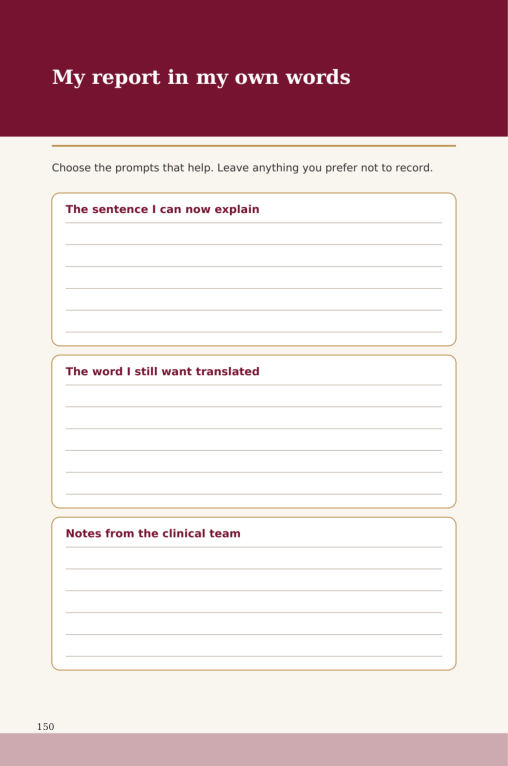
Accessible text for page 162
150
Visual text and description: My report in my own words Choose the prompts that help. Leave anything you prefer not to record. The sentence I can now explain The word I still want translated Notes from the clinical team
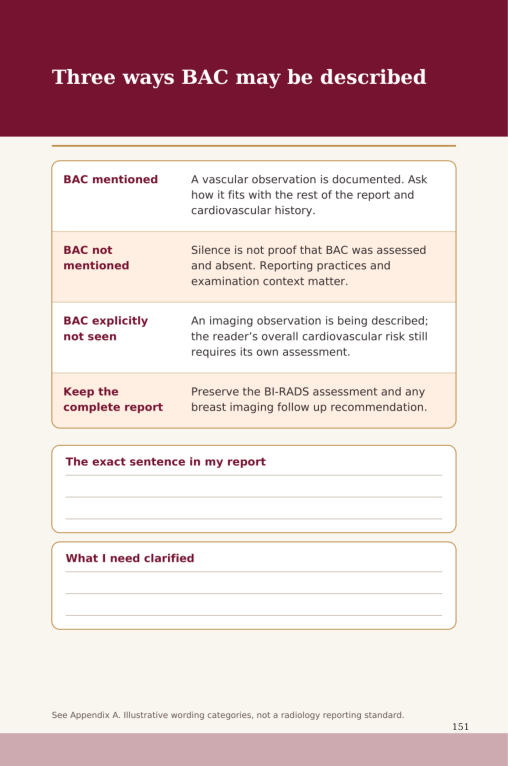
Accessible text for page 163
151
Visual text and description: Three ways BAC may be described BAC mentioned — A vascular observation is documented. Ask how it fits with the rest of the report and cardiovascular history. BAC not mentioned — Silence is not proof that BAC was assessed and absent. Reporting practices and examination context matter. BAC explicitly not seen — An imaging observation is being described; the reader’s overall cardiovascular risk still requires its own assessment. Keep the complete report — Preserve the BI-RADS assessment and any breast imaging follow up recommendation. The exact sentence in my report What I need clarified
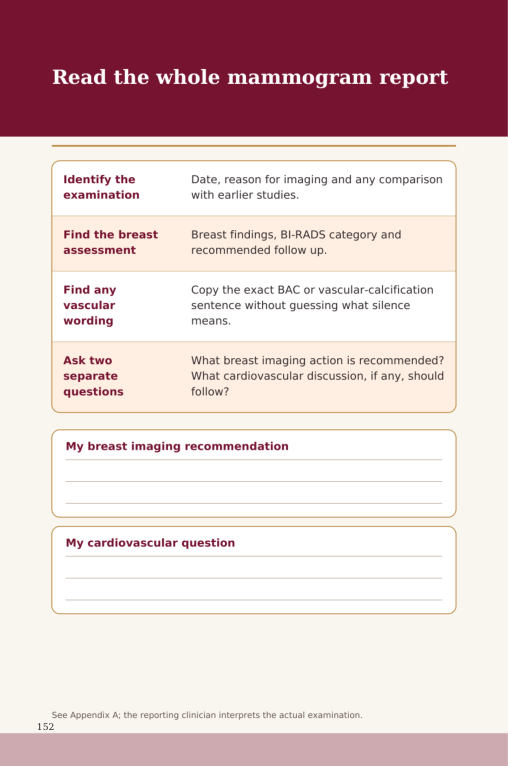
Accessible text for page 164
152
Visual text and description: Read the whole mammogram report Identify the examination — Date, reason for imaging and any comparison with earlier studies. Find the breast assessment — Breast findings, BI-RADS category and recommended follow up. Find any vascular wording — Copy the exact BAC or vascular-calcification sentence without guessing what silence means. Ask two separate questions — What breast imaging action is recommended? What cardiovascular discussion, if any, should follow? My breast imaging recommendation My cardiovascular question
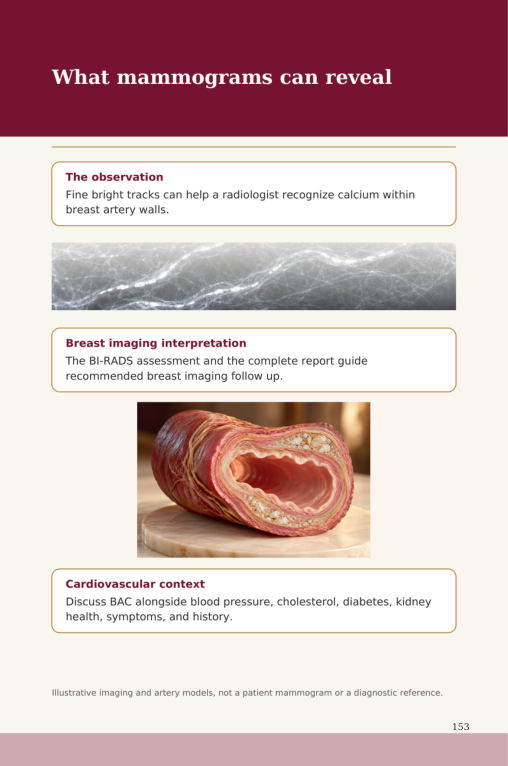
Accessible text for page 165
153
Visual text and description: What mammograms can reveal The observation — Fine bright tracks can help a radiologist recognize calcium within breast artery walls. Breast imaging interpretation — The BI-RADS assessment and the complete report guide recommended breast imaging follow up. Cardiovascular context — Discuss BAC alongside blood pressure, cholesterol, diabetes, kidney health, symptoms, and history.
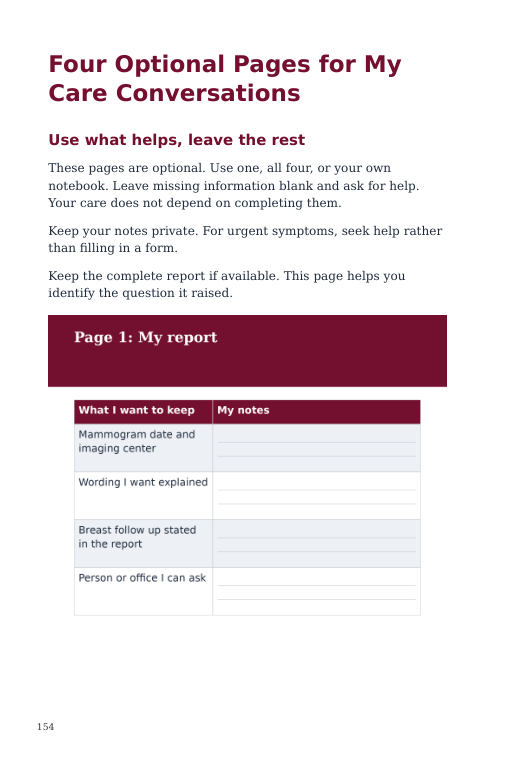
Accessible text for page 166
Four Optional Pages for My Care Conversations Use what helps, leave the rest These pages are optional. Use one, all four, or your own notebook. Leave missing information blank and ask for help. Your care does not depend on completing them.
Keep your notes private. For urgent symptoms, seek help rather than filling in a form.
Keep the complete report if available. This page helps you identify the question it raised.
154
Visual text and description: Page 1: My report. What I want to keep — My notes; Mammogram date and imaging center — ; Wording I want explained — ; Breast follow up stated in the report — ; Person or office I can ask —
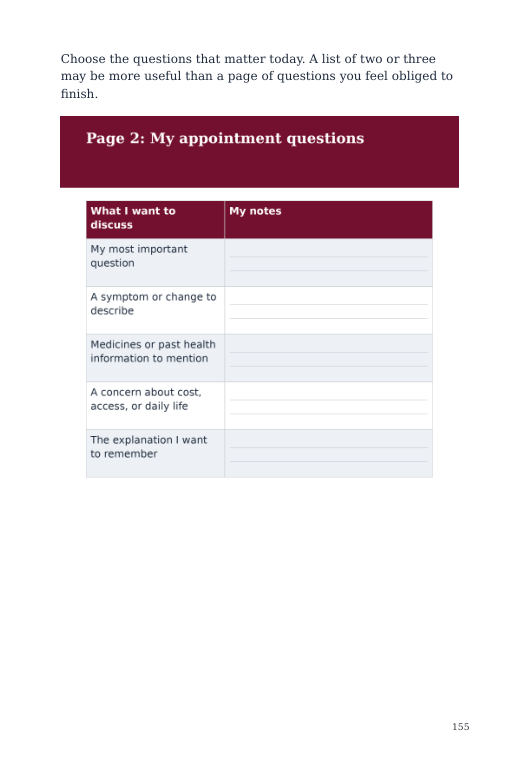
Accessible text for page 167
Choose the questions that matter today. A list of two or three may be more useful than a page of questions you feel obliged to finish.
155
Visual text and description: Page 2: My appointment questions. What I want to discuss — My notes; My most important question — ; A symptom or change to describe — ; Medicines or past health information to mention — ; A concern about cost, access, or daily life — ; The explanation I want to remember —
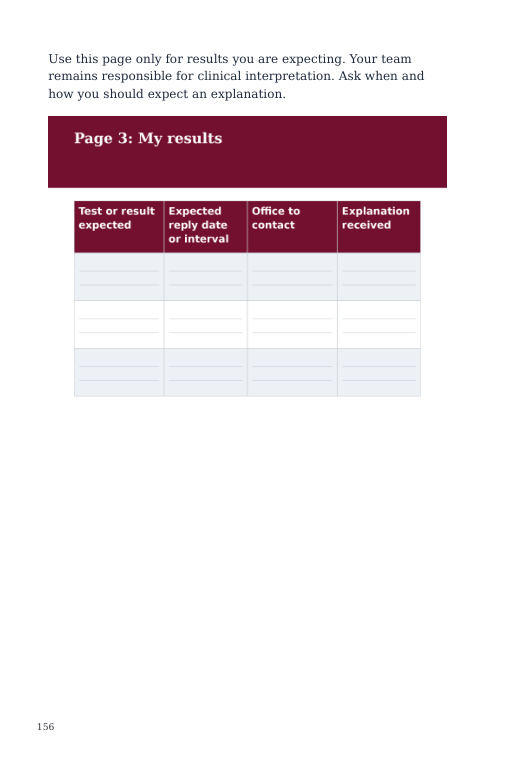
Accessible text for page 168
Use this page only for results you are expecting. Your team remains responsible for clinical interpretation. Ask when and how you should expect an explanation.
156
Visual text and description: Page 3: My results. Test or result expected — Expected reply date or interval — Office to contact — Explanation received; — — — ; — — — ; — — —
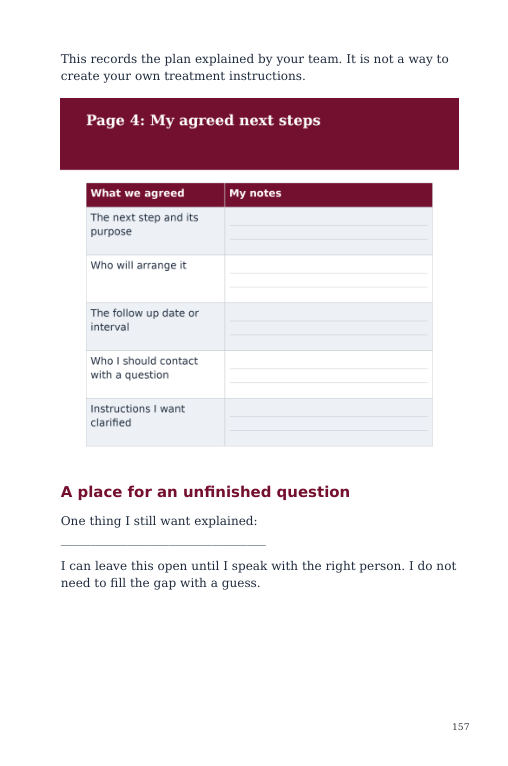
Accessible text for page 169
This records the plan explained by your team. It is not a way to create your own treatment instructions.
A place for an unfinished question One thing I still want explained: __________________________________
I can leave this open until I speak with the right person. I do not need to fill the gap with a guess.
157
Visual text and description: Page 4: My agreed next steps. What we agreed — My notes; The next step and its purpose — ; Who will arrange it — ; The follow up date or interval — ; Who I should contact with a question — ; Instructions I want clarified —
Accessible text for page 170
158
Visual text and description: Ideas I want to revisit Choose the prompts that help. Leave anything you prefer not to record. A topic I would like to return to A question for my next conversation My own notes

Accessible text for page 171
159
Visual text and description: A blank notebook for questions and care planning.
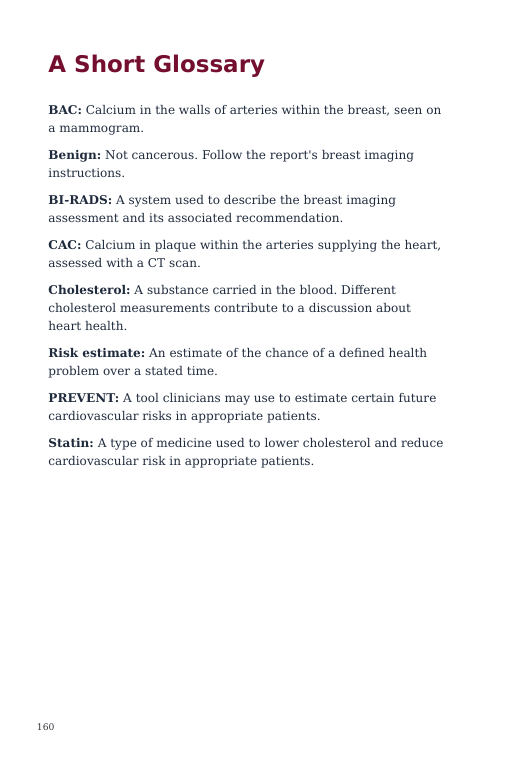
Accessible text for page 172
A Short Glossary BAC: Calcium in the walls of arteries within the breast, seen on a mammogram.
Benign: Not cancerous. Follow the report's breast imaging instructions.
BI-RADS: A system used to describe the breast imaging assessment and its associated recommendation.
CAC: Calcium in plaque within the arteries supplying the heart, assessed with a CT scan.
Cholesterol: A substance carried in the blood. Different cholesterol measurements contribute to a discussion about heart health.
Risk estimate: An estimate of the chance of a defined health problem over a stated time.
PREVENT: A tool clinicians may use to estimate certain future cardiovascular risks in appropriate patients.
Statin: A type of medicine used to lower cholesterol and reduce cardiovascular risk in appropriate patients.
160

Accessible text for page 173
A Note on Medical Illustrations The narrative illustrations show fictional people and settings. The anatomical models and imaging composites are artistic concepts, not patient scans, diagnostic references, or images drawn to scale. Do not use them to interpret your own examination. The text explains the finding; your clinical team interprets your report.
161
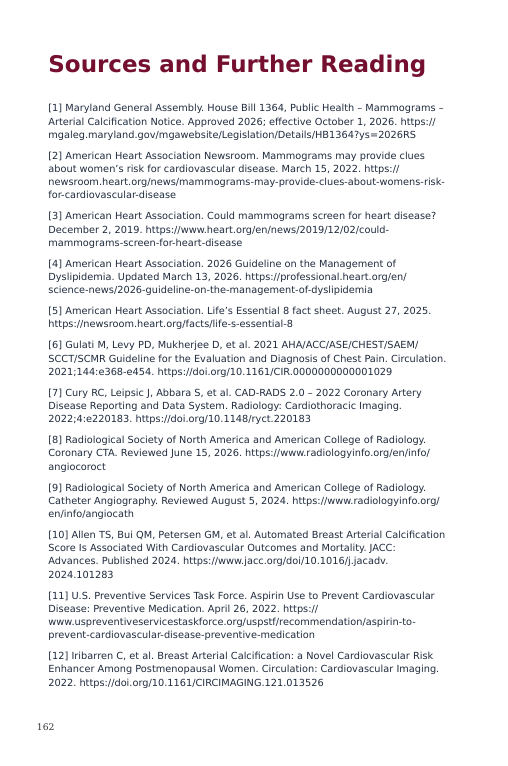
Accessible text for page 174
Sources and Further Reading [1] Maryland General Assembly. House Bill 1364, Public Health – Mammograms – Arterial Calcification Notice. Approved 2026; effective October 1, 2026. https:// mgaleg.maryland.gov/mgawebsite/Legislation/Details/HB1364?ys=2026RS
[2] American Heart Association Newsroom. Mammograms may provide clues about women’s risk for cardiovascular disease. March 15, 2022. https:// newsroom.heart.org/news/mammograms-may-provide-clues-about-womens-risk- for-cardiovascular-disease
[3] American Heart Association. Could mammograms screen for heart disease? December 2, 2019. https://www.heart.org/en/news/2019/12/02/could- mammograms-screen-for-heart-disease
[4] American Heart Association. 2026 Guideline on the Management of Dyslipidemia. Updated March 13, 2026. https://professional.heart.org/en/ science-news/2026-guideline-on-the-management-of-dyslipidemia
[5] American Heart Association. Life’s Essential 8 fact sheet. August 27, 2025. https://newsroom.heart.org/facts/life-s-essential-8
[6] Gulati M, Levy PD, Mukherjee D, et al. 2021 AHA/ACC/ASE/CHEST/SAEM/ SCCT/SCMR Guideline for the Evaluation and Diagnosis of Chest Pain. Circulation. 2021;144:e368-e454. https://doi.org/10.1161/CIR.0000000000001029
[7] Cury RC, Leipsic J, Abbara S, et al. CAD-RADS 2.0 – 2022 Coronary Artery Disease Reporting and Data System. Radiology: Cardiothoracic Imaging. 2022;4:e220183. https://doi.org/10.1148/ryct.220183
[8] Radiological Society of North America and American College of Radiology. Coronary CTA. Reviewed June 15, 2026. https://www.radiologyinfo.org/en/info/ angiocoroct
[9] Radiological Society of North America and American College of Radiology. Catheter Angiography. Reviewed August 5, 2024. https://www.radiologyinfo.org/ en/info/angiocath
[10] Allen TS, Bui QM, Petersen GM, et al. Automated Breast Arterial Calcification Score Is Associated With Cardiovascular Outcomes and Mortality. JACC: Advances. Published 2024. https://www.jacc.org/doi/10.1016/j.jacadv. 2024.101283
[11] U.S. Preventive Services Task Force. Aspirin Use to Prevent Cardiovascular Disease: Preventive Medication. April 26, 2022. https:// www.uspreventiveservicestaskforce.org/uspstf/recommendation/aspirin-to- prevent-cardiovascular-disease-preventive-medication
[12] Iribarren C, et al. Breast Arterial Calcification: a Novel Cardiovascular Risk Enhancer Among Postmenopausal Women. Circulation: Cardiovascular Imaging. 2022. https://doi.org/10.1161/CIRCIMAGING.121.013526
162

Accessible text for page 175
[13] American College of Radiology and Radiological Society of North America. Cardiac (Heart) Screening. RadiologyInfo.org. https://www.radiologyinfo.org/en/ info/screening-cardiac
[14] American College of Radiology. ACR BI-RADS v2025 Manual. https:// www.acr.org/Clinical-Resources/Clinical-Tools-and-Reference/Reporting-and-Data- Systems/BI-RADS
[15] Review of breast arterial calcifications for cardiovascular disease risk prediction. npj Cardiovascular Health. 2026. https://www.nature.com/articles/ s44325-026-00135-4
163
Accessible text for page 176
About the Author Sherry-Ann Brown, MD, PhD, is a physician scientist, cardiologist, educator, innovator, entrepreneur, author, and lifelong learner. Trained as a clinician investigator at Mayo Clinic, her work spans medicine, research, education, mentorship, innovation, and the development of programs that translate knowledge into meaningful action. Her writing explores questions of learning, purpose, strengths, growth, leadership, service, and human possibility. Across a growing collection of books, she invites readers to move beyond acquiring information toward reflection, application, discovery, and meaningful contribution.
Dr. Brown develops educational and experiential resources that extend learning beyond the page, connecting books with opportunities for continued exploration and applied learning. At the center of her work is a conviction that knowledge carries its greatest power when it becomes lived.
164

Accessible text for page 177
165
Visual text and description: Informed conversations, brighter tomorrows
Accessible text for page 178
Companion Resources and Permissions Continue learning Explore the Spark Unfolding Book Club and current reading resources at: books.yourheartspark.com/start
Use the resources thoughtfully Companion reading materials support learning and discussion. They do not diagnose a condition, prescribe treatment, or replace care from your clinical team. Bring personal medical questions to the professionals responsible for your care.
Keep personal information private Use completed workbook pages for your own records and clinical conversations. Do not post medical records, completed health forms, or identifying patient information in public reading groups. Share clinical information through the secure route recommended by your healthcare team.
Permissions and publishing questions For permission requests, corrections, or questions about this publication, write to Dr. Brown Cares LLC at the publishing address on the copyright page. Copyright exceptions allowed by law remain applicable. Do not use publishing correspondence to seek urgent medical help.
Optional services If you choose a separate companion service, review any terms presented by its provider before enrolling or purchasing. Reading this book does not enroll you in a service or establish acceptance of a separate service agreement.
166
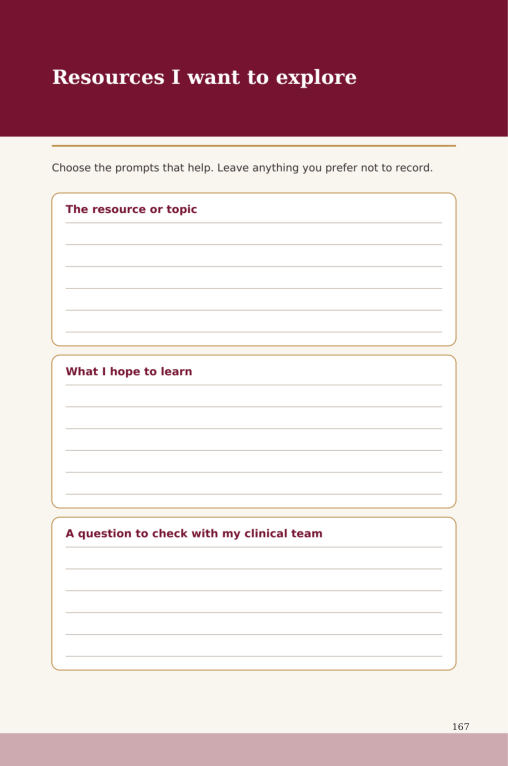
Accessible text for page 179
167
Visual text and description: Resources I want to explore Choose the prompts that help. Leave anything you prefer not to record. The resource or topic What I hope to learn A question to check with my clinical team

Accessible text for page 180
168
Visual text and description: The Spark Unfolding Book Club
Accessible text for page 181
Carry One Clear Question Forward Choose one point from your reading that deserves a clearer explanation. Use this space to prepare for that conversation.
• What I want to revisit after this reading • The person or resource I will ask • What I want to remember from that conversation
Clarity grows when a question meets an answer you can use.
169
Accessible text for page 182
170
Visual text and description: Carry One Clear Question Forward

Accessible text for page 183
Continue the Journey Every book can open another door. Continue exploring the ideas, questions, reflections, and practical resources connected with this growing collection through the Spark Unfolding Book Club.
QR code for Spark Unfolding Book Club Scan the QR code to enter the shared Spark Unfolding Book Club pathway for the growing collection and its related resources.
Visit: https://books.yourheartspark.com/start
171

Accessible text for page 184
172
Visual text and description: My own notes. A useful understanding can grow one conversation at a time.